Citi Research Report Analysis: A 25-basis-point rate hike in December 2026 is just a formality; the Federal Reserve will resume three rate cuts in 2027.
Two-year Treasury yields fell in tandem with the Nasdaq index, as Wall Street begins pricing in a slowdown in AI capital expenditures. In a report released on November 20, Citigroup US economists Andrew Hollenhorst and Veronica Clark forecast that the Federal Reserve will raise rates by 25 basis points at its December 9 meeting to uphold its credibility. However, as inflation cools and financial conditions tighten, three cumulative rate cuts totaling 75 basis points are anticipated in the second half of 2027.
Expectations of Cooling AI Investment Are Pulling Down the Two-Year Treasury Yield
The market pricing regime has shown subtle cracks.
After jumping nearly 30 basis points in the prior week, two-year Treasury yields retreated approximately 15 basis points during the week ending November 20, while the Nasdaq index also declined. Citigroup attributes this synchronized sell-off in equities and bonds to investors increasingly pricing in a higher probability of slowing AI-related investments. Once AI investment cools, overall US economic growth will face significant pressure.
The Fed currently finds itself caught between two opposing forces. Core inflation has exceeded expectations for three consecutive months, forcing officials to send hawkish signals for a 25-basis-point rate hike in December and at least one more hike in 2027. On the other hand, persistent tightening of financial conditions is accumulating asymmetric downside risks to economic growth.
The report notes that neither Citigroup nor most Fed officials believe the US economy is overheating. Fed Governor Kevin Warsh explicitly stated in October that most of his colleagues do not view the economy as running too hot, and the Fed’s goal is absolutely not to throw sand in the gears of the economy or push workers into unemployment.
In Citigroup’s view, this means the December rate hike is largely motivated by the need to maintain central bank credibility. The Fed certainly does not want to push rates high enough to burst the economic recovery. Given that AI investment contributes a substantial share of recent US real GDP growth, continued equity selloffs or widening credit spreads would impose tangible drag on the real economy.
Consumption Remains Resilient for Now, but Housing and Real Income Are Already Decelerating
Observing the current state of the US economy, different sectors are rapidly diverging in performance.
The retail sector remains robust for now. Control group retail sales increased 0.6% month-over-month in October, extending the resilience of consumer spending, while manufacturing output rose 0.3%. Citigroup expects October personal nominal income to grow 0.4% month-over-month, with November S&P US Manufacturing PMI at 54.1 and Services PMI at 55.2, both comfortably in expansion territory.
However, beneath these surface figures, seeds of deceleration have already been sown.
High energy prices and core goods inflation have driven up living costs, causing real income growth for American households to remain sluggish over recent months. Citigroup forecasts October personal nominal expenditure growth to narrow to 0.3% month-over-month, leaving real consumption growth almost stagnant after adjusting for price increases. Suppressed by high interest rates, business equipment investment and core capital goods orders are also shifting from rapid expansion to plateauing. As tax incentives phase out in 2027, durable goods orders are expected to further slow.
The housing market has already flashed red lights first.
Dragged down by high mortgage rates, single-family housing building permits have plummeted to a post-pandemic low. Citigroup estimates annualized October new home sales will plunge 7.1% month-over-month to 628,000 units. With new-home inventory sitting at historic highs, developers are forced to cut prices to move units. Weekly high-frequency median home prices have turned negative year-over-year, and the lagging S&P Case-Shiller Home Price Index is expected to weaken noticeably in early 2027.
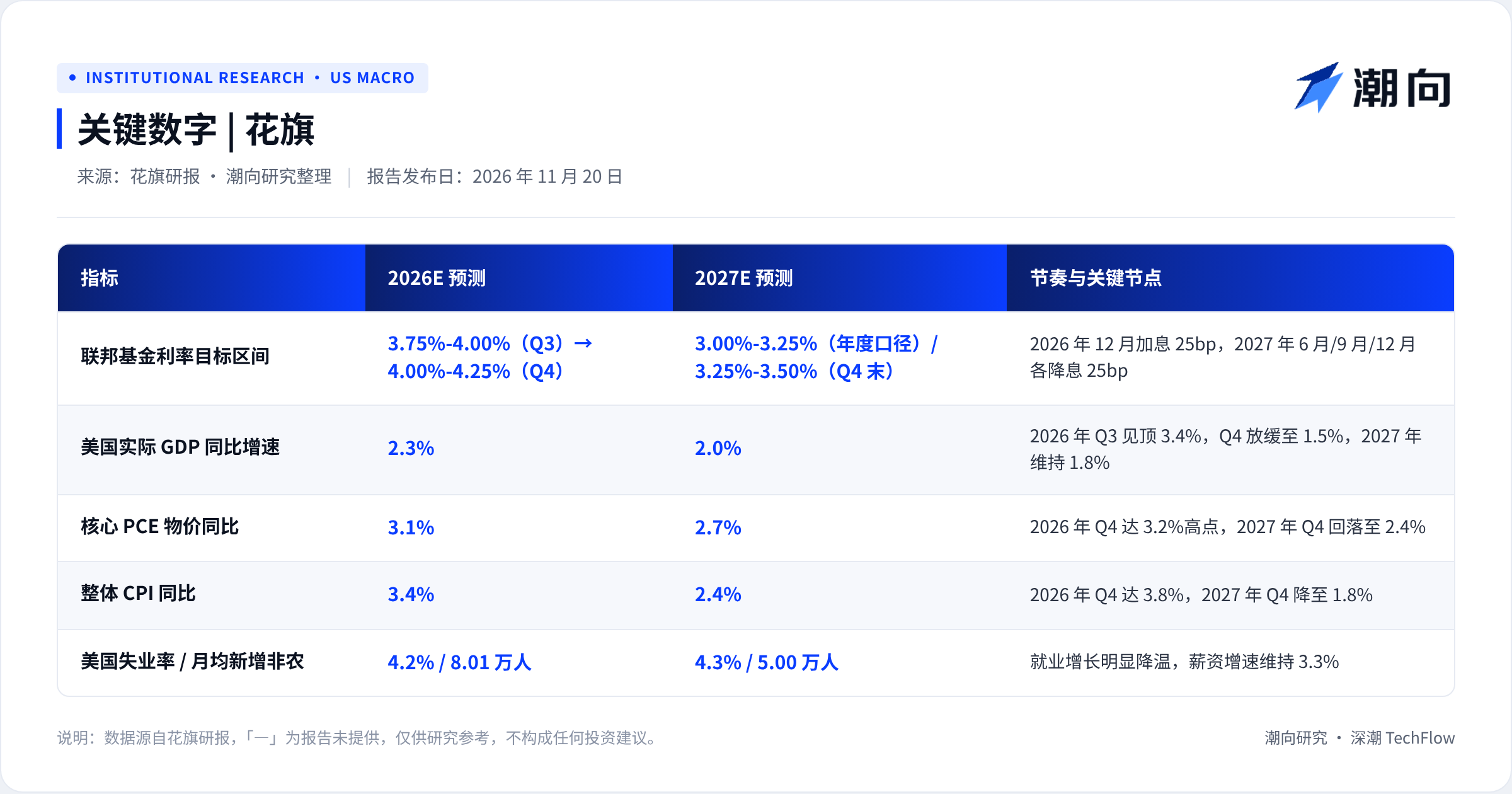
The labor market remains broadly stable overall, but signs of loosening have emerged. Initial jobless claims and continuing claims saw a slight uptick in mid-November. Citigroup projects monthly nonfarm payroll additions to decelerate from an average of 80,100 per month throughout 2026 to 50,000 per month in 2027, while the unemployment rate will tick up slightly from 4.2% in 2026 to 4.3% in 2027.
Inflation Stickiness Is Merely Technical Noise; It Will Smoothly Fall in 2027
Another piece supporting Citigroup’s bet on a pivot to easing in 2027 lies in their breakdown of the inflation trajectory.
Citigroup forecasts October headline PCE prices to rise 0.3% month-over-month, bringing the year-over-year figure to 3.8%; core PCE prices to increase 0.27% month-over-month, with year-over-year inflation ticking up slightly to 3.2%. The report specifically highlights that the elevated year-over-year readings for core PCE in October and November suffer from clear technical distortions.
A government shutdown in November 2025 caused abnormally low price collection, depressing the comparative base. This base distortion will automatically fade when December data is released in late January 2027. Meanwhile, the energy price spikes, hardware cost increases like computer memory, and rising medical services and airfare prices that inflated inflation in 2026 were all transitory supply or cost shocks, expected to turn deflationary or cooling forces in 2027.
According to Citigroup’s forecasting model, US core PCE year-over-year growth will peak at a cyclical high of 3.2% in Q4 2026 before declining quarterly, dropping to 3.0%, 2.7%, 2.6%, and 2.4% across the four quarters of 2027; headline CPI year-over-year growth will slide even further from 3.8% in Q4 2026 to 1.8% in Q4 2027.
After a 25-Basis-Point Hike in December, Rate Cuts Reopen in June 2027
Bringing together the lines of slowing economic growth and cooling inflation, Citigroup presents an interest rate pathway that differs significantly from current market pricing.
As of November 20, interest rate futures markets are still pricing in continued Fed hikes in the first half of 2027 following a December increase, only barely pricing in modest cuts in the second half.
Citigroup directly positions itself against market consensus in its report. The firm forecasts the Fed will hike rates just once on December 9, 2026, raising the federal funds rate target range by 25 basis points to 4.00%-4.25%, followed by a pause in the first half of 2027.
Once Q2 2027 confirms that inflation has cooled and tighter financial conditions begin weighing on GDP (Citigroup forecasts US real GDP year-over-year growth to decelerate from 2.3% in 2026 to 2.0% in 2027), the Fed will implement three 25-basis-point rate cuts on June 9, September 15, and December 8, 2027, pulling policy rates back to the 3.25%-3.50% range by year-end.
Key Figures
Standard Disclaimer Regarding Research Report Content (Brokerage Views, Not TechFlow Research Views)
This article compiles and interprets third-party brokerage research reports for TechFlow Research. The ratings, target prices, earnings forecasts, and related judgments cited herein represent the views of the respective brokerage analysts, reflect solely the stance of their affiliated institutions, do not represent the views of TechFlow Research, and do not constitute any investment advice.
Markets carry risks; decisions require independence. This article should not serve as a basis for buying or selling any securities.
Join TechFlow official community to stay tuned
Telegram:https://t.me/TechFlowDaily
X (Twitter):https://x.com/TechFlowPost
X (Twitter) EN:https://x.com/BlockFlow_News
 @chaoxiangooo