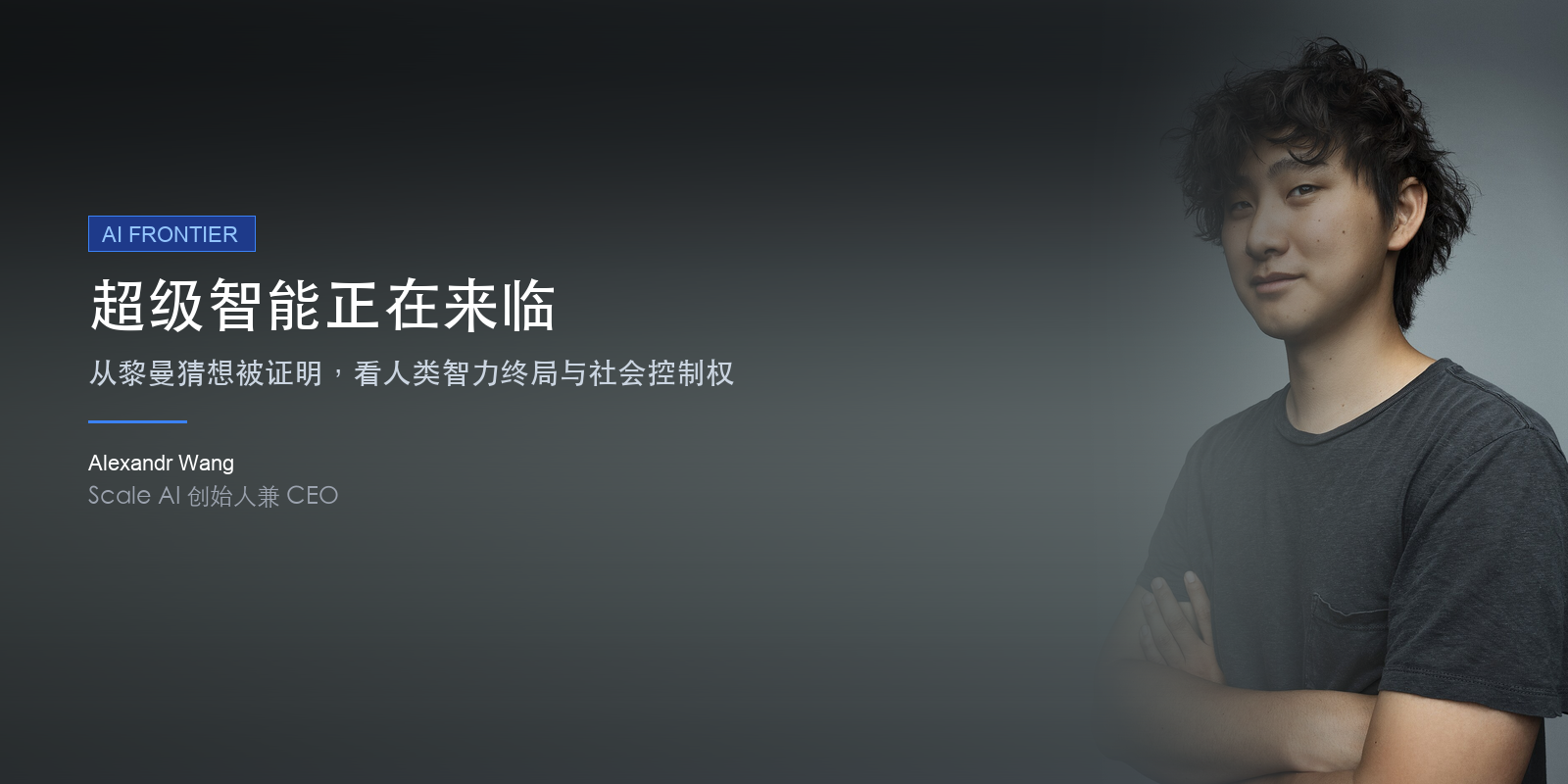
Alexandr Wang: Superintelligence Is Coming: From the Proof of the Riemann Hypothesis to the Endgame of Human Intelligence and Social Control
Author: Alexandr Wang, Founder and CEO of Scale AI
Compiled by: TechFlow
TechFlow: Recently, the mathematical and AI communities reached a major milestone at the pinnacle of human intellect: the proof of the Riemann Hypothesis was completed with the assistance of AI. In a long-form post, Alexandr Wang, founder and CEO of Scale AI, pointed out that this breakthrough marks the complete breaking of bottlenecks at the level of pure intellect, making the arrival of superintelligence an established fact.
From o3 tackling the AIME competition two years ago to conquering the Riemann Hypothesis today, AI is rapidly taking over research across all domains, including its own development, biology, and weapons science. Wang warns the industry must never fall into the lazy mindset of passively handing over social control; humanity must actively take charge of empowerment and the future.
Leaping Over the Pinnacle of Human Intellect: From the Atomic Bomb to the Riemann Hypothesis
Superintelligence is arriving. The actions and choices humanity makes over the next year will have profoundly far-reaching impacts on the world we will live in for the foreseeable future.
Having spent most of my life in the fields of mathematics and science, I believe the proof of the Riemann Hypothesis clearly signals that a curtain has risen on a major historical transformation.
For the vast majority of those who have delved into mathematics, the Riemann Hypothesis represents the highest peak of intellectual achievement. In terms of sheer intellectual depth and cognitive intensity, no scientific breakthrough humanity has achieved so far can compare to proving it.
Growing up in Los Alamos, New Mexico, if compared to the Riemann Hypothesis, many physicists would agree that the difficulty of creating an atomic bomb amounts to little more than a homework problem. The epochal significance of this major discovery we have just witnessed cannot be overstated, and this achievement was accomplished with the assistance of an alien mind that we still do not fully comprehend.
Intelligence Is No Longer the Bottleneck: From AIME to Penetration Across All Domains
For those familiar with math competitions, the last time such a powerful shudder of earth-shattering change occurred was in December 2024, when large models effortlessly swept through the AIME (American Invitational Mathematics Examination) using o3.
In terms of absolute intellectual difficulty, even the trickiest final problems of the AIME are far more demanding than the real-world challenges faced daily by the most senior engineers and business leaders. Admittedly, unleashing model capabilities in other specific industries does require domain expertise, contextual information, practical know-how, and other engineering constraints, but pure raw intelligence is no longer the bottleneck holding everything back.
In fact, over the past two years, as we incrementally addressed these non-intellectual constraints, AI's progress in other fields has been nothing short of astonishing: we have watched software development nearly solved, highly destructive offensive cyber capabilities emerge universally, and powerful autonomous agent capabilities transform models into truly general-purpose and indispensable efficient assistants.
The core insight here is that the hardest math problems on the AIME are extremely complex intellectually, with cognitive demands far exceeding most everyday code development, cybersecurity operations, and business analysis. The entire effort over the past two years has merely been about bridging application-level engineering gaps, enabling models to convert this profound intellect into execution power for concrete tasks.
AI Automating Its Own Research: Acceleration Beyond Human Comprehension
It must be noted that the AIME is ultimately just an extracurricular competition for teenagers. The Riemann Hypothesis, however, is the most intellectually rigorous mathematical peak ever conceived by humanity, and over the past century and a half, countless of history's greatest minds have devoted their lives to it.
While studying at MIT, my professors directly stated that the most difficult intellectual challenges in almost all major disciplines of human knowledge seem slightly simpler when compared to the Riemann Hypothesis, even though other fields often face engineering hurdles like experimental cycles, data acquisition, and feedback loops. Today, the obstacles preventing large models from fully surpassing humans across every field are no longer intelligence itself, but rather industry-specific know-how, underlying engineering pipelines, and experimental iteration. This means AI is poised to become the single largest contributor to technological advancement in virtually every domain, with outputs vastly overshadowing those of humanity's top experts.
Crucially, this logic applies equally to AI research itself. Most frontier researchers would agree that the pure intellectual investment required for foundational algorithm research in AI is obviously far below the intellectual threshold needed to crack the Riemann Hypothesis. Large models have already demonstrated sufficiently powerful cognitive abilities, capable not only of automating all AI R&D processes but also showing superhuman performance in self-iteration and self-improvement, while simultaneously driving progress in biology, cutting-edge defense weapons development, macroeconomic modeling, and other directions at exponential speeds.
The profound implications contained within this chain reaction are immense. Just as the mathematical community has yet to fully digest the entire theoretical impact of the Riemann Hypothesis being proven, all of humanity's frontier scientific fields could be comprehensively accelerated at a terrifying pace that exceeds human cognitive boundaries and regulatory capacities.
Beware the Lazy Mindset: Humanity Must Never Surrender Society to AI
Facing this turning point, we need to scrutinize more deeply than ever before: what kind of future do we actually expect, and by what path should humanity reach it.
It is hard to imagine how humanity can maintain control in front of a completely unrestrained, self-recursively improving system. We similarly struggle to envision what humans will rely on to maintain dominance against a superintelligence framework that is thousands of times smarter and more capable than us across all professional domains. With most scientific and engineering bottlenecks limiting model capability leaps already overcome, we must not only sprint toward extremely urgent topics like safety, alignment, and defensive systems, but also plan every step of technological evolution with highly forward-looking and rigorous thinking.
Within the current AI industry, I have observed a particularly dangerous and typical lazy mindset: many believe the arrival of ASI (Artificial Superintelligence) is a completely inevitable historical certainty, so the only task left is to discuss how to deploy it safely. However, the stakes on the table are far greater than that.
We must never comfortably accept handing over the reins of human society to artificial intelligence. We must exert every effort to build technologies that bring a prosperous, positive future for all of humanity, granting every ordinary person greater agency and empowerment. I firmly believe this goal is entirely achievable, but it necessarily requires the entire tech industry to break free from the current default inertial path and take fundamentally different critical actions.
Join TechFlow official community to stay tuned
Telegram:https://t.me/TechFlowDaily
X (Twitter):https://x.com/TechFlowPost
X (Twitter) EN:https://x.com/BlockFlow_News
 @alexandr_wang