The Centrifuge Token Openness Illusion: deRWA Accounts for 70% of Wallet Addresses but Holds Only 2.6% of Funds
Author: Alea Research
Translated by: TechFlow
TechFlow Summary: The crypto narrative has long championed “enabling everyday people globally to seamlessly access premium Wall Street treasury bonds and credit assets,” but when ideals meet reality, legal and compliance chains have split RWA into two parallel worlds. Fresh data from leading tokenization platform Centrifuge vividly sketches this stark landscape.
The unverified deRWA tokens issued under Regulation S (Reg S) have garnered significant attention on Base and various DEXs, accounting for 72.9% of independent holder addresses, yet their actual pooled asset scale is a mere $24.2 million. In contrast, the nearly $1 billion flagship U.S. Treasury bond and AAA-rated CLO funds under Janus Henderson see their capital almost entirely monopolized by three crypto-native giants: Grove (the reserve allocator for Sky/MakerDAO), Ethena, and Aave Horizon.
Faced with the deep decoupling of the governance token CFG from underlying real-asset yields and severely lacking liquidity in the secondary market, Centrifuge management was compelled to unleash a major governance restructuring via CP172, aiming to completely swap public tokens for traditional corporate equity. This in-depth research report meticulously dissects the underlying dynamics behind RWA’s offshore structures, breakthroughs in securing U.S. transfer agent licenses, instant redemption channels, and token-to-equity conversions.
Among Centrifuge’s most open fund-token products, the deRWA notes legally shut the door completely on all U.S. persons.
As of the end of September, across all EVM-compatible chains indexed by Centrifuge, nearly three-quarters of wallet addresses holding assets valued over $100 held deRWA. However, even after recent growth, they account for merely 2.6% of the protocol’s total pooled fund assets.
In our October podcast episode, we posed a core question to Centrifuge Chief Legal Officer Eli Cohen: why does legal and compliance now sit directly at the decision-making table for core products?
The legal and product teams worked in close synergy to design the deRWA architecture as debt instruments compliant with the U.S. securities law Regulation S (Reg S). Centrifuge listed them for public trading on permissionless decentralized exchanges (DEXs), allowing any non-U.S. buyers to freely hold them without completing KYC identity verification.
The team had previously hired external legal counsel to thoroughly assess the feasibility of launching a U.S.-domestic compliant version, but ultimately proactively abandoned the plan. The reason is that the extremely strict resale and transfer restrictions on U.S. domestic securities would completely nullify the core advantage of free token transfers between wallets.
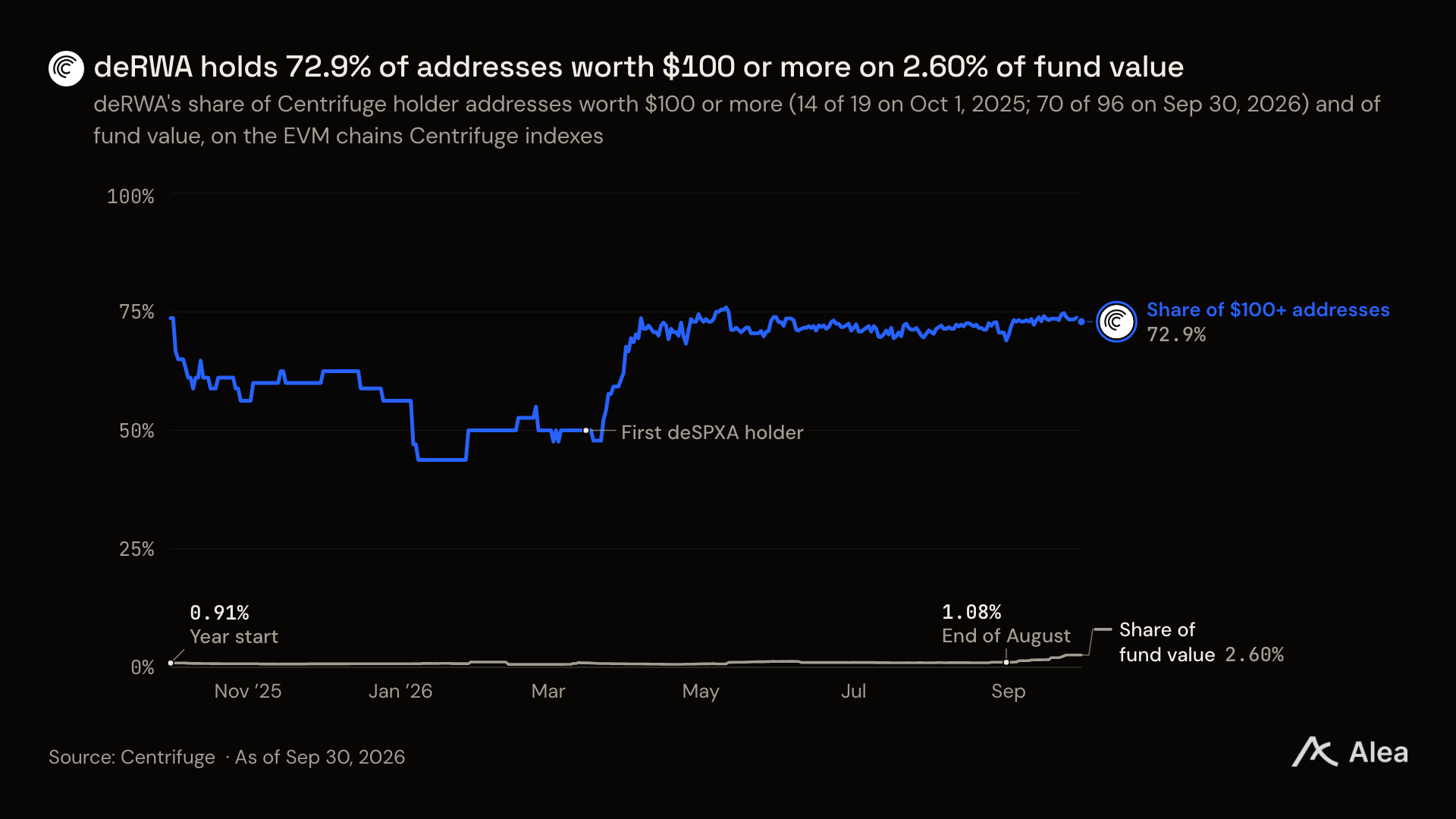
Chart: deRWA share among addresses with assets above $100 climbs to 72.9%, but accounts for only 2.6% of total fund asset size
Key Takeaways
deRWA occupies the vast majority of wallet addresses, while strictly KYC-verified compliant fund shares actually hold the massive capital.
Over the course of a year, the number of deRWA addresses holding over $100 in assets surged dramatically from 14 to 70; in comparison, compliant fund share holder addresses only increased from 5 to 26. deRWA’s scale grew by 133% year-to-date, while the protocol’s total fund scale concurrently declined by 18%, with half of this incremental growth concentrated in September.
Market making and asset management giant Grove effectively dictates the volume and trajectory of Janus Henderson’s U.S. Treasury fund JTRSY and AAA-rated collateralized loan obligation (CLO) fund JAAA.
Grove, responsible for managing Sky’s (formerly MakerDAO) reserve funds, held an average of 89% of Centrifuge’s total fund scale daily over the year ending September 30. Its holdings plummeted by $522.6 million in September alone, accounting for 82% of the month’s total outflows. During Q3, Grove’s reduction in allocations outside Centrifuge actually exceeded its drawdown within the protocol itself.
On September 2, Centrifuge announced the creation of a new independent vault for Janus Henderson, introducing fresh buyers outside of Grove to the protocol by injecting SmartMedia Technologies’ (SMT) loyalty reserve funds into JTRSY and JAAA.
Five instant redemption venues currently cover the four funds—JTRSY, JAAA, HYB, and ACRDX—that pool nearly all of Centrifuge’s asset value. Grove’s Basin pool was first to offer instant redemptions for JTRSY on July 28, and by September 29, four additional exit channels followed suit.
Centrifuge’s expansion roadmap for the U.S. domestic market will heavily rely on its self-built licensed Transfer Agent, a role equivalent to the foundational infrastructure Securitize provided for BlackRock’s BUIDL fund. Centrifuge plans to partner with Janus Henderson within a year to launch exclusive compliance products tailored for U.S. investors. The U.S. Securities and Exchange Commission (SEC) proposed new modernized regulatory guidelines for transfer agents on September 1, with a comment period running until November 3.
CFG token holders approved a restructuring plan to swap tokens for genuine equity in Centrifuge, Inc. (provided holders pass KYC review) with a decisive 98.5% affirmative vote and record-breaking participation rates.
CFG tokens capture zero yield from the substantial management fees paid by JTRSY and JAAA, and their secondary market prices are completely decoupled from the growth of underlying fund scales. The largest contributor to both funds, Grove, purchased 37.8 million CFG tokens on August 25. The restructuring plan still awaits final approval signatures from the Foundation Board and its regulated corporate supervisor.
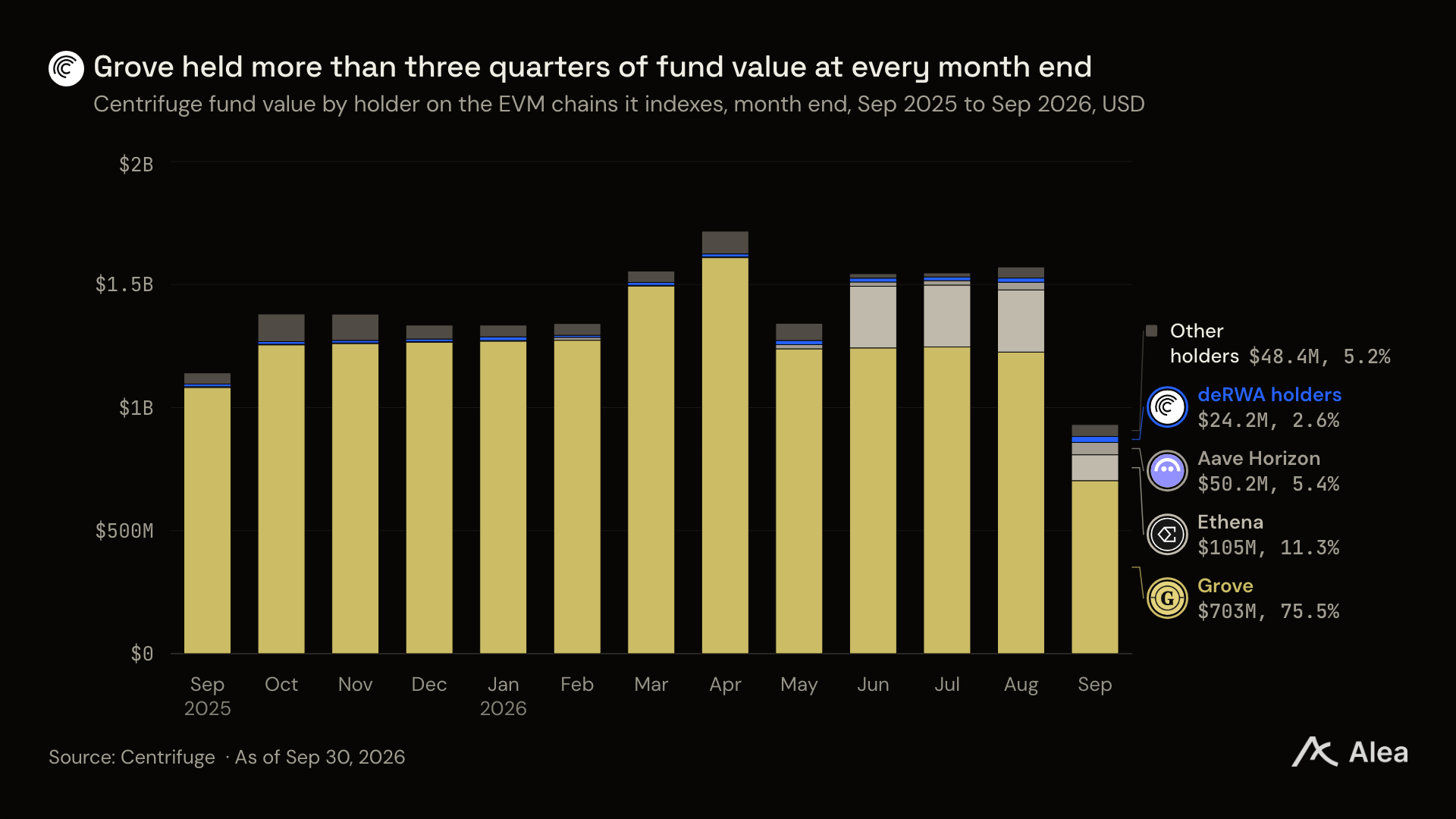
Chart: Monthly stacked scale structure of Centrifuge funds, total drops to $931.2M after Grove & Ethena redemptions, but Grove still exclusively commands three quarters
Legal Team Co-Creates deRWA and Strategically Abandons U.S. Domestic Version
Janus Henderson, Apollo Global Management, and New York Life Investment Management all issue tokenized funds through Centrifuge and its licensed fund vehicle, Anemoy, based in the British Virgin Islands (BVI).
Eli concurrently serves as the compliance officer for Anemoy. He revealed that most institutional investors in Anemoy’s funds are Cayman companies or offshore foundations, and Centrifuge is currently establishing an entirely new Cayman fund entity.
Anemoy sells strictly KYC-verified compliant fund shares to non-U.S. professional institutional investors. Similar to BlackRock’s BUIDL launched in 2024, these base fund shares can only circulate peer-to-peer among whitelisted holders who have passed compliance approvals.
Ondo Finance takes a different approach by directly issuing its self-created Reg S notes, USDY, to non-U.S. investors. Centrifuge’s strategy contrasts sharply: it wraps externally vetted, KYC-certified underlying shares from top-tier external fund managers and repackages them into deRWA notes.
Through this dual-layer packaging, a single Janus Henderson fund can simultaneously reach traditional asset allocation giants via compliant shares and seamlessly integrate into decentralized lending and trading protocols via KYC-free notes, allowing major DeFi protocols to list directly without undertaking cumbersome onboarding reviews.
Eli clearly states that every deRWA note is fundamentally a debt instrument governed by U.S. securities law Regulation S (Reg S), “meaning it absolutely cannot be offered to any U.S. entities.”
Centrifuge previously allocated funds from its “quite limited external legal budget” to specifically evaluate the feasibility of launching a U.S.-domestic compliant version under Regulation D (Reg D) for U.S. accredited investors, with findings concluding it was legally permissible.
However, for a token originally designed to circulate freely between wallets on-chain, stringent resale restrictions like Reg D’s one-year lockup would completely undermine the practical purpose of developing the product. Eli bluntly noted: “The transfer restriction flaws it brings simply make no commercial sense.”
Another compliant pathway to the U.S. market involves establishing private funds exempt under Section 3(c)(7) of the Investment Company Act, but this erects a “prohibitive capital threshold” (requiring investors to be Qualified Purchasers). More importantly, Centrifuge found that domestic U.S. demand for its offshore fund products is exceptionally limited.
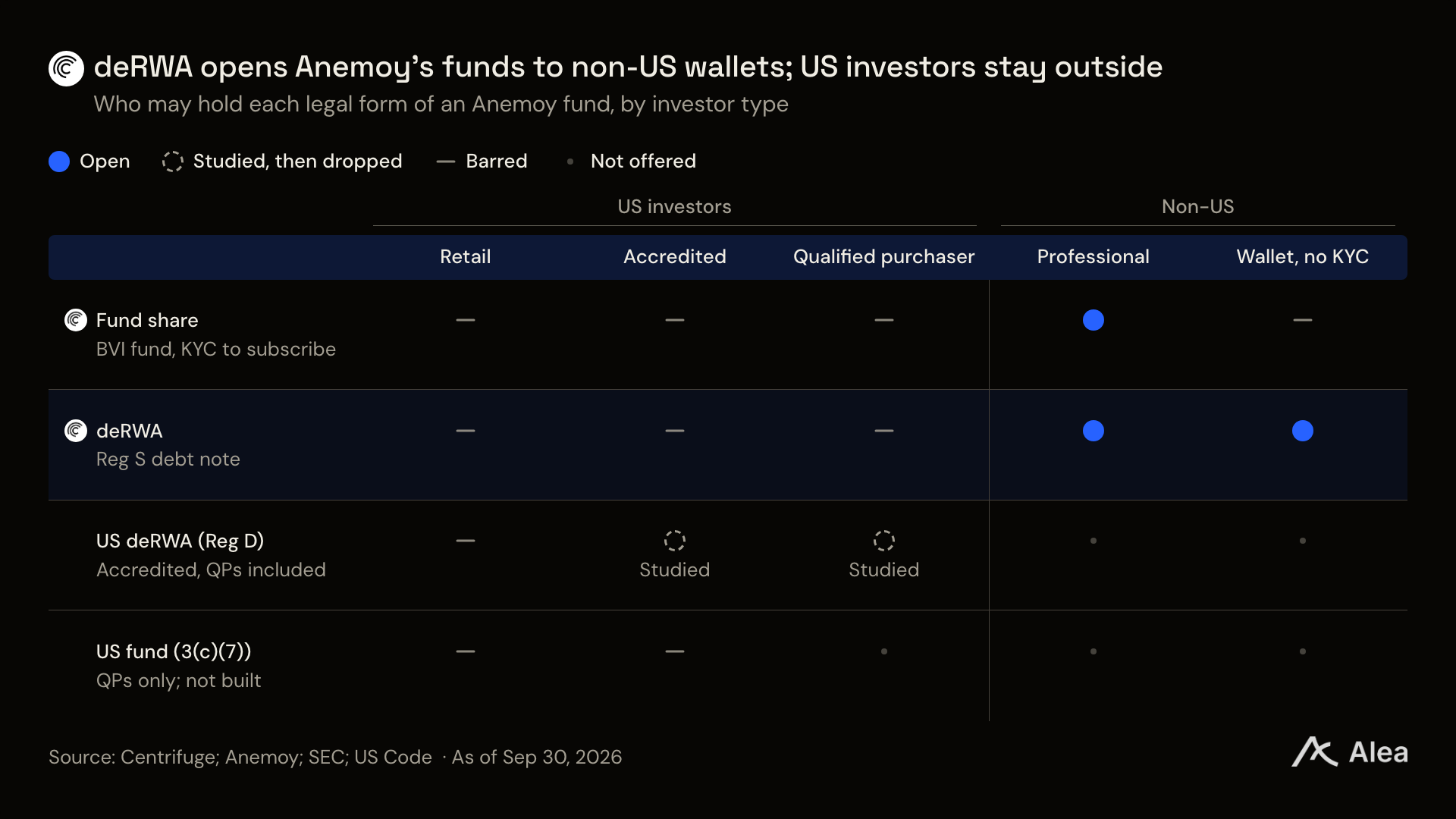
Chart: Access matrix of four legal structures and five investor categories, U.S. investors at any level cannot hold existing Anemoy fund tokens
Coinbase designated Centrifuge as its officially recommended tokenization infrastructure provider in Q2. In August, Compass, Para, and cross-chain liquidity aggregator LI.FI sequentially integrated deRWA notes into their supported apps, wallets, and cross-chain routing networks.
On Coinbase’s incubated Base network, Coinbase’s tokenized U.S. equity product officially launched on August 24, while Centrifuge deSPXA notes tracking Janus Henderson’s S&P 500 fund ran in parallel in the offshore market from day one.
Over the 90-day period ending September 16, cumulative trading volume for deSPXA on Base chain DEXs reached $103.6 million, ranking second among all equity tokens on the chain, with trading turnover amounting to roughly 30 times its daily average outstanding float market cap.
Whale-Dominated: Three Native Institutions Controlled an Average of 96% of Fund Assets in Q3
“You often see BlackRock issuing massive amounts of compliant securities in the DeFi world, but you rarely ever see them turn around and actively buy any of those securities themselves,” Eli commented.
As of the end of Q3, three crypto-native institutional buyers—Grove, Ethena, and Aave Horizon—collectively controlled 92% of the $931.2 million total fund value on the Centrifuge platform.
Aave Horizon, a lending market launched by Aave that supports tokenized funds as collateral, is the smallest among the three giants. As the Aave Risk Committee gradually raised its supply caps, the scale of deposited JAAA grew from $17.3 million to $50.2 million during Q3.
Stablecoin protocol Ethena allocated a portion of its reserve assets backing the minted stablecoin USDe into JAAA. After adding $52.1 million in deposits to the fund, Ethena executed a lightning round of redemptions in a single week in September, slashing its held JAAA assets from $305.1 million down to $105.3 million.
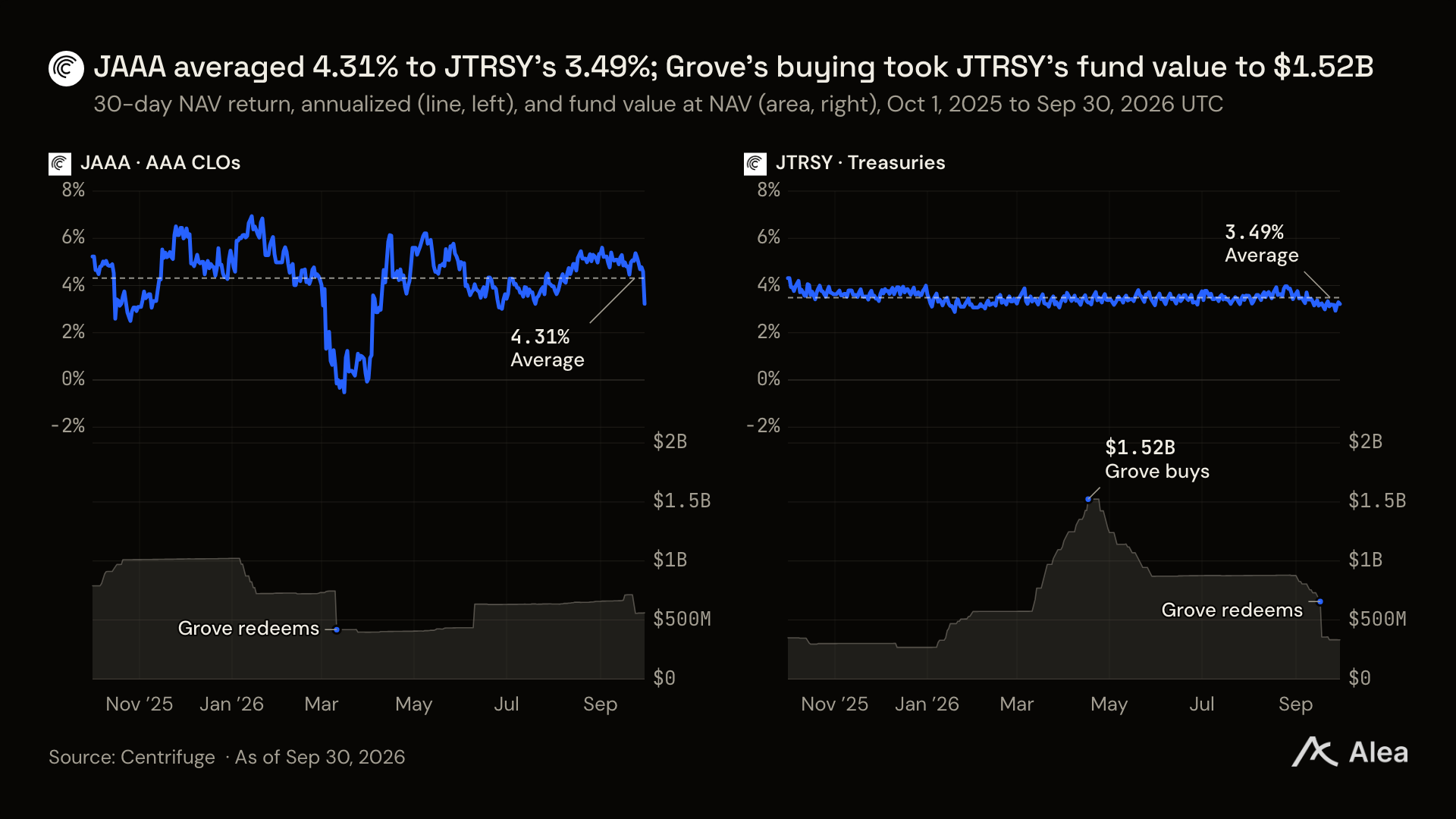
Chart: 30-day annualized return comparison and scale trajectory of JAAA vs. JTRSY, Grove redeemed $327M in JAAA in March and rotated into JTRSY
As the largest backer, Grove once withdrew $327 million from JAAA in a single batch on one day in March, causing the treasury fund JTRSY to overtake it as the larger flagship product; subsequently, Grove purchased $940.6 million in JTRSY across multiple batches before mid-April.
In September, however, Grove’s massive redemptions were almost entirely concentrated on JTRSY, which it had previously heavily weighted, driving the fund’s scale back below JAAA by mid-month. Across Q3, Grove slashed its exposure in Centrifuge by 43% and reduced its allocations on other platforms by 49%.
Among the top seven tokenized fund platforms ranked by AUM, the asset scale of Centrifuge’s JTRSY and JAAA plummeted 41% in Q3, whereas the median scale growth for the other six competing platforms achieved a modest 6% increase.
This sharp pullback caused Centrifuge’s industry ranking to slip from fifth to sixth, trailing Maple, Ondo, Securitize, Spiko, and Superstate, with only Midas sitting below. Meanwhile, Superstate—which had just overtaken it in scale—saw its own quarterly size contract by 8%.
Redemption Buffer Pool: Grove’s Established Basin Reaches Four Times the Size of External Float
To resolve the liquidity bottleneck surrounding large redemptions, Grove established a dedicated exit mechanism for JTRSY, with a liquidity buffer pool exceeding the total circulating retail chips of that fund in the external market.
In early October, Grove’s automated clearing flow pool named Basin maintained up to $100 million in stablecoin reserves, equivalent to more than four times the total holdings of all other JTRSY holders apart from Grove itself as of September 30 (approximately $23 million).
Subsequently, Grove’s on-chain governance formally passed a proposal to raise the Basin pool limit from $500 million to $1.5 billion. Provided the pool maintains $100 million in USDS deposits for ten consecutive days and receives approval from Sky’s risk advisors, it will officially expand and take effect.
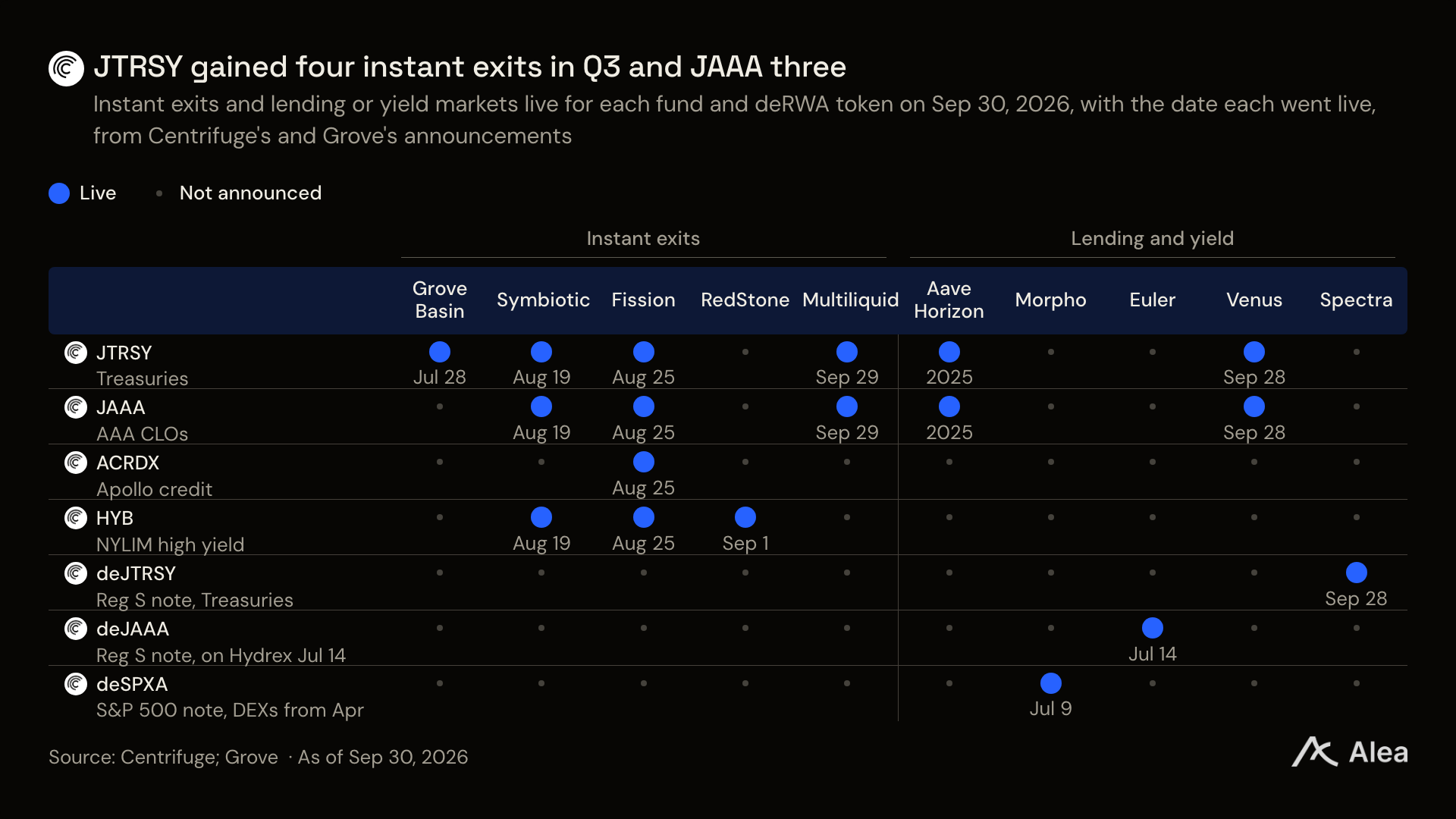
Chart: Panoramic overview of instant redemption exits and lending/market-making ecosystems for Centrifuge’s four funds and three deRWA tokens
During Q3, JTRSY and JAAA, the two flagship funds, captured 7 out of the 11 newly added instant exit channels across Centrifuge’s four core funds. The latest channel opened on September 29, built by Multiliquid to support instant flashing swaps of the two funds into stablecoins via a public market.
The ERC-8161 token standard, co-drafted by Centrifuge’s CTO, opens a second innovative exit path: it allows holders waiting in the redemption queue for cash settlement to tokenize their pending redemption requests and transfer them at par to third-party buyers willing to patiently wait for liquidity.
Eli notes that Centrifuge’s distribution ecosystem across multiple funds boasts high reusability: “Once you successfully plug a U.S. treasury fund into the Morpho lending market, you can seamlessly replicate the identical liquidity architecture onto AAA-rated CLO funds.” However, when redemption settlement cycles for different assets decouple from underlying liquidity, the team must still perform custom development for specific products.
Breaching the U.S. Domestic Market via Transfer Agents
Eli ranks entering the U.S. domestic market as one of Centrifuge’s “highest-level strategic priorities” today. He revealed that an affiliated entity under Centrifuge officially completed registration and filing for a U.S. statutory securities Transfer Agent by the end of 2025.
Centrifuge is plotting and planning U.S. domestic products targeting broad everyday investors, “including retail,” while Janus Henderson has explicitly expressed strong desires for collaboration.
He added that third-party asset managers independently issuing funds on Centrifuge infrastructure handle investor KYC reviews and registration onboarding processes themselves, with some already legally fundraising and selling to qualified U.S. investors.
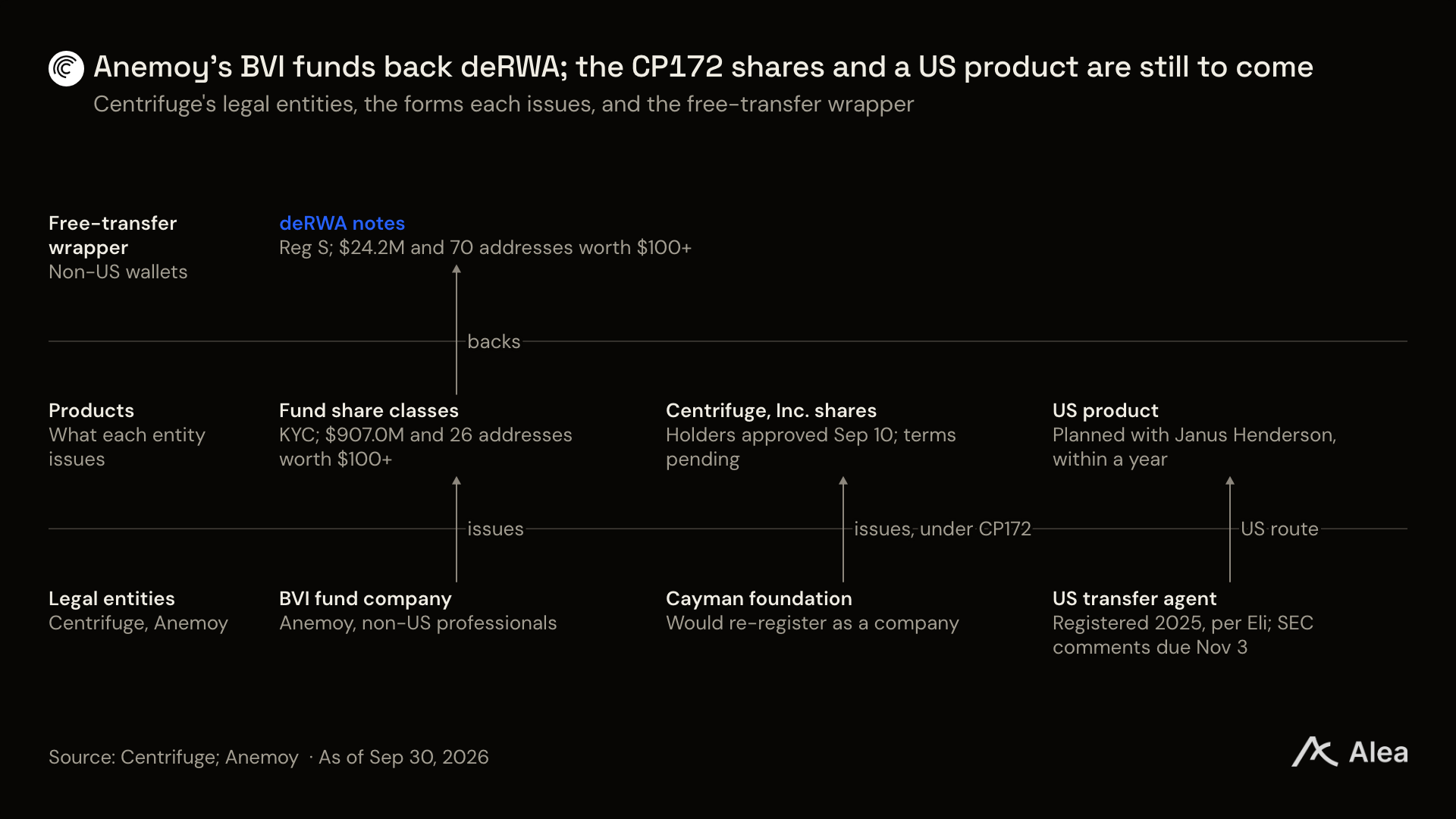
Chart: Centrifuge’s current and planned three-tier legal entities, licensed transfer agents, and token product flow architecture
The rule revision proposal officially released by the SEC on September 1 comprehensively covers the compliant application of blockchain technology by securities transfer agents in public offerings and equity register transfers. This represents the most substantive modernized restructuring of the rule within nearly half a century since the SEC first established related legislation in the late 1970s and early 1980s.
Superstate, similarly acting as a tokenized fund issuer alongside a licensed digital transfer agent, has explicitly stated plans to submit formal feedback.
On September 17, the SEC just approved a five-year conditional regulatory exemption permitting matched trading of listed tokenized U.S. equities within authorized private liquidity pools on compliant chains. However, this targeted exemption temporarily excludes offshore funds and deRWA notes under Centrifuge.
Superstate is working to establish AMM-based decentralized trading pools for its tokenized U.S. equities, where in such systems, “tokens are inherently native, real underlying securities,” eliminating the need to nest any additional offshore derivative wrapping layers.
Governance Restructuring: CP172 Proposal Aims to Swap Decoupled Tokens for Genuine Corporate Equity
The CP172 governance proposal, officially launched by Centrifuge CEO Bhaji Illuminati on August 17, plans to provide every eligible token holder a pathway to swap their CFG tokens at a 1:1 ratio for genuine tokenized equity in Centrifuge, Inc.
Under this restructuring blueprint, the currently Cayman-based Centrifuge Network Foundation will re-register as a standard Cayman Exempt Company. The equity swap operates on a voluntary basis; all applying token holders must pass rigorous KYC verification, and those within the U.S. must qualify as accredited investors.
The official CP172 FAQ bluntly points out that large traditional institutional investors and top-tier strategic partners “will never participate in the protocol through public tokens”; meanwhile, to maintain listings for public CFG tokens on major centralized exchanges, the team has long borne heavy listing agreement costs and enormous market-maker borrowing expenses.
Although Centrifuge successfully scaled up AUM and achieved protocol fee growth, Eli admits: “Token prices are currently highly bound to fluctuations across the entire crypto speculative market, completely detached from real business operations.”
Data corroborates this awkward disconnect: over the past year, the median 30-day rolling correlation coefficient between CFG’s daily price swings and underlying fund asset scale movements is a mere 0.04, whereas its correlation with Bitcoin hits 0.45. Bitcoin’s single-day volatility explains roughly 15% of CFG’s price moves and 25% of ONDO’s trends, while additions or subtractions in Centrifuge’s underlying real assets possess virtually zero explanatory power for CFG’s price.
In late February and mid-March, CFG sequentially listed on South Korea’s Upbit and Binance, the world’s largest crypto exchange, with these two listing events directly contributing to the token’s largest single-day gains recorded year-to-date.
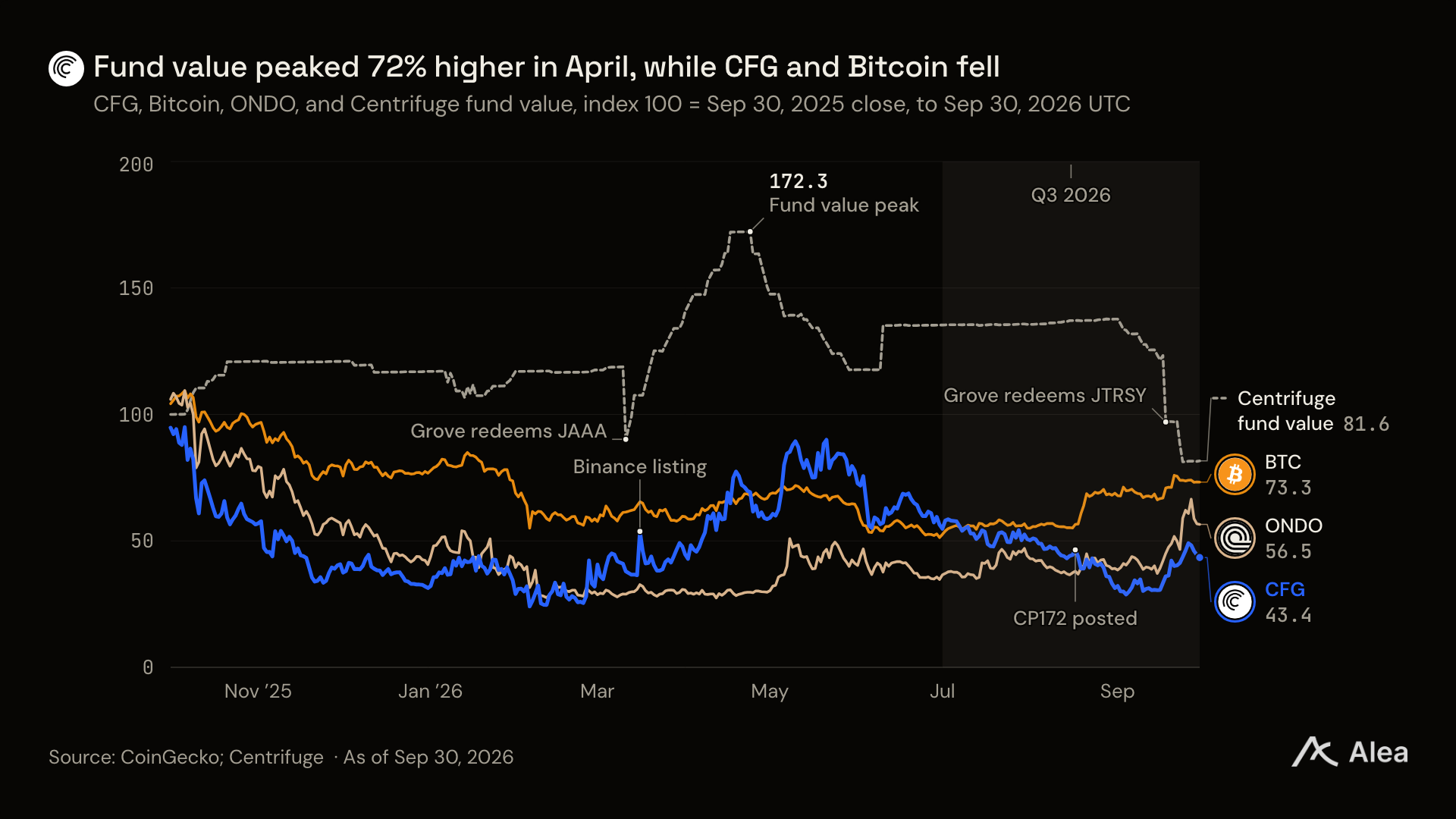
Chart: Severe decoupling comparison between CFG token price action and Centrifuge’s real fund asset scale, Bitcoin, and ONDO trends
In the on-chain vote concluding on September 10, 74.4 million CFG tokens participated in voting, accounting for roughly one-tenth of the total on-chain circulating supply, with turnout volume reaching five times the previous all-time high (13 million tokens).
Notably, among the 35 wallet addresses that ultimately cast votes, none belong to the registered address of the largest backer Grove, and no single voter cast enough ballots to rival Grove’s 37.8 million CFG holdings.
Since ordinary holders keeping tokens on centralized exchanges cannot directly participate in Snapshot on-chain governance voting, some community members have called on governance forums to carve out a dedicated green-channel for equity swaps for this demographic, demanding that future major resolutions altering CFG’s functions be submitted to a general holder referendum.
The current plan opens swap windows to all compliantly qualified holders, with small-to-medium retail investors holding less than 100,000 CFG tokens unified under custodial trusts via CoinList.
In the historical CP171 proposal passed in November 2025, holders had established CFG as Centrifuge’s “sole value capture vehicle” and handed over day-to-day operations entirely to Foundation jurisdiction. The current CP172 proposal, while retaining this singular value capture route, radically shifts the value-bearing entity from circulating tokens to genuine corporate stock.
Foundation board members, including Grove co-founder Kevin Chan and Janus Henderson’s Nick Cherney, must jointly finalize approval and sign off on this restructuring plan alongside the Foundation’s statutory supervisor. Eli stated the team will work intensively over the coming months to nail down the concrete operational execution plan for the equity swap.
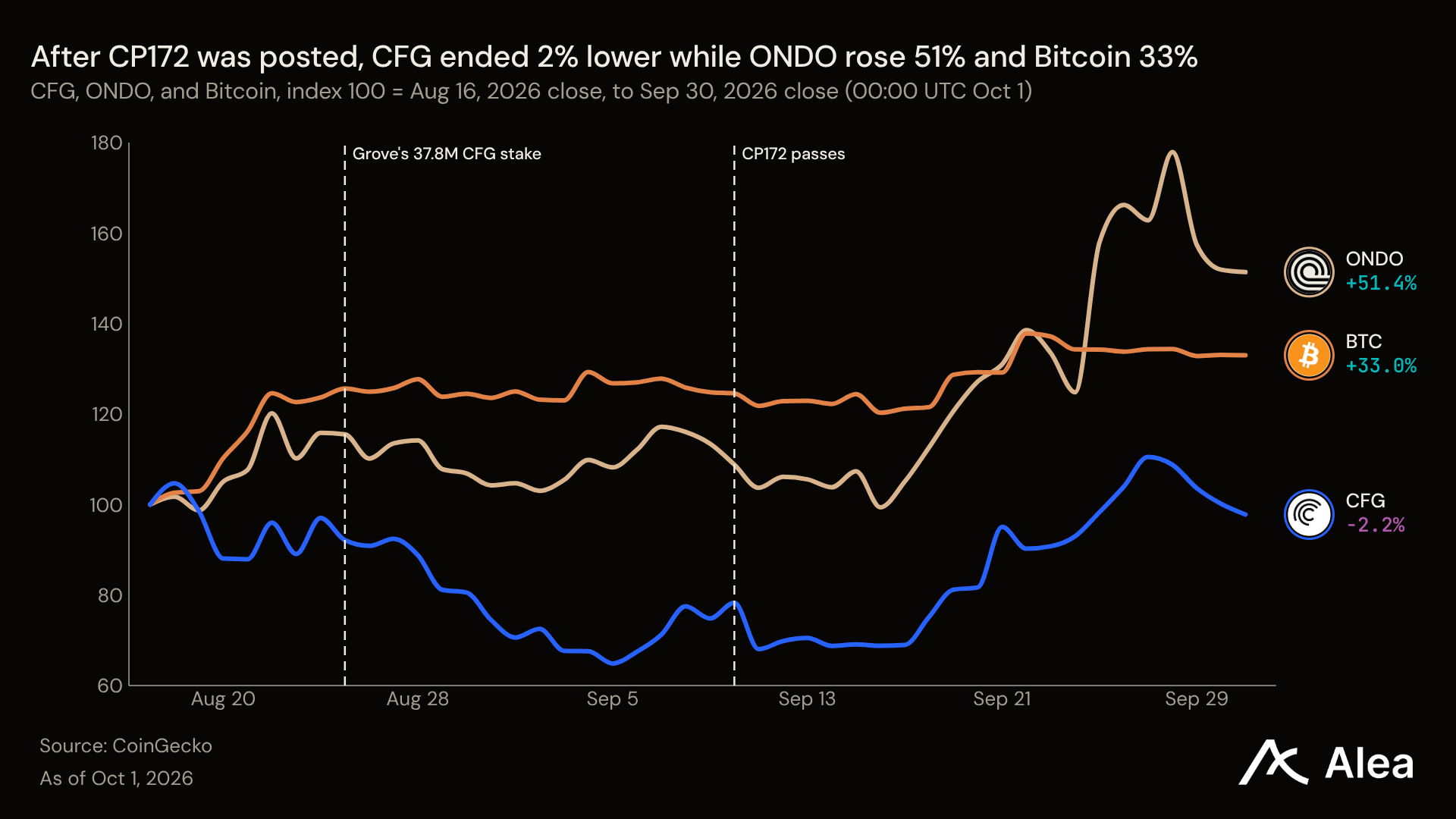
Chart: Relative performance of CFG, ONDO, and Bitcoin and voting window trajectories within six weeks post-CP172 proposal release
Participating holders will secure genuine economic rights long severely lacking in CFG tokens, with acquired share class levels completely matching those held by the founding team and existing early-stage VCs. Once the full equity swap process concludes smoothly, CFG’s original annual 3% token inflation minting will be permanently and completely terminated.
At the fee level, Anemoy charges a 0.25% annual fee for JTRSY and a 0.50% annual fee for JAAA. Following the massive redemption wave in September, estimated against Q3-end surviving fund scales, this aggregate management fee totals roughly $3.6 million annually. However, how much proportion Centrifuge can skim from these management fees remains undisclosed.
Based on peer benchmark valuation metrics, CFG’s then $56.9 million FDV corresponded to a cumulative $902 million AUM across JTRSY and JAAA, meaning the market assigned only a $0.063 token valuation per dollar of AUM. This capitalization multiple barely edges out Maple’s SYRUP, amounting to merely one-tenth of industry leader Ondo’s valuation ratio.
Centrifuge currently has zero token buyback plans and expects no dividend distributions in the near term, with management stating “every dollar of capital will be fully committed to business expansion.”
After the equity swap offer expires and closes, the protocol will also gradually cease providing any market-making liquidity support for public CFG tokens on the secondary market. The team opted for a tokenized stock implementation to “retain greater capital maneuverability in the future,” but management candidly acknowledges that following the swap, these stocks will maintain extremely low liquidity in the secondary market for a notably foreseeable period.
The Ultimate Game of Legal Packaging: Different Shells Filter Different Capital Flows
KYC-free deRWA notes can reach any non-U.S. wallet, while KYC-required compliant fund shares pool hundreds of millions in genuine hard capital from three crypto-native institutions.
Next, CP172 will open the doors to Centrifuge corporate equity to qualified American investors meeting accreditation standards, while the U.S.-domestic compliant fund partnering with Janus Henderson is also scheduled to officially debut within a year.
Meanwhile, the SEC’s comment period for its new on-chain transfer agent regulatory guidelines will officially close on November 3. In late September, Eli revealed that a new Centrifuge fund yielding richer returns than HYB “will officially debut in roughly the next month.”
Core References & Important Indexes
Interviews & Audio: Onchain, Honestly! Episode 20, Conversations with Centrifuge: When Law Becomes the Core Pillar of Product Strategy; Podcast Deep Dive Notes & Highlights Recap.
Governance Proposals: CP172: Comprehensive Exploration of Token-to-Equity Swap Paths; CP172 Official FAQ; CP172 Snapshot On-Chain Vote Final Record; CP171 Historical Proposal: Focusing on Execution, Transparency, and CFG Value Capture Restructuring; CP162 Proposal: Establishing Protocol Real Revenue via Fee Flows Managed by CNF.
Regulation & Law: SEC Modernized Transfer Agent Rule Revision Proposal (Release 2026-81); Federal Register: Call for Comments on Transfer Agent Rules (Deadline: November 3, 2026); SEC Five-Year Conditional Exemption for Tokenized Equity Trading (Release 2026-90); SEC Regulation D Accredited Investor Determination Standards; U.S. Investment Company Act of 1940 Section 2(a)(51) Definition of Qualified Purchaser.
Products & Ecosystem Data: Centrifuge Official dApp & Summarized Page of Underlying Tokenized Funds; deRWA Notes Official Dedicated Page; Centrifuge On-Chain Data Indexer (Underlying Data Source for Holder Addresses & Asset Scale); BlackRock Partners with Securitize to Establish BUIDL Tokenized Fund Official Announcement; Exclusive Vault for Loyalty Reserves Jointly Established by Janus Henderson, SMT, and Centrifuge.
Ecosystem Integrations & Lending Markets: Resolv primeUSD Integrated Into JAAA Via Aave Horizon; JTRSY-Specific Basin Redemption Pool Established by Grove; deJAAA Collateral Lending Market on Euler Platform; deSPXA Collateral Lending Market on Morpho Platform; RedStone Settle Instant Same-Day Exit Channel for HYB; Liquidity Channels Established by Symbiotic for HYB, JAAA, and JTRSY.
DEX & Yield Liquidity Routing: Venus Liquidity Center Established for JTRSY & JAAA; deJAAA & deSPXA Liquidity Pools on Hydrex DEX; deSPXA Trading Market on Base Chain DEXs; Spectra Term Rate Market for deJTRSY on Stellar Chain; Instant Liquidity Routing by Fission for HYB, ACRDX, JAAA & JTRSY; Centrifuge Q1 2026 Review & CFG Spot Listing Progress.
About Alea Research: Alea Research continuously delves deep into microeconomic analysis of crypto protocols and interviews pioneering builders. Its product lineup includes: Protocol Deep Dives & Economic Blueprint Deconstructions (Deep Dives & Blueprints), Investment Theses & Catalyst Analysis (Theses & Memos), Cross-Protocol Benchmarks, Macro Market Weekly Pulse, All-in-One Protocol Data Rooms, and Global Governance Tracking (Governance Tracker).
Join TechFlow official community to stay tuned
Telegram:https://t.me/TechFlowDaily
X (Twitter):https://x.com/TechFlowPost
X (Twitter) EN:https://x.com/BlockFlow_News
 @AleaResearch