Beyond Prediction Markets, How to Determine Whether an Event Will Cause Bitcoin to Rise or Fall?
Written by: Vaidik Mandloi
Edited by: Chopper, Foresight News
Today, all prediction markets, whether Polymarket or Kalshi, output only one type of result: probabilities. Probability is simply a number representing the market's collective assessment of the likelihood of an event occurring.
Over the past two years, this underlying tool has proven that markets can aggregate fragmented information from various sources, predicting future events with greater accuracy than polls, expert reviews, and all previous human forecasting methods.
However, the information of "probability" is actually incomplete in finance. If you hold Bitcoin and see the market predict a 65% probability that the Federal Reserve will cut rates by 75 basis points next month, you know it's highly likely to happen, but have no idea what impact it will have on your holdings. You only know rate cuts are likely, but don't know exactly how Bitcoin's price will move. If the cut happens, will Bitcoin rise to $110,000? Or $95,000, or $140,000? Conventional prediction markets cannot answer this question.
The event itself, and the magnitude of its impact on companies and assets, are two entirely different things. Financial markets have long conflated them. Differentiating between the two is the development direction for next-generation financial products.
The industry is currently building two distinctly different types of products. The first stems from insights provided by prediction markets: since markets are so powerful at aggregating information, why should organizational governance still rely on voting? These products are calleddecision markets. The second is something entirely new: it tells you directly what Bitcoin's price would be if the Fed cut rates by 75 basis points. It doesn't just predict whether rate cuts will happen; it calculates Bitcoin's dollar price under this hypothetical scenario. This type of market is calledimpact markets, and its value is currently severely undervalued. Both categories fall underconditional markets.
I will detail impact markets later. To quickly understand their importance, you can first look at the shortcomings of decision markets.
What Happens When Governance Becomes a Market?
Decision markets were first applied to governance scenarios because DAOs and token voting are inherently flawed: the person holding the most tokens may possess the least information; those with critical information may hold too few tokens to change the outcome. Decision markets flip this dynamic: anyone can invest capital to express their viewpoint, regardless of token holdings. Markets can price information in real time.
Robin Hanson proposed the concept of "oracle governance" as early as 2000, with a straightforward core idea. Suppose a protocol needs to decide whether to slash staking rewards. Instead of token voting, traders price the protocol's token across two futures contracts: one for "reward cuts" and one for "maintaining original rewards." The scenario with the higher token price gets implemented. If you blindly trade without understanding the protocol's economic logic, experts will profit at your expense; your losses will also directly reduce your voting weight for all future governance proposals.
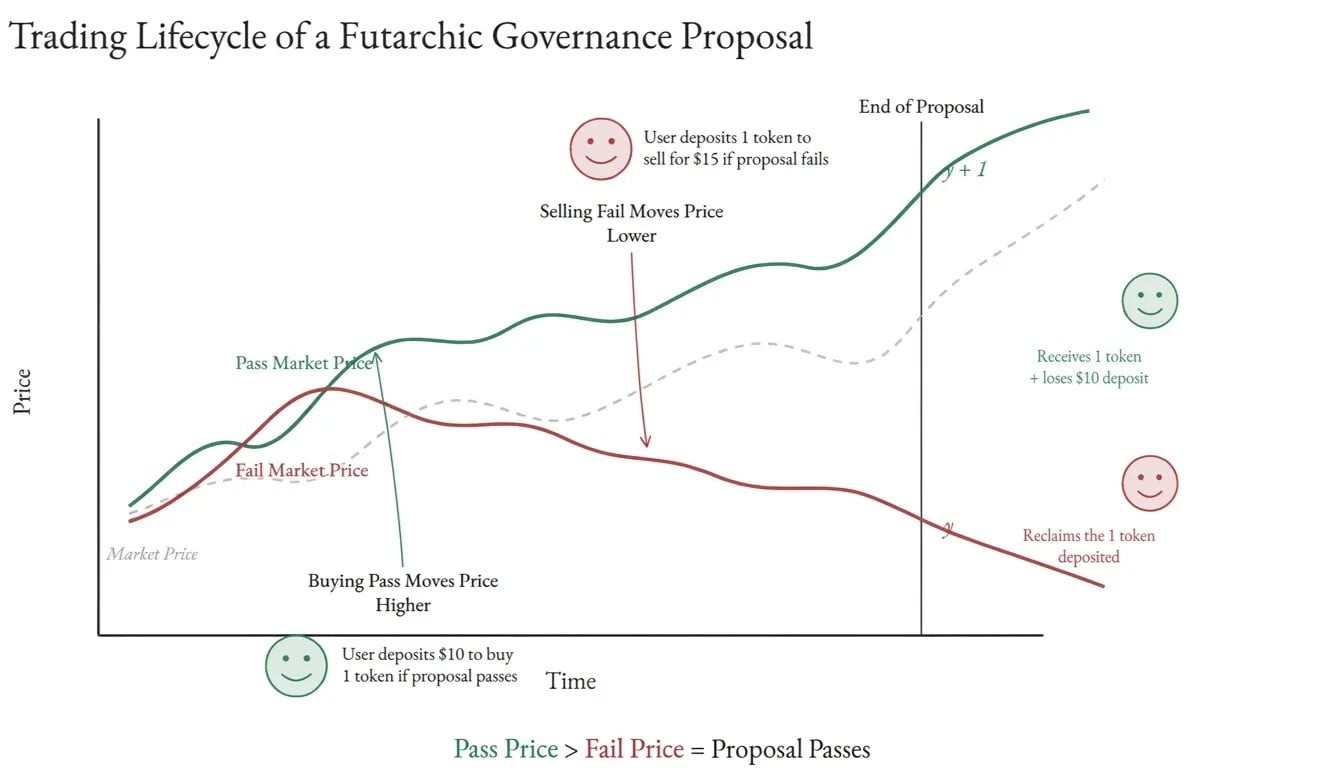
This system grows smarter with use: uninformed capital loses money and exits, while professional, informed capital continuously accumulates. Token voting does the exact opposite—even if you make wrong choices on every proposal for a year straight, your voting weight remains unchanged. Oracle governance forces ignorance to pay a real cost, a feat no prior governance system has achieved.
MetaDAO was the first team to implement this mechanism. Launched on Solana in late 2023, it uses a binary model: each proposal has only two outcomes—pass or fail—and a conditional market determines the final result. Token voting is eliminated, and the market's conclusion carries mandatory force.
However, this yes-or-no model introduces new problems. The market can only answer "yes" or "no"; all parameters within a proposal, such as budget, timeline, and technical changes, must be pre-negotiated in forums before the market opens. This contradicts the original goal of decision markets, as proposal details remain reliant on the old informal consensus discussions, with whales still dominating the conversation. You've merely handed off the final binary choice to the market, which is an improvement, but the proposal design phase remains stuck in the outdated system you aimed to replace.
In September this year, Umia upgraded MetaDAO's system to a multi-outcome version. Instead of simple pass/reject options, multiple parameter sets for the same proposal can compete simultaneously. Through trading, the market automatically eliminates unreasonable parameters. The optimal proposal emerges directly from market trading, rather than being predetermined in forums. If the mechanism's original intent relies on price discovery, this is exactly how it should work.
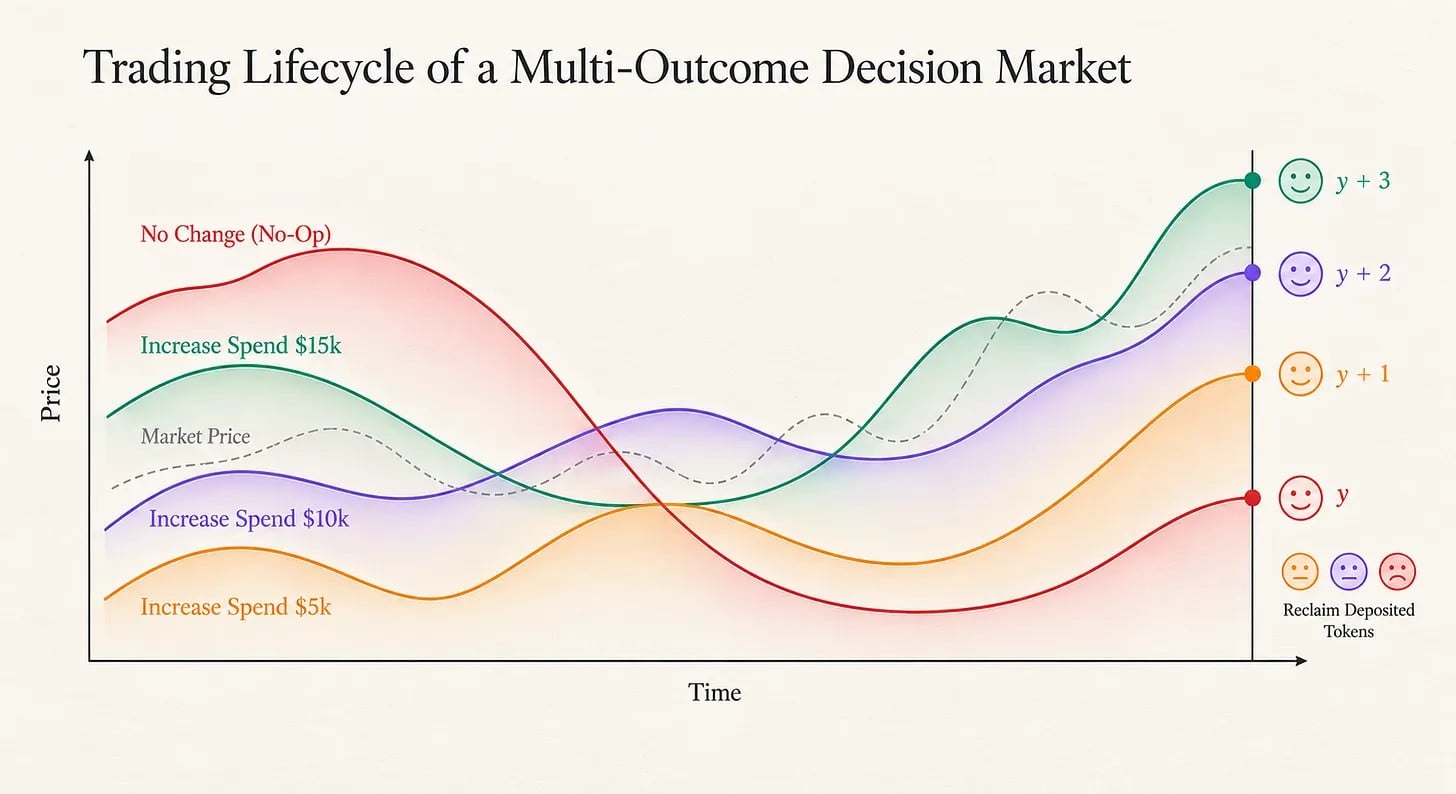
Currently, 22 DAOs are using this mechanism, with 96 proposals already governed through it. Treasury funds managed by markets total $50.5 million, with MetaDAO accounting for $39.3 million. This indicates significant potential for scaling. However, even if treasury sizes increase a hundredfold, decision markets will still face a ceiling. This bottleneck is unrelated to capital, user scale, or development team capabilities.
There is Goodhart's law in economics: once a measure becomes a target, it ceases to be a reliable indicator. Credit ratings were originally meant to assess default risk; after banks began relying on ratings to select mortgage products, investment banks deliberately designed securities to meet rating standards rather than screening for quality loans. As underlying mortgage assets deteriorated, the securities retained their top AAA rating.
Decision markets are inherently prone to this flaw. Token prices rise after a proposal passes partly because the proposal creates value, and partly because passage signals strong team confidence. Even if a high-quality project proposes using treasury funds to mint a bronze bull statue, the token will still rally upon passage; traders are betting on governance confidence, not the statue itself. A similar phenomenon occurs when Apple announces share buybacks at peak valuations.
The entire mechanism breaks down when the market's output feeds back and influences the very asset it aims to evaluate. Fixing this removes trader incentives. But if you remove the governance layer and apply this conditional mechanism to external protocol events—external events whose outcomes cannot be altered by trading—the feedback loop disappears, making prices hard to manipulate artificially. This is the impact market.
What Can Impact Markets Do?
Current hedging tools in crypto are quite crude. If you hold Bitcoin and worry a regulatory decision might impact your position, you have two choices: either sell outright, forfeiting all upside from other bullish scenarios; or buy volatility products, but these track broad market swings, unrelated to your specific concern. Historically, no financial product has allowed isolating a single event to trade the precise price impact it could deliver to an asset. Impact markets achieve exactly this.
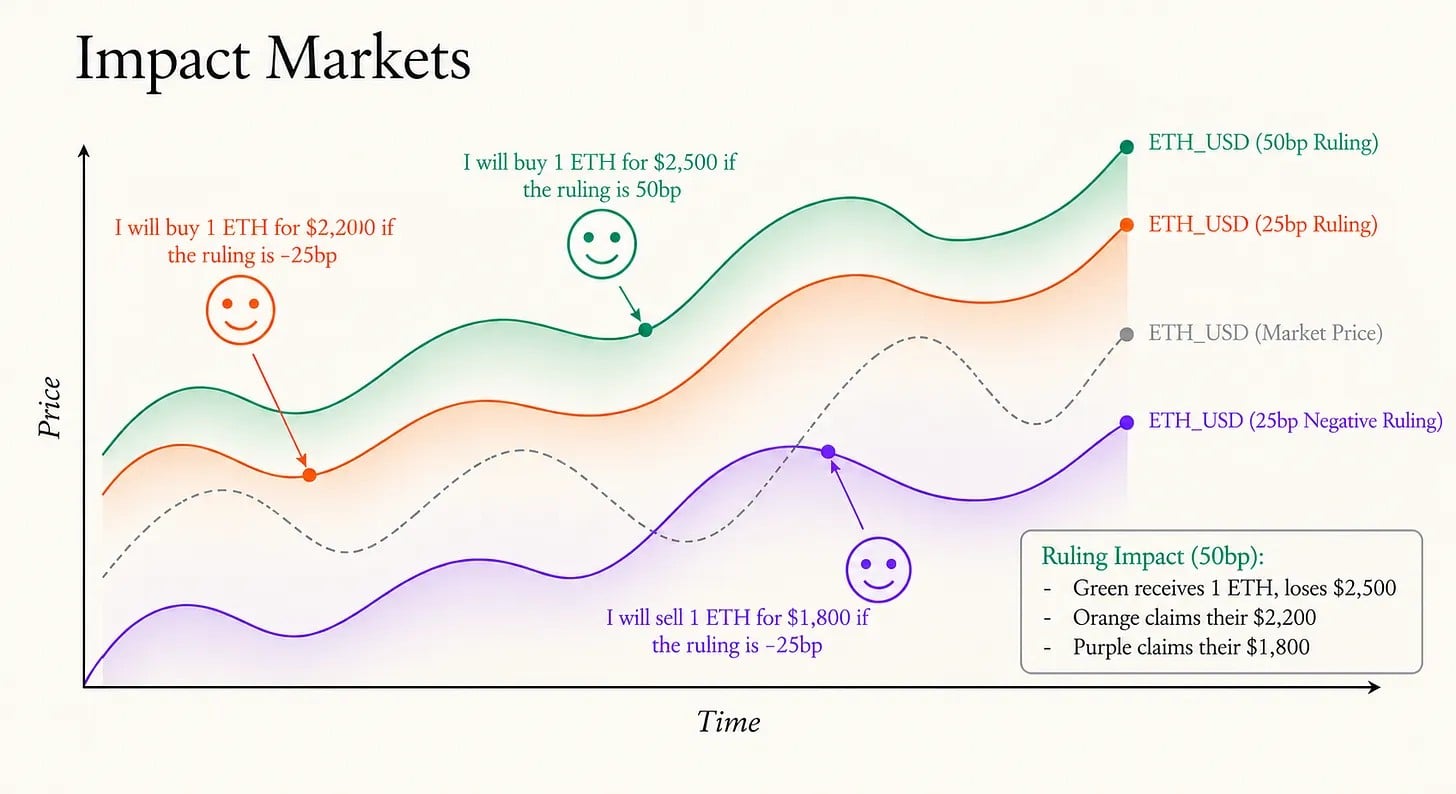
For example, the US SEC is about to rule whether a certain class of DeFi protocols constitutes a security, and you hold a large amount of ETH. You believe that if the ruling is bearish for DeFi, ETH will drop to $1,800. In the "ETH impact market under a bearish SEC ruling scenario," the current market price is $2,300, reflecting the collective expectation that if the ruling lands, ETH's price will settle at $2,300.
You sell this contract at $2,300. Later, the bearish ruling materializes, and ETH drops to $1,800. Because your judgment proves more accurate than the market's, you earn $500 per token. Even if you're wrong and ETH only drops to $2,200, you still pocket $100. Before impact markets emerged, such trades didn't exist. No product allowed trading the specific price fluctuation caused by a single event on a particular asset, with pricing determined by real-time market trading.
Its underlying principle is that the asset price we see today is essentially a compressed single number representing the average outcome of all future possibilities. Impact markets allow us to pierce this surface layer and trade individual future scenarios separately.
To avoid specific risks today, people generally diversify across multiple assets, which essentially amounts to roughly guessing the correlation between asset price movements. Impact markets completely flip this approach: you can hold a heavy BTC position while purchasing targeted risk protection against the specific regulatory or macro events you fear, without selling your holdings or buying volatility insurance for thousands of irrelevant scenarios.
Instead of avoiding risk through asset diversification and betting on directional correlations, you directly hedge against risks in specific scenarios. This represents an entirely new risk management methodology, predicated on products providing conditional prices rather than event occurrence probabilities.
I believe impact markets will far surpass prediction markets in influence. Prediction markets only settle into "occurred/not occurred" results upon expiration; while useful, their application scope is limited. Probabilities themselves cannot be directly traded, nor can they serve as a foundation for complex financial instruments.
Impact markets, conversely, output the dollar price corresponding to an asset under a specific hypothetical scenario. You can use it to hedge risks and continue developing derivatives. Before conditional prices existed, such tools were fundamentally impossible to create. Various derivative products built upon reliable conditional prices will ultimately dwarf the conditional markets themselves, much like how the options and derivatives market vastly exceeds the underlying equity market.
While the market space for "whether an event will occur" is substantial, it naturally hits a ceiling; probability alone limits utility. But for "how much this event will shift asset prices," the corresponding scenarios are endless, with market depth equivalent to the entire financial sector.
The first wave of products is now live, expanding at an accelerating pace. Protocols like Branchpoint have even developed Branchmap, a cross-project universal naming standard that uniformly defines various conditional scenarios. Standardization is crucial: impact markets can only become true financial infrastructure if "ETH under a bearish SEC ruling scenario" means exactly the same thing across all trading platforms. Without unified standards, liquidity fragments, and conditional prices across different platforms become incomparable.
Branchpoint calls this ecosystem "multiverse finance." Each conditional market acts as a window corresponding to a specific future, a branch of reality, representing the world after a particular event occurs or fails to occur. As impact markets mature and liquidity deepens, markets will do more than price single events conditionally; they will fully display an asset's complete valuation across countless parallel futures and distinct scenarios.
For decades, the financial industry has sought to disentangle the drivers behind asset prices. Event study research as a whole relies on historical data retroactively estimating how much a specific event truly drives price movement, relegating the rest to noise. Previously, people could only rough-calculate estimates after the fact.
Impact markets enable this dissection prospectively and in real time. Once such data becomes available, the foundational logic of risk pricing will be rewritten.
In the next phase, conditional prices will integrate into risk models and portfolio systems, which currently rely solely on spot prices and implied volatility. Once connected, the frameworks for capital hedging and risk exposure management in crypto will be fundamentally reconstructed.
This mechanism isn't limited to crypto. Once this pricing exists, capital allocation will trigger chain reactions. Insurance companies can offload niche risks beyond their underwriting capacity to conditional markets, enabling them to accept policies they previously had to reject. VC funds can hedge sector risk and company-specific risk separately, daring to take concentrated positions in founders they believe in, rather than spreading investments across 30 projects to compensate for weak conviction. When governments plan to raise minimum wage, they can use conditional markets to observe real-time pricing of employment impacts derived from capital trading, instead of debating among conflicting economic models.
In the 1970s, options brought a similar revolution to stock markets, birthing many previously unimaginable new industries. Like options, conditional markets are fundamental financial infrastructure. The difference lies in their basis for dissecting risk: they rely on various events rather than the assets themselves; and there is no upper limit to the number of potential events in the world.