Withdrawals Banned After Airdrop Farming: Papertrade Suddenly Changes Rules, Leaving 'Loss-Making Miners' Completely Numb
Author: Gemini, TechFlow
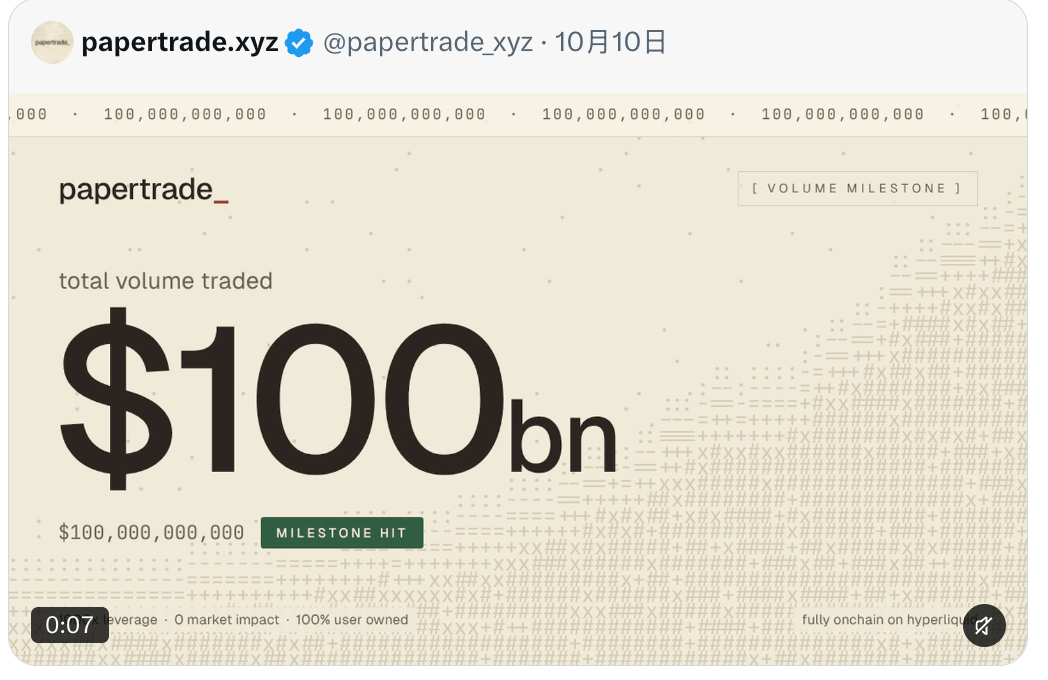
Ten days ago, the HyperEVM-based perpetual contract DEX Papertrade, through its extreme "lose-to-mine" mechanism, absorbed $138 million in deposited funds in an extremely short period, with its nominal trading volume exceeding $10 billion within minutes of launch.
The core betting logic at the time was incredibly absurd: players intentionally blew up their positions using 1000x leverage to gift money away, using real, concrete losses to mint the platform's token $PAPER, gambling on extremely high dividend rights early on and the liquidity premium after the token's future circulation.
But this frenzied crypto experiment may have had its doors welded shut yesterday.
The project officially released a long-form announcement, declaring major modifications to its underlying economic model and throwing a bucket of cold water over all "loss miners." The core message boils down to two points:
First, PAPER tokens are currently banned from being transferred or cashed out; second, the chips mined earlier will be significantly diluted.
Halting $PAPER Withdrawals to Secure Long-Term Project Development
What puzzled many participants most was why the expected token circulation was unilaterally cut off? The hard logic provided by the official team in the announcement was: to prevent the protocol's bankroll from being maliciously shorted by external forces.
In principle, Papertrade's token is essentially a leveraged bet on the protocol's solvency.
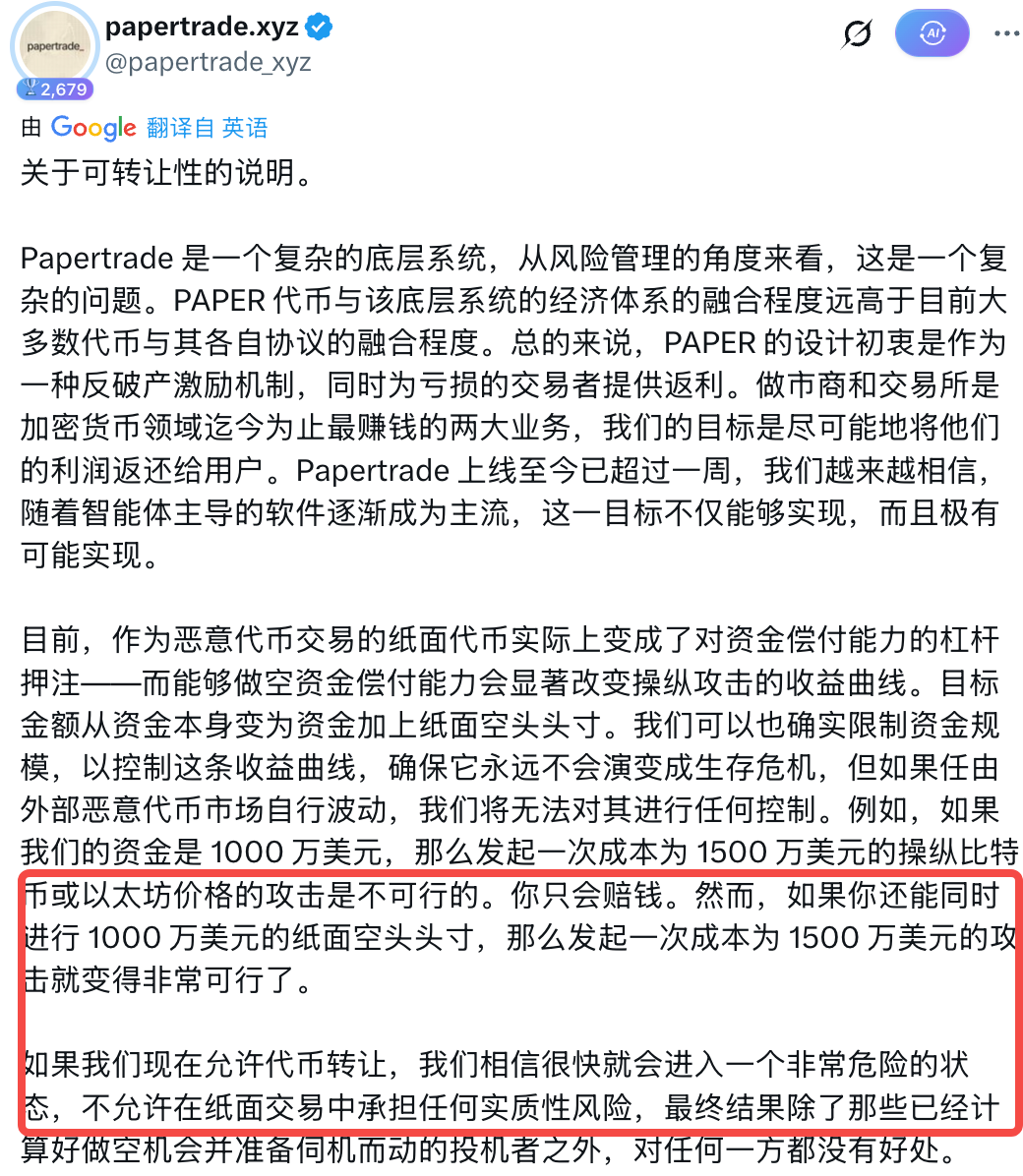
The team calculated a highly realistic scenario: if the protocol's current bankroll size is $10 million, it would actually be a losing proposition for an attacker to spend $15 million manipulating the spot price of BTC to break through this pool.
But if $PAPER allows withdrawals/transfers and can be shorted on external markets, the situation flips entirely. An attacker could simultaneously build a $10 million short position in PAPER externally while spending money to manipulate the spot price and breach the bankroll.Once the bankroll goes bankrupt and PAPER hits zero, the shorting profits can directly cover the cost of driving down the price, achieving risk-free arbitrage.
To avoid becoming an ATM for external capital shorting, the team chose to weld the doors shut. This means that tokens initially farmed through losses have completely lost the possibility of being dumped for cash in the secondary market, transforming into "locked-up receipts" that can only sit internally waiting for dividends.
Early Token Allocations Will Face Long-Term Forced Dilution
If cutting off the exit channel was the first blow, then the comprehensive revision of minting rules strikes at the core interests of early players.
In the project's earliest stages, players could roughly exchange every $1 lost for 100 PAPER. This heavily skewed distribution curve led early participants to believe that by securing first-mover advantage, they could lock in the protocol's future massive profit dividends.
But the new rules drastically reduce the minting ratio, directly tying it to a dynamic ratio of "every $1 million lost mints only about 0.1% of the total supply at that time."
The officials frankly admitted in the announcement: the purpose of this move is to dilute the benefits of veteran players long-term and gradually. Its core logic is to detach the entire token system from the expectation of "early whales locking in massive dividends," returning it to a standard "continuous trading rebate" model typical of conventional exchanges.
Additionally, to combat bots exploiting the bankroll advantage for ultra-short-term arbitrage, the protocol has adjusted the original 0.2 basis point dead zone fee to a punitive charge for closing positions within 6 basis points (during trading hours) or 10 basis points (outside trading hours) of the entry price.
These measures clearly send a message to the market: the protocol will no longer pay a high premium for extreme volume-padding behavior.
The Real Cost of Gaming "On-Chain Rules"
After the rule changes, mass liquidations occurred in Papertrade's pre-market perpetuals, and activity dropped significantly.
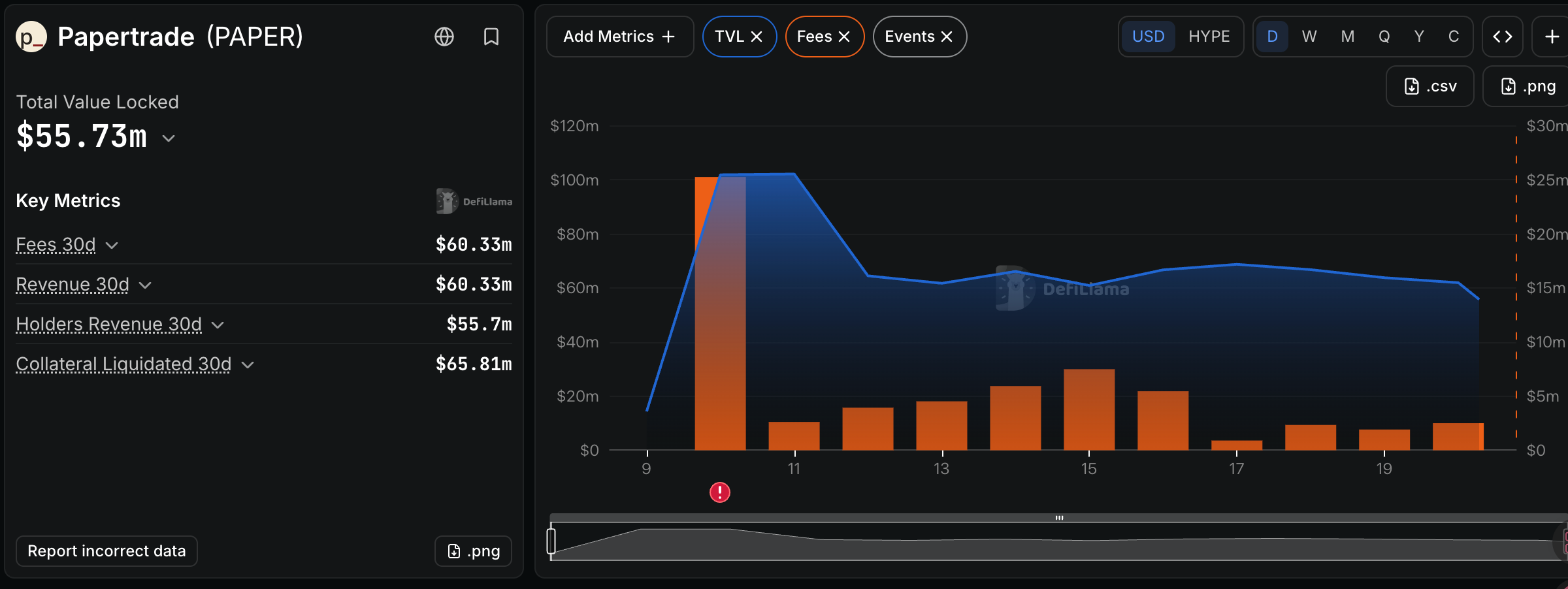
For users who have already incurred actual losses, this creates an extremely passive situation. Their previously central narrative was "high-premium exit," but now the premium has hit zero, and the remaining dividend rights face the pressure of long-term dilution.
Public data shows that among the top 25 high-loss players prior to the rule change, the vast majority remain in a net loss state even after factoring in current dividend rewards.
This reminds me of a classic saying: All final interpretations belong to us.
Airdrop hunters fear project pullbacks the most; projects and users are constantly engaged in dynamic offense and defense. But what they fear most is sudden rule changes, leaving them caught off guard.
Join TechFlow official community to stay tuned
Telegram:https://t.me/TechFlowDaily
X (Twitter):https://x.com/TechFlowPost
X (Twitter) EN:https://x.com/BlockFlow_News
 深潮TechFlow