Less than a day after launch, a wallet drained $1.28 million from Papertrade.
By Xiaobing
Eight hours after Papertrade launched, a single wallet demonstrated how to make money using it.
A Textbook Execution
First, what is Papertrade: a perpetual futures platform built on Hyperliquid, with its biggest selling point being 1000x leverage. Launched on October 10, it features no order book and no market makers; instead, a single USDC liquidity pool acts as the counterparty for everyone. When you go long, the pool goes short; when you profit, the money comes from the pool.
How is pricing determined? It directly reads the mid-price between the best bid and ask on Hyperliquid.
Keep these two points in mind: the pool passively accepts orders, and prices come from the outside. What happened next revolved entirely around these two factors.
Shortly after 6 PM that evening, an address bought roughly 6,060 ETH on the Hyperliquid spot market, pushing the price up by approximately $3. That's a gain of just 0.12%. Under any normal leverage level, this minor fluctuation wouldn't even cover the trading fees.
But Papertrade offers 1000x leverage. 0.12% multiplied by 1000 equals 120%. This address simultaneously held a long position on Papertrade, so the moment the price moved, their margin doubled.
An hour later, they reversed the same strategy: first opening a short position for 30 ETH on Papertrade at 660x leverage, with a notional value of $297 million. Then they rushed to Hyperliquid to dump roughly 6,590 ETH, crashing the price down.
The total trading fees spent on this maneuver on Hyperliquid were about $52,000. The amount withdrawn from Papertrade was $1.28 million. The return on investment ratio approached 1:25.
The Block traced the on-chain records for this address: it deposited approximately $1.2 million on the day and withdrew about $2.48 million. Looking further back, this address started trading on Hyperliquid in February 2025 with a starting capital of $2 million, accumulating $14.2 billion in volume, and netting $13.1 million in profits.
An experienced trader who had navigated Hyperliquid for nearly two years fully grasped its pricing mechanism on Papertrade's very first day of launch.
Why Did This Strategy Work?
Papertrade's design is actually quite straightforward: it aims to build a minimalist perpetual futures exchange. It strips away the order book, market makers, funding rates, and slippage, using a single pool to bet directly against every trader. The losers' losses fund the pool, while winners take money out of it, and losers also receive PAPER tokens as compensation. The platform calls this "turning liquidations into ownership."
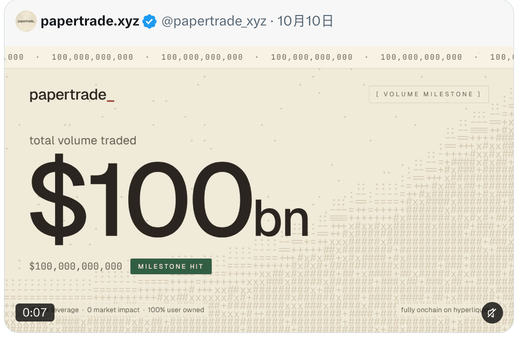
This model functions on one premise: most highly leveraged traders lose money. As long as more people lose than win, the pool grows, PAPER sees dividends, and the system keeps running. Reality confirms this; Papertrade reports that the pool currently holds $5 million and has already distributed $25 million in dividends to PAPER stakers. In just two days, TVL neared $70 million with over 10,000 active addresses. The market demand is real.
However, the model has a structural weakness: it does not control its own pricing.
In traditional exchanges, market makers see excessive exposure in one direction and proactively adjust quotes to price in the risk. Papertrade's pool doesn't do this. It takes orders at whatever price it reads, regardless of whether the counterparty is a retail trader with a $100 margin or a veteran executing a meticulously crafted $297 million notional position.
This is akin to running a casino where the odds are set by the establishment next door, and your gamblers can freely go next door to change them. As long as the cost to shift the odds is less than what they win at your venue, the business works.
$52,000 in costs versus $1.28 million in returns. Clearly, this business model is highly viable.
What Does the Platform Say?
Papertrade's response is that this isn't a flaw in the mechanism design, but rather that position limits were initially set too loosely during launch and are now being tightened.
This statement is correct, but only half of it. Tightening position limits certainly shrinks the profit margin of a single attack to an unviable point. But flip it around: if a platform marketed around 1000x leverage sees its actual usable positions constrained to tiny sizes by risk controls, how much practical value does that 1000x leverage really retain?
The more fundamental contradiction is this: Papertrade is not alone in facing this issue. As long as a platform's pricing relies externally, its counterparty is a passive pool, and its leverage is so high that even minor price fluctuations can trigger massive gains or losses, there will always be profit in moving prices.
Hyperliquid's own HLP liquidity pool has been taught a lesson by similar tactics at least twice. In March 2025, a whale manipulated ETH positions, causing HLP to lose about $4 million. In November of the same year, the POPCAT incident resulted in another $4.9 million loss. The pattern is identical: move prices at A, and reap profits at B.
Papertrade has simply layered another dimension onto this pattern: building on top of Hyperliquid and using its prices as its own quote means essentially setting up an even higher-leverage casino in a market already proven vulnerable to price manipulation.
Who Pays the Bill?
The DeFi derivatives sector is currently locked in a leverage arms race. At 50x, 100x, 500x, and 1000x, each new platform attempts to attract traders with higher multipliers and lower friction.
Traders have indeed been drawn in. But when leverage is pushed to its absolute limit, the risks of pricing and settlement ultimately fall squarely on the liquidity pool. In centralized exchanges, market makers, risk management teams, and insurance funds share these burdens; they are costs, but they ensure the system can withstand shocks. Papertrade stripped out all these intermediaries, giving traders an optimized experience at the expense of shifting the burden onto the pool's LPs.
"Turning liquidations into ownership" sounds appealing. But if the pool is continuously drained through targeted attacks, the ownership anchored by PAPER becomes tied to a constantly shrinking treasury.
The $1.28 million lost in this incident is not fatal to Papertrade; the platform is still operating and TVL continues to grow. However, the structural flaws exposed will not vanish simply by tweaking a few parameters.
Thousand-fold leverage sells thrill, but on the other side of that thrill lies fragility.
Join TechFlow official community to stay tuned
Telegram:https://t.me/TechFlowDaily
X (Twitter):https://x.com/TechFlowPost
X (Twitter) EN:https://x.com/BlockFlow_News
 深潮TechFlow