Galaxy Research Report: Implant Chips Discovered in Ledger Wallets During Distribution; Bitcoin’s ‘Most Secure’ Segment Faces Consecutive Breaches This Quarter
Author: Alex Thorn (Head of Galaxy Research)
Translated by: TechFlow
TechFlow Summary: In the recently concluded Q3 2026 and early Q4, the bitcoin-native infrastructure camp, traditionally known for its safety and conservatism, has suffered devastating blows consecutively. From the Coldcard firmware pseudo-random number vulnerability leading to over 1830 BTC stolen, to the Liquid sidechain bridge being used to mint 3998 fake L-BTC out of thin air and withdrawn worth $320 million, to Bitget losing $387.5 million due to a compromised third-party security vendor. And the latest breathtaking black swan that collapsed the self-custody defense line is the hardware poisoning incident exposed by CryptoBilis, Southeast Asia's officially authorized distributor for the hardware wallet leader Ledger: hackers implanted an independent secret-stealing flexible circuit board inside the device, directly reading the 24 seed phrases displayed on the screen and silently relaying them back via a pre-configured eSIM LTE network, perfectly bypassing Ledger's Secure Element security chip and official authenticity verification. Within one hour, 474 cold wallet addresses were drained of over $91 million. Head of Galaxy Research Alex Thorn authored a major research report deeply reviewing this supply chain poisoning attack, warning that in the AI era, attacks targeting hardware supply chains and code boundaries are evolving exponentially.

Event Timeline: Official Authorized Dealer Poisoning, Malicious Chip Eavesdrops on Seed Phrases
Hardware wallet giant Ledger is urgently investigating a massive asset theft case affecting Southeast Asian users. All victims purchased Ledger devices through CryptoBilis, which had previously been listed on Ledger's official website as an authorized dealer for Indonesia, Malaysia, and the Philippines.
On Friday, October 9, Ledger publicly disclosed for the first time that it has requested the distributor to suspend all device sales and shipments, and urgently urged any users who purchased devices from this channel within the past 90 days not to activate their devices; if already activated, funds must be immediately transferred to new secure devices initialized with brand-new seed phrases. The following day, Ledger officially confirmed that "one of the victim's devices contained an unauthorized hardware implant." Subsequently on Tuesday, Ledger further revealed the attack mechanism of this malicious hardware: a completely independent spy component was implanted inside the casing, which directly captured the 24 English seed phrases displayed on the screen during the user's initial power-on setup, and silently relayed them to hackers via cellular network (LTE) using a pre-configured eSIM chip with communication protocols!
What is extremely insidious is that the implant did not touch the core security chip (Secure Element) inside the device or Ledger's proprietary operating system at all. For this reason, when the tampered victim device connects to the official client, it still perfectly passes Ledger's official Genuine Check security verification! Independent hardware teardown teams discovered that this spy implant has been iterated through at least three generations, with the latest generation even using a professionally customized flex circuit hidden beneath the screen. Ledger emphasized that its official direct-sales channels and internal systems have not been breached, and all confirmed cases point to CryptoBilis, which has suspended all hardware sales.
On-Chain Data Review: 474 Addresses Targeted in Concentrated Raid, $91 Million Evaporates Instantly
Observing on blockchain explorers, this theft is by no means scattered isolated incidents, but a carefully planned and long-hidden "major harvest."
According to Galaxy Research statistics, a total of 474 victim addresses were completely drained, spanning Bitcoin, Ethereum, Arbitrum, Polygon, and TRON networks, with stolen funds amounting to at least approximately $91 million: TRON suffered the heaviest losses, with 146 TRON addresses looted of roughly $64.5 million worth of USDT and TRX; 279 Bitcoin addresses were raided for 213 BTC (worth approximately $17.6 million at the time); another 49 Ethereum-based addresses lost ETH and stablecoins worth $8.8 million. Including BNB Chain losses tracked by some on-chain monitoring agencies, the total amount involved reaches between $93 million and $95 million.
On-chain analysis shows that anomalies in Bitcoin quietly began probing as early as October 7, but up to 88% of the assets (approximately $80 million) were centrally emptied by hackers using automated scripts within a mere one-hour window starting at 05:00 UTC on October 9, a timeframe tightly coinciding with the morning Ledger released its official warning statement. The vast majority of victim Bitcoin addresses had never recorded any transfer or outgoing transactions prior to this, belonging to typical pure cold storage (Cold Storage), and most funds were deposited within the past 90 days; some addresses can even be traced back to 2021, which perfectly matches the operational characteristics of users restoring original seed phrases into tampered new devices.
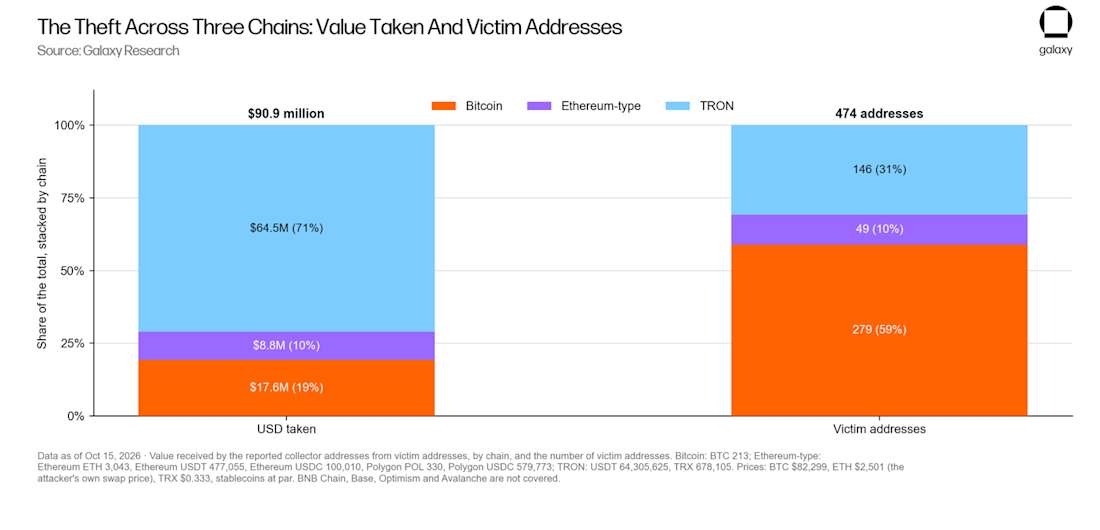
Figure 1: On-chain flow chart of stolen Ledger funds. Hackers centrally transferred $80 million in assets within a 1-hour window at 05:00 UTC on October 9, affecting 474 victim addresses across Bitcoin, Ethereum, TRON, etc.
Money Laundering Pathways and Current Fund Status: Tether Urgently Freezes Ten Million Dollars
As of October 15, approximately $56.6 million in stolen assets remained stagnant in the hacker-controlled central aggregation address: including 208 untouched BTC, approximately 12,800 ETH (mostly bridged from TRON), and 7.5 million USDT in TRON relay accounts created on the morning of the raid.
Among the transferred funds, approximately 5,400 ETH (roughly $13.5 million) has been washed through the mixer protocol Tornado Cash, while about $2 million flowed into centralized exchange deposit addresses. Notably, stablecoin issuer Tether has urgently assisted in freezing $10 million in USDT linked to this case in the hacker's address. In desperation, at least one victim has even called out to the hackers via on-chain transaction messages (OP_RETURN), begging that if the remaining assets are returned, they would offer a generous bounty commission.
Galaxy Deep Analysis: Nobody Attacks Private Key Mathematics, They Attack Everything Wrapping Around It
Two weeks ago, Thad Pinakiewicz sharply pointed out in a research report: in today's cryptographic world, nobody stupidly attacks the underlying mathematical algorithms of private keys anymore; hackers target those external links that issue instructions to mathematics. The Ledger distributor hardware poisoning case is precisely the most brutal echo of this proverb in the physical real world.
The security chip perfectly executed its core function, but the seed phrase was directly spied upon and broadcast from the screen by an extra chip that should not have existed. Galaxy Research believes this incident triggers three layers of profound reflections that demand vigilance:
Reflection One: Paradigm Shift in Network Vulnerability in the AI Era
Many in the industry currently enjoy debating whether artificial general intelligence (AI) will eventually crack elliptic curve cryptography (ECDSA) in the future. But we must soberly recognize that in the realistic threats of the near future, seeking purely mathematical breakthroughs is completely counterproductive.
Reviewing this quarter's painful losses, none of the attacks required overturning cryptographic mathematics: Coldcard's firmware build flaws, Liquid cross-chain bridge validation cache vulnerabilities, Bitget's reliance on compromised third-party security products, down to this physical hardware poisoning consisting of flex circuits and eSIMs. Although there is currently no evidence that these events directly utilized AI tools, AI is fundamentally altering the attack-and-defense economics surrounding everything around private keys.
Cutting-edge large language models can now efficiently mine real vulnerabilities from widely used open-source code and firmware, causing the time window from vulnerability introduction to hacker weaponization to collapse rapidly: Hacken statistics show that 77% of industry losses in Q3 were attributed to supplier and development tool flaws, disclosed but undeployed patches, and infrastructure blind spots outside audit scopes. Meanwhile, AI enables criminal syndicates to conduct full-process assembly line operations at extremely low costs: building highly realistic dealer e-commerce storefronts, deploying flawless AI live customer service, and setting up automated databases behind the scenes to collect hundreds or thousands of seed phrases while waiting for the harvest.
For builders and holders in the crypto industry, entirely new security assumptions must be established: every third-party dependency in your codebase, every physical link in your supply chain, is being continuously probed and penetrated by tireless opponents using automated tools 24/7. Defenders must rush ahead of hackers, turning the same automated review tools against their own code, firmware, and suppliers.
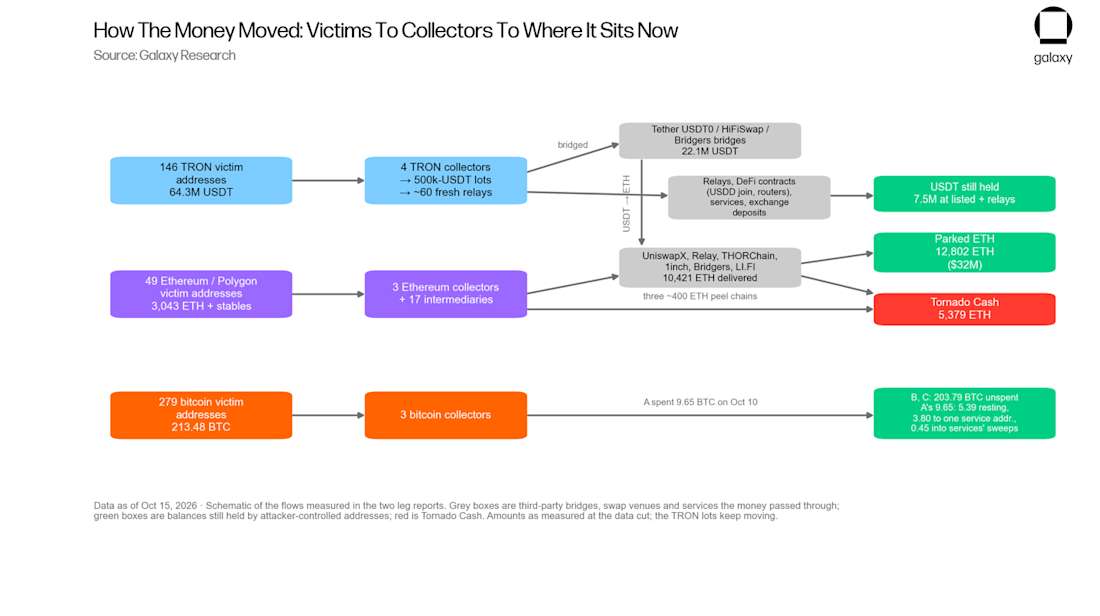
Figure 2: Panoramic view of major security event losses in Bitcoin-native infrastructure in Q3 2026. Covers Coldcard, Liquid bridge, Bitget, and Ledger distributor poisoning, with cumulative losses exceeding $1.1 billion.
Reflection Two: The Cruel Nature of Digital Bearer Assets and Self-Custody Discipline
This is the most brutal true face of digital bearer assets when self-custody defenses completely fail.
Precisely because Bitcoin possesses unmatched censorship resistance and confiscation-proof nature, once lost, it absolutely cannot be recovered by any force. You cannot complain to any central issuing institution, there are no credit card chargebacks, and no court ruling can forcibly transfer an on-chain UTXO. Among this plundered sum of $91 million, the only portion removed from the hacker's actual control is the $10 million in USDT urgently frozen by Tether using its admin private key. This detail cruelly reminds us again that USDT is fundamentally not a bearer asset, but a central liability with admin forced control rights. And those 208 BTC quietly resting in three Bitcoin addresses can be clearly watched by everyone on-chain, yet no one can touch them in the slightest.
In traditional banking, such a massive robbery would inevitably trigger thunderous lockdowns by multinational federal special task forces; whereas in the crypto world, the 474 victim addresses, mainly belonging to ordinary retail investors in Southeast Asia, could ultimately only helplessly write pleas for mercy in OP_RETURN transactions.
But this by no means negates the value of self-custody. Quite the opposite, it warns us: self-custody is absolutely not an item you casually buy off a shelf, but a set of daily operational discipline that must be strictly enforced. Hardware devices are merely one link in the entire trust chain; the logistics supply chain transporting it, the screen you trust with your naked eyes, your physical backups, and inheritance plans constitute other equally critical links. Please strictly adhere to the following red lines: firmly purchase only directly from official factory channels; any device received pre-opened or accompanied by pre-printed seed phrase cards must be immediately considered fully compromised; for critical assets unable to bear zero-loss exposure, private keys must be distributed across multi-signature or geographically dispersed environments featuring different brands and technical solutions, ensuring that a single hardware failure or a point-of-failure supplier disaster does not escalate into a fatal catastrophe.
Reflection Three: The Darkest Season for the Bitcoin-Native Conservative Ecosystem
The Ledger supply chain poisoning case draws a heavy period on the continuous blows suffered by the Bitcoin-native infrastructure camp over the past two and a half months:
• On July 30, Coinkite disclosed that Coldcard hardware firmware had a weak pseudo-random number generation vulnerability since 2021, resulting in over 9,000 addresses automatically drained, with cumulative theft exceeding 1,830 BTC (worth approximately $150 million at current prices).
• On September 6, a software flaw in the Liquid sidechain Elements allowed attackers to mint approximately 3,998 unbacked fake L-BTC out of thin air and cash out real Bitcoin, worth about $320 million at the time; after Blockstream patched the cross-chain bridge, the attacker claimed to return 3,400 BTC as a white hat, but withheld approximately 600 BTC as a so-called security bounty.
• On September 24, exchange Bitget suffered a massive loss of $387.5 million due to a penetration of a third-party security vendor's system, with the attack attributed to a North Korean hacker group; days later, NEAR Intents, which successfully intercepted the related money laundering funds, also faced a retaliatory $3.8 million hacker attack.
Statistics from CertiK and Hacken show that industry cumulative losses in Q3 reached $1.1 billion to $1.3 billion, followed closely by the Ledger incident in the first week of Q4. These shocking lists of victims are no longer unaudited shady DeFi smart contracts, but rather the most revered totem giants in self-custody like Coldcard and Ledger, along with the Liquid sidechain jointly operated by alliances of Bitcoin pioneer enterprises. In every disaster, the underlying cryptographic mathematics wavered not even slightly; all collapses occurred entirely in the gray areas of software engineering implementation, physical supply chains, or human operational maintenance.
The only glimmer of comfort lies in the significant progress of the industry's defense coordination mechanisms: within hours of the incident, on-chain data across the network completed precise tracking, Tether swiftly froze assets, NEAR Intents cut off the black money flow, and the Liquid attacker also refunded 85% of the funds through on-chain negotiations, a vast difference compared to the Mt. Gox era back then. Yet the lesson left for everyone this quarter remains profoundly heartbreaking: any blind optimism assuming that 'merely holding ground within Bitcoin-native infrastructure guarantees an absolute safe haven' has been ruthlessly shattered by cruel reality.
Bitcoin's underlying mathematics experienced a brilliant quarter; however, the human world wrapped outside of mathematics lost completely.
Join TechFlow official community to stay tuned
Telegram:https://t.me/TechFlowDaily
X (Twitter):https://x.com/TechFlowPost
X (Twitter) EN:https://x.com/BlockFlow_News
 @galaxyhq