Token Terminal Research Report: Asset Tokenization Won’t Wait for the U.S.: The Real Landscape and Hidden Winners Behind 90% Offshore Issuances
Author: Token Terminal
Compiled by: TechFlow
TechFlow Summary: The on-chain market capitalization of tokenized stocks has officially surpassed $3.7 billion, with approximately 95% tracking US-listed equities and ETFs. Astonishingly, over 90% of these tokenized US stocks are issued by offshore entities outside the United States. Regulatory hesitation has not hindered financial innovation; when one country says "no," capital and issuers quickly flow to jurisdictions that say "yes." By deconstructing four key dimensions—market cap, holder base, DeFi utilization, and on-chain trading volume—Token Terminal reveals the true distribution of power behind this global offshore tokenization frenzy, and highlights an unseen American winner, Alpaca, which quietly custodies 83.5% of the underlying stocks.
According to Token Terminal's latest tracking data, the total market capitalization of on-chain tokenized stocks has officially surpassed $3.7 billion, with approximately 95% of assets pegged to and tracking US-listed equities and core index ETFs.
However, virtually none of these assets are legally issued within the United States. Of the total tokenized stock market cap, issuing entities registered outside the US hold a dominating 90.4% share, spread across multiple overseas jurisdictions. This stark structure vividly demonstrates that issuers will always gravitate toward regions with the fastest market entry and least resistance. From our perspective, this means that regardless of how conservative regulators in any single country may be, the global tokenization of assets will inevitably accelerate. When one nation shuts its doors, financial innovation and capital flows will instantly migrate to those that open theirs.
Leveraging a new database detailing the registration locations of each issuing entity, we analyze in depth through the following five charts the true performance of tokenized stocks across (1) market cap distribution, (2) holder base, (3) DeFi utilization, and (4) secondary market trading volume, ultimately revealing the true invisible winners supporting the underlying operations of the entire ecosystem.
Market Cap Distribution by Issuance Jurisdiction: Offshore Regimes Take Full Dominance
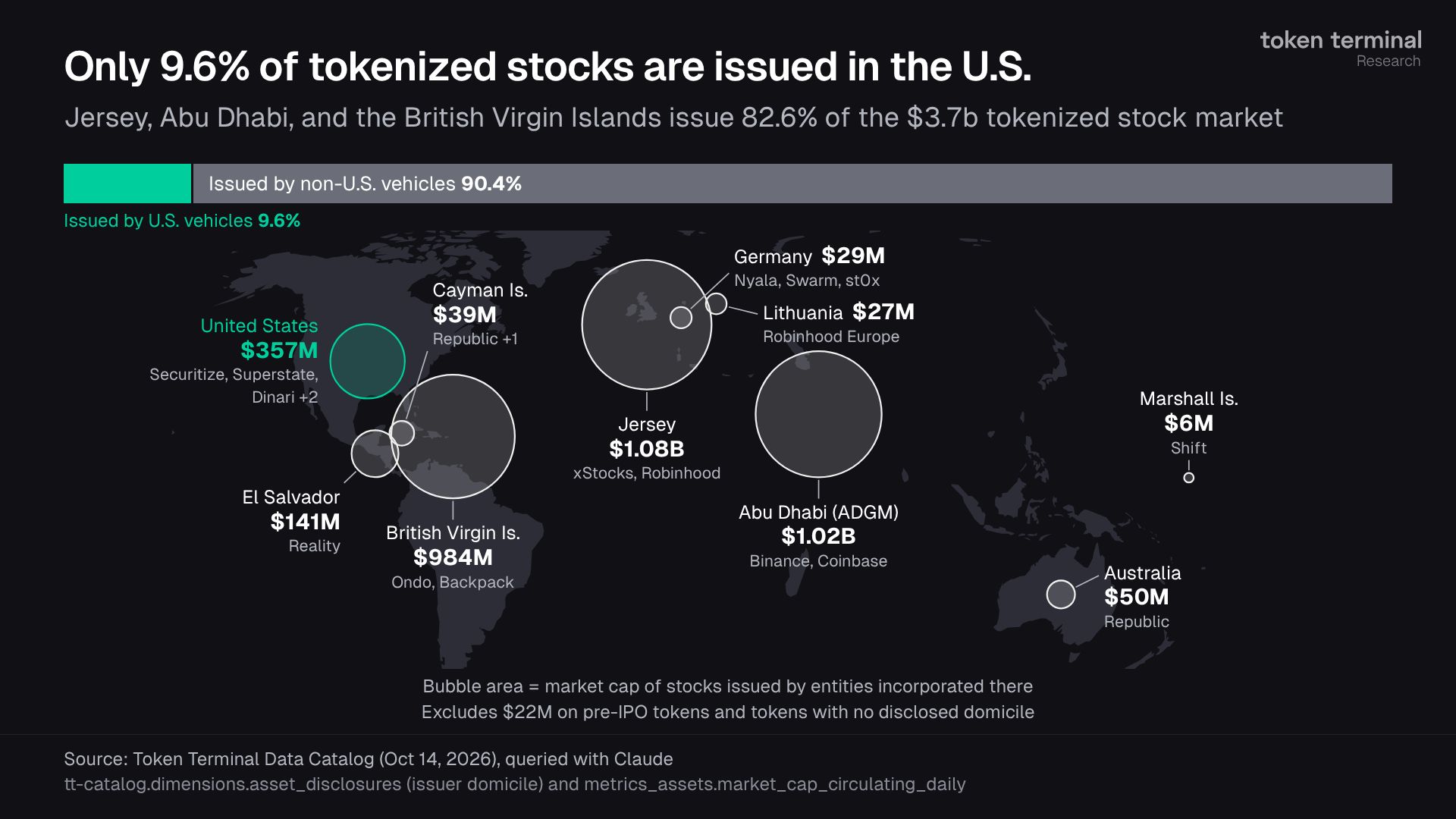
Chart: Share of tokenized stock market capitalization broken down by issuing entity registration location.
Within this $3.7 billion tokenized stock market, 90.4% is issued by offshore legal entities outside the United States. Jersey leads with a 28.9% share, followed closely by Abu Dhabi at 27.4%, and British Virgin Islands (BVI) ranks third with 26.3%.
In other words, the vast majority of on-chain exposure to US equities accessed by global investors comes from offshore issuers that explicitly refuse to directly serve US residents. Even US-based publicly traded companies like Coinbase and Robinhood opt to issue tokenized assets through offshore entities established abroad. Currently, no single overseas jurisdiction holds an absolute monopoly, meaning that even if one country suddenly imposes a ban, issuance demand will simply shift to other friendly jurisdictions, making it impossible to halt the robust growth of the entire sector.
Holder Structure: 5 Million On-Chain Holders Flock to Offshore Tokens
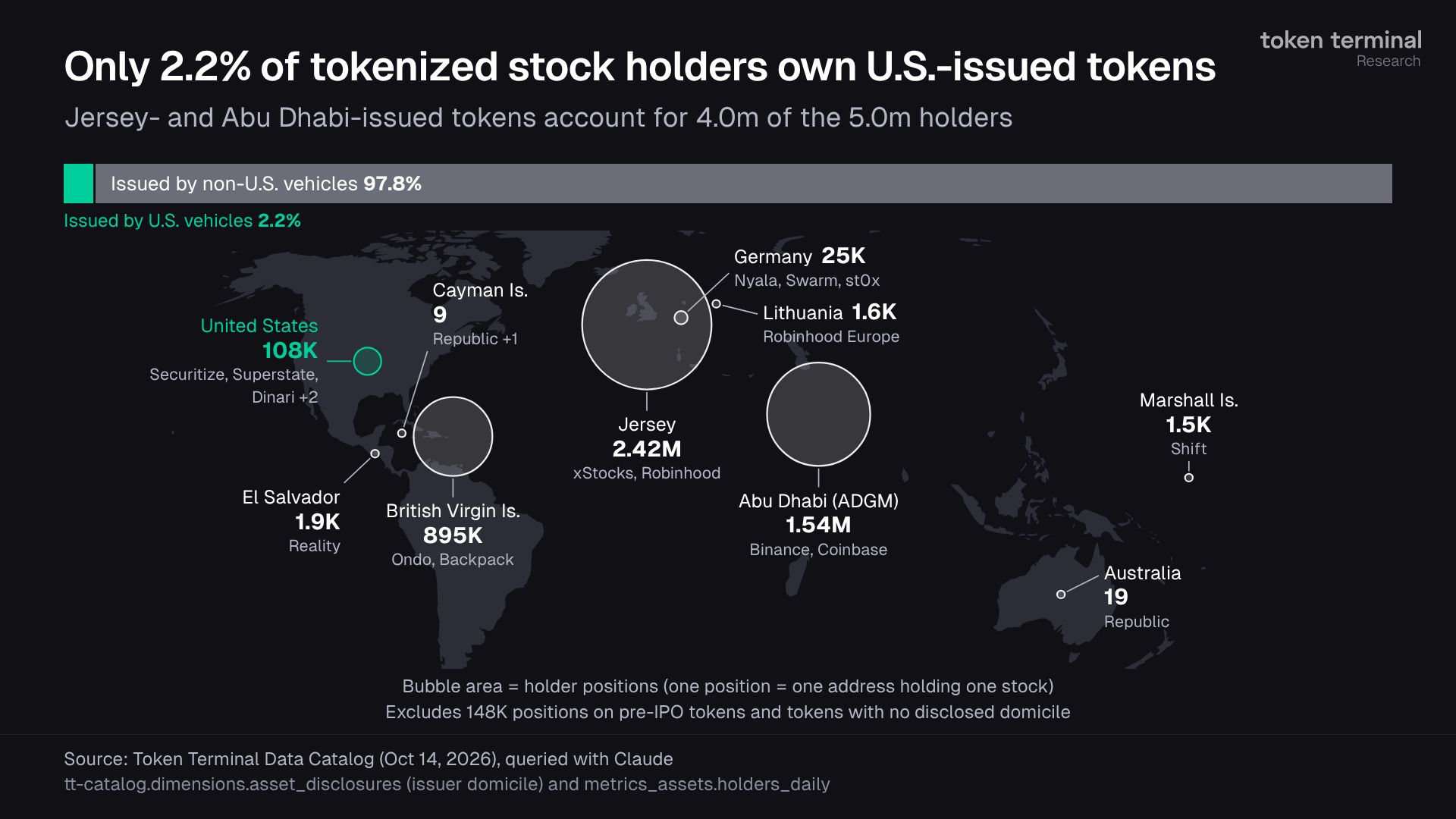
Chart: Comparison of tokenized stock holder counts by issuing entity registration location.
Among the network-wide 5 million tokenized stock holders, assets issued by offshore entities attract a massive 97.8% of users, while holders of tokens issued within the US account for a mere 2.2%.
Specifically, Jersey-based issuer xStocks and Robinhood's platform collectively hold 2.4 million holders; Abu Dhabi's Binance bStocks and Coinbase ecosystem hosts 1.5 million holders; and BVI-based Ondo and Backpack have accumulated 894,700 holders, demonstrating characteristics of larger average holdings but more concentrated per-user positions. The global retail demand for 24/7 trading of tokenized US stocks is enormous, and the offshore issuance ecosystem serves as the sole backbone absorbing this massive demand.
DeFi Utilization: Offshore Assets Lead the Charge in Activating Yield Flywheels
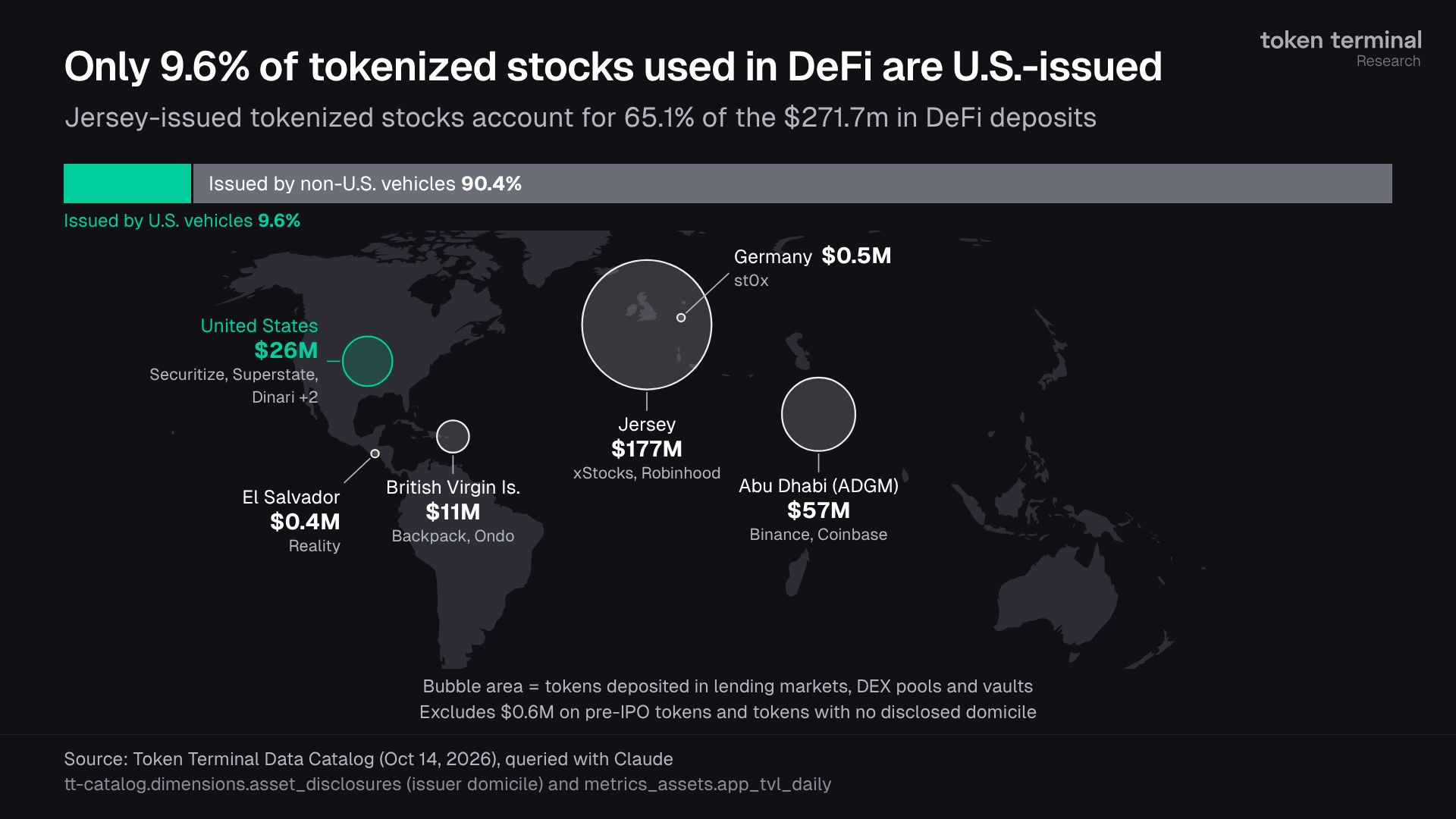
Chart: Distribution of tokenized stocks deposited into lending markets, yield vaults, and DEX liquidity pools.
Of the $271.7 million in assets deposited into DeFi lending markets, yield vaults, and decentralized exchange (DEX) pools, offshore tokens account for a 90.4% share.
Tokenized stocks issued by Jersey-based entities xStocks and Robinhood jointly contributed $176.9 million in DeFi deposits, representing a striking 65.1%. In sharp contrast, Ondo, the largest issuer registered in the BVI (with a tokenized market cap reaching $951 million), currently holds only about $3 million in DeFi. This clearly proves that merely possessing a large market capitalization does not equate to deep DeFi integration. The pioneers who first transformed tokenized US stocks from dormant assets into highly efficient, yield-bearing, and collateralizable productive assets all emerged from innovative soil outside the United States.
On-Chain Trading Activity: 99.3% of Volume Belongs to Offshore Assets
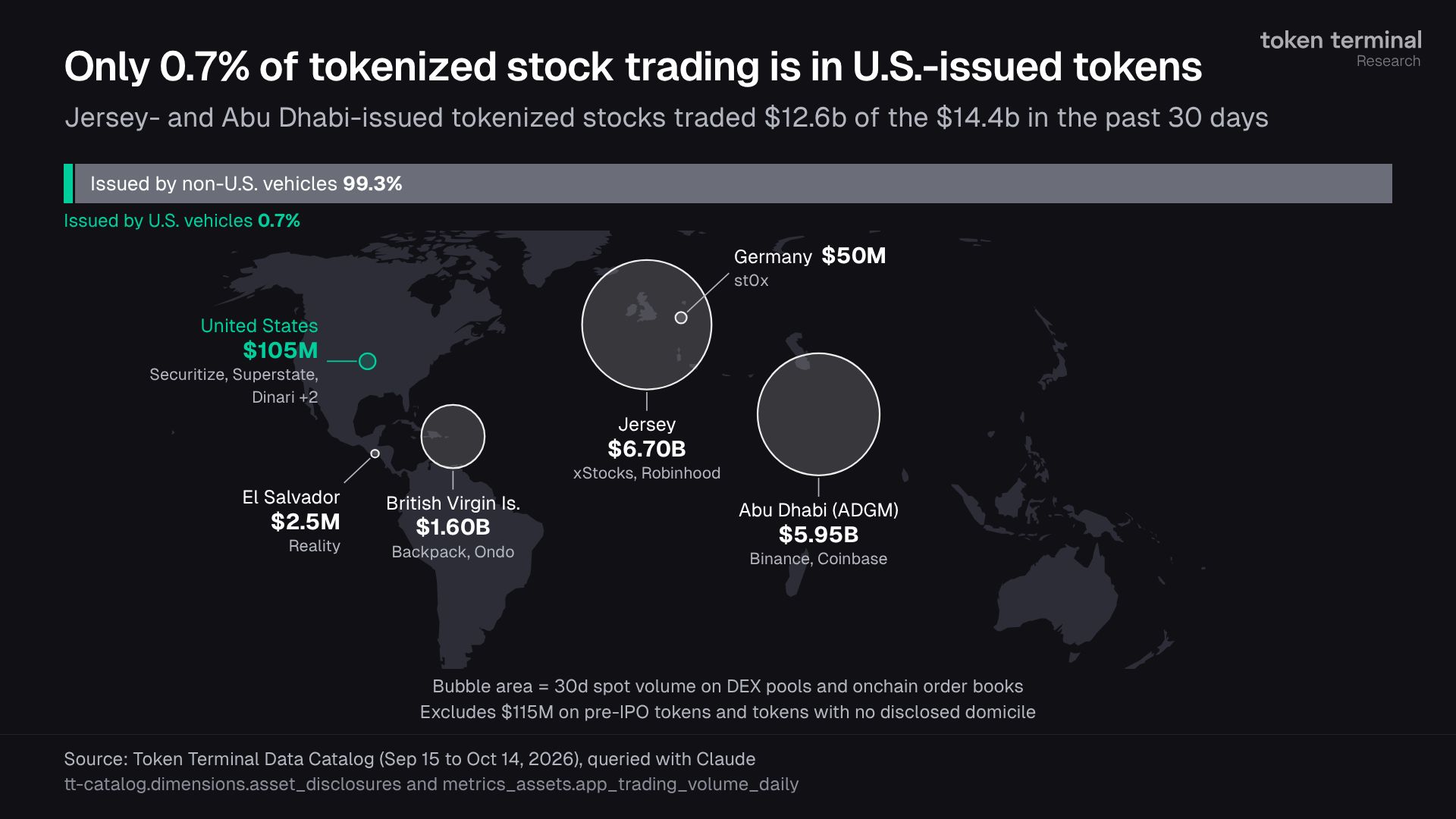
Chart: On-chain trading volume distribution for tokenized stocks over the past 30 days. Offshore tokens hold an overwhelmingly dominant position.
Over the past 30 days, of the $14.4 billion in on-chain trading volume recorded for tokenized stocks, transactions involving offshore-issued assets accounted for a staggering 99.3%.
Jersey-based entities (xStocks and Robinhood) drove $6.7 billion in volume, while Abu Dhabi-based entities (Binance bStocks and Coinbase) contributed $6 billion. By comparison, tokens issued domestically in the US generated only $104.5 million in trades over the past month, a figure drastically mismatched with their 9.6% market cap share. If you are matching trades for any tokenized US stock on-chain today, you are interacting almost 100% with offshore-issued tokens.
The True Invisible Winner: Alpaca, Custodying 83.5% of Underlying US Equities

Chart: As a core licensed broker, Alpaca custodies 83.5% of the underlying physical stocks across the network.
Beneath this seemingly offshore-dominated wave lies an astonishing fact: for 83.5% of the total network tokenized stock market cap, the actual underlying equities are physically custodied by the same US-licensed broker, Alpaca.
Whether it's Ondo, xStocks, Binance bStocks, Robinhood, Coinbase, or Reality, although they are registered in four different countries and follow diverse foreign legal and regulatory frameworks, in terms of backend architecture, they have all unequivocally selected US-licensed broker-dealer Alpaca as the underlying custodian for physical stocks.
This means that while the issuance, holding, and trading of the vast majority of tokenized stocks indeed occur offshore and on-chain, the corresponding real equity assets remain quietly sitting in the vaults of the US regulated financial system. Alpaca has become the largest invisible winner in the tokenized stock wave to date. At the same time, this highlights the current market's over-concentration risk, leaving ample room for competition among emerging custody providers in the future.
However, this fragmented landscape may be approaching a turning point. The recent signal of an "Innovation Exemption" released by the US SEC indicates that domestic regulators are probing the waters for tokenized stocks. Once domestic regulations ease, issuance activity could rapidly flow back to the United States, just as it initially went overseas. Asset tokenization always obeys the iron law of flowing toward the deepest liquidity markets, and the on-chain reconstruction of global financial infrastructure has only just begun.
Join TechFlow official community to stay tuned
Telegram:https://t.me/TechFlowDaily
X (Twitter):https://x.com/TechFlowPost
X (Twitter) EN:https://x.com/BlockFlow_News
 Token Terminal