Galaxy Research Report: The Next Stop for Prediction Markets Is Conditional Markets, 22 DAOs Have Entrusted $50.5 Million to Market Governance
Author: Zack Pokorny
Compiled by: TechFlow
TechFlow Editorial Note: Polymarket and Kalshi have demonstrated the demand for "pricing events." Galaxy's report asks about the next step: rather than merely betting on whether an event occurs, traders can now trade how much an asset will be worth post-event. Decision markets have expanded beyond MetaDAO into Solana and EVM ecosystems, while impact markets are seeing projects like Proof and If Market racing toward mainnet launches this year. Despite a still-small scale and most products remaining in testing, the resurgence of on-chain options volume and execution of bespoke "hedge anything" trades indicate that the next wave of demand for derivatives need not be confined to perpetual contracts.
Decision markets are expanding, impact markets are nearing mainnet deployment, and new infrastructure is pushing event-driven finance beyond traditional prediction markets.
Introduction
Over the past 18 months, Galaxy Research has conducted extensive research on prediction markets and their derivative forms: decision markets and impact markets. We have discussed the applicability of decision markets to decentralized autonomous organization (DAO) governance, explored their potential as cold-start mechanisms for early-stage crypto projects, considered using prediction and impact markets as hedging tools, and analyzed Hyperliquid's HIP-4 result markets.
A common thread running through these studies is that prediction markets are merely a "version 0.0" of event-driven markets and hedging tools, while broader experiments led by decision and impact markets are flourishing behind the scenes. At the time, except for a few outliers like MetaDAO, most of this field existed only as ideas shared in X posts and whitepapers. Now, the landscape is shifting: multiple projects are entering testing phases, and a new generation of experiments is rolling out.
The following sections outline the current progress in this sector, who is building it, and where the intellectual discourse and experiments spawned by this movement are heading.
Why Conditional Markets?
Prior to this, we discussed impact markets and decision markets as two distinct concepts. It is more appropriate today to view them as subsets of a broader category we term "conditional markets." Their market mechanisms function identically: conditional trades are listed and only settle upon the realization of a specific outcome. The key distinction lies in decision markets also settling a binding outcome (for example: if the price in the conditional market exceeds the spot price by more than 5%, the management team adds a specific protocol feature). Given the identical mechanics and the impending expansion of event-driven markets and hedging instruments, categorizing them together makes the most sense.
Beyond definitions, conditional markets as event-driven markets and hedging tools possess several characteristics that differentiate them from prediction markets. We elaborated on these in our previous reports; a few key distinctions include:
Transcending the binary "all-or-nothing" attribute of prediction markets.
Enabling participants to trade real assets and their prices, rather than probability-based synthetic underlyings.
As a byproduct of information, it outputs the impact of future events on asset valuations, rather than the probability of an event occurring.
These features (along with others mentioned in linked reports) open up possibilities fundamentally unattainable by prediction markets, across hedging, payoff structures, and market signaling.
What is the Current Progress of Conditional Markets?
Since our last study, both decision and impact markets have made substantial progress. The following sections detail the current status of each, the projects building at the market and infrastructure layers, and the experiments taking shape around them.
Decision Markets
In September, Umia, an ownership token issuance platform for Ethereum Virtual Machine (EVM)-compatible chains, went live, thereby expanding the design space for decision markets. Previously, decision markets were largely confined to MetaDAO on Solana, which pioneered the concept and served as the first scaled implementation.
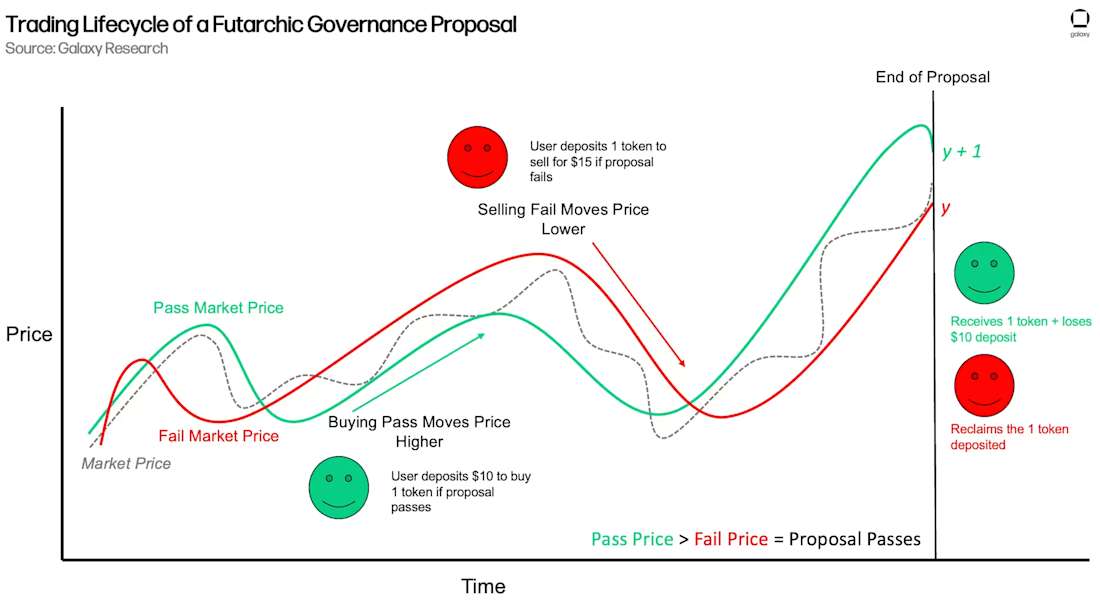
To date, decision markets have been binary: traded proposals are either approved or rejected. Proposers first solicit community feedback, draft a proposal, and then launch the market. While this allows decisions to be traded via the market, friction arises from social dynamics inherent in the drafting process and from fixing all variables within a single proposal (e.g., raising the monthly burn rate from $50k to $65k, or swapping 50% of the DAO treasury for yield-bearing stablecoins). Traders must judge based on fixed parameters, even if they agree with the general direction but not the specifics (e.g., a trader might believe monthly spending should increase, but only to $60k; or think the DAO should move treasury funds, but cap it at 30%). Consequently, optimal outcomes rely on social filtering, may require repeated proposals to emerge, or might never get priced and traded at all.
The figure below illustrates what such markets look like at a macro level.
With Umia's launch, we now have multi-outcome decision markets: traders can make decisions on specific parameters of a proposal (e.g., should spending increase from $50k to $55k, $60k, or higher?). This allows traders to align with the proposal's direction while expressing views on specific details. As a result, traders are pricing individual parameters rather than a fixed proposal, keeping the proposal's scope broader. Because traders price single parameters instead of a monolithic proposal, this design reduces reliance on social filtering typical of binary "pass/fail" decision markets, converging on an "optimal" outcome before deployment. Multi-outcome markets no longer depend on drafters socially filtering the "correct" version before listing; instead, this filtering happens through price discovery. In practice, decisions can be priced more accurately and efficiently. Markets naturally surface the specific parameters truly supported by the community, rather than forcing everyone to judge a parameter arbitrarily written into a proposal and bet on whether the market agrees with it.
The figure below shows what these markets look like at a macro level. They are fundamentally similar to binary-outcome decision markets, except with multiple tradable markets.
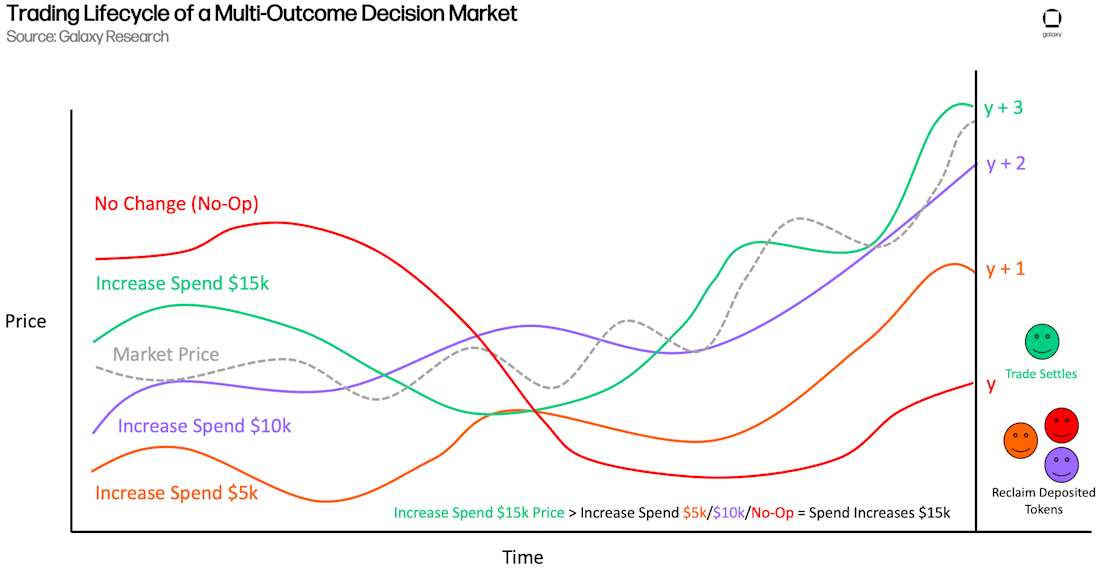
A challenge faced by multi-outcome markets is potential liquidity fragmentation, as the number of tradable markets scales linearly with the number of possible proposal outcomes. Umia's design avoids requiring traders to split capital across every market. Instead, it allows a single deposit (stablecoin or DAO token) to simultaneously convert into corresponding positions across all outcomes (e.g., a $5 USDC deposit can simultaneously trade across "spending increases by $5k," "$10k," "$15k," and "unchanged"). This works because these markets are mutually conditional, meaning only trades in the winning market will ultimately settle. Thus, trader capital can exist everywhere simultaneously without facing loss risk in more than one place. Practically, a single deposit covers the entire outcome space, enabling traders to build positions on every possible parameter without pre-betting on which will pass. This is the key to maintaining liquidity in multi-outcome markets. Since one deposit can trade across each market, adding more outcomes does not dilute capital, and market depth does not thin out as the number of markets grows.
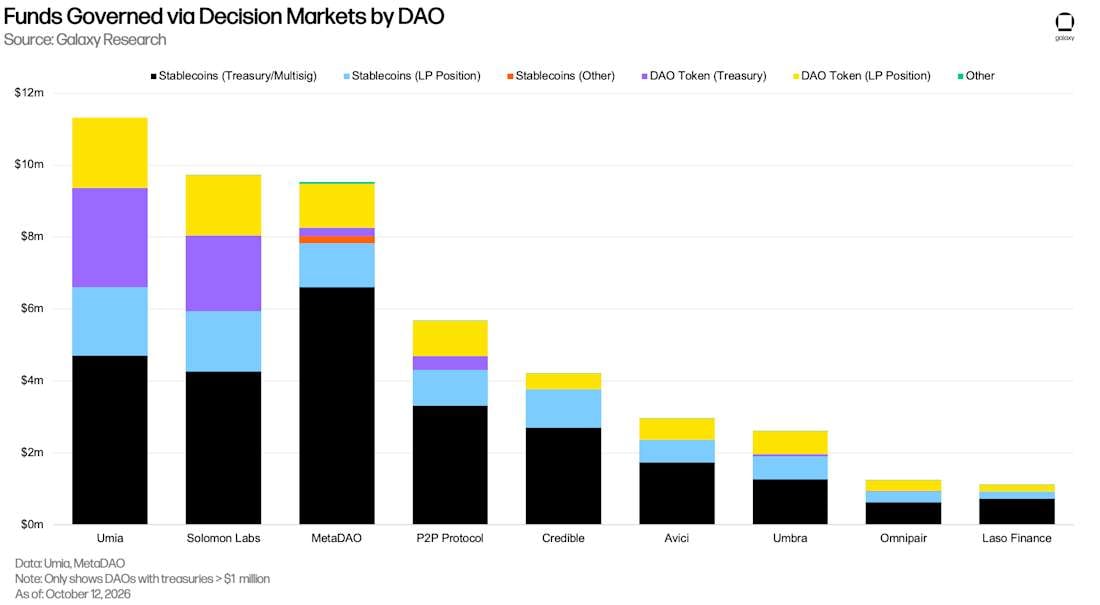
Currently, decision markets manage a total value of $50.5 million across 22 DAOs. This figure includes stablecoins and tokens held in DAO treasuries governed entirely by decision markets (e.g., DAO tokens held on balance sheets, liquidity provider positions, and all other tokens held by the DAO). The MetaDAO ecosystem controls the majority of assets in market-governed treasuries: operating in 21 of the 22 DAOs using decision markets, representing 78% of the total assets in market-governed treasuries. While $50 million sounds modest, MetaDAO's market-governed DAO issuance platform only completed its initial fundraising 11 months ago.
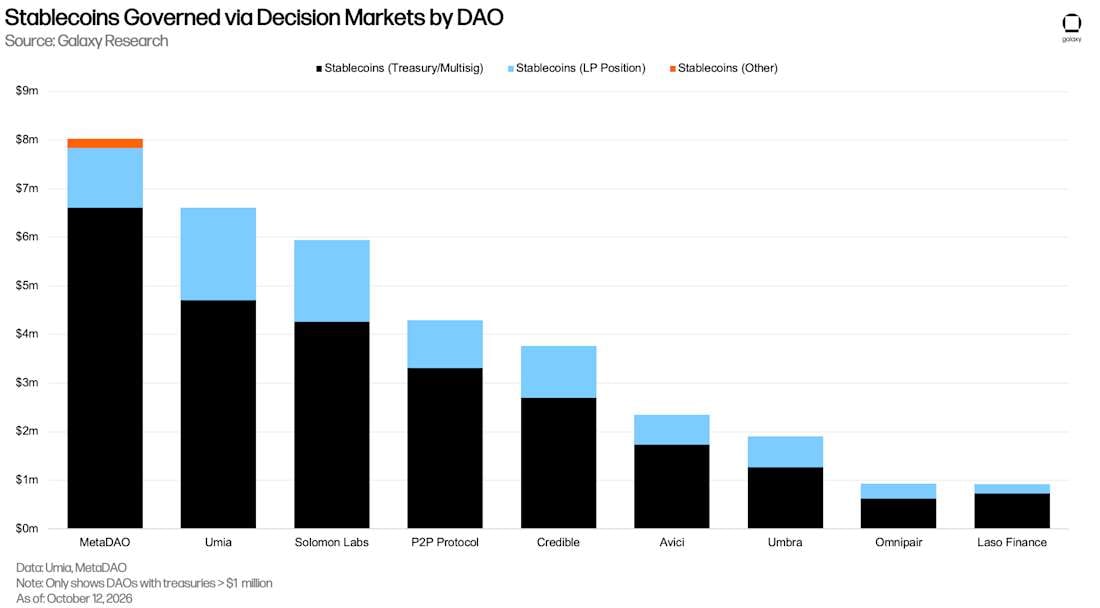
If looking strictly at the stablecoin portion of these DAOs' balance sheets, the value managed by decision markets stands at $35.8 million. This is a critical metric to track, as it represents the liquidation value of these organizations should investors choose to withdraw funds. Similar to overall market-governed treasury assets, the MetaDAO ecosystem controls the vast majority of the stablecoin value managed by decision markets, accounting for 82%.
Umia's launch brings unprecedented competition to the decision market sector. This is crucial for growth and adoption for two reasons: it helps expand the asset size of market-governed treasuries, and broadens the range of chains available to decision-market-based organizations.
Expanding the asset size of market-governed treasuries is arguably the sector's most important KPI, as the value of assets managed by decision markets determines the economic stakes involved in any proposal, and stake size is what draws volume to the market. A proposal built around a small treasury or low market-cap token will have minimal dollar-value impact even if passed, leaving traders with little incentive or capacity to allocate significant capital to price it. As the scale of managed assets grows, the value impact of comparable decisions increases, allowing the market to accommodate larger positions and attract more capital and sophisticated traders competing to price accurately. As multiple projects issue decision-market DAOs instead of relying on a single incumbent, more organizations will run proposals through this mechanism at any given time, increasing total volume even if individual markets haven't grown yet.
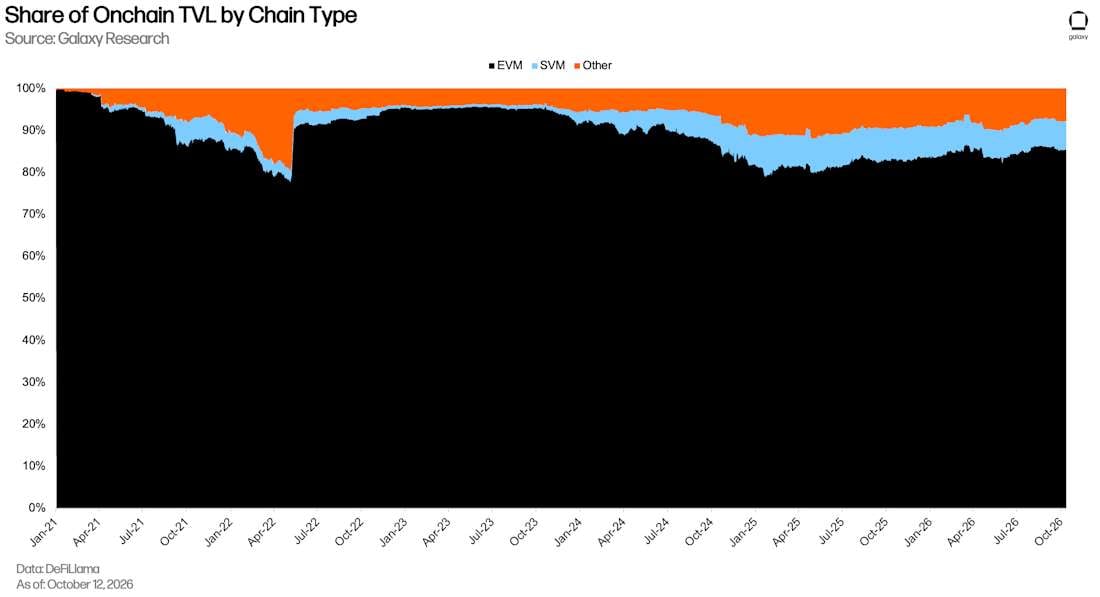
Competition also expands the chains these organizations can choose from. Previously, decision markets were effectively limited to Solana because MetaDAO was the only project issuing tokens best suited for decision markets—a "target function effectiveness" issue we outlined previously. With Umia's launch, projects can now issue decision-market DAOs with viable tokens on either Solana or EVMs. Together, these chains account for roughly 92% of Total Value Locked (TVL) by chain type, significantly broadening the potential market for this design.
Impact Markets
Since our earlier research, impact markets have made substantial progress: several projects are completing testing and moving toward mainnet, while new players are entering at both the market and infrastructure layers. Teams are employing distinctly different design approaches and operating at various tech stack layers, ranging from standalone markets to the underlying infrastructure supporting them. Soon, we should see tradable products launching on mainnet applications.
It is increasingly clear that competition in this niche will intensify over the next year. Understanding what projects need to win as competition heats up clarifies why these markets are useful in the first place, starting with traders. The information these markets generate is valuable, but it is a byproduct of a healthy market, not the product itself. What is sold to traders is exposure; exchanges must be built around "giving users a genuine reason to take, hold, and hedge risk," because those behaviors generate the volume information relies on. This means determining winners must be trader-centric: liquidity must be high enough that odds command the same authority mainstream media now affords Polymarket and Kalshi; exposures must be sufficiently robust; leverage must compete with perpetual contracts. Conditional markets do not exist in isolation. Their relationship with underlying perpetual contract markets and prediction markets is vital to overall health, making hedging and arbitrage between them practical and cost-effective. Finally, markets require short tenors and fast turnover, aligning closer to the rapid pace of prediction markets, to match traders' attention cycles.
Below are profiles of several projects building impact markets.
Lightcone was the first team to publicly articulate the impact market product as it is known today, announcing the project in October 2025, followed by other teams. Lightcone also coined the term "impact market," effectively naming the category. The project is currently in testing and aims for a public mainnet launch by year-end.
Proof takes a vertically integrated approach, building a full-stack exchange on its own infrastructure. The team has experience building and operating derivatives exchanges, maintains a heavy trader focus, and designs decisions revolve around supporting liquidity and providing attractive exposure. The figure below illustrates Proof's vertical integration design across conditional markets, perpetual contracts, and prediction markets (which it calls "binaries").
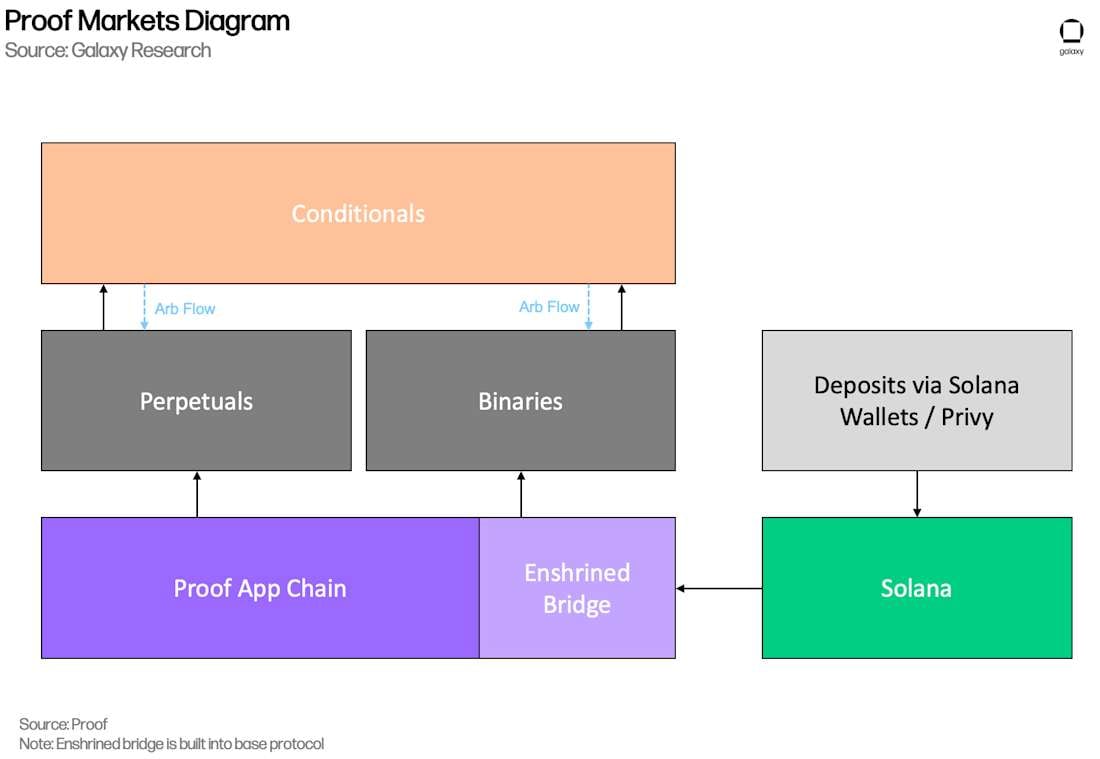
Founded this year, Proof has launched its application chain testnet and a v0 exchange version, hosting a trading contest that attracted approximately 500 traders to test the market design. The team targets a gated mainnet launch in the next one to two months (around November 2026). Capital efficiency and relationships between primitives are core to Proof's design. Its margin framework supports leveraged netting between perpetual contract and conditional markets. This serves three purposes:
Allow traders to gain more efficient exposure on single positions;
Enable market makers to efficiently hedge conditional exposures using underlying perpetual contracts;
Facilitate capital-efficient direct arbitrage between conditional markets, perpetual contracts, and prediction markets (critical for pricing and market health, and potentially a catalyst as it connects traffic from previously siloed markets).
Proof is also building its own perpetual contract exchange rather than layering conditional markets on third-party infrastructure. This is necessary to achieve margin netting between conditional markets and underlying assets. Since conditional markets are built atop this base exchange, execution quality at the base directly dictates how much liquidity and pricing quality the conditional layer can support.
At a macro level, Proof argues that a well-executed exchange can capture arbitrage flow from both prediction markets and perpetual contracts against the same base liquidity. This matters because shared liquidity deepens markets, narrows spreads, and makes resulting exposures more attractive to traders. Proof further believes this unified design can overcome liquidity constraints that historically limit event markets, promising deeper prediction market exposure in categories beyond sports and elections.
The rationale for vertically integrating these primitives lies in the fact that markets do not exist in isolation. For conditional markets to become an attractive product, peripheral components—base perpetual liquidity, margins, execution, settlement, and arbitrage pathways—must operate as a unified system.
If Market adopts a different design than Proof. Rather than offering an on-chain solution, it provides exposure through synthetic, cash-settled positions. Users deposit stablecoins, and positions settle in cash at settlement based on the underlying asset's spot price. Nothing is tokenized or custodied throughout the process. The team cites two reasons for this approach, relating to product demand and user experience (UX): there may be limited natural interest in holding tokenized versions of market underlying assets; and for a product designed to price event impacts rather than custody assets, a pure cash-settlement model delivers a simpler UX.
Every market on the platform is organized around a common event (e.g., "Will the Fed cut rates at the next FOMC meeting?"). Sub-markets represent different framings of this event (e.g., prices for Brent crude, gold, or Microsoft stock depending on whether the event occurs or not). Each market splits into YES and NO "verses," each containing its own complete set of asset-specific order books, while all assets in that market share a prediction market order book. This prediction market serves two purposes: obviously, to price the probability of the event itself; and second, to absorb locked-in P&L when traders close impact market positions prior to settlement, converting it into prediction market tokens that traders can sell immediately or hold until settlement. At settlement, positions in losing verses receive full refunds of deposited margin.
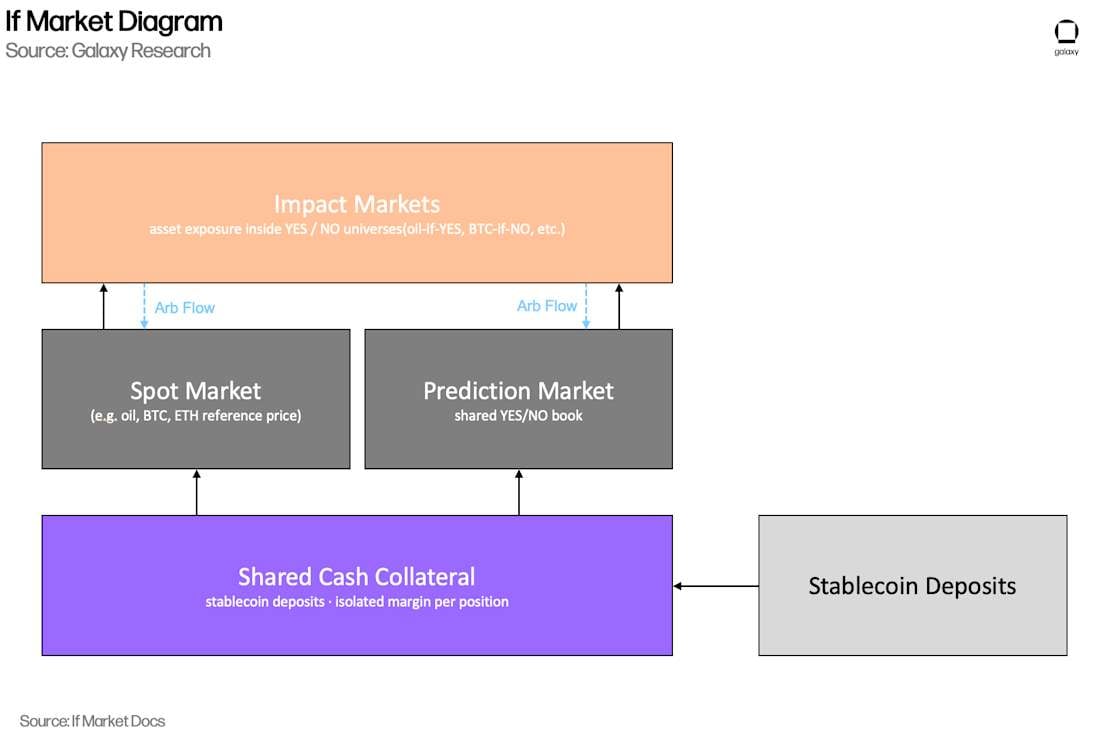
Leverage functionality rolled out on the platform in September. Positions use cross-margin on a per-trade basis, with tiered position limits based on notional value. Some markets offer up to 10x leverage. Unlike perpetual designs, If Market has no funding rates, instead anchoring conditional prices near spot via arbitrage, managing this risk through position limits rather than funneling prices toward oracles. Liquidation mark prices use the time-weighted average price of the order book rather than single trade prices. Settlement prices come from outlier-filtered external data sources; where market rules specify, a short TWAP window is applied, making it harder to manipulate settlement near expected dates.
The product remains in testing, but the platform's inaugural trading contest concluded on September 30, attracting over 2,000 traders and executing more than 6 million orders.
Beyond exchange and market-level developments, infrastructure for impact markets is beginning to take shape.
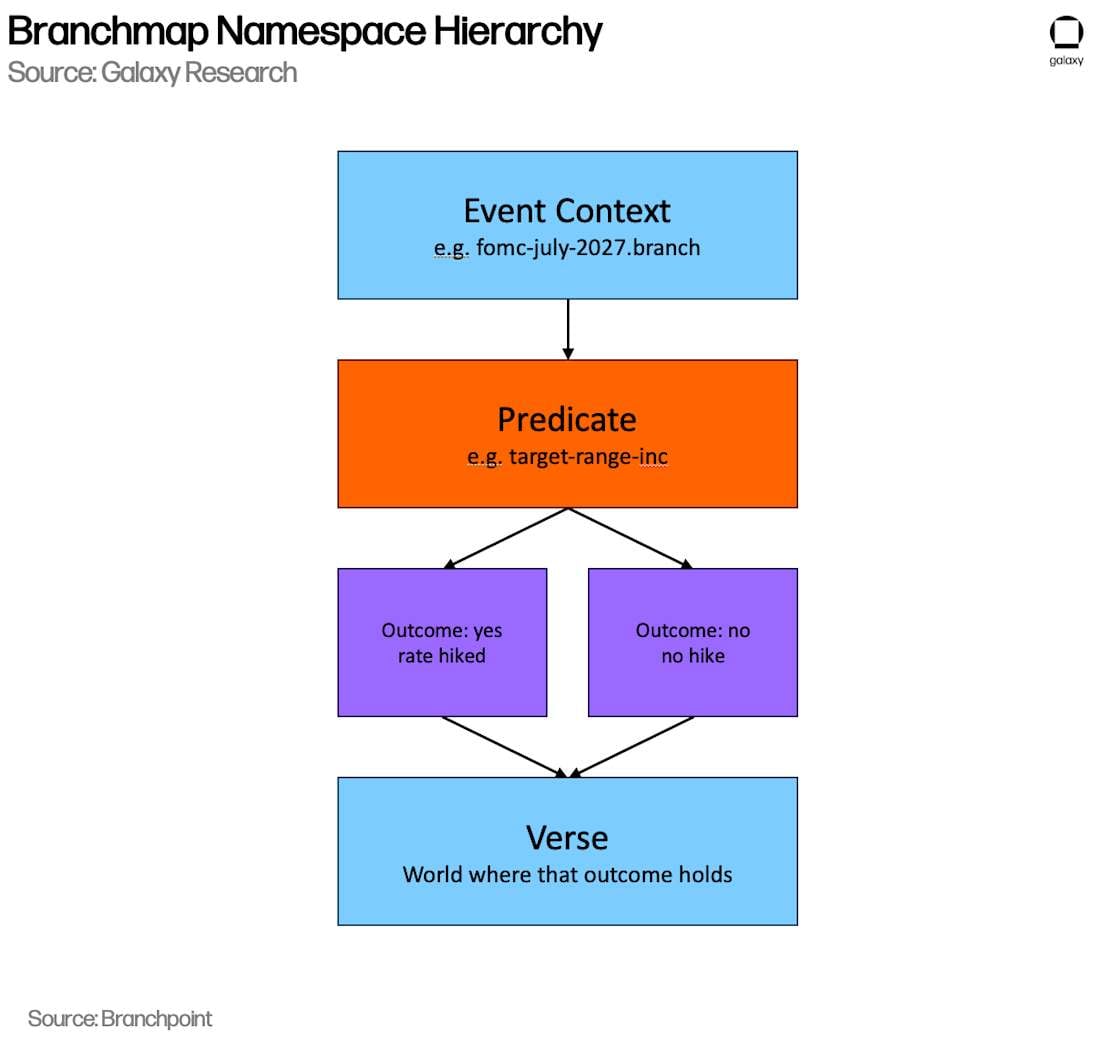
Branchpoint is building Branchmap, a semantic namespace layer aimed at "multiverse finance" (a term originally coined by Paradigm research partner Dave White), with impact markets being just one supported application. Rather than building an exchange first, Branchmap positions itself as shared infrastructure, granting stable, machine-readable identities to events, predicates, and outcomes on-chain. This allows prediction markets, DEXs, lending protocols, and any other on-chain apps to reference the same underlying event data and compose around it. For example, a single registered event, such as whether the Fed will raise rates at a specific FOMC meeting, could simultaneously feed a prediction market pricing the rate hike probability, a DEX listing conditionally paid BTC based on that outcome, and a lending protocol accepting this conditional BTC as collateral, without each protocol needing to independently define or verify the event and settlement logic.
The figure below illustrates the structure of this namespace. It provides an event context (e.g., Fed interest rate decision) containing a predicate (e.g., will the target rate be raised?), which in turn generates named result entries for every possible outcome. A combination of selected results across one or more predicates defines a "verse"—the financial world in which conditional assets exist, though the verse itself is not a persisted namespace entry.
The core idea is that prediction markets already act as pricing units for specific outcomes: a binary contract paying $1 when an event settles in a certain way is economically equivalent to holding $1 in the universe where that outcome occurs. Branchmap builds on this by allowing any asset to be split into multiple versions conditioned on each possible outcome of an event, then merged back together after settlement. The figure below demonstrates this mechanism: a root asset splits into verse-conditioned copies for each result of a predicate, and after predicate settlement, surviving branches merge back into standard unconditional assets.
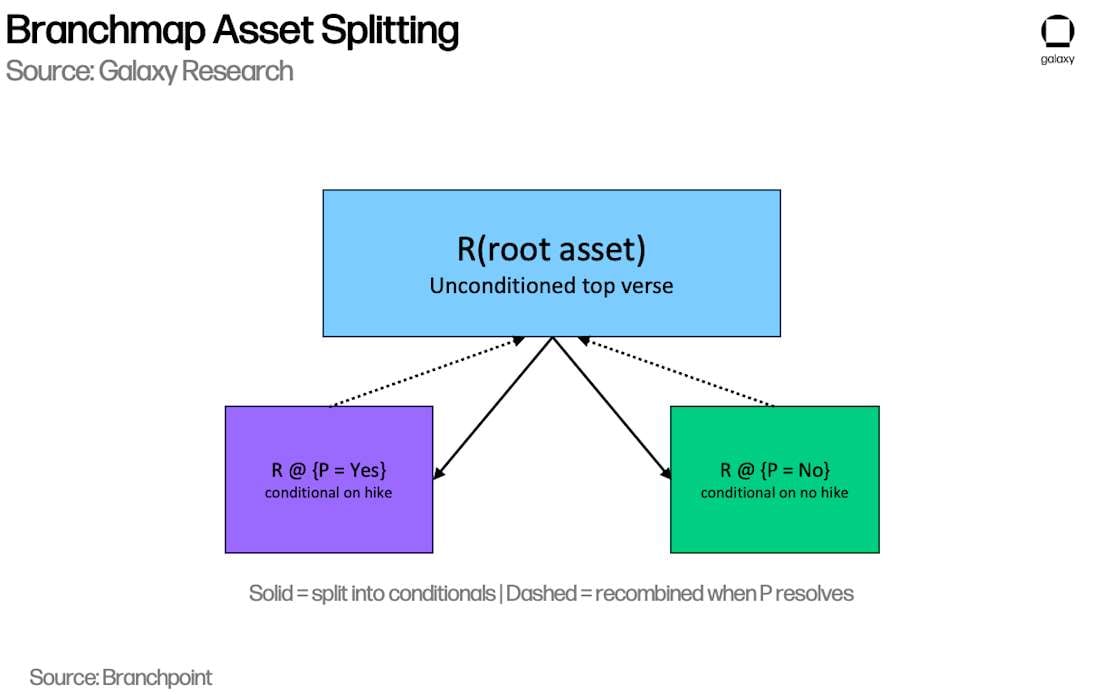
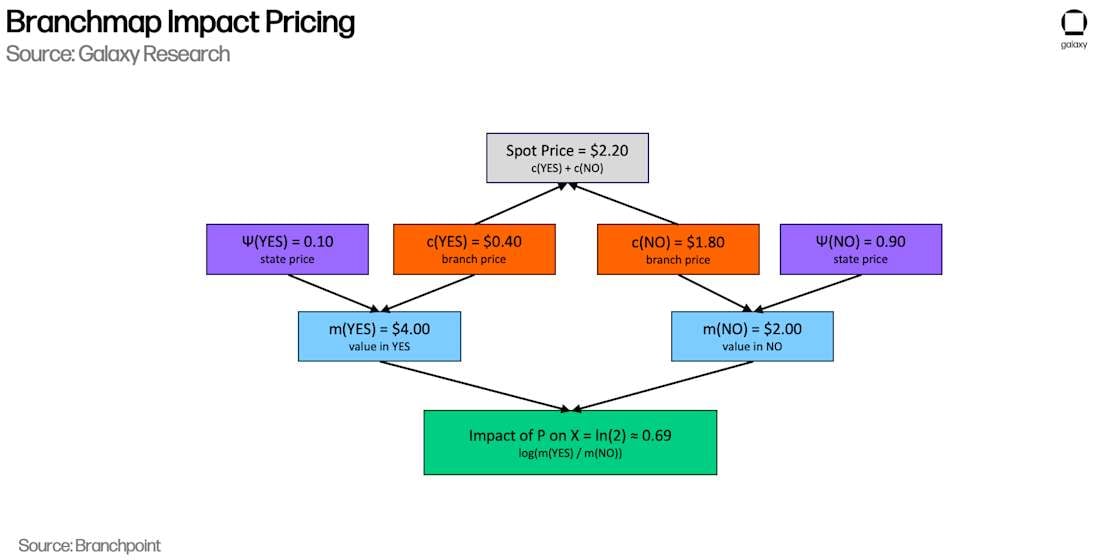
This splitting mechanism establishes a direct link between the probability assigned to an outcome by prediction markets and the price of assets conditioned on that outcome—the exact decomposition impact markets aim to price. Branchpoint explicitly lists this correlation as one of its applications: the equity price of an asset in a specific universe (its "branch price") can be decomposed into state prices provided by prediction markets, and the market-implied value of that asset within that universe ("in-universe value"). State prices are simply the price of the outcome token in the prediction market, approximating implicit market probabilities when discounting is negligible. In practice, conditional asset markets reveal branch prices; dividing these by state prices restores in-universe value. Within Branchpoint's framework, the natural logarithm of the ratio of in-universe values between an asset's "Yes" and "No" branches for a given event constitutes a quantifiable "impact" statistic (see below). Because the namespace assigns identical event, outcome, and settlement identities to both price sets, impact markets can theoretically be built atop it without provisioning custom infrastructure for each market.
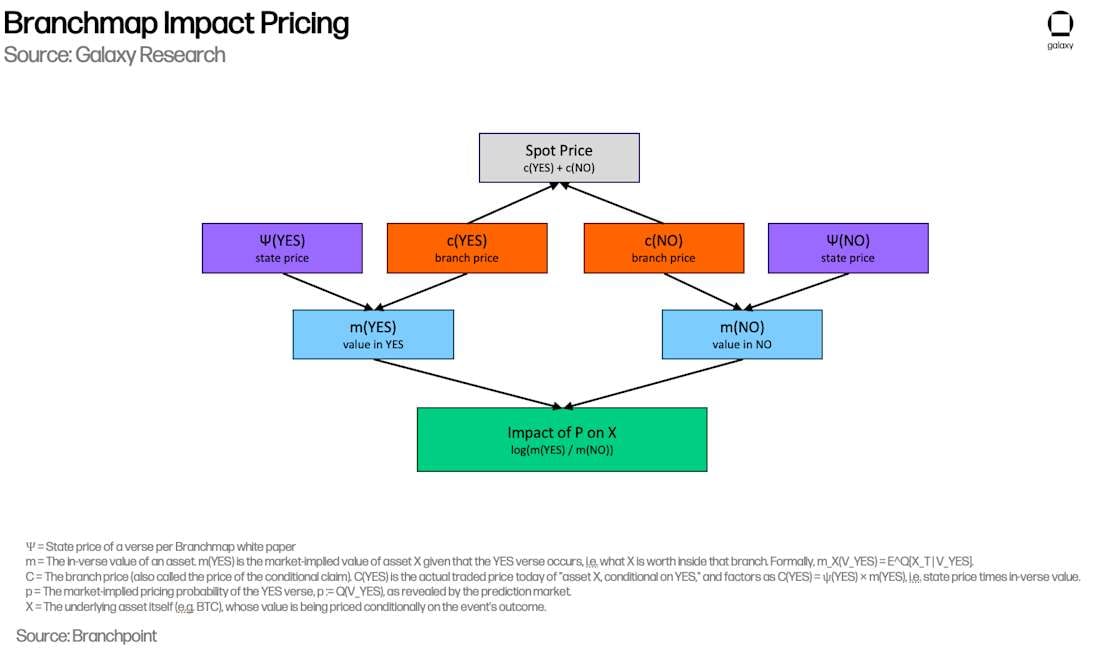
Assume the predicate is "Will Florida temperatures drop below 28°F for more than three consecutive hours in December?" with the prediction market pricing frost at 10%. If a frozen concentrated orange juice (FCOJ) right payable only in the "Yes" verse trades at $0.40 per pound, while the corresponding "No" verse right trades at $1.80, dividing each branch price by the state price yields in-universe values of $4.00 in the "Yes" verse and $2.00 in the "No" verse. Thus, the market expects orange juice value to double if a freeze occurs, with the impact value being the natural log of this ratio: ln($4 / $2) ≈ 0.69. Summing the two branch prices precisely equals the unconditional price of $2.20 for the orange juice.
Branchpoint's pilot deployment is projected to be a single-chain EVM namespace initially controlled by the team, with a long-term roadmap aiming for a decentralized, cross-chain namespace allowing other venues and protocols to claim and govern independently. Like other infrastructure-layer projects, Branchpoint's utility to the impact market sector ultimately depends on whether venues and market operators adopt Branchmap as a shared foundation for their events and conditional assets, rather than building isolated event definitions and settlement logic.
Behind the Scenes Developments
As the world grows increasingly complex, the downstream impacts of singular events—whether political, regulatory, technological, or environmental—are exerting growing influence on asset prices and corporate balance sheets. Risks that investors and corporations might now wish to actively hedge were either milder or nonexistent in the past, or the tools to hedge them and achieve certain payoff structures simply did not exist. The natural conclusion is that market participants and enterprises should be able to hedge against any event, not just the narrow slivers of risk traditional financial instruments originally targeted, while accessing payoffs tailored on demand. Conditional markets embody this concept, but they likely represent just one step toward a broader pathway of more flexible, event-driven financial instruments.
The dominant on-chain hedging tool today, perpetual contracts, carries limitations that may push demand toward alternatives. Perpetuals offer linear payoff structures (exposure scales proportionally with underlying price regardless of absolute levels), which do not suit every use case. Certain risks are better expressed through non-linear or event-conditioned payoff structures rather than constant 1:1 exposure. Perpetuals also carry liquidation risks (see the "Oct 10" incident), which not all traders are willing to bear.
Several projects are actively working around these concepts, and related discourse continues to grow.
Options Protocols
Since January 1st, Derive's options business has seen significant growth. Monthly options notional volume dropped from $1.47 billion in January to a trough of $629 million in February, subsequently recovered steadily throughout the summer, and surged in September to $3.82 billion—roughly 2.6 times January's level. The pace over the past 30 days (Sept 13 to Oct 12) ran approximately 195% higher than in January. Options open interest followed a more volatile trajectory: starting at $590 million at the beginning of the year, dipping to a low of $359 million in late June, then recovering to peak at $2.49 billion on Sept 21 before retreating to $1.66 billion by Oct 12. This figure sits roughly 181% above Jan 1st levels, over 4.6 times the June low, and about 34% below the September peak.
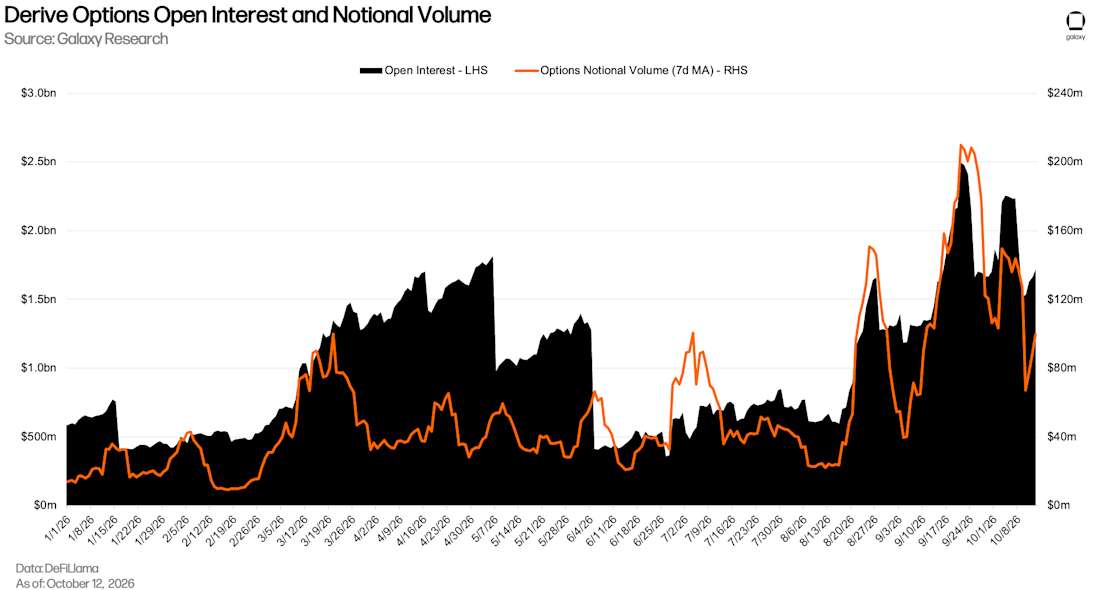
Historically, on-chain options have faced significant headwinds compared to off-chain counterparts due to capital requirements that structurally make them more expensive, particularly for sellers: sellers must pre-post 100% margin on-chain, whereas off-chain allows lower margin with dynamic margin calls. Nevertheless, recent trends serve as a meaningful signal that on-chain traders are actively seeking hedging tools beyond perpetuals, indicating positive momentum for the adoption of the more exotic conditional and event-driven instruments detailed elsewhere in this report.
Castle Tech
Castle Technologies is a New York-headquartered startup founded this year. Its value proposition centers on transforming event risks ignored by traditional insurance and derivatives markets (such as tariffs, geopolitical shocks, or specific legislation) into structured, tradable hedging instruments.
Castle's recent transaction with a California goat herding company perfectly illustrates what a hedging contract looks like when risks are too narrow and specialized for insurers to price or existing markets to touch.

Conditional markets have truly gone "baa-y."
The expiration of California's shepherd wage exemption clause could increase Western Grazers' labor costs by three to fourfold, reaching up to $240,000 annually. The company manages roughly 4,000 goats used to clear vegetation prone to wildfires. No insurer would underwrite a policy tied to a specific legislative outcome, and prior to Castle's intervention, there was no options market, no perpetual contract, and no prediction market addressing this issue; such events naturally lack retail bid-interest anyway.
Castle's work involved building pipes from scratch to take this exposure: translating an ongoing legislative situation into a precise, self-verifying settlement condition, then locating a counterparty willing to price and hold this type of risk shunned by traditional underwriters. Western Grazers entered a swap agreement with Castle structured so that if the California legislature fails to resolve the wage issue before the Oct 1 deadline, the company receives roughly $500,000 in payouts; if legislators resolve it, there are no payouts. Castle back-to-back swapped this risk to quant firm Susquehanna, which priced and absorbed the exposure, with the trade ultimately clearing and settling through a Kalshi prediction market venue.
The result was a customized underwriting policy executed via a prediction market exchange channel: one fill, one counterparty, and a settlement condition drafted specifically for this trade rather than pulled from an exchange shelf. Castle end-to-end manufactured a hedging contract that previously lacked tools, markets, or insuring appetite, enabled entirely by prediction market infrastructure. The transaction demonstrates market demand for "hedge everything" products. Enterprises increasingly face risks outside traditional insurance and derivatives coverage (regulatory, legislative, highly localized) and are willing to pay hard premiums for bespoke, on-demand solutions.
Statebook
Statebook is more of a theoretical construct than a ready-made product, but it offers a useful new framework for organizing event-driven hedging tools. Proposed in a working paper titled "Markets for All States of the World," the premise flips conventional finance: instead of forcing traders to adapt to available instruments, it proposes designing financial markets around specific payoff structures (i.e., the exposure a trader seeks), then reverse-engineering which existing contracts or combinations can replicate that payoff.
The mathematics underpinning this concept echo the state price theory discussed in the Branchmap section, though the two originate from different premises. Branchmap's state prices derive from an Arrow-Debreu-style partitioning: a predicate (e.g., "Did the Fed raise rates?") settles via oracle, and the resulting outcome directly defines a verse whose existence requires no options chain. Statebook's state prices stem from a narrower, more specific model: the Breeden-Litzenberger model. Differentiating European call option prices by strike price recovers the market's implied price for the underlying asset finishing above (or within) any given level or interval, effectively turning an options curve into a ladder composed of digital/boundary rights and interval rights. Branchmap uses its state definitions to grant conditional assets a shared semantic identity, allowing on-chain protocols to reference the same event and compose around it. Conversely, Statebook operationalizes state definitions as an execution layer: viewing ordinary options, boundary/threshold rights (e.g., "pay $1 if index closes above 100"), and interval rights (e.g., "pay $1 if index closes between 100 and 110") as different lenses on the same set of options-implied state prices. Consequently, a right lacking its own order book, such as a narrow interval bet, can still execute by assembling two more liquid digital rights or a matched pair of options, with Statebook routing to the cheapest available path and disclosing a deterministic, executable price.
In essence, this aligns with the overarching ambition driving all conditional markets: building infrastructure capable of hedging any precisely definable event or price outcome, rather than limiting payoffs to those with established, deep, specialized markets today. Statebook achieves this via execution and routing rather than Branchmap's on-chain semantic namespaces; furthermore, its foundation heavily anchors in traditional finance and regulated US market structures rather than DeFi. On-chain venues like Hyperliquid and Polymarket appear merely as comparative benchmarks, not the primary focus of the paper. Nevertheless, the thesis remains consistent. Conditional markets, impact markets, and Statebook are different variations of the same philosophy: markets should be organized around the world states traders seek exposure to, rather than around whatever contracts happen to exist. Notably, the Statebook paper points out that today's dominant on-chain hedging tool, perpetual contracts, cannot be integrated into this framework due to lacking fixed maturities and therefore terminal payoffs required to define states. This implies perpetuals and Statebook-style rights likely serve distinct, complementary hedging needs rather than competing for the same demand.
Conclusion
As impact market projects approach mainnet and multiple teams build upon the decision market concept, the design space for conditional markets is beginning to expand. Initially dismissed as merely a "version 0.0" of event-driven finance, prediction markets have instead sparked a Cambrian explosion of experimentation over the past 18 months. Decision markets overlay binding governance outcomes onto this mechanism; impact markets isolate the impact of events on asset prices rather than just pricing the probability of occurrence. Today, infrastructure and downstream concepts like Branchmap and Statebook are propelling the foundational idea that "markets should be organized around the world states traders actually want exposure to" into entirely new territories. With Umia bringing competitive pressure to decision markets for the first time, alongside multiple teams concurrently building impact markets at both market and infrastructure layers, competition across the entire tech stack should notably intensify over the coming year.
That said, everything remains nascent. The learning curves for both traders and builders are steep; every impact market project mentioned herein is either still in testing or, like Statebook, remains a working paper rather than a deployed product. Liquidity for these novel instruments must essentially be accrued from zero, with demand for certain models proving more niche than advocates anticipated. The sector is still exploring optimal foundational architectures—whether Proof's vertically integrated stack or If Market's cash-settled, non-tokenized route fares better. By contrast, decision markets have advanced further: DAOs are already actively utilizing MetaDAO and Umia designs, with organizations governed by decision markets rapidly spreading. The coming year should clarify how the unresolved questions facing impact markets get solved, and how far decision market adoption can scale from its current base.
Join TechFlow official community to stay tuned
Telegram:https://t.me/TechFlowDaily
X (Twitter):https://x.com/TechFlowPost
X (Twitter) EN:https://x.com/BlockFlow_News
 @galaxyhq