OKX Tests US Tokenized Stock Trading: SEC Exemption Pathway Requires Actual Dividends and Voting Rights, Offshore Model Faces Restructuring
Author: John Chen
Translated by: TechFlow
TechFlow Overview: OKX's tokenized US stocks now cover more than 70 tickers, yet they remain locked out from US users; this latest filing aims squarely at the "Innovation Exemption" channel opened by the SEC in September. The key lies in the new rules requiring tokens to carry genuine dividends and voting rights—OKX's offshore synthetic products fail to meet these standards. For investors, what truly matters is what structure it unveils in the US and when its joint venture with NYSE parent company ICE, OKXICE, will obtain its licenses.

The exchange is attempting to bring its on-chain equity business to the one market that its current products cannot reach.
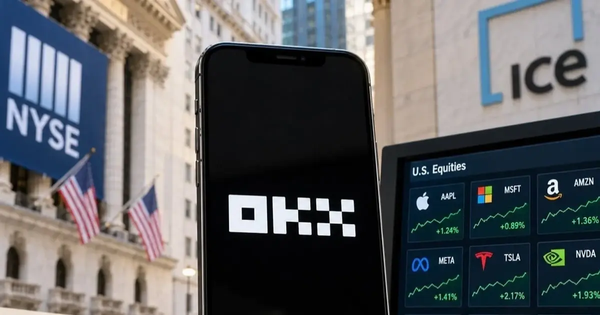
According to Bloomberg, OKX has filed an application with the US Securities and Exchange Commission (SEC) to launch a tokenized stock trading platform in the United States.
As of early October, the application itself had not yet appeared in public SEC records. However, the timing still makes sense: Washington has just officially opened a channel for such transactions.
What OKX Is Already Selling, and to Whom
OKX is no newcomer to the tokenized stock space. On July 15–16, 2026, it launched a product line called "Unified Tokenized Stocks," also known as products powered by xStocks.
The initial offering covered more than 40 US stocks and ETFs. By September 2026, the list expanded to over 70 tickers, offered through a dedicated Money app.
Users can trade these tokens around the clock, 24/7, priced in the stablecoin USDT. Settlement occurs on Solana and OKX’s own network, X Layer.
These tokens are backed 1:1 by underlying shares held by third-party issuers. OKX acts as a distributor rather than an issuer.
These products are governed by Regulation S, an SEC rule governing securities issued outside the United States. US persons are barred from purchasing them, and EU users are excluded as well.
Despite being backed by equities, existing products are classified as synthetics. Token holders receive price exposure but do not enjoy shareholder rights such as dividends or voting.
SEC Opens a Door in September
The regulatory landscape shifted on September 17, 2026. That day, the SEC rolled out a five-year "Innovation Exemption."
The exemption allows qualified tokenized securities venues (TSVs) to trade tokenized National Market System (NMS) stocks on-chain. NMS stocks largely refer to those listed on major US exchanges.
Trading can be conducted through approved automated market makers (AMMs) and liquidity pools.
This exemption runs until September 17, 2031, and carries a strict requirement: tokens must retain genuine shareholder rights, including dividends and voting rights.
This condition significantly impacts OKX. Under its current structure, its Unified Tokenized Stocks are synthetic products and do not align with the new framework. Simply opening access to US users would not qualify these products for the exemption.
Connection with ICE
OKX is also advancing another pathway into the US market. In June 2026, it announced a joint venture with Intercontinental Exchange (ICE), the parent company of the New York Stock Exchange.
Namely OKXICE, the joint venture aims to offer tokenized NYSE stocks once it obtains approval as a US broker-dealer and futures commission merchant (FCM).
These approvals are currently pending review at the SEC and the Commodity Futures Trading Commission (CFTC). A broker-dealer license permits a firm to execute securities trades on behalf of clients, while FCM status covers futures and derivatives businesses regulated by the CFTC.
What This Means
For OKX, a US tokenized stock platform would unlock the world's largest equity market—the very segment its flagship product currently ignores. Regardless of how many additional tickers it lists, the wall built by Regulation S will continue to cap the reach of its current offerings.
The Innovation Exemption rewards tokens with complete shareholder rights. Any platform OKX rolls out in the US will likely need to differ from the synthetic tokens it sells in offshore markets: to route real dividends to token holders, each unit must come bundled with actual voting rights.
Key developments to watch include whether this application goes public and what structure it outlines; whether OKX's US products will be designed to meet the TSV standards under the Innovation Exemption; and how the SEC and CFTC will rule on OKXICE's broker-dealer and FCM applications.
Join TechFlow official community to stay tuned
Telegram:https://t.me/TechFlowDaily
X (Twitter):https://x.com/TechFlowPost
X (Twitter) EN:https://x.com/BlockFlow_News
 深潮TechFlow