The Complete Landscape of the Options Sector: Exchanges, Prediction Markets, and Yield Products – Stop Confusing Them
Author: Castle Labs
Compiled by: TechFlow
TechFlow Summary: On-chain options are heating up again, but the market conflates three entirely different products: exchange-based options, binary predictions, and structured yield products. This article breaks down exactly which platform serves whom, helping you avoid pitfalls from choosing the wrong tool.

Options are back in vogue.
A few viral posts showcased massive returns, and with $DRV's growth, options have returned to the public eye. So, has the time come for options to go mainstream?
The truth is, they just need a little push.
Earlier this year, we already covered options in our report in collaboration with Block Scholes.
In this short article, we take our research a step further to address the market's biggest misconception about options: people still use one umbrella term to refer to several completely different types of option products.
We break this category down into at least three active product families:
1. Exchange-style option platforms: Derive and Paradex.
2. Binary options and prediction market-style platforms: Polymarket, Kalshi, and Hyperliquid HIP-4.
3. Structured products and yield strategies: Rysk and Hegic.
Buying a capped-risk call option on Derive is not the same thing as a HYPE holder selling a covered call via Rysk. Similarly, a user betting on election results or BTC price on Polymarket is using a fundamentally different product than a trader pricing skew on Paradex.
This distinction matters because it helps users understand the value proposition of each platform, and which one truly fits their strategy or use case.
Option Exchanges
This category includes protocols that more closely resemble traditional option exchanges. Think of them as the option equivalents of Uniswap. Anyone can use these platforms to find option strategies that match their exposure needs. This category has made significant progress.
Initially, these platforms operated through passive liquidity provision pools, which severely limited liquidity and scalability.
Today, they have shifted to a hybrid model combining central limit order books (CLOB) and request-for-quote (RFQ) systems, supplementing order book liquidity with professional market maker liquidity.
Examples include Derive and Paradex.
Target users: Professional traders, market makers, funds, and active retail options traders.
Less suitable for: Passive holders, users seeking one-click yields, and prediction market users wanting clear "yes/no" outcomes.
Derive
Derive spun off from Lyra, one of the earliest options AMMs.
Today, Derive runs its own L2 on the Optimism tech stack, offering cross-margin options through an order book interface.
Its trading volume has been growing consistently throughout the year, accounting for over 90% of daily total option volume.

A quick glance at the user interface (UI) makes their target audience very clear: they do not hide the complexity of options, instead targeting mature volatility traders.
Rather than simplifying the experience, Derive aims to provide full functionality for those who understand options, positioning itself as exchange infrastructure.
Users can select across different assets, strike prices, and expiration dates, then combine them to build their own payoff structures.
An example shared by KoolAid recently went viral:

This user opened a bull call spread on ETH.
He bought an ETH call option expiring on March 26, 2027, with a $5,000 strike price, while simultaneously selling an ETH call option with a $7,000 strike price.
For those unfamiliar with options, this means he is betting that by March 2027, ETH will trade between $5,000 and $7,000. You think you're bullish enough on ETH?
Beyond this lofty target, the post went viral due to the massive return potential: the user invested $300,000 and could profit up to $20 million if ETH hits $7,000. He only makes money if the price stays between $5,000 and $7,000; otherwise, the options expire worthless.
This showcases Derive's capability: a plug-and-play interface that allows sophisticated users to construct their own option strategies.
Derive recently recorded its largest single-day trading volume ever, with a notional volume exceeding $500 million.

On the backend, it uses an off-chain matching engine to ensure instant execution, while settling on-chain via its L2.
Derive will soon launch V3, transforming the protocol into a zkVM on the Ethereum mainnet, bringing all the benefits that entails.
Additionally:
- Higher throughput
- Cross-margin across portfolios
- Faster listing for RWAs and long-tail assets
- Native vaults
- Borrowing additional non-cash assets
Derive will be able to offer options on a wider range of assets, including equities, commodities, etc. The deployment of native vaults means third parties can create strategies, effectively acting as curators for structured products.
Thus, Derive is best suited for users who want genuine options infrastructure rather than simplified yields: what could be seen as a weakness is actually its strength.
Paradex
In mid-September 2026, Paradex announced the integration of Paradigm's RFQ into its options platform.

Users can build their own payoff structures, ranging from simple to multi-leg strategies. Quotes are then routed to the RFQ system, where market makers and institutional liquidity providers submit their best prices for execution.
Leveraging RFQ avoids the need to bootstrap order book liquidity for every market, which was a major hurdle for early options protocols.
Furthermore, Paradex can tap into Paradigm's RFQ, one of the deepest and most liquid implementations with a multi-year track record. Since its founding in 2019, it has processed over $1 trillion in volume.

For context, this is the exact same RFQ system used by leading options exchange Deribit, which accounts for an average of 27% of its trading volume.

This options platform aims to support as many assets and payoff structures as possible. However, execution quality and liquidity often become constraints. More and more options platforms are moving away from relying solely on order book liquidity, instead depending on RFQ systems backed by efficient quotes from professional market makers.
With this implementation, Paradex has upgraded into a mature options trading platform, allowing users to configure their own RFQ structures and receive quotes from one of the industry's most liquid RFQ providers.
Binary Options
As discussed in our previous report in collaboration with Block Scholes, prediction markets are structurally identical to binary options.
Each contract pays out a fixed amount if conditions are met at expiry; otherwise, it expires worthless.
In this sense, prediction markets are priced based on vanilla call options and function similarly to a bull call spread, i.e., a combination of two call options on the same underlying asset.
Under this strategy, the user buys a call option with a lower strike price while simultaneously selling a call option with a higher strike price. The result is a three-zone payoff structure, where the two extreme zones mirror binary options:
- Below the lower strike: Both calls expire worthless, resulting in a $0 payout.
- Above the higher strike: The payout equals the difference between the two strike prices.
- Between the lower and higher strikes: The payout scales linearly from $0 up to the strike differential.

Polymarket
Polymarket relies on the Gnosis Conditional Tokens framework to create outcome contracts. To aggregate liquidity, it employs a hybrid CLOB model with market maker incentives.
Market resolution might be one of Polymarket's most criticized aspects, as it relies on UMA's Optimistic Oracle and Chainlink for crypto-related markets. UMA has faced numerous issues before, such as markets questioning whether Volodymyr Zelenskyy wore a suit.
These markets are inherently simpler than options, and their ultra-short expiration times attract more retail users, making them a solid complement to other sports or political markets on the platform.
Currently, Polymarket offers 5-minute, 15-minute, and 1-hour markets where users can go long or short. Due to their fixed expirations and binary payouts, these function as binary options. However, the issue is that payouts depend on the price at the market's final timestamp, which may trade above or below a strike price, preventing traders from expressing views on specific asset ranges.
Nevertheless, adoption for these markets is growing rapidly. Options protocols can learn from prediction markets by abstracting complex outcomes into simple "yes/no" decisions rather than multi-outcome events.
Kalshi
Kalshi focuses on providing regulated products for US customers, which is its key differentiator.
Kalshi also offers 5-minute and 15-minute markets, utilizing a liquidity model similar to Polymarket—a hybrid approach sitting between a CLOB and institutional market makers.
Currently, both Polymarket and Kalshi require permissioned market creation. However, permissionless workflows featuring user-generated markets (UGMs) could eventually emerge as an additional layer of binary options—acting as a hedging tool where users set their own strikes and expirations. This would be supplemented and driven by the expansion of asset classes across prediction market platforms.
HIP-4
HIP-4 takes a slightly different path compared to the two giants in this category. In fact, we could describe HIP-4 as a framework for decentralized outcome markets.
Launched in May 2026, HIP-4 is Hyperliquid's implementation of outcome markets, supporting binary market results, and opened permissionless deployment in late August.
Launching these markets follows a flow similar to HIP-3: users must lock capital (over 500,000 HYPE) to create a market and earn 50% of the fees.
HIP-4 markets encompass more than just prediction markets; they also include scalable options. Beyond supporting these primitives, HIP-4's biggest unlock is the ability to support everything within a single environment, enabling previously much more complex trading strategies.
Users previously had to operate across at least two or three different platforms (e.g., voting on an interest rate cut while simultaneously hedging their position with a BTC short using the same collateral).
Ultimately, with HIP-4, they can execute everything on a single platform.
HIP-4 launched in phases, accumulating over $150 million in trading volume to date.
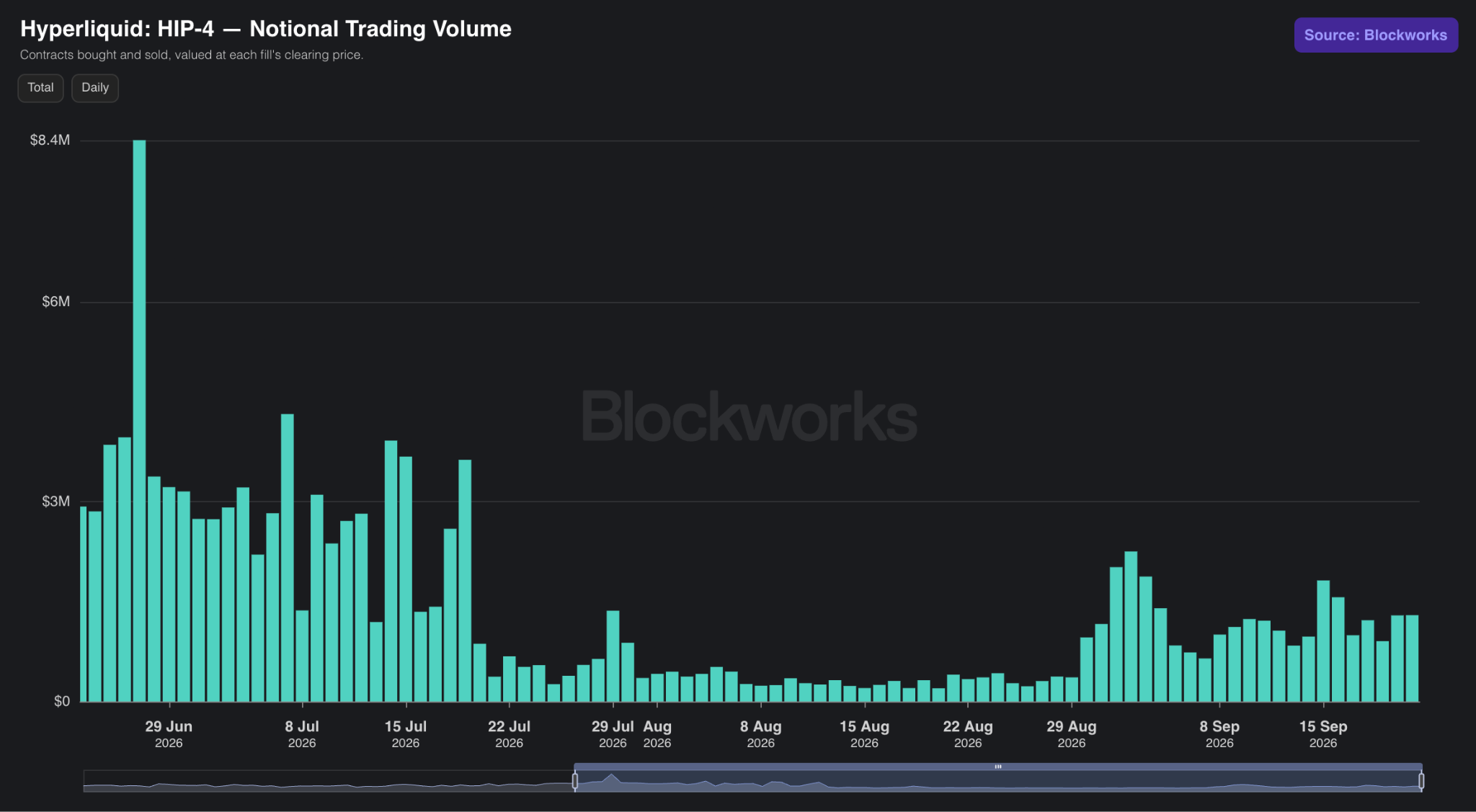
After initially launching with 15-minute BTC markets, HIP-4 saw slower momentum until recent permissionless deployments enabled builders like Outcome and Tradexyz to roll out their own markets.
This is equally significant for builders and further exemplifies Hyperliquid's "infrastructure-first" philosophy. Shared accounts and collateral, combined with full composability, unlock entirely new possibilities for what can be built on Hyperliquid.
Target users: Active Hyperliquid traders, retail traders, and sophisticated traders looking to hedge or execute complex strategies (complementing their spot or perpetual trading).
Less suitable for: Passive holders seeking one-click yields, or prediction market users.
Structured Products & Yield Strategies
Unlike general-purpose platforms designed for buying, selling, and settling options, these protocols are designed with a narrower focus.
They focus on specific aspects of options design and targeted use cases; therefore, they are less general-purpose than the ones mentioned above (which largely resemble exchange interfaces).
Rysk
Rysk makes options feel more like a yield product for HYPE holders, rather than a professional volatility dashboard.
Originally launched on Arbitrum, it has found product-market fit (PMF) on Hyperliquid.
Rysk's value proposition is straightforward: it allows users to pre-earn yield on their spot holdings.
In reality, there is a large base of HYPE holders sitting on massive unrealized gains; Rysk provides them a way to generate yield via covered calls while hedging their positions.
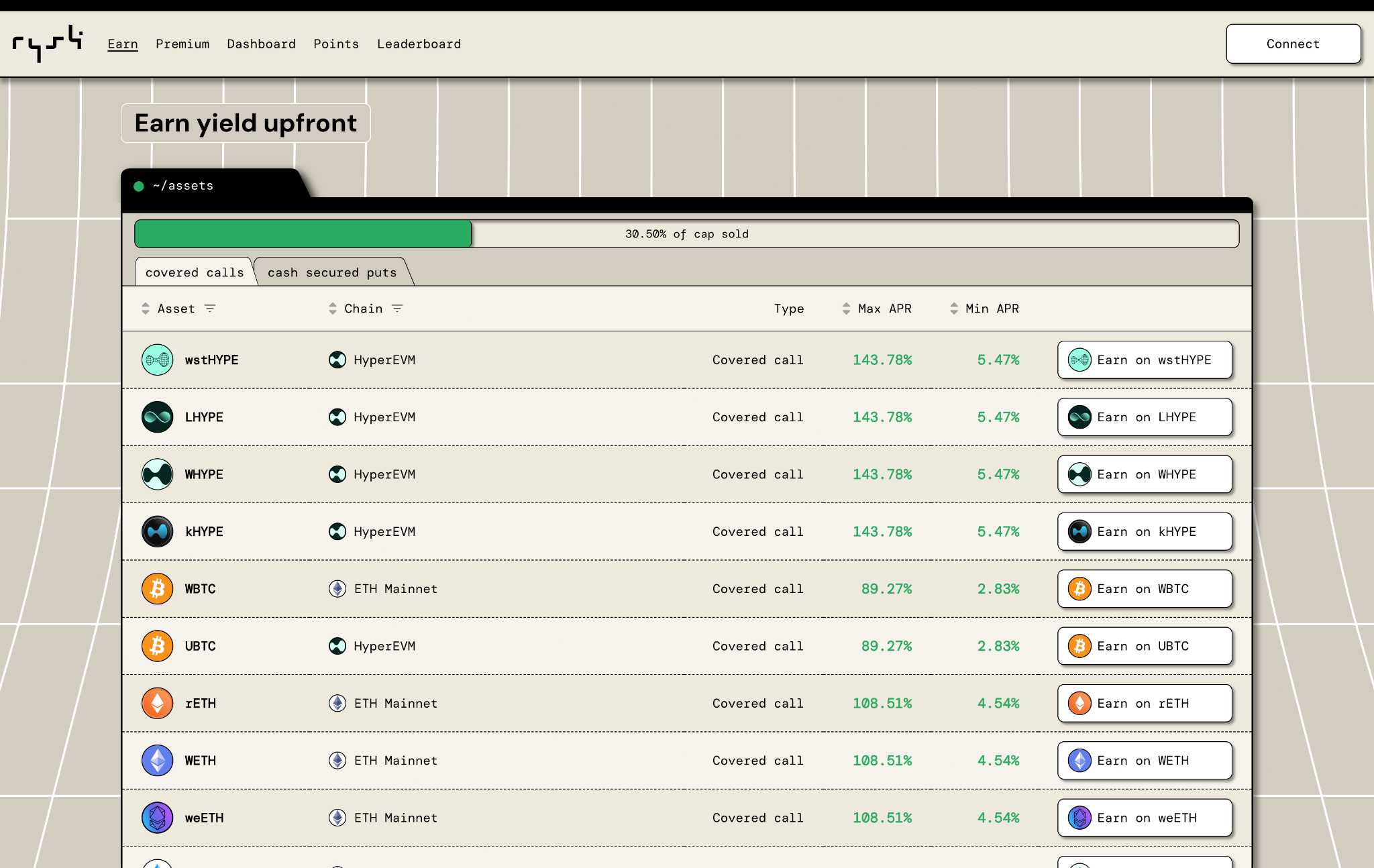
This highlights a direct difference between this product and others: it is not a public platform for retail users hunting for generic option strategies. Instead, Rysk has a specific utility: it enables users with spot exposure to hedge their positions and generate yield using covered calls.
To some extent, it operates similarly to Pendle: it transforms non-yielding spot assets into income-generating products.
It isolates what Pendle calls the YT and distributes it to users as yield until the covered call expires.
Let's look at a practical example of how Rysk works.
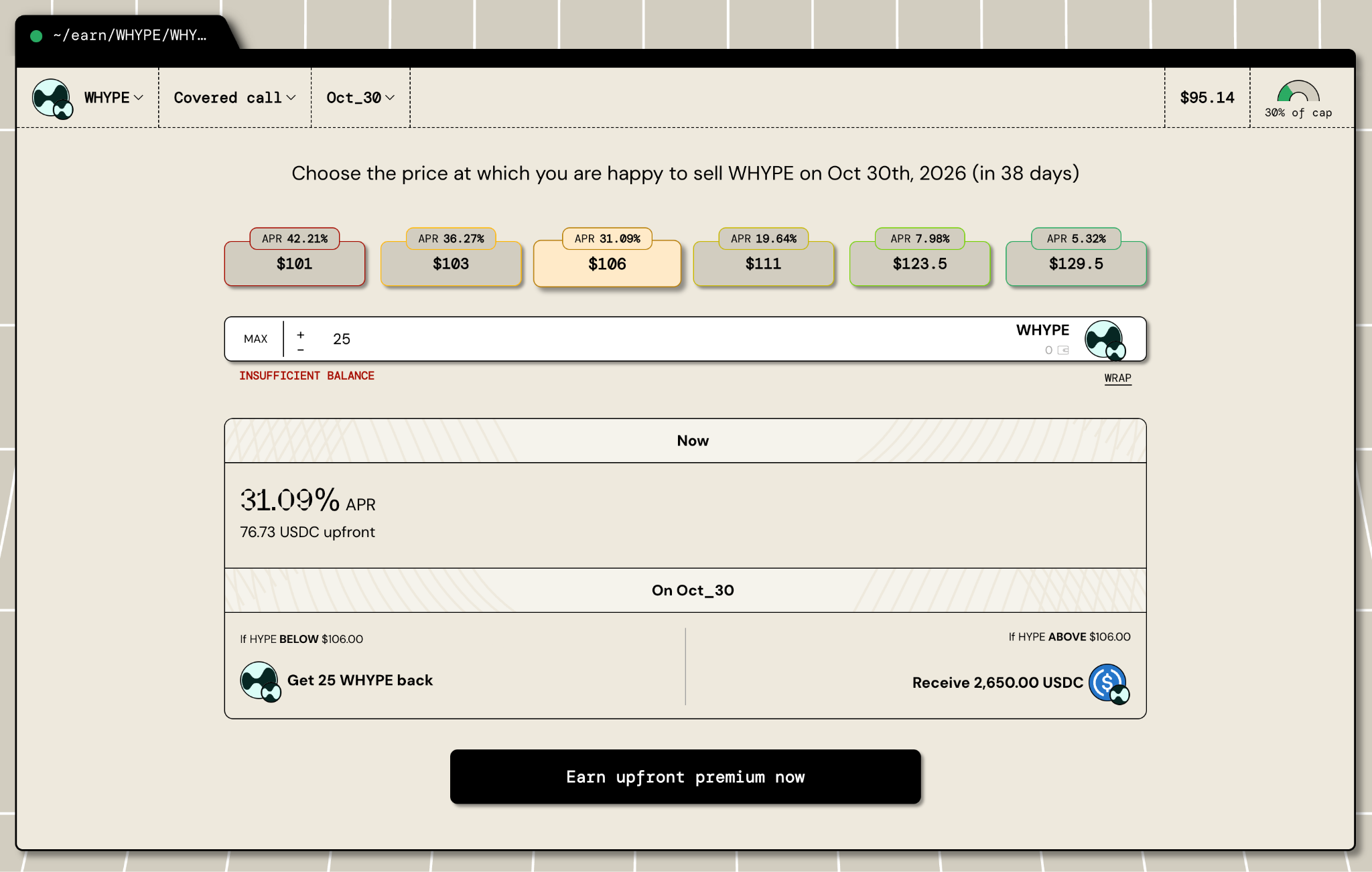
Users can select their preferred asset and expiration date, with a clear understanding of the expected yield.
They immediately receive upfront yield in the form of an APR. At expiry, if the asset price stays below the strike, they get their original spot asset back plus the accrued yield. If HYPE instead breaches $106, they will only receive an equivalent amount of USDC, along with the pre-generated yield.
Therefore, unlike other protocols measured by options premium volume, Rysk's success is better defined by its TVL—the scale of assets locked into covered calls to generate yield. Reaching $50 million recently is even more impressive, as monthly expirations reset the TVL to 0.
This reflects a user profile completely distinct from other options platforms.
Target users: Institutions, large treasuries, directional funds, market makers, retail whales, and passive holders seeking one-click yields.
Less suitable for: Retail options traders, market-neutral funds, and prediction market users wanting "yes/no" outcomes.
Hegic
Hegic is an on-options trading protocol that simplifies option trading into a one-click experience, keeping users anonymous, just like the Hegic developers themselves.
Hegic restricts listed assets to ETH and BTC; however, compared to Rysk, it also allows users to express divergent views through spreads and other strategies.
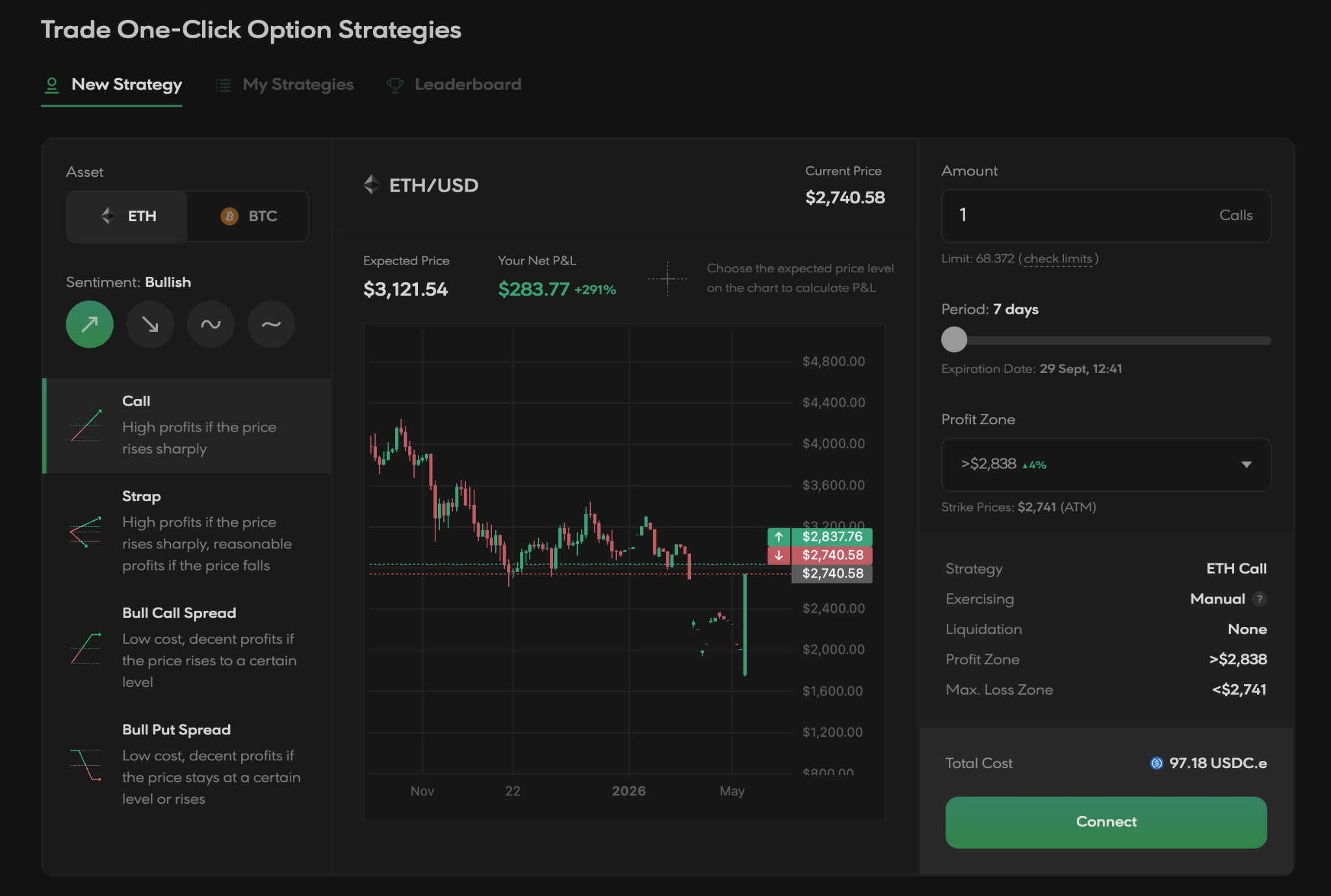
Hegic options are American-style, meaning users can exercise at any time before expiry.
Hegic also features its own native token, which users can deposit into its proprietary liquidity model, Stake&Cover (S&C).
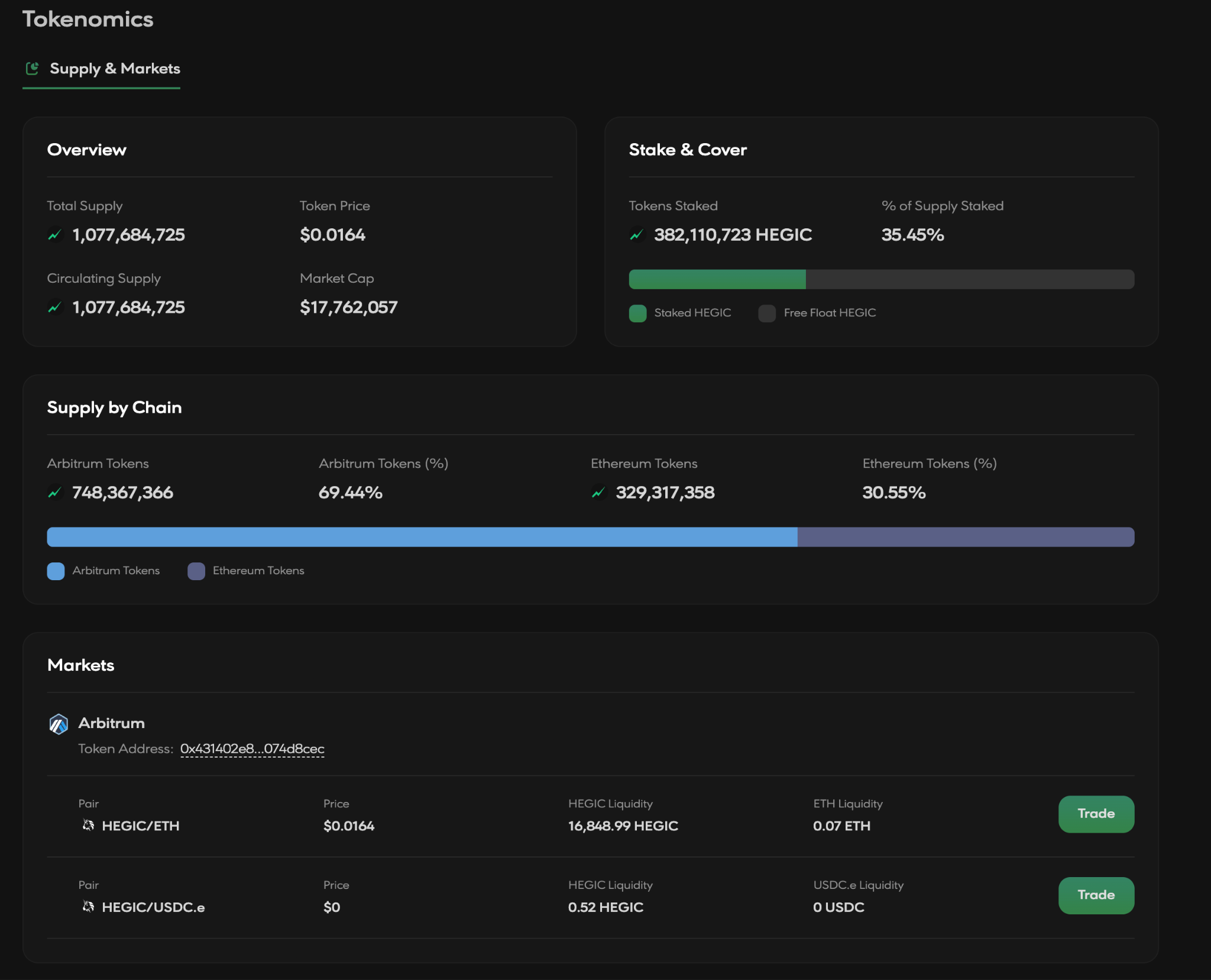
Hegic utilizes a peer-to-pool model.
Under this model, Hegic tokens in the pool act as collateral for options and strategies, similar to early GLP, where a vault serves as the counterparty to traders on the platform.
Consequently, S&C depositors receive 100% of the protocol's cumulative P&L.
Compared to Rysk, Hegic is a broader platform focused on specific assets and offers a wider range of strategies beyond covered calls.
Sitting between Rysk and Derive, it supports a limited number of assets but provides heavily abstracted and maximally simplified strategies.
Target users: Large BTC and ETH holders, large treasuries, market makers, and DeFi whales.
Less suitable for: Retail options traders, market-neutral funds, and prediction market users wanting "yes/no" outcomes.
A Variety of Option Choices
This brief article demonstrates that "options" is a broad term, with builders in the space focusing on different parts of the tech stack.
Today, we see Derive, operating as a mainstream quantitative options exchange platform, achieving robust growth.
Paradex has just announced support for Paradigm's RFQ, so we expect its quote depth and trading volume to correspondingly improve and grow. Other platforms like Polymarket and Kalshi are still figuring out how to expand their total addressable market by attracting more options traders and integrating them with their event markets.
HIP-4 events rolled out by Tradexyz will serve as a watershed moment, revealing whether Hyperliquid is the right home for event markets and ultimately leading to competition with major binary options platforms like Polymarket and Kalshi.
However, yield products like Rysk are extremely fascinating to us, boasting a clearly defined niche positioning and utility. Expanding to more assets and chains is merely the first step in growing the user base.
Expanding the scope of complex strategies is also a priority, as it currently mainly targets users holding spot positions who are sophisticated enough to want to hedge or generate yield.
Despite this, we feel the options sector is only just beginning. The market environment is maturing, and user profiles are evolving accordingly. Institutional investors will grow more sophisticated, and we anticipate that recent viral posts about "massive payouts" will ultimately drive more retail users to experiment with these products.
Join TechFlow official community to stay tuned
Telegram:https://t.me/TechFlowDaily
X (Twitter):https://x.com/TechFlowPost
X (Twitter) EN:https://x.com/BlockFlow_News
 @castle_labs