IOSG Talk|Betting on the Frontier: Why the Best Crypto Investments Are Born in Bear Markets
Written by: Jocy Lin, IOSG
This article is adapted from Jocy’s keynote speech at Money Frontier 2026 in Hong Kong. For readability, we have made moderate edits that stay faithful to the original meaning, and corrected any verbal slips or abbreviations used during the live presentation.
I. Opening: Knowing the White, Guarding the Black
Hello everyone, I’m very glad to be invited by the Benmo community to gather with you here during this bear market.
The theme I’d like to share this time is quite fascinating—Contrarian Investing, Betting on the Frontier: Why investments made during a bear market often yield the greatest returns.
Let me briefly set the background. This should be my fourth bear market. While many people feel it strongly this time, it’s also very different from the past. I really like a line from the Dao De Jing: “Knowing the white, keeping to the black”—understanding what is bright yet willing to stand in the darkness, to persevere. That itself is a virtue.
Before Taking the Stage, Many Friends Asked: Is IOSG Still Investing?
We are still investing. The current feeling is very similar to 2018 and 2019—many people don’t know how to invest. IOSG will continue to invest in the crypto market. We do not want to be the “last gatekeeper of Asian crypto VCs.” Instead, we hope more investors will join Web3 to help more Asian entrepreneurs build a better future together.
Today, I will first lay out the macro background using three “appetizers”—Bitcoin, stablecoins, and Ethereum—and then dive into four directions, sharing the real, revenue-generating businesses we see firsthand.
II. Bitcoin: The Four-Year Cycle Outweighs All Narratives
Let’s start with Bitcoin.
This recovery from the 2022 lows was driven by several Bitcoin-specific catalysts: the collapse of Silicon Valley Bank in 2022, the spot ETF hype pushing prices to $60,000, and Trump’s election driving it up to around $120,000. By the end of 2025, most of these catalysts were already fully priced in.
Since then, the landscape has changed. After 2025, the AI cycle began, and AI-related assets, gold, and NVIDIA have all been strengthening. Theoretically, these conditions should be bullish for Bitcoin, but Bitcoin has stopped reacting to them, dropping 29% year-to-date.
Why is this happening? Borrowing a phrase from the Benmo community’s “Bit Shenshi,” which is quite interesting: The four-year Bitcoin cycle once again outweighs all more complex narratives. The cycle framework previously pointed clearly to a Bitcoin top in October 2025, and indeed it was exactly that—the subsequent bear market also began in October 2025.
Many will argue that the four-year cycle might just be a coincidence. But we’ve seen that many crypto OGs make this four-year cycle self-reinforcing: As long as enough investors expect the market to peak at a certain stage of the cycle, they reduce positions at roughly the same time—collective behavior, in turn, creates the cycle they anticipated. This also explains why, despite favorable macro conditions, Bitcoin still turns downward. Fewer and fewer people believe that “AI, gold, and the broader market” can prop up Bitcoin.
Therefore, I believe the cycle still holds. Over the next few months, the focus shifts from explaining “why Bitcoin is underperforming” to identifying whether the next accumulation phase has already begun.
Here, I’ll also share some internal data research from IOSG. We tracked the duration of each cycle, and the results are remarkably consistent: Since 2015, the bull runs have each lasted approximately 1,060 days. Based on this, we’ve outlined several possible scenarios for this cycle:
- Scenario 1: Bitcoin bottoms in the $45,000–$60,000 range, likely by late October this year (2026);
- Scenario 2: Lower, dropping to $40,000–$55,000 in Q1–Q2 2027;
- Scenario 3: Various other iterations.
To be honest, there are countless versions when predicting cycles, but our internal data research points toward the scenario outlined above.
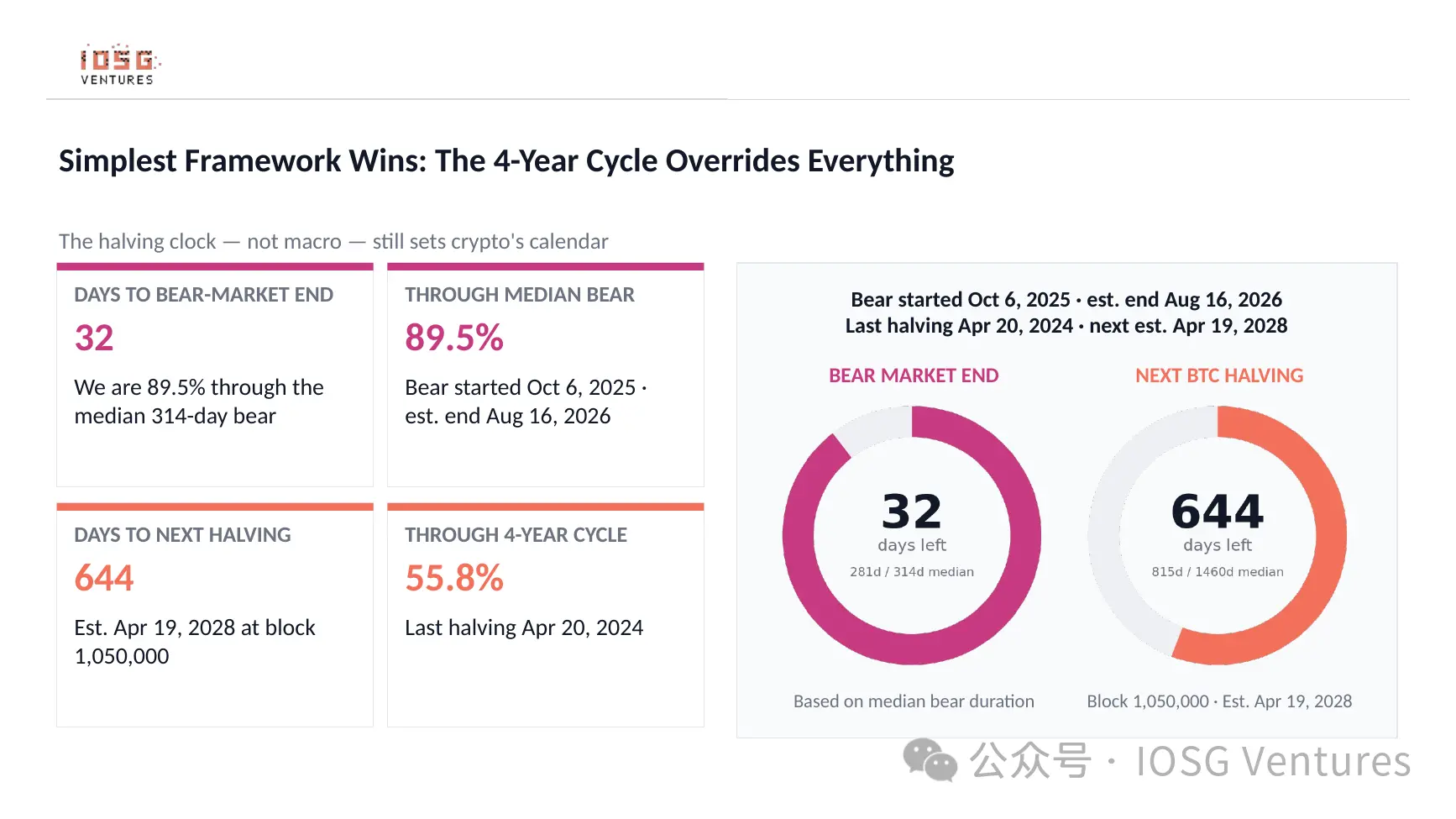
Four-Year Cycle and Bottoming Scenarios
III. Stablecoins: A Year as Important as 1975 and 2001
The second “appetizer” is stablecoins. This is a monumental year for them—an incredibly impactful one.
I’d like to draw two analogies.
On May 1, 1975, the SEC abolished Wall Street’s 183-year-old fixed commission system, turning stock trading from a game for the wealthy into one accessible to ordinary people, ultimately spawning a $140 trillion asset management industry where giants like Fidelity and Vanguard were born. In 2001, China’s entry into the WTO was also the single most transformative event for its economy.
I believe we are witnessing the exact same phenomenon happen again today, only this time on the stage of stablecoins in the crypto industry. With the GENIUS Act becoming law, banks can now legally issue dollars on-chain. I believe that following the passage of this bill, crypto will hit a turning point, shifting from a “high-risk asset” to “legitimate financial infrastructure.” Looking back in hindsight, 2026 will be remembered in history just like 2001 was.
IV. Ethereum: Moat, Challenges, and the Question of Future Leadership
Now, let’s talk about Ethereum. This topic is hard to sum up in a few words, so I’ve listed two tables: one for its strengths, one for its challenges.
There are four main strengths: As a settlement layer, it hosts the largest volume of stablecoins and RWAs; Security and yields—the vast majority of DeFi security and yields reside on Ethereum; Through Layer 2 scaling, the finality of an entire Rollup ecosystem settles back to Ethereum; And it boasts the most extensive developer infrastructure of any L1.
The challenges are equally concrete: L2s siphon off fees that would otherwise go to L1; The ETH/BTC pair has clearly underperformed in this cycle; And there’s competition from new public chains like Hyperliquid, as well as off-chain rivals.
But I think the core issue doesn’t lie in these areas. Recently, I’ve written quite a bit about Ethereum on Twitter. My central thesis is: If you compare Vitalik with Elon Musk, much of what Vitalik says won’t truly be understood until 10 years later, regarding why he said it and how it came to pass. What we’re eagerly awaiting is for Vitalik to be on the front lines like Elon.
Vitalik has also said he wants to turn Ethereum into a “smaller ship.” But honestly, from Tomasz’s departure to the establishment of new Ethereum institutions, everything ultimately points to a core question: Who provides leadership for Ethereum? Who governs? Who manages? Which founder will step up to the front lines to make this decentralized, open organization great again? I believe this is a massive challenge.
As for stablecoins themselves, everyone is quite familiar: Ethereum’s side is dominated by institutional capital and developed markets; Tron’s side relies mainly on USDT, serving developing markets and cross-border dollar flows.
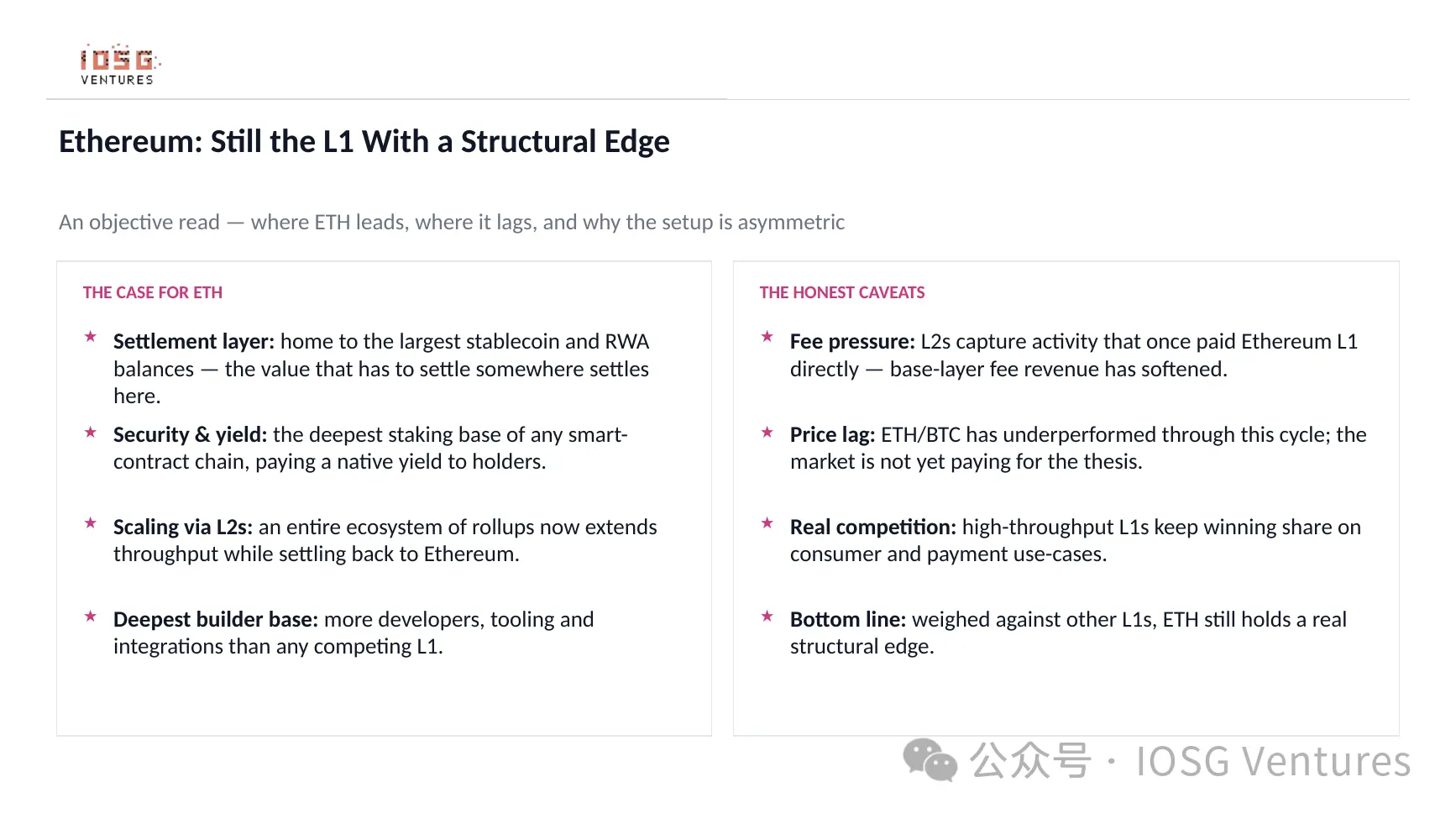
Ethereum: Strengths and Weaknesses
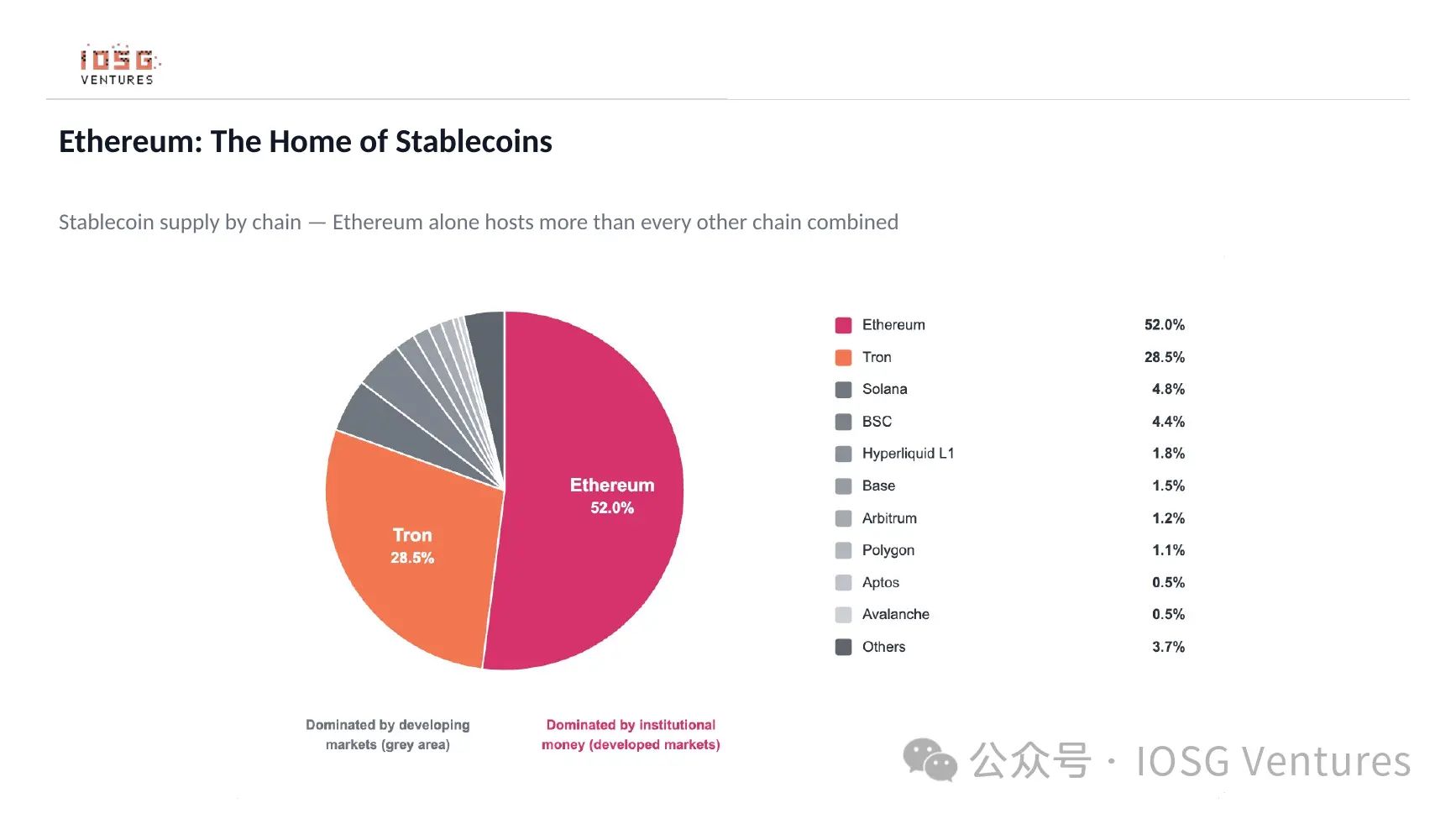
Distribution of Stablecoins by Chain
V. How We Invest in a Bear Market: Redefining Allocation Ratios
Next, let’s discuss how IOSG executes investments during a bear market—which is fascinating in itself, because we’ve redefined our allocation ratios during downturns.
We’ve lowered the weight of primary markets, while the proportions allocated to OTC, secondary markets, and incubation are rising.
At the same time, we’re observing a clear trend: Crypto is evolving from a trading venue into internet-native financial infrastructure.
Layer 1: Better Money, Better Rails. Stablecoins have proven that superior money and settlement rails can achieve internet-native status ahead of traditional systems.
Layer 2: Internet Capital Markets. RWAs and tokenization provide on-chain dollars with clearer real-world yields and collateral.
Layer 3: Mass Adoption. I believe the crypto industry will mirror the internet sector, producing the next TikTok and the next Pinduoduo.
Layer 4: AI Agent × Crypto. As financial infrastructure becomes internet-native, end-users will no longer be limited to humans—agents also require wallets, payments, identity, and programmable ownership.
Ultimately, money goes on-chain, assets go on-chain, value concentrates at the application and interface layers, and AI agents will share the same infrastructure as humans.
VI. Why the Best Investments Happen in a Bear Market
Let’s return to the present. Why are the best trades and investments happening in this bear market? Because in bear markets, quality is often mispriced, and genuine revenue proves itself. Here are three key cards:
First, valuation misalignment. When sentiment hits rock bottom, genuinely valuable projects get priced below their intrinsic value—the best entry prices only emerge when everyone else is exiting.
Second, genuine revenue ensures survival. We prefer businesses that validate cash flow over mere narratives. If a project can weather a bear market—with clear customers and a defined product—it will be compounded magnificently in a bull market.
Third, withstand scrutiny. We only invest in projects that can clearly articulate their business model from start to finish: who pays, why they pay, and how much. Revenue that can be externally validated is true revenue.
In this cycle, we’ve seen projects in Crypto that are genuinely profitable, ranging from hundreds of millions to around $5.8 billion in scale, distributed across DeFi and various infrastructures. Below, I’ll break down four directions to share what we’re seeing firsthand.
Direction 1 · Stablecoins & Payments: Circle, fun.xyz, RedotPay
At IOSG, we still hold four-hour IC (Investment Committee) meetings every week. Some ask, given it’s a bear market, what projects are even worth discussing? Actually, many.
Circle: Three Revenue Streams, One DCF
Many ask about Circle, so let me explain its model. It primarily generates revenue in three ways:
First, reserve income. With roughly $73 billion in reserves invested in short-term bonds at a 3.5% annualized yield, it earns about $2.6 billion a year, fluctuating with Fed policy.
Second, distribution costs. Circle distributes the bulk of its revenue—about 62%—to partners like Binance and Coinbase, leaving it with a gross margin of only 38%.
Third, underlying long-term equity value. Circle has built its own public chain, CCTP cross-chain protocol, and developer APIs, which currently account for only about 6% of revenue.
We constructed a DCF valuation model for Circle: From stablecoin float → (yield) reserve income → (38% gross margin) stablecoin gross profit → (15x multiple in year three, discounted at 20%) present value per share.
fun.xyz: The Stripe Checkout of the Crypto World
fun.xyz can be understood as the Stripe checkout solution for the crypto world—a Universal Deposit Address (UDA) through which all funds entering Polymarket must pass. IOSG is also one of its investors.
RedotPay: A Crypto Card Spendable Anywhere
RedotPay is currently the most popular crypto payment card on the market. A crypto card usable anywhere that accepts Visa or Mastercard, it truly brings Crypto into real-world applications.
A few key metrics: Over 5 million cards issued globally, total payment volume (TPV) of around $3 billion, leading the market by a factor of 4, and annualized revenue of approximately $150 million. Our foundational conclusion is: Products combining payments and stablecoins, like RedotPay, are migrating toward the mass market and have already gained traction.
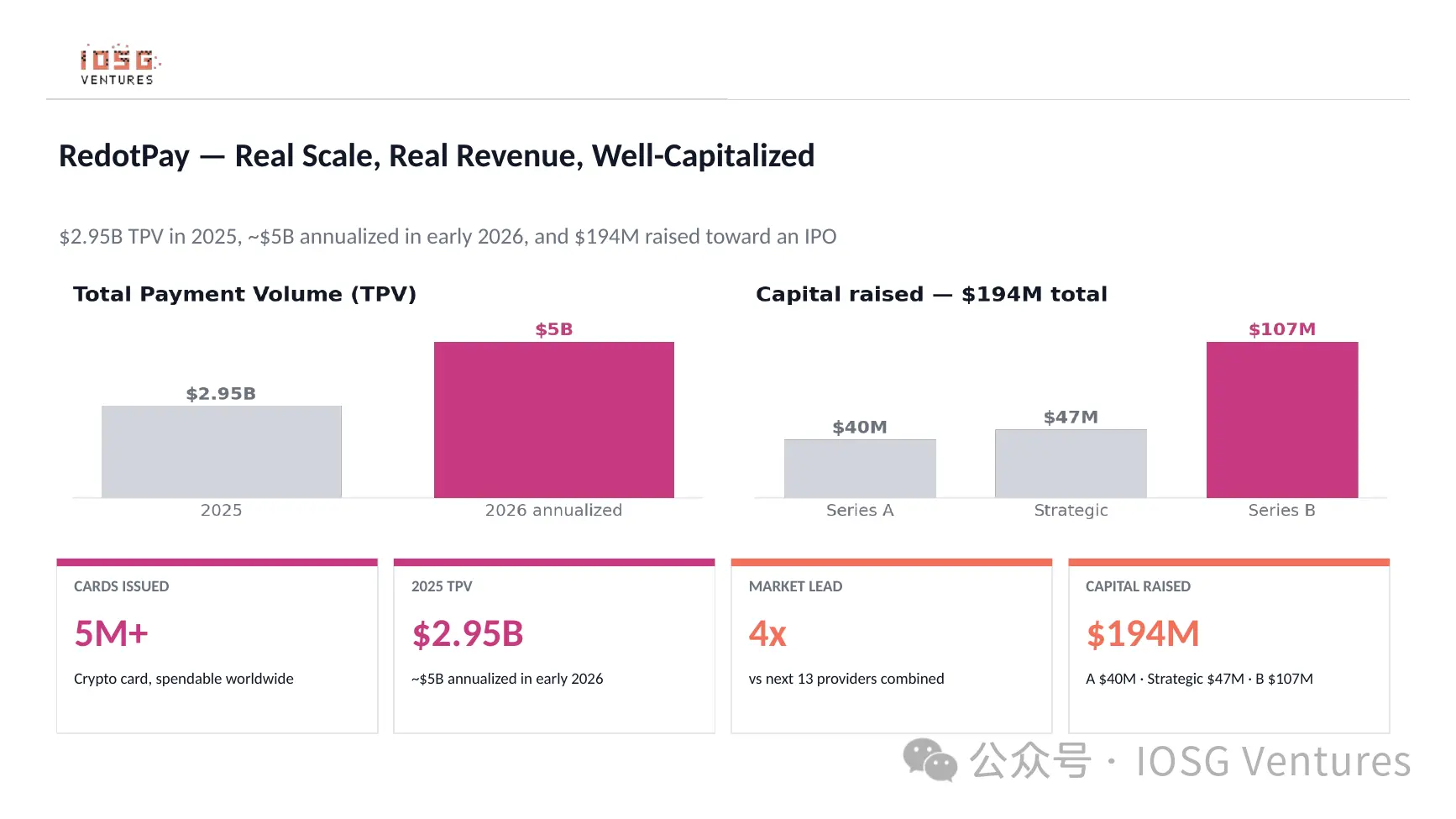
RedotPay Scale and Capital
Direction 2 · Prediction Markets: The Niche Future is the Mass Future
The second direction is prediction markets, which are moving toward the mainstream. Niche products migrate to become mass products; the niche future is the mass future. This represents the cold-start phase helping crypto achieve mass adoption.
Looking at the scale of two industry leaders: Polymarket reported $26.2 billion in trading volume in Q1 2026, up 90% quarter-over-quarter; during the World Cup (June 11 to July 19), volume exceeded $15 billion. Its differentiation lies in globalization and non-custodial operation, making it one of the best representatives of next-generation crypto applications. Kalshi takes a compliance route, secured federal licenses, recorded about $32.1 billion in Q1 2026 trading volume, and distributes through Robinhood and Interactive Brokers. Founded in 2018 and questioned for years, it survived the bear market, obtained licenses, and achieved the steepest revenue curve we’ve seen in U.S. fintech.
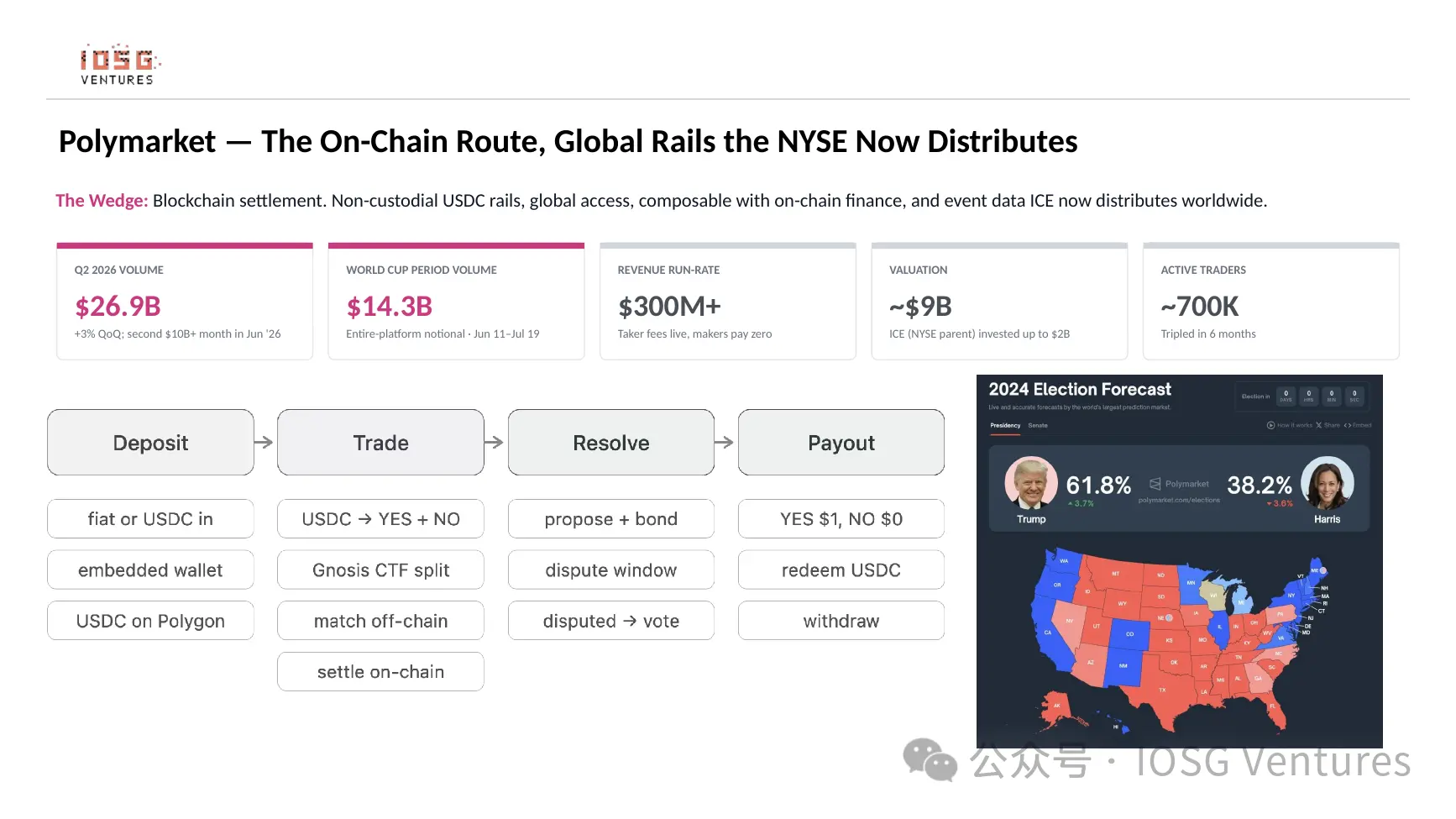
Polymarket · On-Chain Route
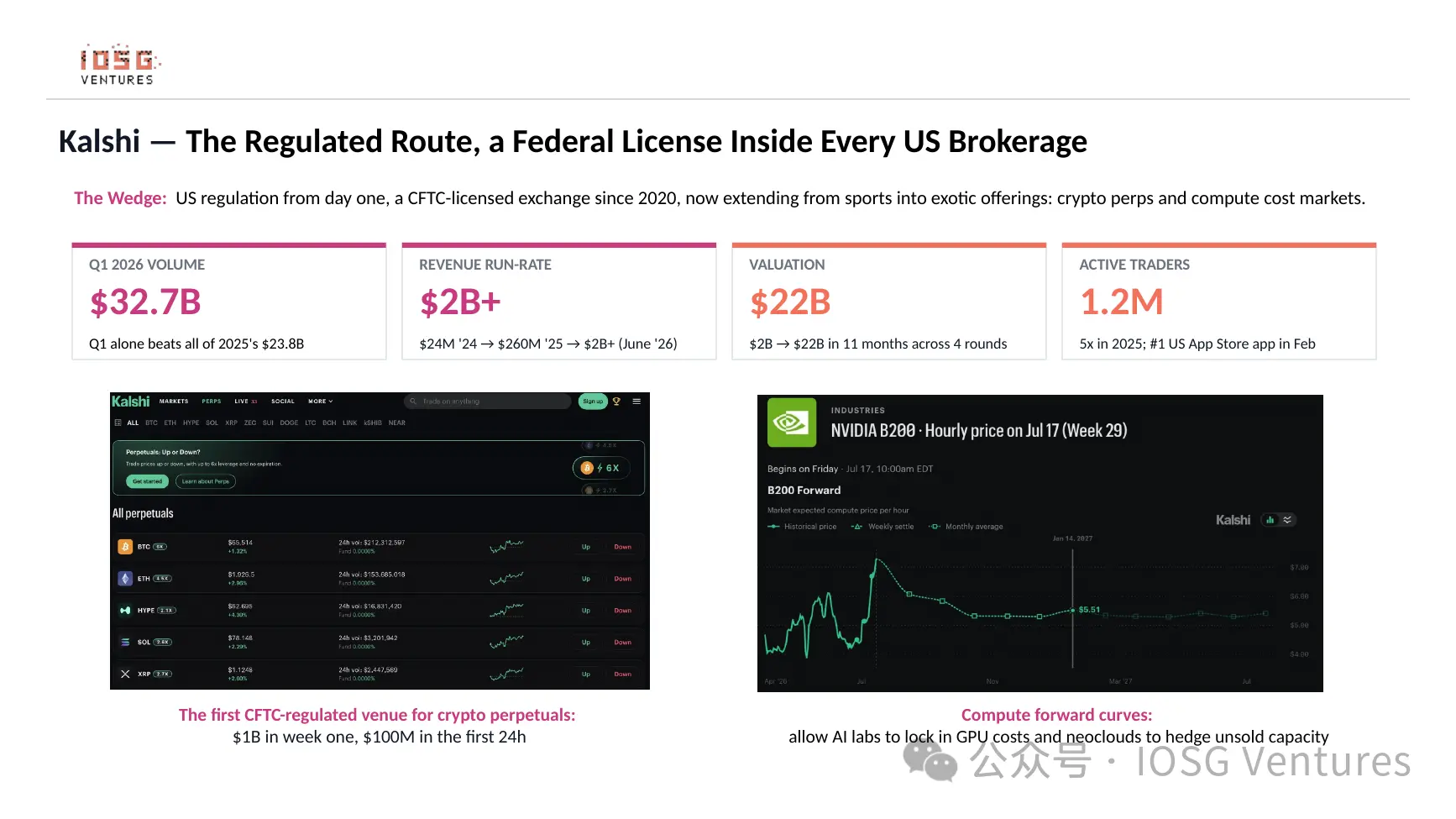
Kalshi · Compliance Route
Direction 3 · AI × Crypto: Computing Power, Data, and Capital Flow
The third direction is AI and crypto.
For the past five years, attention has focused on model quality: whose Transformer is better, whose RLHF is smarter. Now we need to think about a more fundamental logic: Where does computing power come from? Where does data come from? How does AI money flow?
First, computing power. Crypto has already proven one thing: open networks can coordinate hardware resources globally. During Ethereum’s PoW era (before The Merge in 2022), the aggregated GPU power across the network was equivalent to a frontier training cluster. This doesn’t mean miners’ GPUs can be directly used to train frontier models—the metrics differ—but it proves that with token incentives, you can aggregate scattered idle hardware worldwide. If this mechanism is correctly applied to the AI compute market, it becomes a genuine opportunity.
Second is data, and third is how AI money flows, namely the agent banking model. Let’s look at a few specific cases.
Grass has roughly 8.5 million users earning credits by sharing unused bandwidth via browser extensions and apps. Its network layer distributes scraping tasks from AI labs to these nodes, then cleans and structures web pages into enterprise-grade data. The key architecture lies in distributing demands from AI buyers (like enterprises willing to pay for training data, e.g., OpenAI, Anthropic) to on-chain users, incentivizing them with tokens or revenue. Currently, its dataset exceeds 250 PB. The economic model is highly realistic: ~$17 million in revenue in 2025, projected to exceed $70 million in 2026. As you can see, token projects in crypto are now highly tangible, generating revenue, cash flow, and paying customers. Prioritizing B2B then expanding to B2C is also one of our investment philosophies.
Hyperbolic is another portfolio company of ours, operating an inference and GPU compute marketplace. Over 250,000 developers are building on the platform, with clients including several frontier AI labs.
The third is a typical project bridging Crypto and AI: Nous Research, known as Hermes (“Dragonfly”). I won’t delve into the entire tech stack due to time constraints.
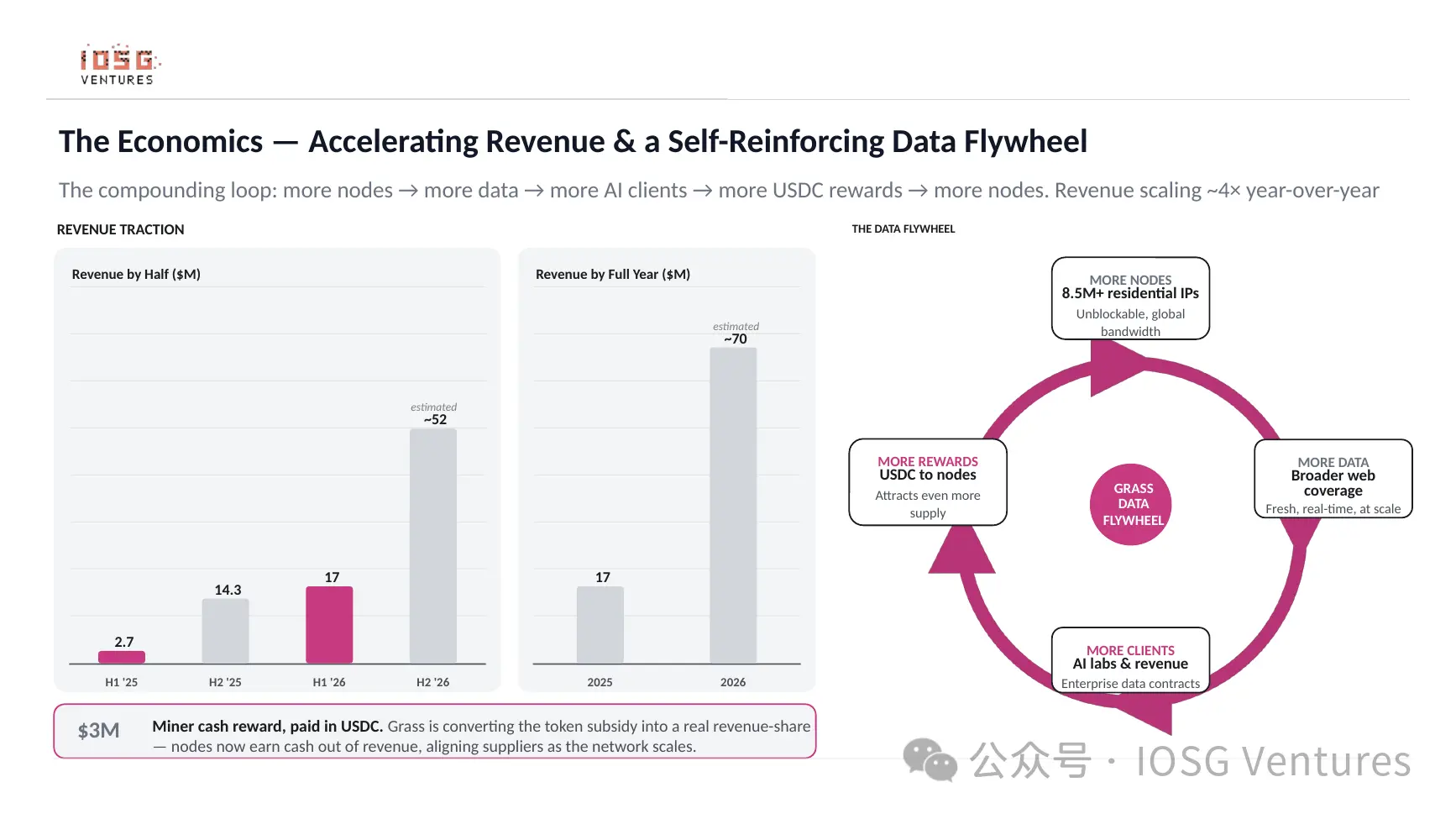
Grass Economic Model and Data Flywheel
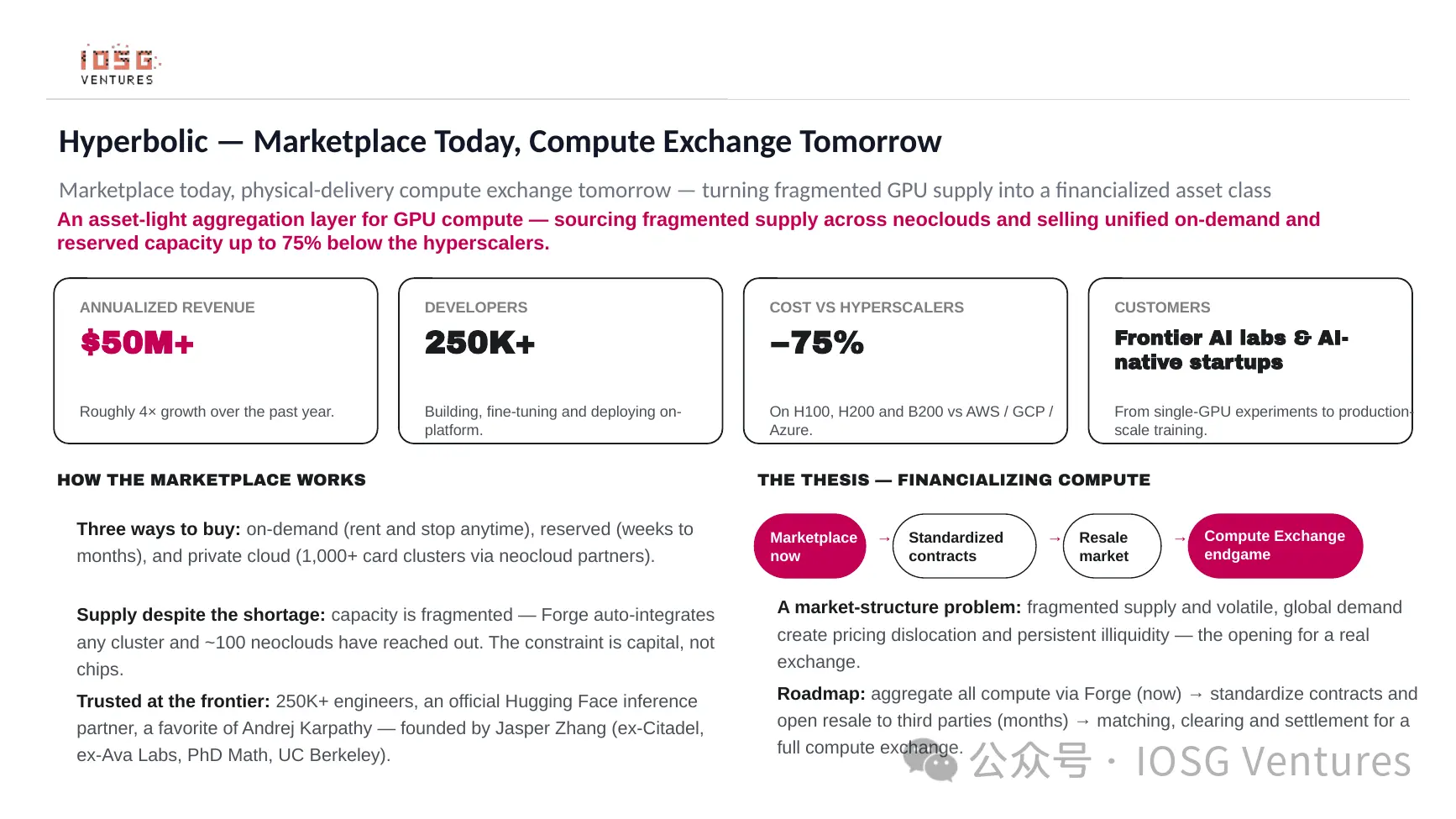
Hyperbolic Compute Marketplace
Direction 4 · On-Chain Trading & Credit: Collector Crypt, Hyperliquid
The fourth direction is on-chain trading and on-chain credit, a highly fascinating segment.
Collector Crypt operates like a “pawnshop + card shop,” but on-chain. By revenue, it’s already among the top two applications on Solana. The model is straightforward, in three steps: Step 1 Supply side: Buy and custodian physical cards, storing them in vaults; Step 2 On-chain tokenization: Each card becomes a tradable token, redeemable at any time; Step 3 Liquidity/Exit. Currently, its cumulative volume exceeds $1 billion, MAU stands at 4 million, and it’s one of Solana’s largest applications by daily revenue; protocol revenue was ~$7.2M in April, ~$9M in May, ~$15M in June, and ~$12M in July. At this scale, its annual revenue could surpass $200 million this year. It’s a genuinely revenue-generating project with issued tokens and clear demand.
Hyperliquid is also highly interesting—why do people say it’s “eating Binance”? In plain terms, it’s a self-compounding buyback flywheel. Think of it as a decentralized, futures-focused version of Binance: Every trade incurs a fee, and roughly 97% of those fees are used to buy back tokens; more trades generate more fees, which buy back more tokens, creating a continuous loop.
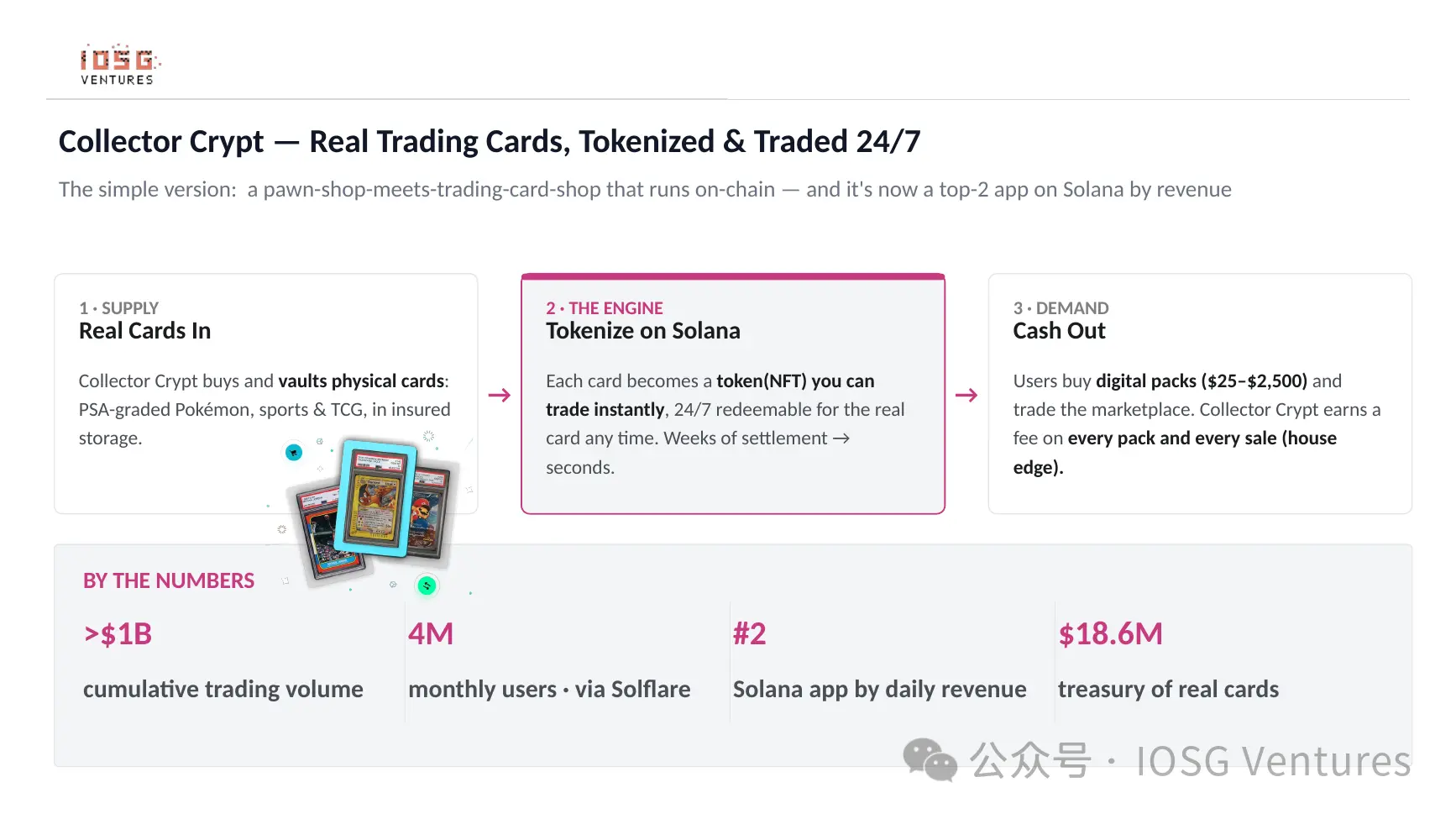
Collector Crypt · On-Chain Cards
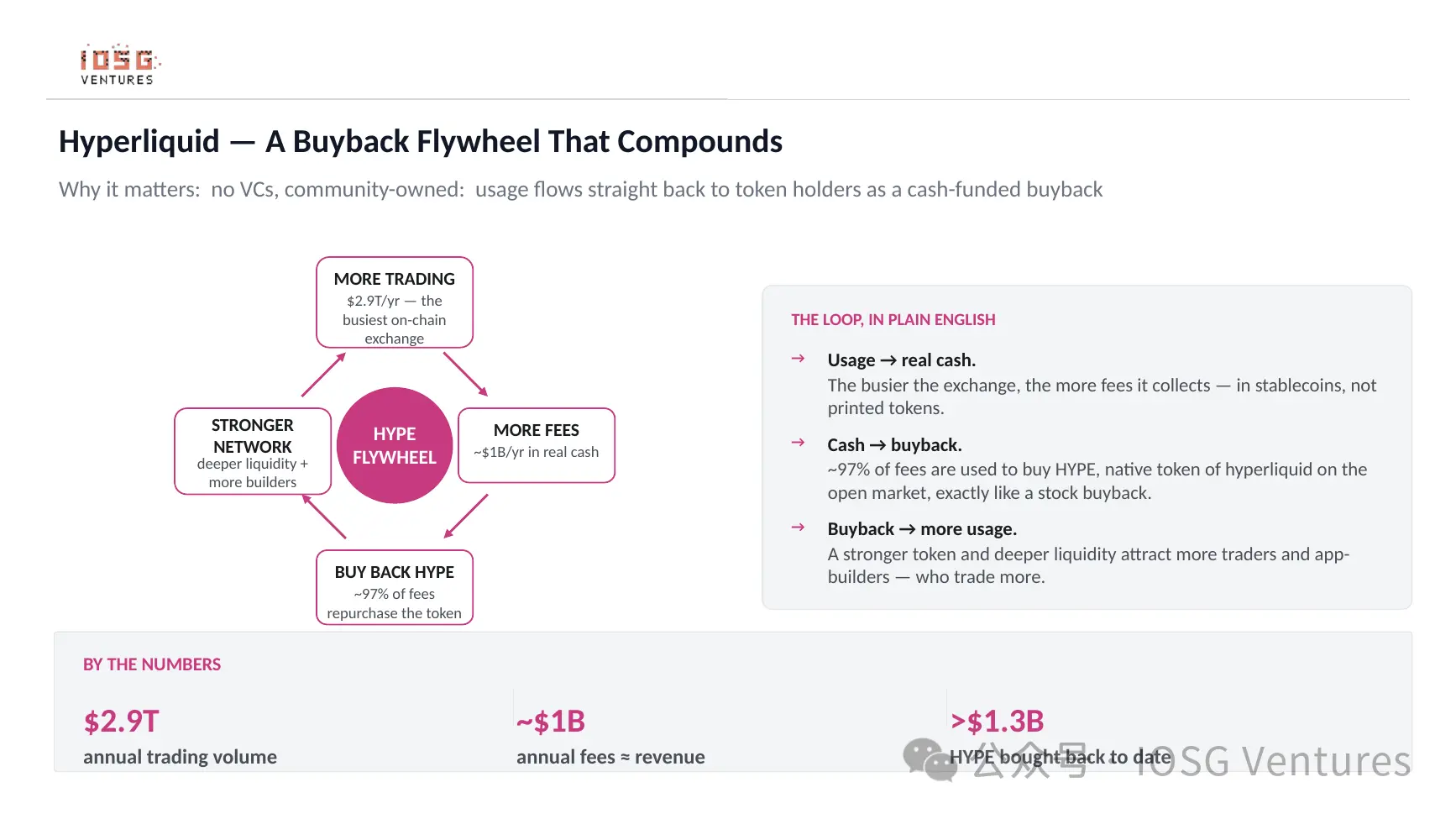
Hyperliquid · Buyback Flywheel
VII. IOSG’s Foundation: East-West Reach + Research Moat
Why us? Because IOSG possesses the best reach for global opportunities—most of our portfolios bridge East and West, North America and Asia; we also catch the core paradigm of each cycle early. Supporting all of this is our exceptionally solid research—deep research forms our investment moat.
VIII. Conclusion: The Bear Market is the Starting Point for Positioning
Thank you for your time, and I’ll wrap things up.
The best investment opportunities are often hidden within the worst sentiments. Key takeaway: According to “Bit Shenshi”'s assessment, Bitcoin has a chance to hit a bottom by late October this year. So friends who pivoted to AI or U.S. stocks can turn back and reassess the new opportunities in the crypto market.
So what will we capitalize on?
First, projects with genuine revenue. Stablecoins, payments, and AI-crypto intersections are all generating new, verifiable cash flows.
Second, businesses unfairly punished by this winter. Many projects have strong fundamentals but are priced as if the bear market is already 90% complete—this pricing misalignment is an opportunity in itself.
Third, IOSG has identified them early. Three rounds of contrarian, research-driven investments aim for one purpose: identifying the winners before the bull market arrives.
The bear market is the starting point for positioning. Thank you.
Join TechFlow official community to stay tuned
Telegram:https://t.me/TechFlowDaily
X (Twitter):https://x.com/TechFlowPost
X (Twitter) EN:https://x.com/BlockFlow_News
 IOSG Ventures