Bitwise: Bitcoin Decouples from US Stocks, Officially Entering Digital Gold Pricing Cycle
By André Dragosch, Head of Research Europe at Bitwise
Translated by Luffy, Foresight News
One of the longest-standing controversies surrounding Bitcoin is whether it truly qualifies as "digital gold." Proponents of this view largely argue from a theoretical standpoint that, like gold, Bitcoin possesses scarcity, fungibility, divisibility, and can be held without third-party custodianship.
Opponents offer more grounded counterarguments: Bitcoin’s historical price performance has been radically different from gold’s. They point out that Bitcoin has repeatedly experienced drawdowns of 50% to 80%, using this to challenge the narrative; moreover, Bitcoin was created much more recently than gold and has yet to achieve comparable acceptance as a store of value.
However, key shifts in the market have recently occurred that may help bridge this divide. It turns out that when genuine macroeconomic risks materialize, Bitcoin indeed plays the role of "digital gold," and right now is precisely the moment when this value begins to materialize.
Bitcoin-Gold Correlation Hits Six-Year High
August brought major macroeconomic developments. U.S. 10-year and 30-year Treasury yields rose, prompting Treasury Secretary Scott Bessent to intervene in the markets by increasing purchases of long-dated bonds. This intervention sends a clear signal that we may be entering a new era of financial repression and yield curve control.
Following the intervention, Bitcoin posted its strongest single-week rally since March 2024, surging 22.4%. Yet most investors overlooked one crucial detail: during this move, Bitcoin’s price action moved in high sync with gold.
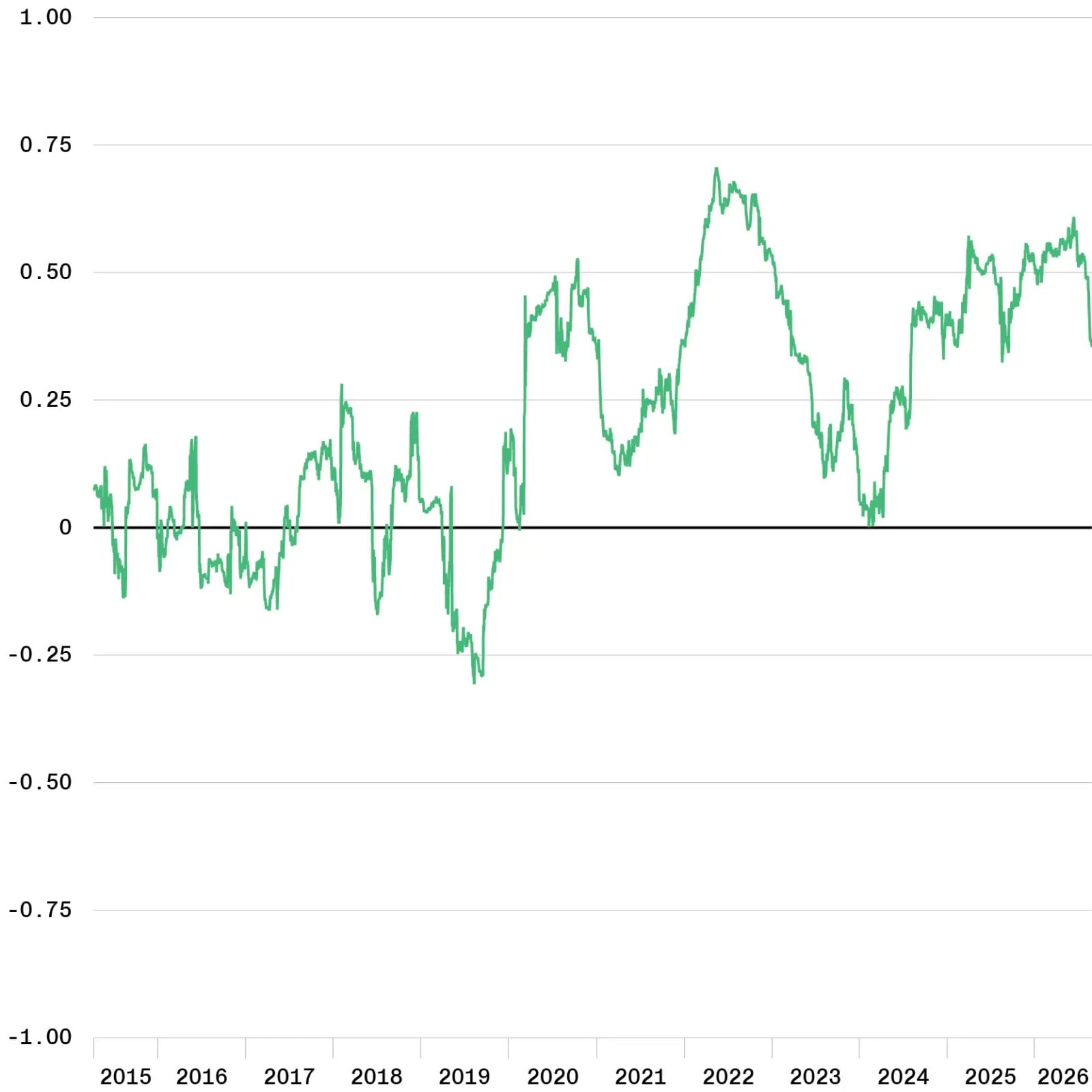
Specifically, gold gained approximately 5% for the week while U.S. equities declined. Diving deeper into the data yields a highly instructive conclusion: the three-month rolling correlation between Bitcoin and gold climbed to a six-year peak.

90-day rolling correlation between Bitcoin and gold. Data source: Bitwise Asset Management, Bloomberg Terminal; statistical period: 2015-04-13 to 2026-08-31; gold uses spot price.
The last time their correlation reached these levels dates back to 2020, amid multiple waves of fiscal and monetary easing worldwide during the pandemic. In other words, the two periods in history where governments carried out large-scale macroeconomic interventions coincided exactly with the two peaks in Bitcoin-gold correlation.
Meanwhile, Bitcoin’s correlation with U.S. equities has fallen to a one-year low, signaling a decoupling between hard assets and the stock market. The thesis that "Bitcoin is merely leveraged tech growth equity" may no longer hold true.
Bitcoin’s correlation with the U.S. stock market has retreated from its highs.
90-day rolling correlation of Bitcoin against the NASDAQ 100 index. Data source: Bitwise Asset Management, Bloomberg Terminal; statistical period: 2015-04-13 to 2026-08-31; benchmark used: NASDAQ 100 Total Return Index.
Furthermore, Bitcoin exhibits a significant negative correlation with the U.S. Dollar Index (DXY). As the dollar comes under pressure and weakens, Bitcoin (alongside gold) tends to benefit.
Bitcoin maintains a negative correlation with the U.S. dollar.
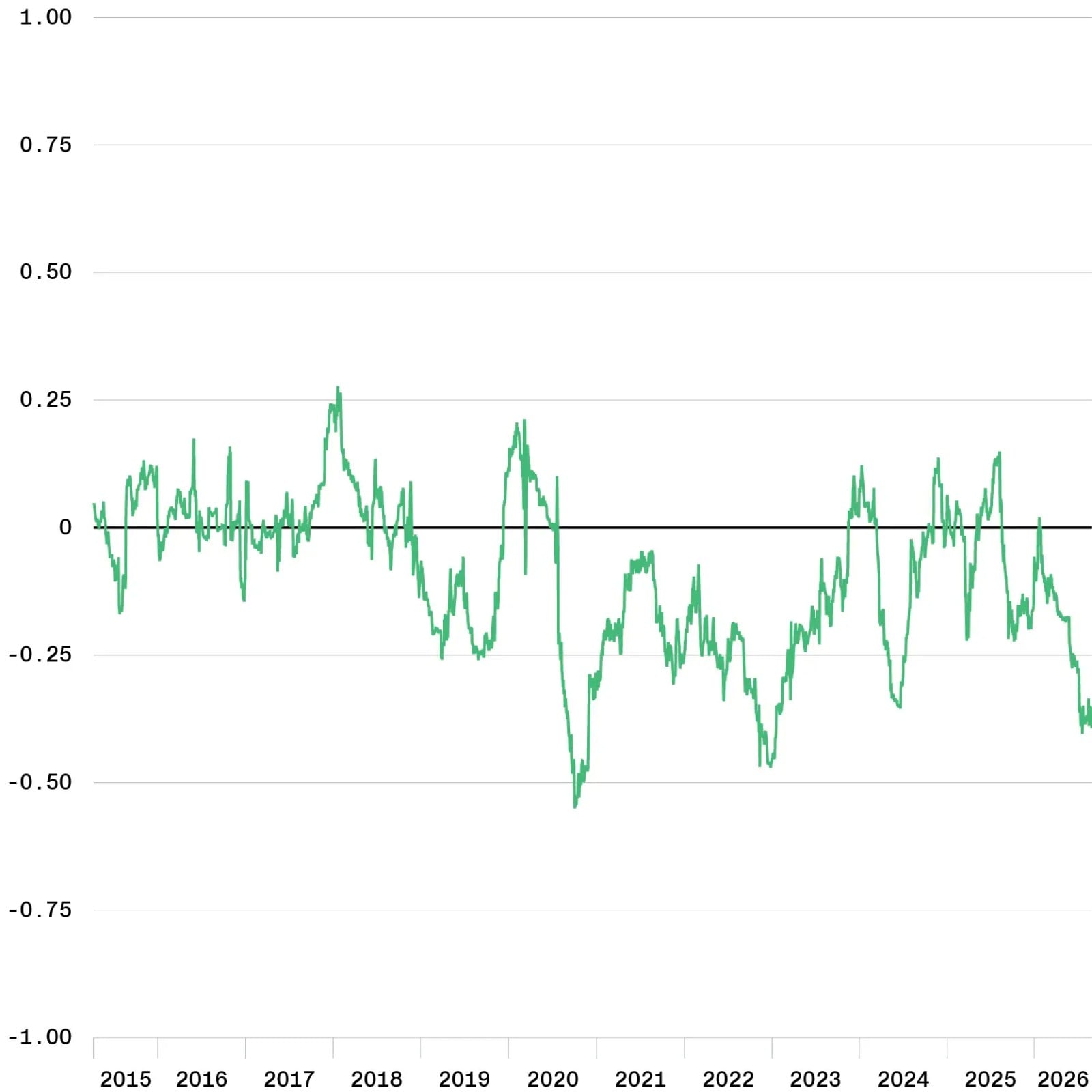
90-day rolling correlation of Bitcoin against the U.S. Dollar Index. Data source: Bitwise Asset Management, Bloomberg Terminal; statistical period: 2015-04-13 to 2026-08-31; U.S. dollar measured via DXY.
Bitcoin as a Hedge Against Currency Depreciation
The data conveys a clear message. First, Bitcoin is not equivalent to gold. Gold is a mature store-of-value asset forged over millennia; Bitcoin, born less than two decades ago, belongs to an entirely new class of innovations. When macroeconomic risks are no longer the focal point of the market, Bitcoin and gold still exhibit pronounced divergences in their price action.
But once macroeconomic tensions rise and macro variables exert tight constraints, facing currency depreciation risks, the boundary where investors choose between gold and Bitcoin is constantly blurring. Under such specific market conditions, Bitcoin begins to act as an elastic, amplified version of gold.
Gold commands a massive market valued at roughly $30 trillion, with holders predominantly comprising central banks, sovereign wealth funds, and large institutional asset managers. The scale of this capital pool far exceeds the venture capital and crypto-native capital that drove pricing in Bitcoin’s earlier stages. Should Bitcoin officially enter this store-of-value arena, its valuation framework will be benchmarked against a vastly larger market.
The correlation data delivers a very clear conclusion: investors are no longer torn between choosing gold or Bitcoin to hedge against currency depreciation; instead, they allocate to both assets simultaneously to jointly mitigate risk. Over the past fifteen years, Bitcoin has consistently been priced through the lens of a risk asset; if this strong correlation trend with gold persists, its value narrative over the next fifteen years could be completely rewritten.
Join TechFlow official community to stay tuned
Telegram:https://t.me/TechFlowDaily
X (Twitter):https://x.com/TechFlowPost
X (Twitter) EN:https://x.com/BlockFlow_News
 @BitwiseInvest