The U.S. Treasury is becoming a “shadow central bank,” as the independence of the Federal Reserve’s monetary policy faces erosion.
By Bao Yilong, Wallstreetcn
As the U.S. Treasury Department continues to expand its T-bill financing scale, its functions are increasingly resembling those of a de facto currency-issuing authority, and it is gradually encroaching on the Federal Reserve's domain through quasi-monetary policy operations.
On September 2, Bloomberg macro strategist Simon White pointed out that this trend will structurally elevate inflation pressures, undermine the Fed's policy independence, and expose market stability as well as real stock and bond returns to greater risks.
Currently, T-bills account for 22.7% of the U.S. total outstanding debt, exceeding the Treasury's informal 20% ceiling. Excluding Treasuries held by the Fed, this ratio rises to 24.1%.
White believes that as fiscal deficits continue to widen, this proportion is expected to climb further, at which point policy rates will no longer merely be the core variable for monetary policy, but will become the key anchor determining fiscal stability.
This structural shift means that if the Fed attempts to control inflation through rate hikes, it will face stronger political and fiscal headwinds. Higher rates would directly increase the government's borrowing costs, effectively acting as automatic fiscal tightening, which in turn exerts counter-pressure on monetary policy.
White bluntly stated that in the context of continuously expanding T-bill issuance, finding an interest rate level that simultaneously meets inflation targets, maintains financial stability, and prevents government borrowing costs from spiraling out of control may simply be an impossible task.
From Financing Instrument to "Shadow Money": The Evolving Role of T-Bills
T-bills have long been a routine tool for short-term government financing, but White notes that the Treasury is deliberately substituting T-bills for longer-dated bonds to absorb financing demands stemming from widening fiscal deficits.
From the Treasury's own perspective, this strategy carries a clear financial logic:
- Short-term debt financing costs are typically lower than those for long-term debt, and T-bills tap into a broad pool of capital preferring low-duration assets;
- Compared to long-term bonds, T-bills exert a smaller drain on bank deposits, helping to sustain market liquidity and real economic spending;
- Moreover, this approach somewhat sidesteps the political sensitivity of publicly implementing financial repression, although the Treasury's expansion of the repurchase program has already been viewed as a substantive step in that direction.
However, in White's view, T-bills are no longer just ordinary short-term financing instruments. According to the hierarchy of money theory proposed by Perry Mehrling, the top of the financial system consists of Fed reserves, followed sequentially by bank deposits, repurchase agreements, and money market fund shares—forms of "shadow money."
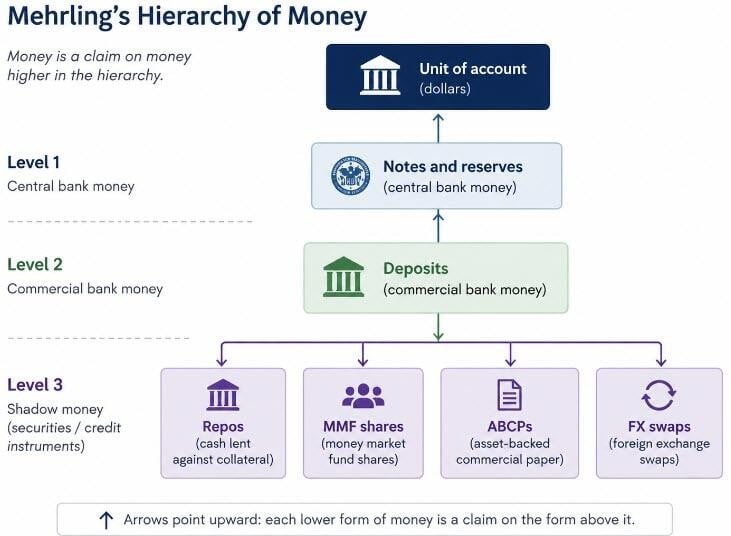
Due to their extremely short maturities and minimal valuation uncertainty, T-bills typically enjoy a zero haircut in the repo market and can be repeatedly recycled via collateral rehypothecation without losing value.
White points out that this makes T-bills functionally ever closer to money itself—a liquidity instrument suitable for final settlement.
The Rehypothecation Amplification Effect, With Quasi-Money Supply Quietly Expanding
White specifically emphasized the critical role of the rehypothecation mechanism in this process.
In the repo market, dealers can obtain collateral either from their proprietary Treasury holdings or borrow it via reverse repos, and then pledge the latter again to other counterparties.
Citing a 2021 academic study referenced by Bloomberg, Treasury collateral was rehypothecated three to five times on average between 2015 and 2021; during other periods, estimates from various sources suggest even higher figures. In other words, dealers are effectively constantly amplifying the amount of usable effective collateral available in the market.
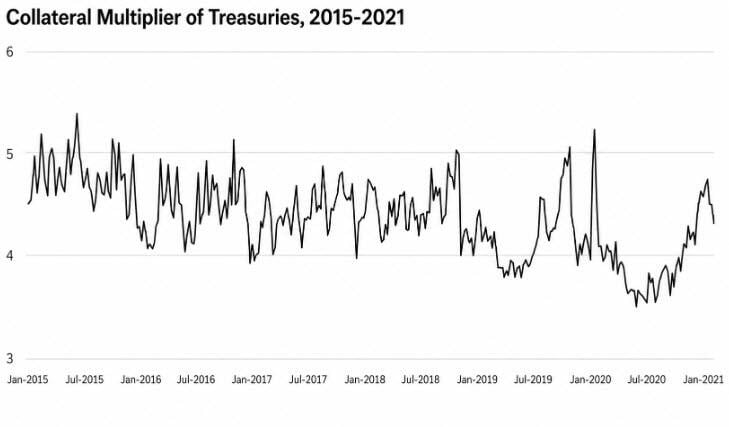
White notes that for long-term Treasuries, each round of rehypothecation gradually erodes the actual value of the collateral through haircuts; but because T-bills carry a zero haircut, they can be pledged repeatedly without value depreciation. This characteristic allows T-bills to continuously replicate themselves within the financial system, generating a quasi-money liquidity expansion effect.
Historically, a rising share of T-bills in total outstanding debt often precedes an uptick in structural inflation.
White believes there is a rational transmission mechanism behind this: increased liquidity pushes up asset prices, strengthens the wealth effect, and artificially suppresses capital costs, ultimately transmitting to the real economy and driving up the overall price level.
The Fed Faces a Dilemma, With Policy Independence Under Fundamental Challenge
White argues that the expanding scale of T-bill issuance poses a fundamental constraint on the Fed's policy space.
As more public debt becomes directly tied to short-term rates, every Fed rate hike immediately increases government interest expenses, equating to automatic fiscal tightening. This mechanism objectively creates political pressure, making it harder for the Fed to act decisively when inflation resurges.
White directly pointed out that as the T-bill share continues to rise, "the Fed may in the future no longer be able to set policy in the optimal way to meet its inflation target."
Meanwhile, increased T-bill supply could also trigger fragility in the short-end funding market. If new supply drives T-bill yields higher, money market funds might shift capital from the repo market to T-bills, thereby reducing liquidity supply in the repo market.
White specifically highlighted that, given the current relatively low combined balance of Fed reserves and the reverse repo facility relative to GDP, the risk of this capital migration triggering tightness in the short-term funding market is particularly noteworthy.
At the financing structure level, the Treasury itself will face heightened vulnerability. T-bill issuance entails more frequent and larger-scale auctions, meaning any rise in inflation expectations is instantly reflected in borrowing costs. Even if the Treasury intends to curtail long-term bond issuance, a substantial spike in term premiums could ultimately cause long-term financing costs to rise rather than fall.
White's conclusion is quite pessimistic: as the T-bill share expands, the policy rate will simultaneously bear the dual function of monetary policy and fiscal stability. Between inflation targets, financial stability, and fiscal sustainability, finding a balanced interest rate level that fully satisfies all three sides is likely an unsolvable puzzle.