The $399 Yellow Duck Hides Hugging Face's Greatest Ambition
Author | Yuhangyuan
Editor | Jingyu
Few robots make you smile at first sight.
On August 27, Pollen Robotics, under Hugging Face, opened pre-orders for the Microduck.
A two-legged robotic duck standing 25 centimeters tall and weighing less than 800 grams, available in four colorways for $399, shipping before Christmas. It can walk, squat down and stand back up, flip itself over after being pushed down, and even strap on a pair of detachable roller skates to glide. Its beak is articulated; it can lower its head, pick up socks or markers off the ground, straighten up again, and still hold its “loot” in its mouth.

Microduck Soccer Match | Image Source: Hugging Face
It lacks voice interaction and cannot speak, but it is equipped with a microphone and speaker. After initial setup, each Microduck generates its own unique “voice identity.”
The official positioning is clear—treat it as a living creature, not an assistant.
If all you see is “cute,” you are likely underestimating what lies behind this duck.
01 An “Electronic Pet” Ready to Play Straight Out of the Box
What’s inside the box is simple—the robot body, one battery, one USB-C cable, and one game controller. Plug it in, pair the controller, and the duck starts moving.
It comes pre-installed with seven behavior strategies, each an independent motion model trained via reinforcement learning. Push the joystick on the controller, and the Microduck takes steps forward on its short legs. Its gait is wobbly, slow, but steady. Let go of the stick, and it stops immediately, standing perfectly upright.

Despite lacking wings, the little duck has pretty good balance | Image Source: Hugging Face
Pressing buttons triggers different actions—squatting, standing up, lifting a leg to kick a ball. Judging from the GIFs, the one that makes you want to play on repeat is probably “getting up on its own.” Push it backward, and it lies flat on its back for a second, then twists its body, props up its head, flips over, and stands back up smoothly in one fluid motion.

The duckling’s beak can truly pick up socks, and it can even roller skate | Image Source: Hugging Face
The beak can grasp objects. Lower your head, open your mouth, pick up a small item on the floor, raise your head, and take two steps forward—this action is called “Grab,” resembling a real duck fishing at the water’s edge.
The accessory pack includes a pair of detachable roller bases. Attach them to unlock “Skating Mode.” Also included is a small ball to kick, a laser pointer for it to track with its camera, and NFC tags—you can preset different behavior commands on them, stick them to a desk, and when the duck walks over and scans one, it will trigger the corresponding action.

Users can train virtual ducklings to perform various actions in a simulated environment | Image Source: Hugging Face
To put it plainly, the unboxing experience design philosophy leans more toward Nintendo than Boston Dynamics. You don’t need to know any code to play with it, but if you do, the playability scales exponentially—every factory-installed action can be retrained, or you can train a brand-new behavior from scratch and deploy it back to the physical robot.

Ducklings in different colors sitting in a row together | Image Source: Hugging Face
The four color choices are also deliberate. Hugging Face says the duck design was chosen because the robot’s proportions and wobbling gait naturally resemble a duck. Placed together, the four colors (off-white, graphite, lavender, sky blue) “look like a group of distinct characters rather than a row of identical machines.”

Official stickers let you customize your little duck yourself | Image Source: Hugging Face
The kit also comes with stickers, letting you add lips and eyes to give the duck a personalized look. When multiple ducks gather, they can team up to play soccer, creating a chaotic yet joyful scene.
02 The Duck Raised by the Community
Microduck did not appear out of nowhere.
Its predecessor was called Open Duck Mini, an open-source project initiated by Antoine Pirrone, an R&D engineer at Pollen Robotics. Inspired by the BDX robot from Disney’s “Star Cruiser” experience—a bipedal, expressive little character—Pirrone aimed to replicate it using 3D printing and inexpensive servos. The bill of materials cost around $400, assuming you already had a printer and a soldering iron at hand.

The duckling’s predecessor, Open Duck Mini | Image Source: AIFITLAB
The project accumulated over 2,600 stars on GitHub. At this year’s Google I/O, two Open Duck Minis took the stage, running Google’s Gemma 4 model locally on Raspberry Pi 5 and Jetson Orin Nano devices for on-device speech inference without connecting to the cloud. That demo made many realize for the first time that hardware costing a few hundred dollars could already run a decent language model locally.
But the direction of Microduck is almost the opposite of that demo. Open Duck Mini’s breakout moment was doing inference—making small models “speak” on device; Microduck’s core selling point is control—using policy models to drive the robot to “act.” Each of the seven factory-installed behaviors is a reinforcement learning strategy trained in the MuJoCo physics simulator and deployed to the physical robot to run at a frequency of 50 Hz.
In other words, Pirrone’s community project was picked up by Pollen for commercial mass production, but the core philosophy remains unchanged—providing more people with a tangible platform to get hands-on with reinforcement learning and sim-to-real transfer.
03 “Open Source,” But Only Halfway
The Microduck software stack is fully open-sourced under the Apache 2.0 license, including the SDK, MuJoCo simulation environment, and complete reinforcement learning training pipeline. All seven factory-installed action policies are also public. You can fork, modify, retrain, and deploy them back to the physical robot. The official team even encourages users to publish their newly trained behaviors to the community so other ducks can learn them too.
Hugging Face CEO Clem Delangue’s promotional pitch on X was straightforward—“A $399 open-source robot you can teach new tricks to with reinforcement learning.”

Some actions the duckling can currently perform | Image Source: Hugging Face
Strictly speaking, however, calling it an “open-source robot” stretches the truth. Pollen Robotics explicitly states that neither the hardware design nor the circuit diagrams will be open-sourced. This means while you can view, modify, and retrain the entire “brain” that makes the duck move, the blueprints for building its “body” remain locked down.
It is a product with an open-source soul running inside a closed-source shell.
For the pure open-source community, this might be a pity. But from a business perspective, the logic is clear—hardware is Pollen’s moat, while opening the software is to build an ecosystem. What Hugging Face does best is turning developer communities into flywheels. Opening model weights turned Hugging Face Hub into the GitHub of AI, and now they want to replicate the same logic with robotic behavior policies.
Train a walking policy, publish it to Hub, have others download and run it on their own ducks—that is the physical-world mapping of “models are useful because people can build on one another's work.”
04 Hugging Face’s Board Game for Embodied Intelligence
To understand Microduck, you have to view it within Hugging Face’s layout in embodied intelligence over the past two years.
In early 2024, Hugging Face lured Remi Cadene away from Tesla to serve as Chief Research Scientist, leading a brand-new open-source robotics project. Several months later, LeRobot was released—an end-to-end open-source tool library for robotic learning, positioned as the “Transformers for robotics,” integrating dataset hosting, model training, and physics simulation.
In April 2025, Hugging Face acquired Bordeaux-based Pollen Robotics, bringing about 20 employees onto the team. Pollen’s flagship product, Reachy 2, is a research-grade humanoid robot priced at around $70,000, already deployed at top universities like Cornell and Carnegie Mellon. But $70,000 is destined to cater to a niche market.
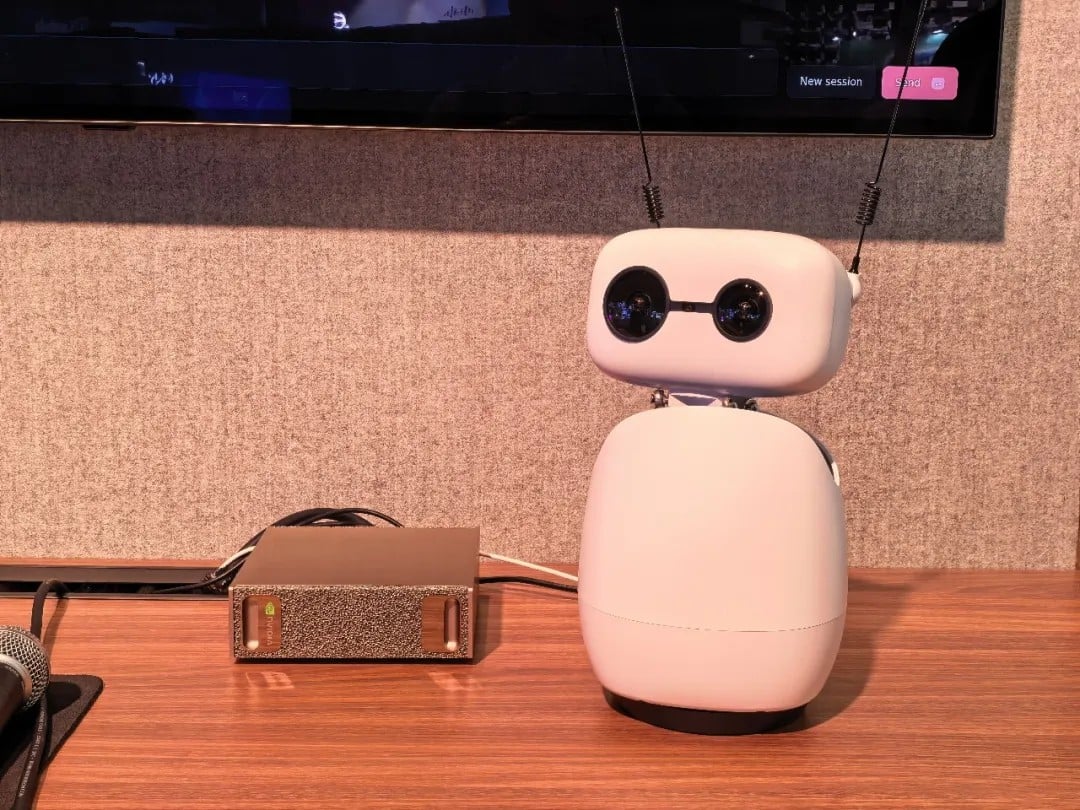
GeekPark chatted with the Reachy Mini robot at this year’s GTC conference in March | Image Source: GeekPark
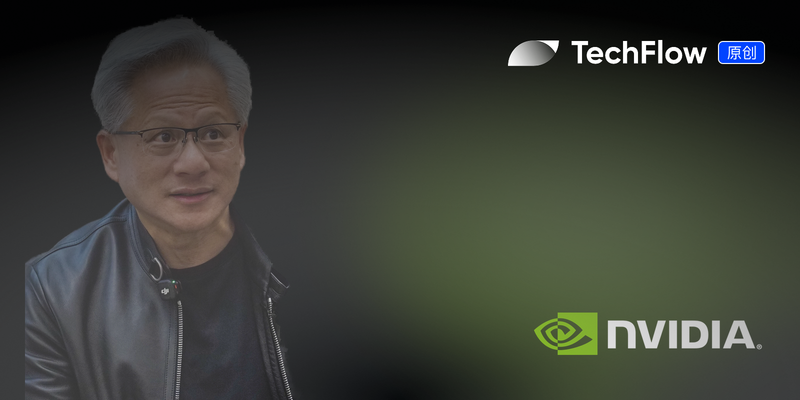
Just three months after the acquisition, in July 2025, the Reachy Mini was released. A 28-centimeter-tall desktop robot starting at $399, focusing on conversational interaction, facial animation, and visual recognition. At this January’s CES, Jensen Huang personally demonstrated it during his keynote speech, using a DGX Spark paired with the Reachy Mini, labeling it “your own office R2-D2.” Pollen revealed that the Reachy Mini has cumulatively shipped 3,000 units.
Looking back at this lineup now, the logic is very clear—LeRobot builds the platform, Pollen provides the hardware, Reachy Mini targets “interaction,” and Microduck targets “mobility.” The two product lines complement each other rather than compete. The Reachy Mini has a head, antennas, and speech capabilities, making it suitable as a carrier for conversational AI and vision models; the Microduck has legs, can walk, and can grab things, making it ideal as an experimental platform for reinforcement learning and motion control.
Hugging Face aims to cover the two most core research directions in embodied intelligence simultaneously on a desktop, all for under $500.
05 The $13 Billion Duck
All of these layouts now come with a larger backdrop.
On the exact same day Microduck opened for pre-orders, multiple media outlets reported that Nvidia had basically reached an agreement to acquire Hugging Face for approximately $12.9 billion. If completed, this would rank among Nvidia’s largest acquisitions in history.
Nvidia’s intentions aren’t hard to guess. The boom in open-source models directly drives demand for GPUs—every model training and inference session on Hub potentially translates to greater compute consumption. But beyond the model ecosystem, Nvidia’s ambition in embodied intelligence is equally massive.

At the end of this year's GTC conference, Jensen Huang interacts with the Baymax robot | Image Source: GeekPark
From Isaac Sim to the GR00T foundational model, and then to the Cosmos world model, Nvidia has already been building a full-stack robotics toolchain from simulation to deployment. The LeRobot brought by Hugging Face, Pollen hardware, and developer community precisely fill in the missing puzzle pieces of “low-cost hardware entry” and “community flywheel” in this system.
A $399 duck, on Nvidia’s chessboard, might be the cheapest yet most effective user acquisition tool. By allowing students, researchers, and hobbyists worldwide to run through the entire reinforcement learning process on the Microduck, they will naturally grow into users of Nvidia’s embodied intelligence ecosystem.
However, the acquisition also brings uncertainty. Hugging Face’s core values are openness and neutrality—it hosts models from everyone, including Meta, Google, Mistral, and others. Once placed under Nvidia’s wing, whether this neutrality can be maintained and whether the community will vote with their feet are unresolved questions.
The Microduck itself won’t solve any core challenges in robotics, and Pollen acknowledges this. But it might give more people the chance to get their hands dirty with those very challenges. In a field like embodied intelligence that is still far from large-scale commercialization, getting more people “into the game” might be more important than any single technological breakthrough.
This duck stands steadily. As for the grand chess game behind it, that has only just begun.