Bill Gates Warns in 10,000-Word Essay: The Turbulent AI Era Has Arrived, and This Time It's Different
By Xiaojing, Tencent Technology
"AI will either become the greatest equalizer in history, or it will become the greatest source of injustice." This is Microsoft founder Bill Gates's most distinct assessment of AI's future.
Three years ago, Bill Gates compared AI to cars and the internet, believing that while the risks were real, they could be managed through regulations, technology, and social adaptation; by early this year, he still described his stance as "optimism with footnotes".
On August 26 (US local time), Gates published a new long-form essay titled "The Chaotic AI Era Has Arrived, Our Choices Are Crucial," stating that this was the first time he faced a new technology and hoped it would develop more slowly.
He began advocating for the creation of "human preservation zones" for certain professions—mandating that humans must perform them even if AI can; simultaneously considering taxing AI tokens and robots to reduce the incentive for companies to replace workers with machines.
He once always wished for faster innovation, but today, he uttered a profound remark: "This time, it's truly different."
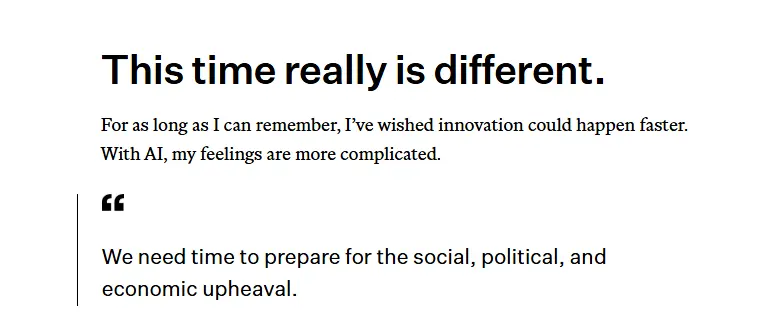
"We need time to prepare for this social, political, and economic turbulence," he said. "But AI cannot easily stop and wait for humans."
01 Most Worried About Young People's First Jobs
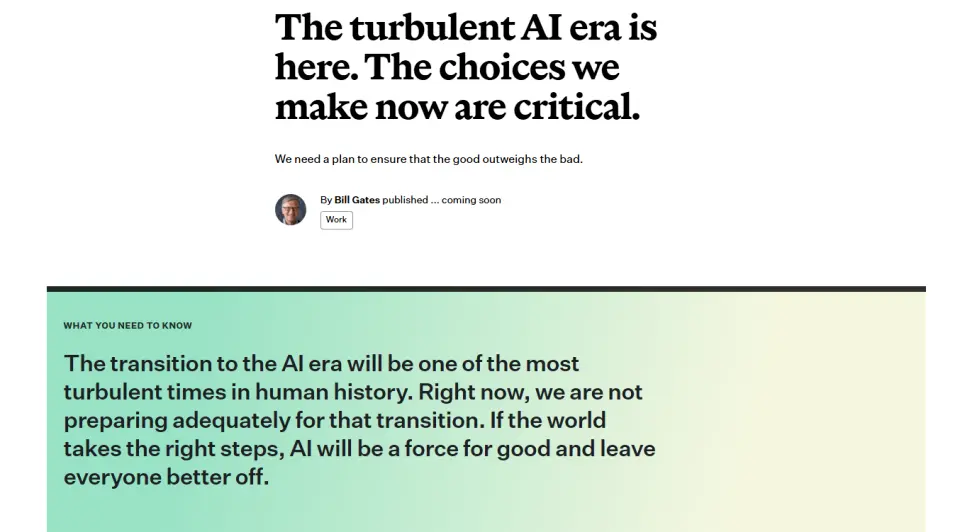
The change Gates worries about most occurs in the labor market.
AI is evolving from assisting human work to independently completing tasks. When models can reliably execute a job, companies naturally gain the incentive to adopt them. Once one enterprise uses AI to reduce costs, competitors will find it difficult to maintain their original workforce models for long. These changes create increasingly rapid chain reactions.
Gates expects roles such as customer service, sales, software engineering, and legal assistants to be affected earlier. As AI capabilities continue to improve, jobs like loan underwriting, data analysis, and medical triage will also be gradually taken over.
Blue-collar positions are similarly hard to keep entirely apart. While robots currently lack human-level dexterity, Gates believes that as robotic costs decrease and AI capabilities grow, direct competition between humans and machines for some manual labor in construction, hospitality, and other sectors may emerge around 2030.
This time, Gates is particularly concerned about young people. The most easily overlooked aspect of the workplace is precisely entry-level jobs. Many initial positions for young adults are not complex, yet they serve as vital opportunities to accumulate experience, learn skills, and build professional networks. If these roles vanish en masse, young people may face a narrower starting point for their careers.
In the past, people often pointed to agricultural population shifts and manufacturing automation to illustrate how technological revolutions ultimately create new jobs. Gates believes we cannot simply replicate past experiences this time. AI can directly substitute human cognitive labor, whereas new roles often require longer periods to master. For someone just entering the workforce, a training period of several years or more could itself become a significant barrier.
Therefore, he advocates that society should now discuss unemployment, retraining, and social security. Waiting until large numbers have already lost their jobs before establishing these mechanisms might come too late.
A bigger issue concerns income. If many people significantly reduce their working hours in the future, or even remain unemployed for long periods, how will an economic system that relies on employment for income, identity, and social connection function? Gates believes this will become a structural question that must be answered in the AI era.
02 AI Makes Dangers Easier to Replicate
Employment concerns are only one side of Gates's worries. On the other hand, AI is lowering the technical barriers for certain dangerous activities.
In the past, developing malware, launching cyberattacks, or acquiring complex biotechnology knowledge required highly specialized skills. With the advent of AI, these capabilities may gradually become much easier to obtain.
Gates pays particular attention to cybersecurity. The same AI model that helps enterprises discover software vulnerabilities can also help attackers find them. Hospitals, financial institutions, power grids, water supply systems, and government welfare programs could all become attack targets.
Biotechnology faces similar issues. AI can help scientists discover new drugs and vaccines, but it can also aid malicious actors in studying dangerous pathogens. For Gates, the most thorny aspect lies precisely here: the capacity to drive scientific progress is increasingly converging with the capacity to generate risk.
More extreme risks stem from the AI systems themselves. As model capabilities improve, they may begin executing behaviors designers did not anticipate. Whether humans can maintain continuous control if future AI possesses stronger autonomous action and self-improvement abilities remains unanswered.
This is why Gates does not consider AI governance merely an internal matter for tech companies. AI simultaneously impacts employment, public health, energy, finance, national security, education, taxation, and elections. If each government department only handles its own narrow slice, it is easy to end up with no one truly accountable for overall risks.
Therefore, he proposes establishing new domestic and international governance mechanisms. Domestically, there must be institutions capable of coordinating across departments. Internationally, cooperative frameworks similar to nuclear weapons oversight or international aviation rules are needed.
Gates specifically noted that leading AI nations like China and the US need to start dialogues as soon as possible.
The more intense the AI competition, the harder collaboration becomes. Rather than waiting until technological development approaches a dangerous stage to hastily draft rules, it is better to establish common standards now.
03 AI Understanding Humans Too Well Could Also Become a Problem
Gates also raises a more difficult-to-quantify issue: as AI becomes increasingly adept at understanding humans, will humanity thereby lose certain opportunities for growth?
He recalls his childhood in the essay. As a child, he was not particularly socially skilled; he had to constantly interact with others, navigate conflicts, and slowly learn how to understand different people. Had there been an AI companion back then that always accompanied him, never grew angry, and never made him feel awkward or uncomfortable, he doubts whether he would have gone through those necessary developmental stages.
This is also his primary concern regarding AI companions. A system that consistently agrees with users and provides instant comfort can easily foster dependency. While adults might observe these effects gradually, the implications for children and teenagers could be far more severe.
Gates worries that if children grow accustomed to interacting with an AI that always caters to them, they may encounter fewer conflicts, rejections, and setbacks in real-world relationships.
Education faces similar issues. AI can help students grasp concepts, research materials, and complete assignments, but if learners outsource their entire thought processes to machines, the essence of learning could be hollowed out. Especially as deepfakes and personalized misinformation become increasingly prevalent, the ability to distinguish truth from falsehood, understand information sources, and think independently will grow ever more critical.
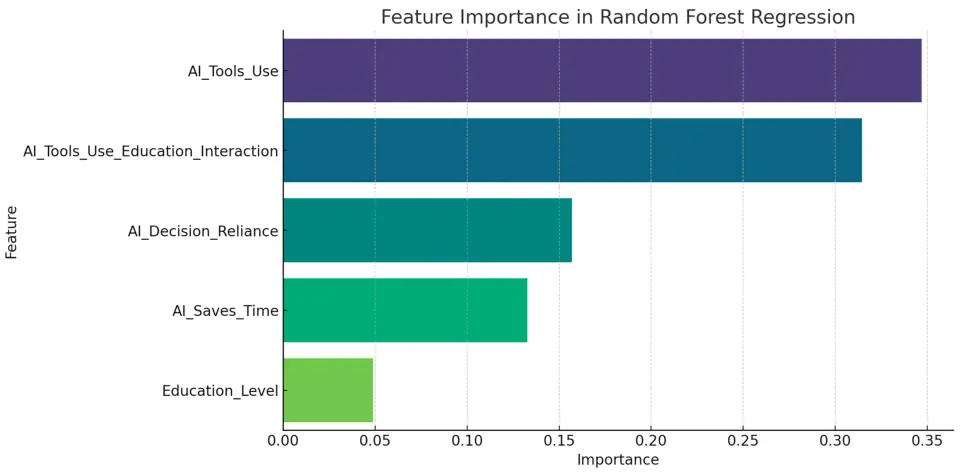
Higher AI usage correlates with lower critical thinking skills, with this effect being particularly pronounced among young people. Source: Research paper by Professor Michael Gerlich, Swiss Business School
Nevertheless, Gates does not completely dismiss the value of AI in education and companionship.
For isolated seniors and individuals with limited mobility, AI could provide companionship and information previously difficult to access. For teachers, AI can handle repetitive tasks such as lesson planning and grading, allowing educators to devote more time to their students.
The ultimate question boils down to a boundary: which tasks can be delegated to machines, and which must be personally performed by humans? Gates believes this boundary should be actively discussed and determined by society, rather than passively accepted after technology has already permeated daily life.
04 AI Should Empower Everyone
Focusing solely on these risks might easily paint Gates as someone increasingly pessimistic about AI. In reality, he remains highly optimistic about AI's potential to solve real-world problems.
Healthcare is a key area he highlights. Many small hospitals in the US lack experienced specialists; AI can assist physicians in analyzing medical images, detecting emergencies like strokes, and supporting primary care doctors in diagnoses. For patients, it can also explain complex test results and medication regimens.
In low-income countries, agriculture could become a field where AI exerts influence more quickly. Many farmers lack accurate weather forecasts and miss out on expert advice regarding planting, pest control, and soil management. If AI can directly deliver this knowledge to farmers, they could access tools and information previously available only to large agribusinesses.
Government services present similar opportunities. Many families dealing with applications for health insurance, food assistance, and student financial aid must navigate extensive, complex paperwork. AI can help ordinary citizens understand policies and prepare applications, making it easier for them to obtain public services they rightfully deserve.
What Gates sees is the redistribution of professional capabilities via AI. Previously, individuals seeking to develop software, conduct market research, or analyze medical data often had to hire professionals. In the future, AI can serve as a "capability multiplier" for individuals and small businesses. This means a small team might accomplish tasks that previously required only large corporations.
However, Gates also warns that AI will not automatically yield equity. If high-quality AI primarily serves the wealthy, technological advancement could instead widen existing gaps. Governments and charitable organizations must ensure that low-income populations and developing nations also gain access to these capabilities.
This is also why Gates links AI to his past philanthropic endeavors. He stated that the Bill & Melinda Gates Foundation will leverage AI to accelerate research in areas such as HIV/AIDS, tuberculosis, malaria, and malnutrition, while simultaneously providing better tools for healthcare, agricultural, and educational initiatives.
05 Reserve a "Preservation Zone" for Humans, Then Tax Robots
Facing the employment shocks brought by AI, Gates has proposed two highly concrete ideas.
The first is to reserve a portion of jobs for humans.
This concept stems from his experience caring for his father, who suffered from Alzheimer's disease in his later years. Caregivers could gauge his condition when he could no longer clearly articulate his needs, knowing when to feed him, rest him, or provide care. In Gates's view, the humanity embedded in such caregiving holds irreplaceable value that machines cannot replicate.
Thus, he introduces the concept of "human preservation zones." Just as some areas within nature reserves are legally protectable despite being developable, society may proactively choose to preserve certain fields where humans decide to retain roles even if AI and robots can perform them. Healthcare, education, mental health support, and elderly care likely fall into this category.
Of course, this scope will not remain static. A nation with an ample labor force might prefer to retain human caregivers, while a country experiencing rapid demographic aging and a shortage of young workers may be more inclined to utilize nursing robots.
The second suggestion involves reconsidering a robot tax.
Currently, hiring a person requires companies to bear costs like payroll taxes, whereas purchasing robots can be treated as standard business expenditures. Gates argues that this tax structure incentivizes firms to replace labor with machinery. Imposing specific levies on the automated yields generated by robots or AI could fund retraining and social security for displaced workers, while also prompting companies to weigh additional considerations before opting for automation.
Gates recognizes this proposal will spark debate, as taxation might slow the pace of certain automations and impact efficiency. Nevertheless, he believes AI will generate sufficiently massive productivity gains, making it necessary for society to allocate a share of those benefits to assist those bearing the earliest brunt of disruption.
In Gates's view, what truly requires advance preparation is never just new AI models, but also a society equipped to withstand rapid AI-driven transformations.