Wall Street's Imagination Can't Keep Up With Nvidia's Pace
By Su Yang, Tencent Technology
NVIDIA once again delivered a stellar earnings report, with revenue, operating profit, and earnings per share all hitting record highs.
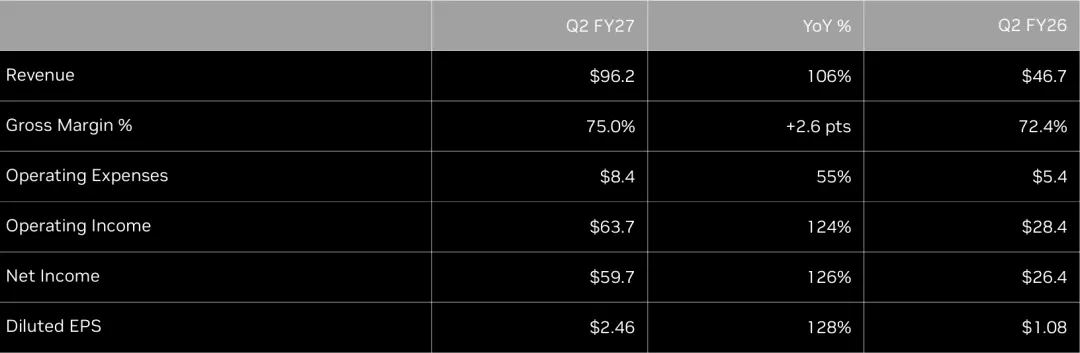
On August 26 US local time, NVIDIA reported its results for the second quarter of fiscal 2027, ending July 26, 2026. The report shows that NVIDIA's quarterly revenue reached $96.221 billion, up 106% year-over-year and 18% quarter-over-quarter; net income reached $59.688 billion, up 126% year-over-year; diluted earnings per share were $2.46, up 128% year-over-year.
Compared to last quarter's revenue of $81.615 billion, NVIDIA continues to break growth records. At this time last year, the company's single-quarter revenue was only $46.743 billion, nearly doubling in just one year.
After the earnings release, NVIDIA's after-hours stock price initially fell about 1.3%, then surged over 4%, reflecting a divergence and shift in market focus: investors used to wonder whether NVIDIA could consistently beat expectations, but now they are more concerned about how long AI infrastructure buildouts will continue and whether next-generation chips and new business models can sustain future growth.
In terms of profitability, NVIDIA maintains exceptionally high levels.
In the second quarter, the company's operating profit reached $63.734 billion, up 124% year-over-year; on a Non-GAAP basis, net income was $53.954 billion, up 118% year-over-year. For the same period, gross margin hit 75%, higher than 72.4% in the prior-year quarter and slightly above the 74.9% recorded in the first quarter.
NVIDIA Founder and CEO Jensen Huang stated, "Artificial intelligence has reached an inflection point. It is doing useful work, its tokens are driving productivity and profitability. Now, compute is revenue."
Today, more AI labs and startups are expanding rapidly, while new directions such as open-source model ecosystems and physical AI are also gaining traction, propelling the entire AI industry into a broader buildout cycle.
Meanwhile, NVIDIA continues to increase shareholder returns. In the second quarter, the company returned approximately $26 billion to shareholders through stock buybacks and cash dividends. As of the end of the quarter, the remaining authorization for stock repurchases stood at approximately $99 billion.
01 Data Center Revenue Surges, AI Cloud Clients Grow Faster
The core driver behind this round of NVIDIA's growth remains its data center business.
In the second quarter, NVIDIA's data center revenue reached $89.023 billion, up 117% year-over-year and 18% quarter-over-quarter, accounting for almost all of the company's revenue growth. As global enterprises and cloud service providers continue investing in AI infrastructure, demand for NVIDIA GPUs remains elevated.
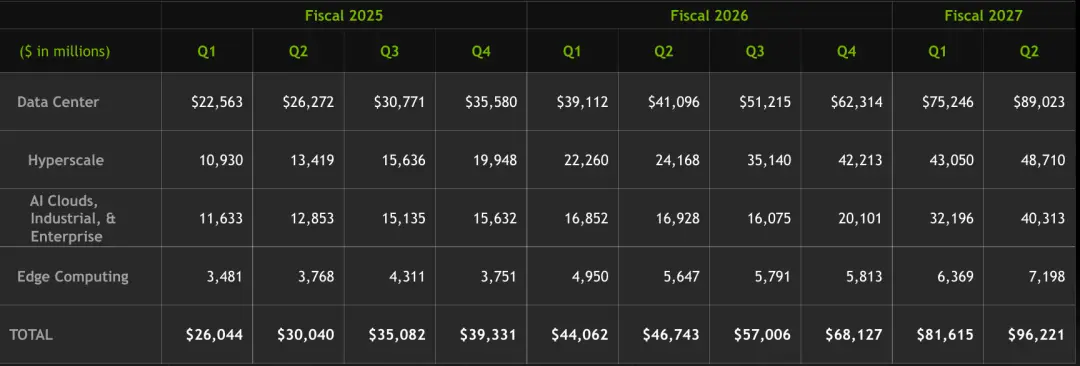
NVIDIA adjusted its data center business reporting methodology in the first quarter, segmenting customers into two major categories: Hyperscale and ACIE.
Among them, revenue from Hyperscale clients reached $48.71 billion, up 102% year-over-year and 13% quarter-over-quarter, primarily driven by large public cloud and internet companies.
Meanwhile, AI Cloud, Industrial, and Enterprise clients (ACIE) contributed $40.313 billion in revenue, up 138% year-over-year and 25% quarter-over-quarter. This segment covers AI-native companies, enterprise clients, sovereign AI clients, and hyperscale computing demands utilizing AI cloud services.
The new segmentation reveals that AI compute demand is spreading from a handful of cloud giants to enterprises, governments, and broader industry verticals. However, investors remain focused on the underlying profitability and long-term demand across different client segments, rather than just order volume growth.
The mainland China market remains a key variable in the earnings report.
NVIDIA noted that revenue from Hopper products shipped to mainland China during the second quarter accounted for less than 1% of data center revenue. Additionally, the company excluded any mainland China data center compute revenue from its third-quarter outlook.
Besides the data center business, edge computing revenue reached $7.198 billion in the second quarter, up 27% year-over-year and 13% quarter-over-quarter. Growth was driven by Blackwell workstation sales, though rising memory and system prices partially offset gains in consumer PCs.
02 Blackwell Ultra Ramp-Up, Vera Rubin Enters Full Production
NVIDIA is advancing its product roadmap from standalone GPUs to comprehensive computing platforms.
In the second quarter, Blackwell Ultra emerged as a key driver of data center business growth. NVIDIA stated that the quarter's data center revenue increase stemmed primarily from the large-scale deployment of Blackwell Ultra infrastructure. As cloud providers and AI firms continue building massive AI compute clusters, Blackwell is transitioning into broader commercial deployment.
Meanwhile, NVIDIA has begun preparing for the next product cycle. In the second quarter, the company announced that the Vera Rubin platform has entered full production, with related rack systems already running on partner cloud platforms such as CoreWeave and Google Cloud.
The Rubin platform encompasses not only GPUs but also CPUs, networking, software, and system-level solutions. Notably, the Vera CPU is NVIDIA's first processor designed specifically for AI agents, with plans for adoption by leading global technology vendors.
Additionally, NVIDIA announced that the NVIDIA Groq 3 LPX, designed for interactive AI inference, has also entered full production. The company aims to strengthen its competitiveness in real-time AI inference scenarios through products like the Groq 3 LPX.
Beyond hardware, NVIDIA is also bolstering its software ecosystem.
In the second quarter, the company launched the DSX platform, offering developers a complete solution for designing, building, and operating large-scale AI factories. By integrating compute, networking, software, and systems, the platform assists customers in constructing larger-scale AI infrastructure.
In the AI software space, NVIDIA continues to expand the NVIDIA Agent Toolkit and enhances development capabilities through PhysicsNeMo and CUDA-X libraries. The company stated it is collaborating with global software platform providers to roll out new software, open-source models, and partner projects.
For NVIDIA, product competition has evolved beyond individual chip performance to encompass a complete ecosystem spanning chips, networking, software, and systems. Nevertheless, the market continues to monitor the pace of the transition from Blackwell to Rubin and whether the new generation of platforms will continue to drive customers to expand their AI infrastructure investments.
03 AI Infrastructure Entails Funding Phase, NVIDIA Assumes Greater Buildout Role
As AI data centers scale up, NVIDIA is taking on a greater role in infrastructure construction.
FY2027 Q2 earnings reveal that as of July 26, 2026, NVIDIA's total forward commitments have reached $360 billion. This includes $279 billion in supply and capacity commitments, $29 billion in cloud service agreements, $23 billion in capital expenditures, and $25 billion in equity investments.
These commitments are primarily tied to future AI infrastructure expansion. The most closely watched among them is NVIDIA's involvement in SB Energy's PORTS-Pike project in Ohio.
NVIDIA stated it is providing credit support for SB Energy's technology campus in Ohio. The project's initial phase involves developing approximately 4.25 GW of land, power, and facilities to house NVIDIA infrastructure for OpenAI. NVIDIA's maximum guarantee obligation stands at $105 billion, phasing in once conditions such as the data center reaching operational status are met.
At the same time, NVIDIA is driving larger-scale capital investments in AI infrastructure. The company has announced strategic partnerships with firms including Apollo, BlackRock, Blackstone, Brookfield, Goldman Sachs, and KKR, aiming to mobilize over $500 billion in third-party capital for AI infrastructure development in the coming years.
Jensen Huang believes AI infrastructure buildouts are entering a new phase, requiring substantial capital investment to support AI model training, inference, and the expansion of diverse applications.
However, as NVIDIA takes on more infrastructure projects, markets are increasingly scrutinizing the capital strain associated with this model.
At the end of the second quarter, NVIDIA held combined cash, cash equivalents, and marketable debt securities totaling $56.6 billion. Concurrently, the company issued $25 billion in senior unsecured notes in Q2 for general corporate purposes. NVIDIA stated that its financial position remains robust, with future investments primarily directed toward supporting the supply chain, infrastructure, and long-term growth requirements.
04 Q3 Revenue Projected to Exceed $100 Billion as Competitive Pressures Mount
For the upcoming quarter, NVIDIA maintained its growth trajectory expectations.
The company projects third-quarter FY2027 revenue to reach $108 billion, plus or minus 2%, with both GAAP and Non-GAAP gross margins expected at 74%. NVIDIA emphasized that this guidance excludes any data center compute revenue from China.

Compared to the $96.2 billion in Q2 revenue, NVIDIA expects continued growth in the third quarter. However, market attention has shifted from single-quarter performance to long-term competitive dynamics.
Currently, competition in the AI chip market is intensifying. NVIDIA highlighted in its report that it is maintaining its edge through comprehensive computing platforms encompassing processors, interconnect technologies, software, algorithms, systems, and services, aiming to meet both AI training and inference demands via this integrated ecosystem.
Meanwhile, competitors are accelerating their deployments. AMD continues to launch data center products, while Google is advancing its self-developed TPU chips. Major tech companies serve as both key NVIDIA customers and active developers of their own computing platforms.
Investors are particularly focused on the development of the AI inference market. As AI applications multiply, compute demand is expanding beyond model training to inference services. Through the Vera Rubin platform, Groq 3 LPX, and its software ecosystem, NVIDIA is bolstering its inference capabilities to maintain its market leadership.
Nevertheless, sustaining future growth requires answering several key questions: Will Blackwell Ultra and the Rubin platform continue to drive increased customer purchasing? Can AI infrastructure investment maintain its current pace? And as clients develop more in-house chips, will NVIDIA's share of the AI compute market be impacted?
$96.2 billion in revenue marks another milestone for NVIDIA amidst the AI wave.
For NVIDIA, record-breaking financial figures validate the success of the previous cycle, while the next phase presents the challenge of maintaining its core positioning as the AI industry enters a much larger-scale buildout stage.