Bitcoin Surges 22% in a Single Week: 13-Year Data Backtest Reveals a 50/50 Coin Flip Conclusion
Author: Jake Pahor (August 23, 2026)
Edited by: TechFlow
TechFlow Summary: Bitcoin surged approximately 22% this week, marking its largest single-week gain in years, closing around $76,500 on Sunday evening (Bitstamp) after briefly touching $79,461 intraday. Coinglass data shows roughly $2.7 billion in short positions were liquidated in a single day, with Bloomberg calling it the largest short squeeze of record. Faced with the recurring question, "Did I miss out?", the author backtested 46 similar surges since 2013. Of these, 30 occurred when prices were more than 30% below historical highs. The results? In 15 cases, there was never another chance to get back on board; in the other 15, the entire rally was erased within six months. A massive single-week pump alone cannot distinguish between a bottom and a trap. However, he points out that the true signal isn't the "green week," but whether the CSH score can hold above 30 and continue rising over the following weeks (currently 31.9). Historically, four instances of a "violent breakout past 30 following an extremely low score" all corresponded to bear market bottoms. In contrast, during July 2022, the score stalled at 28 without breaking 30, and it took another four months to find the true bottom. The author's conclusion: rather than predicting direction, execute a predefined plan of "buy below 30, hold steady above 30."
Bitcoin surged approximately 22% this week, setting the stage for its largest single-week gain in years. According to Coinglass, roughly $2.7 billion in short positions were liquidated in a single day during the rally. Bloomberg described this as the largest short covering event on record. Prices briefly touched $79,461 before pulling back and stabilizing around $76,500 on Sunday evening (Bitstamp).
My inbox has been flooded with one question, asked in a dozen different ways: "Did I miss it?"
Half of people online say: Yes, the bottom is in, and you're too late. The other half says: This is obviously a fake breakout, and lower lows are still ahead. Both sides sound completely certain.
So this issue will do only one thing. I went back through 13 years of data, found every week that mirrored this week's move, and checked what happened afterward. The answer surprised me, and it’s not what either camp wants you to believe.
A minor confession before we begin: I didn’t witness any of this firsthand. I went fishing, had zero cell service, and came back to a repriced market and a phone that wouldn’t stop ringing. Why it doesn’t matter will become clear at the end.
CSH Risk Dashboard
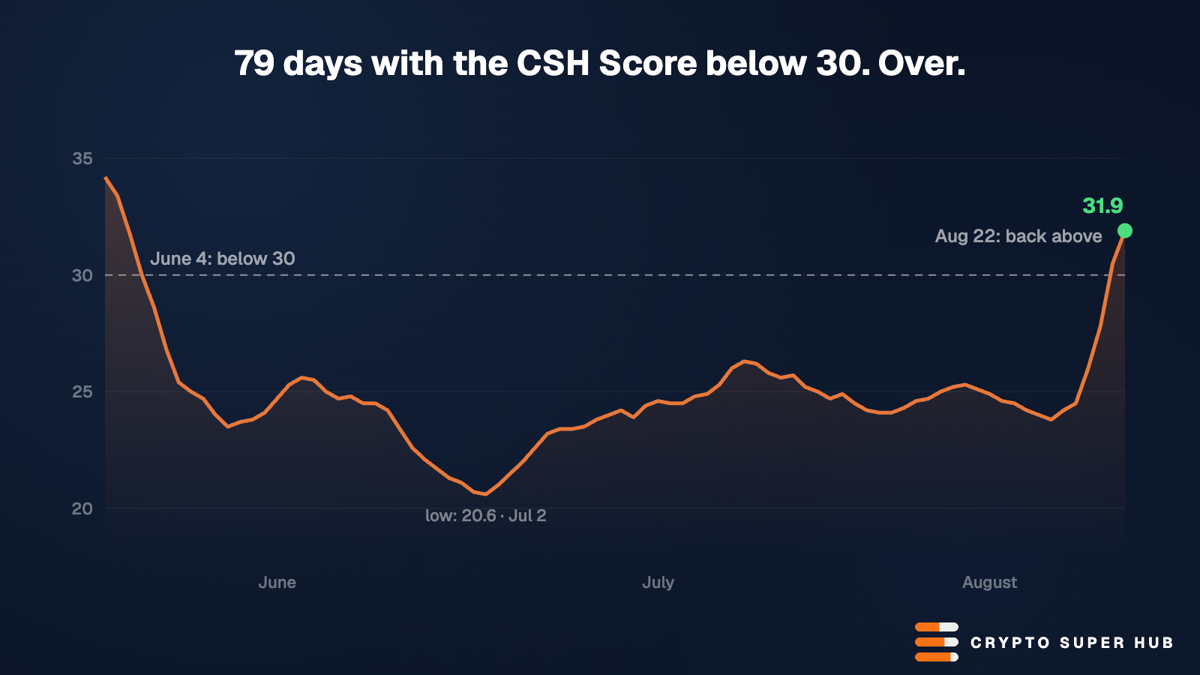
- CSH Score: 31.9, mid-cycle (24.0 a week ago, representing the sharpest single-week score jump this bear market)
- BTC: Sunday reading approx. $76,500, weekly high of $79,461, up ~22% for the full week (Bitstamp)
- The 79-day stretch at lows is over. The score remained at 30 or below from June 4 to August 21, breaking above that range on Saturday.
- Still in the bottom 25% relative to historical peaks, roughly 39% below the October high of $124,774.
- The current score bracket corresponds to $69,632–$86,377. The top of the 20-bracket sits at $69,632, roughly 9% below Sunday's price.

The readings have changed, but my rules execute according to fixed logic: once the score exceeds 30, my plan stops buying. Cash reserved for readings below 20 remains on the sidelines. You can watch the exact same number update hourly, free of charge, just like me:
What Happened After Bitcoin's 30 Similar Moves in the Past
Let me first explain the methodology in plain terms. I pulled our complete daily price history and CSH score records dating back to 2013, filtering for every week where Bitcoin gained 18% or more in a single week. Large moves tend to cluster, so consecutive qualifying days are counted as a single event.
Over 13 years, that yields 46 events. An average of three to four per year, and they almost never occur midway through a cycle. They only appear at extreme extremes: near bull market tops, or deep inside bear markets. This isn't a coincidence. Volatility of this magnitude rarely stems from new buyer demand entering the market; it's typically a stampede of short positions being forced to cover at once—and shorts only crowd into that degree of positioning after prices have fallen for consecutive months. This week fits that pattern perfectly.
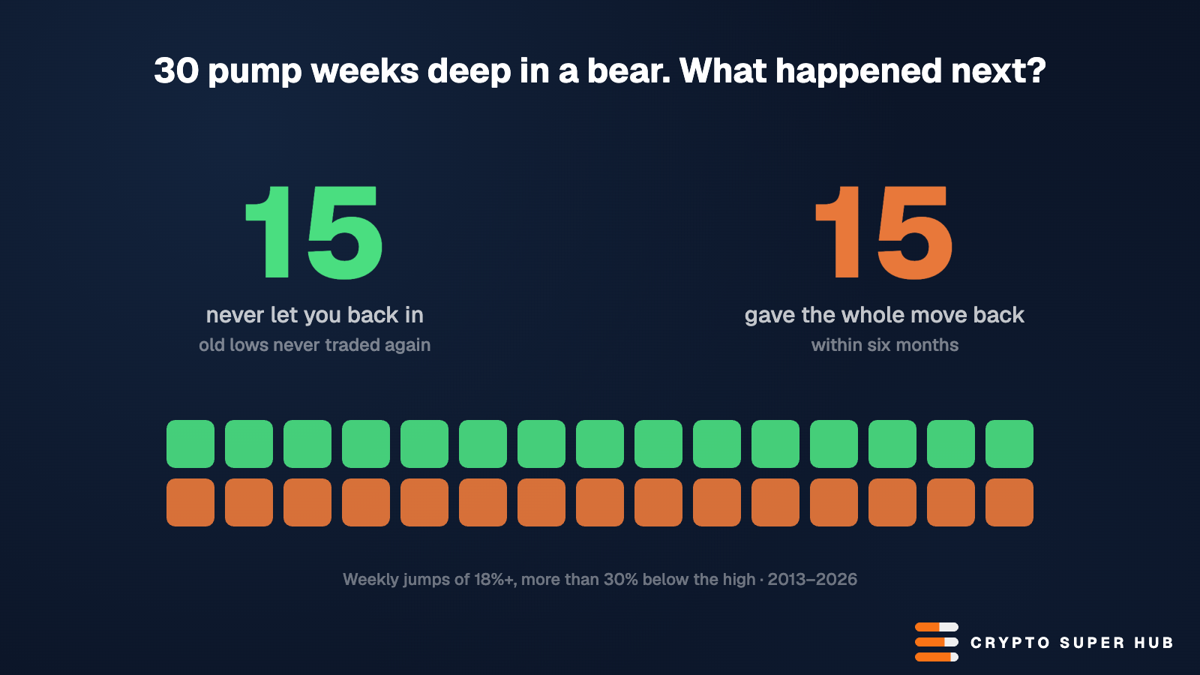
Of those 46 events, 30 occurred in our current position: more than 30% below historical highs. Here is exactly what happened after each of those 30, recorded without omission or selection bias.
In 15 cases, you never got another chance to get back on board. Prices marched higher, and the lows prior to the surge were never tested again.
In the other 15 cases, the entire rally was erased within six months. Some even printed new lows.
Fifteen versus fifteen. So when someone tells you this week proves a bottom is in, or proves it's a trap, the truth is: thirteen years of data show that a single pump simply cannot distinguish between these two outcomes. No one can predict which way it will go.
The Part That Isn't a Coin Flip
The surge itself tells you very little. What happens in the weeks following the surge tells you a lot.
I looked for the events most similar to today's scenario: a prolonged period of depressed low CSH scores, immediately followed by a violent weekly pump that pushed the score past 30. Historically, this has happened only four times.
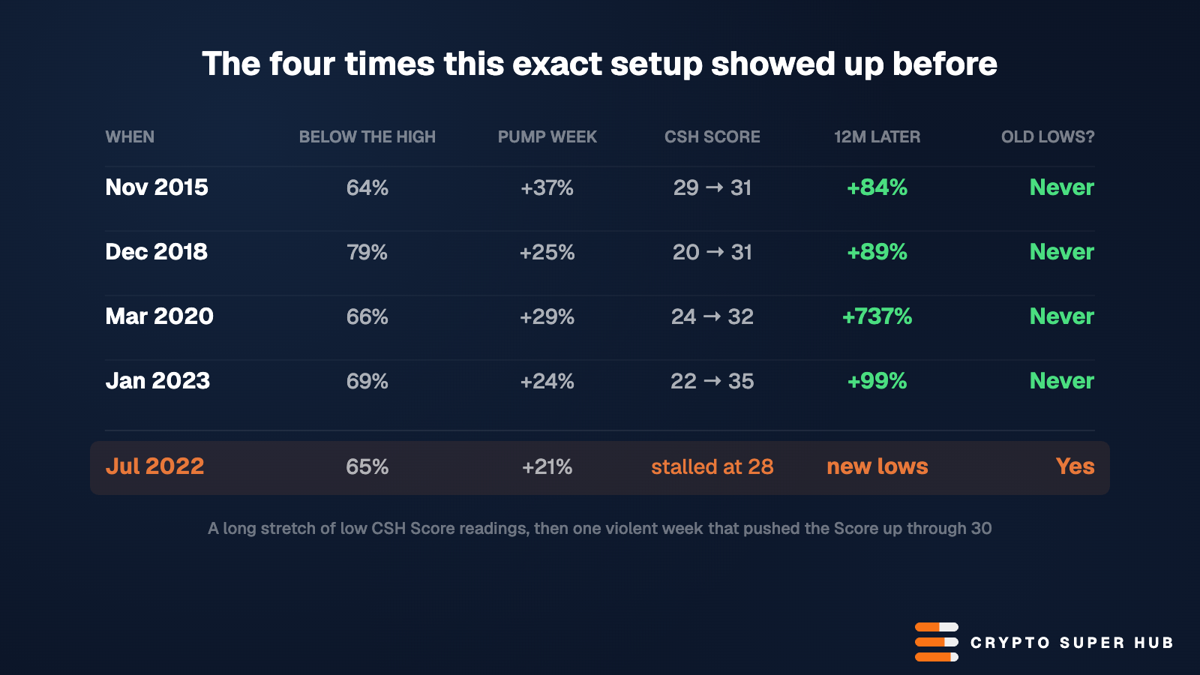
All four instances ultimately coincided with the end of their respective bear markets. The worst 30-day period following them saw only an 11% decline, and twelve months later, gains ranged from +84% to +737%.
Then there was one case that looked identical but wasn't. July 2022: a 21% weekly gain, still 65% off the peak, with a CSH score in the low 20s. The difference only became clear afterward. The score stalled at 28, never managing to break 30. It took another four months for Bitcoin to find a true bottom at $15,742. A nearly identical story played out twice at the end of 2014: two consecutive pumping weeks with gains over 20%, CSH scores stuck in the single digits, both rallies completely reversed, and that bear market dragged on for another full year.
Therefore, the useful signal has never been that green week. It's whether the CSH score holds above 30 and continues climbing in the following weeks. Today it reads 31.9. That is the exact number I will be watching closely over the next month, and you can track it alongside me in the app.
There is also one finding to help calm your heart rate: even in those four instances where the "surge truly was the turning point," Bitcoin spent roughly a month consolidating or declining before the trend actually started. If this time is genuine, you still have time to react calmly like an adult. That urgency screaming "you must act this week" is the short squeeze talking, not the data.
What Should You Do Facing a 50/50 Coin Flip?
You stop trying to predict it.
For months, my baseline scenario has been: this bear market still has room to fall. This week's move slapped that view squarely in the face. If Bitcoin continues to close above its long-term trendline and the CSH score holds above 30, I will publicly withdraw that stance right here in this newsletter.
But the key point is: my buys have never depended on that viewpoint. During the days the score sat entirely in the 20 bracket, the plan bought weekly. At 31.9, it stopped, because this rule is equally black-and-white: buy below 30, hold steady above 30. If we drop back into the 20 bracket, buying automatically resumes; if it breaks below 20, the reserved cash deploys; and if we never see the 20 bracket again, I'm already fully positioned. Being wrong on direction never becomes an expensive mistake.
That is what I take away from this week. Not a prediction. But a plan that works regardless of how the coin flips.
Quick Hits
- According to Coinglass data, roughly $2.7 billion in crypto shorts were liquidated over 24 hours on August 19, with Bloomberg calling it the largest short liquidation of record. Much of this week's rally was driven by short covering rather than new buying pressure.
- Reports suggest the catalyst was: the U.S. Treasury announced it will at least double the size of its long-end repo operations, raising them from $2 billion to at least $4 billion per operation.
- The short squeeze continues: roughly another $1 billion in shorts were wiped out on August 21 as Bitcoin broke through $75,000 (CoinDesk).
Weekly Outlook
- The focus going forward is on "continuation". In every past instance, looking solely at the pumping week itself cannot distinguish a true bottom from a fake breakout. The divergence appears in the following weeks—watch whether the CSH score holds 30 and keeps climbing. 31.9 is the number to watch closely.
- Weekly closes vs. the bullish resistance band: The 20-week and 21-week moving averages currently sit around $69,400 to $69,600 (Bitstamp weekly data). This week's close sits roughly $7,000 above that band. Note that April and May also closed above this band before reversing lower—which is precisely why my rules require "consecutive closes" rather than a "single close above." Notably, this resistance band aligns almost perfectly with the top of the CSH 20-bracket.
- September is historically a weak month for Bitcoin. If history repeats this year, the starting point of the CSH 20-bracket sits at $69,632, roughly 9% below Sunday's price. That is historically where "cheap" resets begin.
Closing Thoughts
Returning to that fishing trip, because it illustrates the entire argument through a simple story.
It was the most important week of the year, yet I had no real-time signals, and it cost me absolutely nothing. My plan has been buying since February, running right through those 79 consecutive days the CSH score lingered in the 20 bracket—that dry, boring stretch when nobody wanted to talk about Bitcoin. Positions were built long ago. This week simply updated the number beside them.
This wasn't earned by staring at charts. It was earned months ago, when I wrote down the plan and let it run on autopilot.
The market will serve up more weeks like this. The best time to decide how you'll respond to them is now—while everything is still quiet.
— Jake
Join TechFlow official community to stay tuned
Telegram:https://t.me/TechFlowDaily
X (Twitter):https://x.com/TechFlowPost
X (Twitter) EN:https://x.com/BlockFlow_News
 @jake_pahor