Private Markets Intel War Heats Up: Where Does VC Alpha Come From in the AI Era?
Author: insights4vc
Translated by: TechFlow
TechFlow Reads: VC returns are extremely concentrated, making early discovery of great companies nearly the lifeline of a fund. This article breaks down the latest evolution of private market data tools and whether they actually deliver alpha. For investors currently using AI and research tools to source deals, this serves as a sobering map.
Venture capital has always been an information business. The advantage often lies in timing: founders tell former colleagues before updating public records; new companies start hiring before appearing in databases; investors begin following a team before a funding round is announced.
This edge matters because VC returns are highly concentrated. Data cited in 2026 Oxford academic research shows that in a long-term LP dataset, 4.5% of deployed capital accounted for approximately 60% of returns. [1] Thus, missing out on just a few exceptional companies can derail an entire fund. But discovering them early is only part of the equation. Investors also need to build conviction, secure allocation, obtain meaningful ownership stakes, and stay right over several years.
The private market data industry is now converging closer to the moment a company is born. PitchBook, Crunchbase, Dealroom, Tracxn, and CB Insights remain the core record systems for deals, funds, valuations, and corporate history. PitchBook generated $174.7 million in revenue in Q2 2026, annualizing to nearly $700 million. [2] New platforms are not replacing this layer. They are extending it with faster updates, behavioral data, and signals that surface before traditional corporate records exist.
Three shifts stand out most prominently.
First, companies like Harmonic and Specter are building continuously updated knowledge graphs of companies and people, rather than relying primarily on periodically refreshed profiles. Second, specialized products are hunting for earlier behavioral signals. Evertrace tracks founder formation metrics, including company registrations, technical activity, research publications, and domain names. Frontrun monitors changes in the follow graph of select VCs on X. Third, APIs and Model Context Protocol (MCP) implementations are moving this data directly into funds' own software and AI workflows. Crustdata represents the infrastructure layer of this market, while Affinity supplements it with first-party relationship data from emails, calendars, and CRM activities.
Adoption is visible, but evidence of investment alpha is less clear. Harmonic states hundreds of VC teams use its platform, Specter reports over 300 investment firms, Evertrace over 200 funds, and Affinity over 3,300 private capital institutions. Publicly traded Tracxn disclosed 2,289 client accounts for fiscal year 2026. [3][4][5][6] Most of these figures are self-reported by the companies themselves. Suppliers rarely disclose the complete universe of companies their models surface, making it difficult to assess precision, recall, false positive rates, or the economic value of individual leads.
No single signal is sufficient on its own. Departures may be early but ambiguous. Company registrations are objective but common. GitHub activity holds value in developer-led markets but has limited relevance elsewhere. Hiring velocity and employee migrations offer broader signals, while revenue, customer, and usage data often carry more decision-making weight, though they arrive later. When multiple trusted industry experts simultaneously follow the same company, investor attention can provide early indicators, albeit platform-dependent and potentially self-reinforcing.
The strongest defensive moats likely lie deeper in the data stack: historical time series that cannot be reconstructed post-hoc, accurate entity resolution across people and companies, permissioned first-party fund data, and distribution via CRM systems, APIs, and agents. Public data is not necessarily proprietary. But five years of correctly timestamped change history can become a defensible asset.
AI is more likely to make these infrastructures easier to query rather than eliminate the need for them. As research, categorization, and workflow costs decline, clean data, provenance, and institutional context become increasingly valuable. Investment judgment, allocation, and relationships still cannot be solved by simple automation layers.
The likely outcome is a broader private market intelligence marketplace rather than a standalone sourcing software category. Mature databases will augment discovery and predictive capabilities. CRMs will serve as the orchestration layer. Large institutions will combine external data streams with proprietary data and internal scoring systems, while smaller funds will rely on integrated products supplemented by niche signals.
By 2030, sourcing deals using natural language queries across company, people, behavior, and relationship data will likely become routine. Fully autonomous deal selection remains far from reliable. The scarce inputs in VC remain judgment, allocation, trust, and ownership.
Partner Highlights
At insights4vc, we focus on teams building infrastructure for emerging market categories.
Umia is developing a new operational model for native token projects. The platform integrates fundraising, legal incorporation, treasury management, and governance into a single system, enabling projects to launch from day one with clearer structures and more accountable decision-making.
For more information on Umia, contact [email protected]
1. Venture Capital Has Always Been an Information Business
Sourcing starts with fund math. With returns so heavily concentrated that one or two investments can dictate a fund’s performance, missing the right founder carries exceptionally high costs: losing a key person matters more than refining the analysis of dozens of median deals.
This does not mean maximizing deal flow volume. More companies often mean more noise, less attention, and weaker relationships. The goal is to increase the probability of seeing companies that fit the fund’s thesis, while preserving enough time to evaluate them and secure allocations. Sourcing software is only useful when it improves this equation or reduces the cost of doing so.
The economic upside can be substantial. Imagine a $100M seed fund targeting 10% ownership. If earlier discovery allows you to hold 10% instead of 5%, and the company exits at $2B, the gross difference is $100M before accounting for dilution, follow-ons, and carried interest. But the odds of capturing that edge are slim. A signal generating 500 irrelevant leads, consuming analyst time without improving allocation, can destroy rather than create value.
The expected value of early discovery can be expressed as: Probability of identifying eventual outliers × Probability the fund acts and wins × Incremental ownership or price advantage × Final outcome, minus data, software, and attention costs.
Early discovery matters most where allocation is tight: elite serial founders, rapidly forming rounds, and emerging tech clusters. It matters less in late-stage investing, capital-intensive industries with long validation cycles, or processes mediated by bankers and broad auctions. Contacting founders too early without a credible reason can also backfire.
Meanwhile, the opportunity set is becoming harder to monitor manually. Dealroom’s 2026 ecosystem coverage spans 77 countries and over 325 cities. Startup Genome studies millions of companies across hundreds of ecosystems. [7] The NVCA recorded over 15,000 U.S. venture transactions in 2025. [8] Dealroom tracks roughly 4,900 active pure-play VC firms. Including corporates, accelerators, and cross-investors, there are approximately 9,500 active investors. [9]
Current observable activity exceeds what any partner network can sustainably process. Sourcing is no longer just about information acquisition, but about deciding which information warrants attention.
2. From Rolodexes to Private Market Databases
Traditional VC sourcing has always relied on multiple channels. Personal networks connect investors with founders, operators, angels, lawyers, bankers, limited partners, and portfolio executives. Universities, accelerators, demo days, and conferences concentrate discovery. Warm intros and inbound pitches bring funds beyond direct circles.
These channels remain valuable because they carry context and trust, not just names. Their weakness is coverage. Networks reflect geography, career history, and social structures. Events are cyclical. Inbound deals typically only surface after founders decide to raise. Referrals may signal quality or simply strong connections.
Private market databases solve a different problem: making companies, deals, investors, and funds searchable at scale. PitchBook, Crunchbase, Dealroom, Tracxn, and CB Insights are most useful when entities can be identified. Identification paths include company names, domains, financing events, or investor relations. PitchBook reports covering 12.9M companies, 3.2M deals, and 171K funds. Crunchbase states it processes 30M verified updates annually. Tracxn tracks millions of companies along with financial and equity structure data. [10][11][12]
Relationship platforms add another layer. Affinity, 4Degrees, and custom-built systems organize conversations, notes, ownership, and warm paths. Company databases identify which startups match a thesis. Relationship maps show who can reach them and what the target already knows.
These categories are increasingly overlapping. Mature databases are adding predictive scoring and AI research. Discovery products are accumulating historical records. CRMs are integrating external data and agents. Boundaries are blurring, but underlying problems remain distinct.
3. The Startup Information Timeline and the Risk Intelligence Stack
A startup becomes visible incrementally. Long before a funding announcement, founders may depart, new legal entities form, or domains register. GitHub activity, early hiring, or shifts in investor networks may also emerge. Each added signal reduces uncertainty, usually at the cost of lead time.
The trade-off is straightforward: signal confidence typically rises as events move further from founding. A researcher leaving a lab might start a company, join another team, or stay academia. A newly registered entity could be a holding company. A registered domain may never go live. At the earliest stages, software ranks hypotheses about companies that may not yet exist. Once a venture starts hiring, launching products, or gaining traction, the object of measurement becomes much clearer.
This timeline has spawned multiple overlapping risk intelligence layers, rather than a single new software category.
Founder Intent and Pre-Incorporation Intelligence
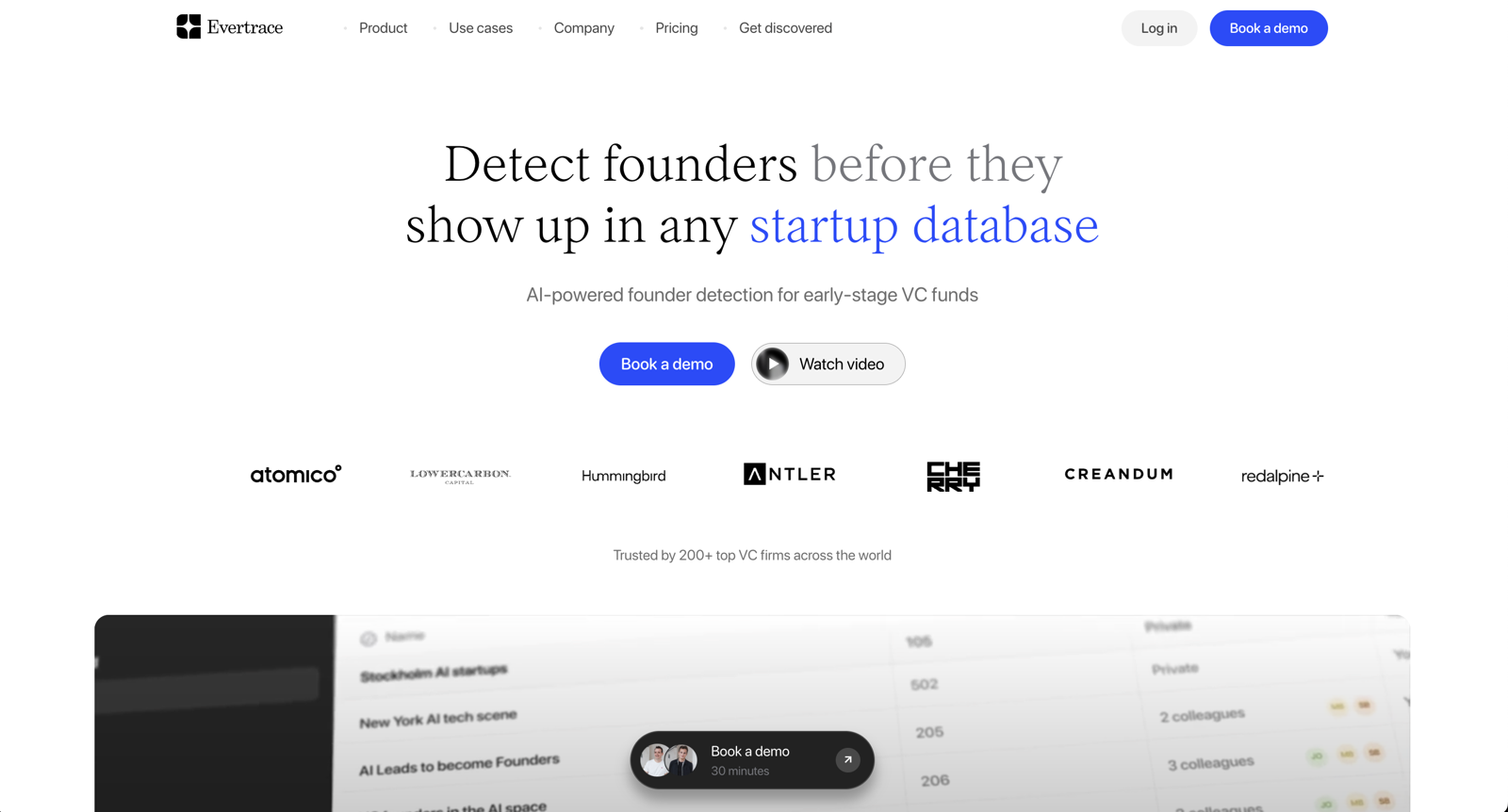
Evertrace is the most specialized expert. Harmonic and Specter also track founder movements and early company formation. Signals include registration data, employment changes, technical activity, research grants, and domain names.
Investor Attention Intelligence
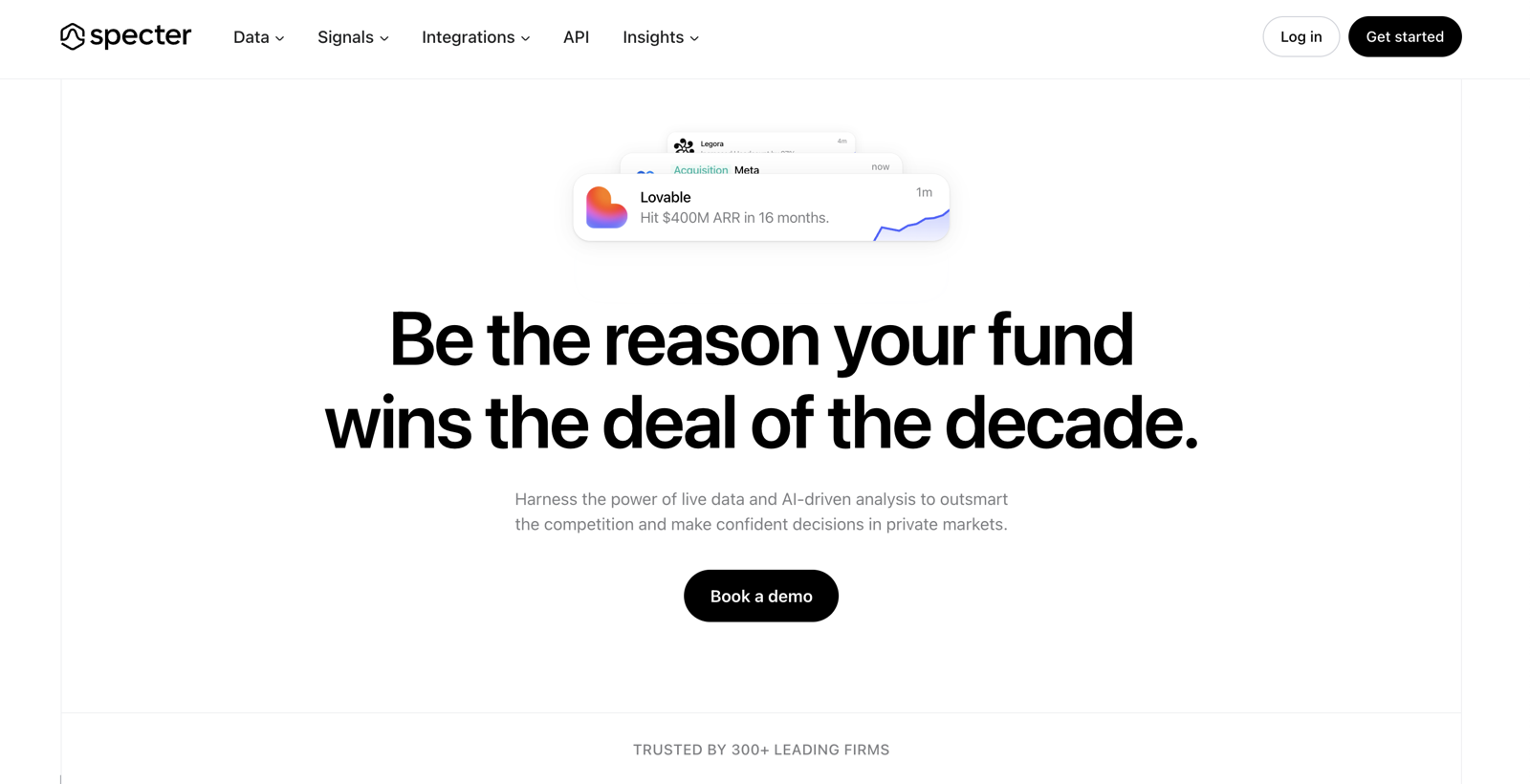
Frontrun monitors changes in the follow graph of selected investors on X. Specter incorporates investor interest into broader datasets. These products treat relevant investor behavior as a signal that an entity is worth watching, not as proof of company quality.
Continuous Company Intelligence
Harmonic and Specter maintain continuously updated company and people graphs. Dealroom, Tracxn, Crunchbase, and CB Insights are moving in the same direction via alerts, growth metrics, predictive scoring, and AI research. The distinction from traditional databases increasingly comes down to refresh rates and data architecture, not rigid category boundaries.
Private Market Data Infrastructure
Crustdata, People Data Labs, Coresignal, and Aviato provide APIs, bulk datasets, and agent-ready access. They serve firms building custom sourcing engines. Grata and SourceScrub offer similar programmatic access, focusing more on private equity and M&A. The trade-off is control versus complexity: buyers gain flexibility but must handle entity resolution, scoring, and workflow design.
Relationship Intelligence
Affinity and 4Degrees leverage authorized communication logs and institutional history. Attio offers a more flexible AI-native CRM with API and MCP support, though it requires additional configuration for VC workflows. This layer is particularly defensive, as competitors cannot purchase another fund’s meeting histories, notes, or introduction paths.
Mature Private Market Platforms
PitchBook remains the system of record by scale. Dealroom excels in startup ecosystems and regional partnerships. Tracxn leads in global taxonomies and structured company research. Crunchbase dominates contributor and usage networks. CB Insights specializes in market research and predictive scoring.
These layers increasingly function as an operating architecture:
External data streams + fund CRM, email, calendar, and notes + entity graphs + signal models + LLMs or agents + human investment workflows
Most of this stack is already assembler. The harder problems are less visible: matching the same person or company across sources, preserving accurate historical timestamps, and generating reliable outcome labels. Funds also must maintain underlying data rights and build investment processes that genuinely act on signals.
Interfaces are becoming easier to build. The quality of underlying data and connections remains the constraint.
4. Founder Detection: Finding Companies Before They Exist
Founder detection pushes VC sourcing to the earliest possible node: before a company is fully formed or publicly visible.
Evertrace was founded in Copenhagen in 2024 and stands as one of the category’s most prototypical specialists. The company claims over 200 VC funds use its platform to monitor signals. These include business registrations, GitHub activity, patents, research papers, grants, domains, app stores, Product Hunt, and social platforms. [5] It raised at least $600,000 in a publicly reported 2025 funding round. [13]
Value comes from correlating weak signals, not relying on any single event. A senior researcher might leave a company, register a new entity with former colleagues, spin up a technical repo, and buy a domain. Individually, none are decisive. Together, they justify further follow-up.
This approach is particularly suited to deep tech, AI, and university-linked investments. Research output and technical activity often surface far ahead of commercial milestones.
Its limitations are structural. Registration data coverage varies by country, and job titles are largely self-reported. Domains or corporate filings may be delayed, masked, or reused. GitHub is highly informative in open-source and developer-centric markets, but its utility drops significantly in biotech, industrial manufacturing, or many enterprise sectors.
There is also modeling risk. Systems trained on historical VC outcomes may over-weight familiar patterns, including top-tier employers, universities, and established startup hubs. Models overly reliant on founder archetypes risk replicating the exact biases investors aim to escape.
Therefore, founder discovery is best treated as a ranking system, not a prediction engine. The key question is not whether software can identify every future company, but whether it can consistently filter a manageable pipeline of high-quality leads earlier than existing channels.
Useful metrics include weekly precision on top leads, geographic and sector coverage, and time-to-first-partner-review. They also encompass conversion rates to high-quality founder conversations. Currently, public evidence points more toward adoption and workflow utility than proven investment returns.
Extreme earliness presents a practical constraint. Founders at companies that do not yet exist publicly may not respond well to automated outreach based on inferred intent. A better approach is usually to flag relevant signals first, then engage through trusted introductions or explicit rationales.
Consequently, founder discovery complements rather than competes with relationship intelligence. One determines who to watch; the other evaluates whether and how a fund should reach out.
5. Investor Attention as Alternative Data
Investor attention provides another early signal. The premise is simple: before a funding round goes public, investors reveal information through observable behavior. Following a founder, connecting with a new company, or having multiple industry experts cluster on the same profile can signal activity behind the scenes.
A single follow means little. Concentrated action by relevant investors over a short period is far more informative, especially when they possess domain expertise aligned with the target’s industry.
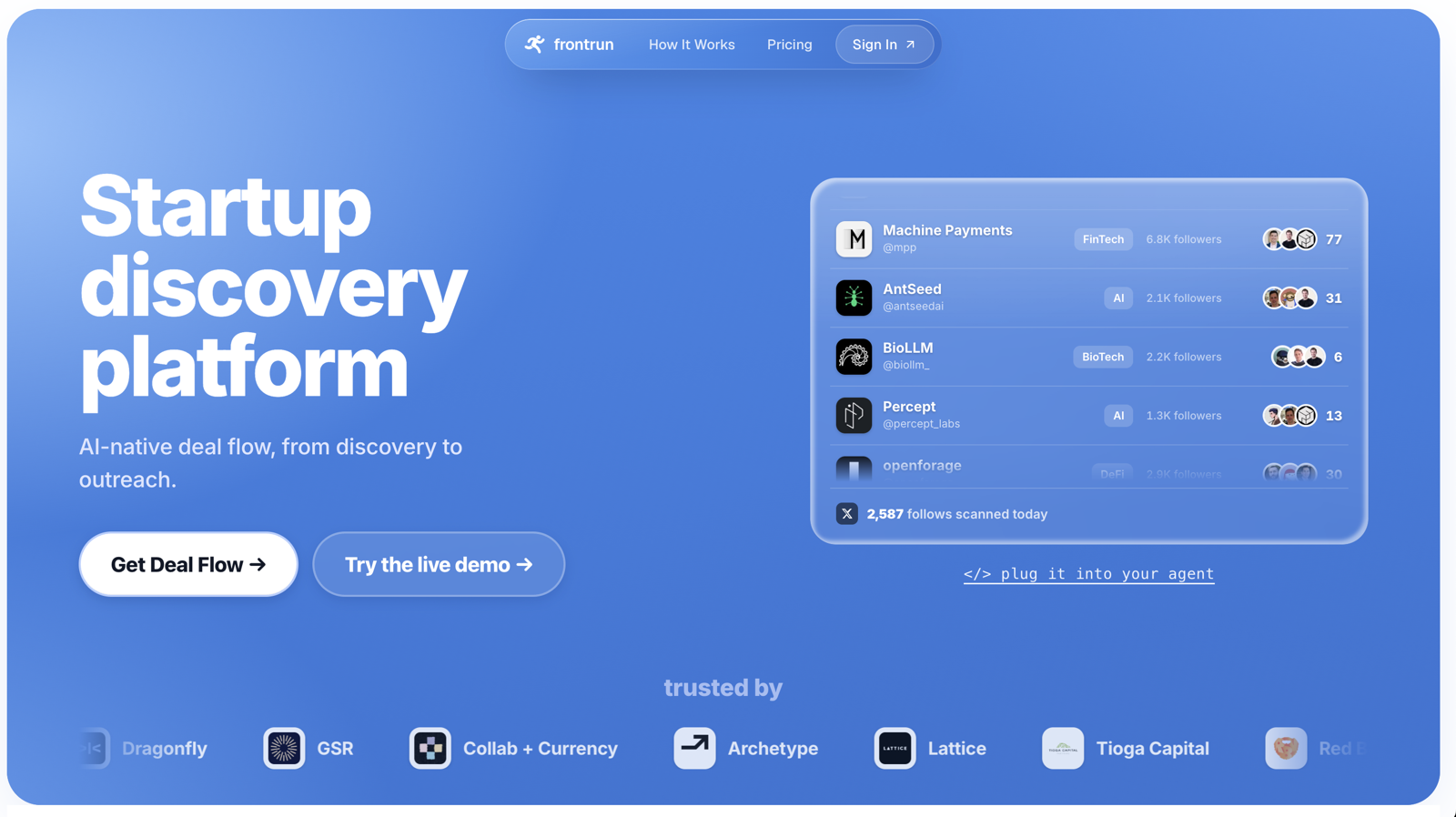
Frontrun is the most explicitly focused product around this concept. The platform claims to track the follow graph of over 2,000 VC investors on X. It identifies attention clustering around small or unlisted accounts, then resolves founders and classifies companies. The Starter plan costs $49/month for 100 accounts; the $99 Pro plan covers 250 accounts and adds API and MCP access. [14] This positions it closer to a specialized signal source than an institutional-grade private market database.
The company also continuously publishes records of startups it claims to have identified before funding announcements. In July 2026, Frontrun reported 46 such rounds, averaging 83 days of lead time, with subsequent total funding reaching $2.36 billion. [15] Examples include Orthogonal, flagged 213 days before a $4.3M raise; Ornn, tagged 162 days prior to an a16z-led $33M round; and naturalpay, identified 159 days before a Forerunner-led $30M Series A.
This distinction matters. Public records indicate that investor attention signals can precede formal funding announcements. Yet it does not disclose the full universe of companies the system flags. Without a public denominator, there is no way to know how many signals went nowhere, how many companies were already known to investors, or how many are irrelevant to a given fund.
Without that denominator, the data cannot prove predictive accuracy or investment alpha. It demonstrates lead time, not whether funds leveraging the signal consistently make better investments.
The quality of the observer itself matters. A security-focused investor following early-stage security companies is far more informative than a generalist doing the same. Two independent experts may yield more signal than ten investors from the same social circle. Effective attention models must therefore weight domain expertise, independence, and timing, not just raw follower counts.
The signal also carries platform risk. Frontrun relies heavily on X, whose API access and pricing may shift, particularly for commercial use cases. [17][18] The follow behavior itself can become reflexive. If investors know their follows are being monitored, they may delay, hide, or delegate the action. Widely tracked signals can quickly lose validity.
Accordingly, investor attention is better viewed as a prioritization layer rather than a standalone measure of company quality. Its value increases when combined with founder changes, hiring, corporate activity, and a fund’s own relationship data.
Enduring advantages come from identifying the right observers, maintaining long-form timestamped history, and proving that attention signals provide incremental information beyond simpler metrics like hiring growth, accelerator participation, or generic social buzz.
6. Continuously Updated Private Company Intelligence
The bigger shift in VC data may be continuous profiling rather than predicting companies before incorporation. New platforms no longer maintain periodically refreshed company profiles; instead, they track how teams, products, networks, and commercial signals evolve over time.
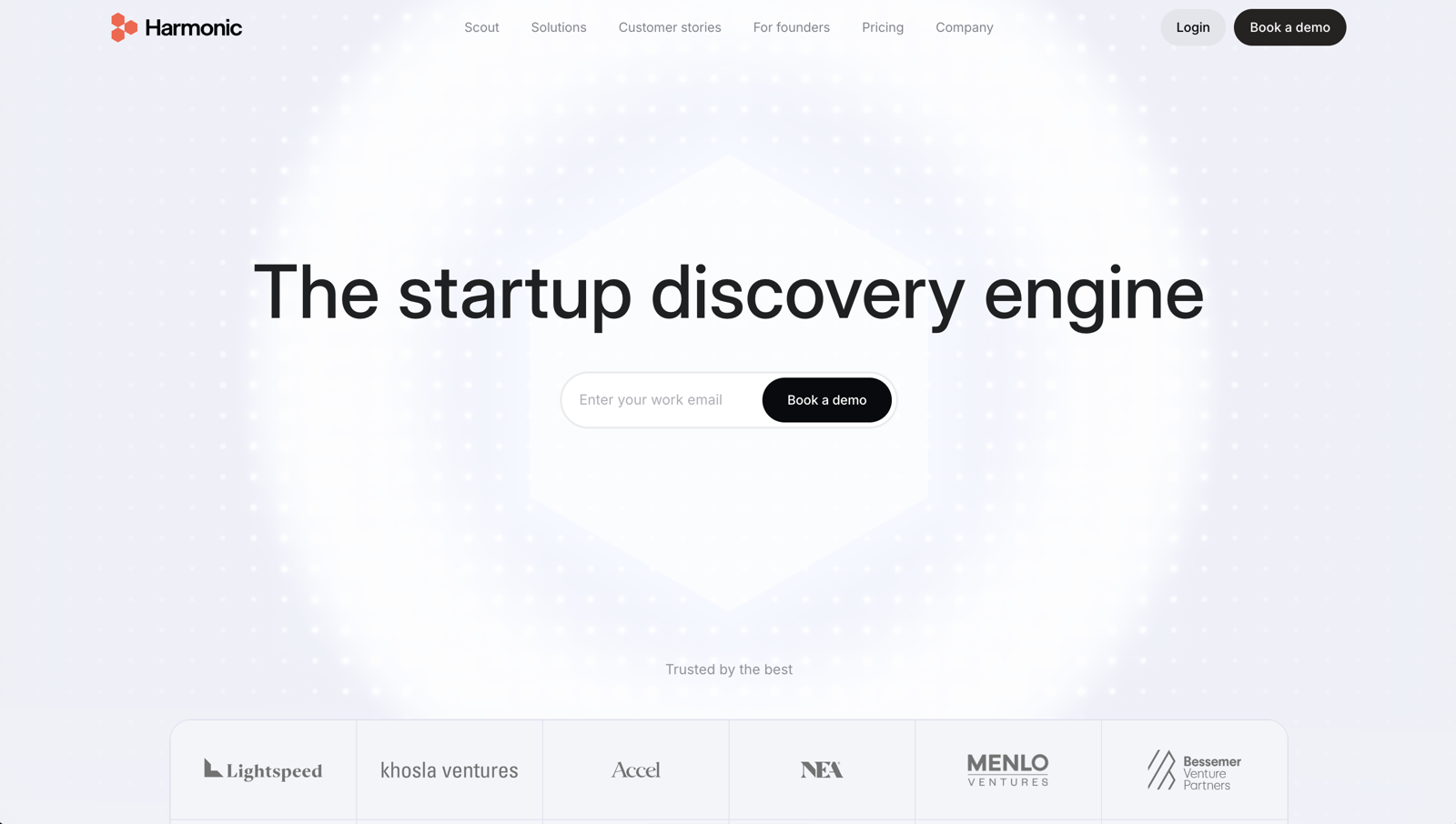
Harmonic claims to track over 35M companies and 195M people, covering everything from incorporation to scaling. It combines corporate profiles, team data, historical changes, and network context. [3] Its platform links external company data with LinkedIn contacts, email, calendar, and CRM activities. It now includes an AI research agent called Scout, alongside API, bulk data, and MCP access. Harmonic has raised $30M and states that hundreds of VC teams are using the product. [19]
Specter takes a similar approach on a broader graph. The company reports coverage of over 50M companies, 500M people, and 300K investors. Signals span deals, talent, revenue, news, and investor interest. [4] It offers API, bulk data, and MCP access, integrates with Affinity, Attio, and Salesforce, and claims over 300 investment firms use the platform.
Both are better understood as continuously updated knowledge graphs rather than static startup profile databases. This distinction matters. Traditional search might identify European infrastructure companies. A real-time graph can then ask: Of those, which ones onboarded two senior compiler engineers last quarter, saw rising open-source activity, and have not yet entered the fund’s pipeline.
This requires more than aggregating massive data volumes. Entity resolution remains one of the core technical challenges. A single company may operate under multiple legal entities, DBAs, domains, GitHub orgs, and X handles. The same founder might hold multiple overlapping roles. Funding events may surface with different dates, currencies, or company names. A single misattribution can turn multiple accurate observations into a flawed conclusion, and AI interfaces might make that error appear more convincing.
Mature private market platforms are shifting toward the same paradigm. Dealroom now combines company data with signals, alerts, AI research, and MCP integration. Advanced plans start at $14,500/year, with an MCP tier at $20,000. [20] Crunchbase states it refreshes 15M predictive signals weekly and claims to forecast 84% of funding events, though published figures do not disclose corresponding false positive rates. [11] CB Insights has long incorporated predictive scoring via its Mosaic module.
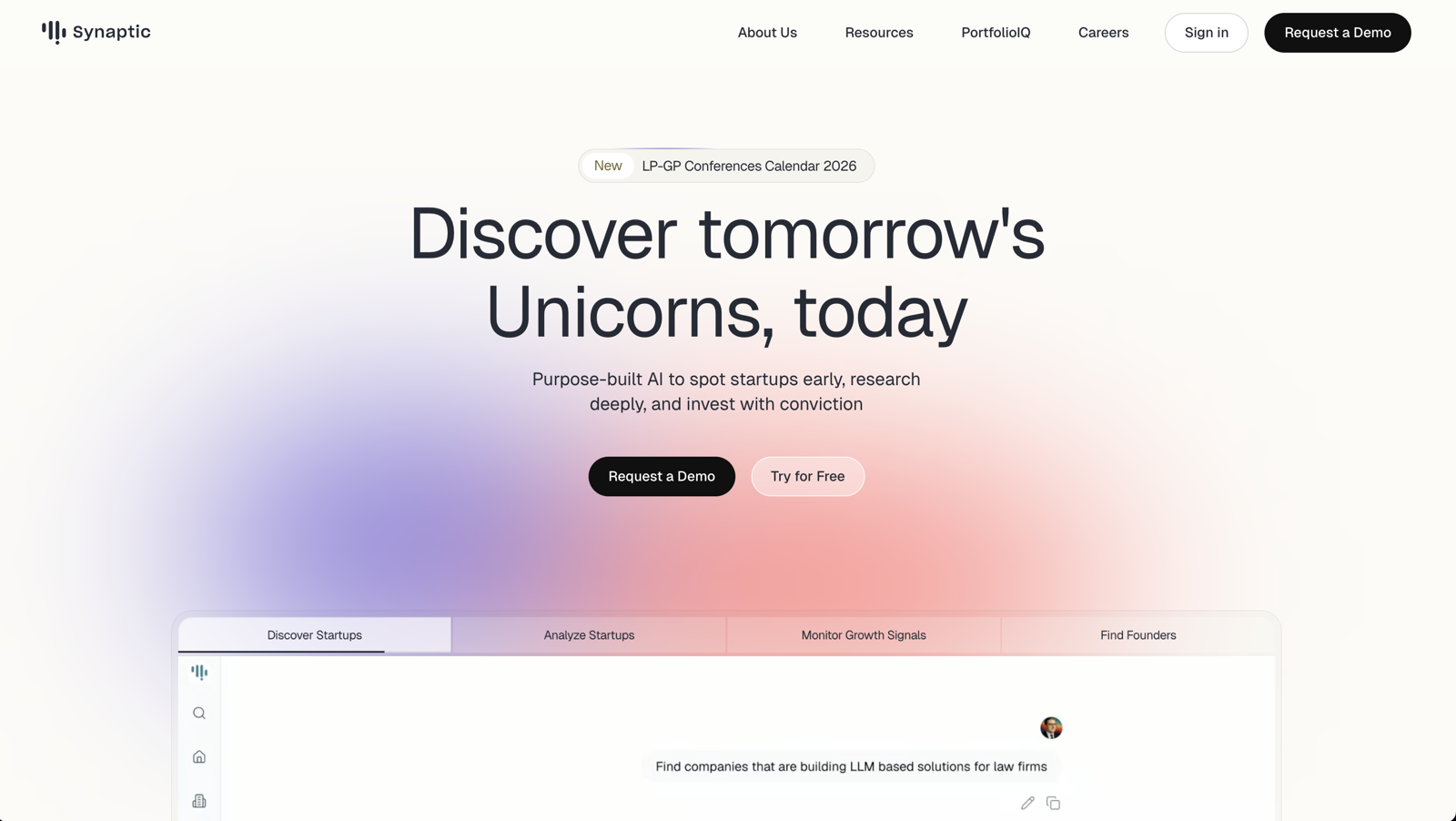
Synaptic occupies a similar but slightly later-stage position in the stack. Originally developed internally at Vy Capital, it combines alternative signals like hiring velocity, network heat, and product reviews with corporate-level data to identify private companies gaining momentum. It focuses less on finding companies at incorporation and more on measuring acceleration after visible operational footprints emerge, making it particularly suited for growth-stage, crossover, and portfolio monitoring workflows.
The boundary between static databases and continuous intelligence is therefore narrowing. What once differentiated new platforms is becoming standard feature parity in private market data.
The competitive focus is shifting from who owns the largest company database to who can maintain the cleanest historical records documenting how companies, people, and networks evolve over time.
Join TechFlow official community to stay tuned
Telegram:https://t.me/TechFlowDaily
X (Twitter):https://x.com/TechFlowPost
X (Twitter) EN:https://x.com/BlockFlow_News
 @insights4vc