From Supporting the Yen to Buying Back Long-Term Bonds: Bessent Makes Two Moves in One Month, Both Pointing to US Treasury Long-End Risk
Author: Fu Peng
US Treasury Secretary Bessent has made aggressive moves in the two core markets of exchange rates and bonds within just one month:
Step 1: US-Japan Joint Exchange Rate Intervention (Early Month)
As the largest overseas official holder of US Treasuries, if [the US] does not assist Japan in intervening in the exchange rate market, relying solely on the depletion from Japan's unilateral intervention, ultimately Japanese officials would have to sell off US Treasuries on a large scale to sustain it. Announcing a US-Japan joint support for the yen is essentially defusing the potential overseas US Treasury "sell-off bomb" in advance, preventing pressure on long-end US Treasuries.
Step 2: Doubling the Scale of Long-End Treasury Buybacks (Wednesday)
Targeting the window period of weak liquidity in the summer of August, [this] precisely struck the one-sided shorting power on the long end, forcibly suppressing long-end yields and term premium.
Current short-end bond yields reflect high productivity investment demand in the real economy and nominal inflation compensation, which indeed can support this cost of capital. As long as productivity and inflation remain resilient, short-end interest rates will be difficult to decline;
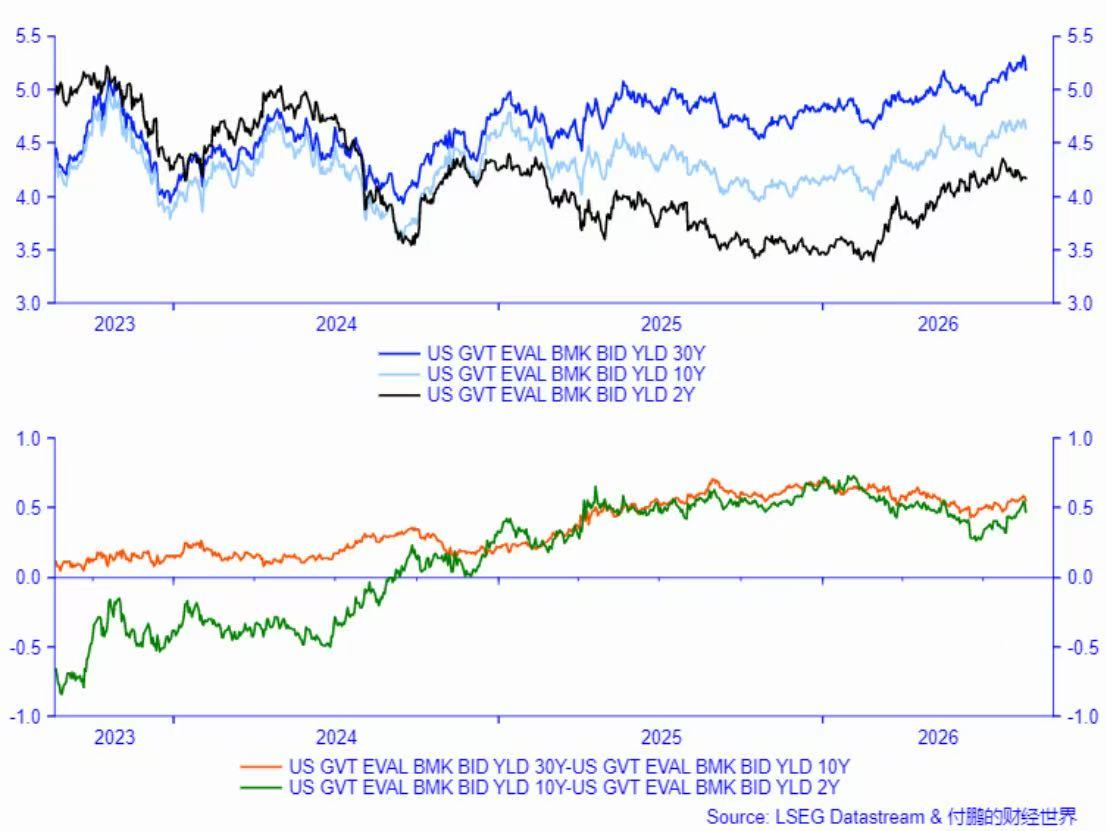
The core driving force behind the upward movement of long-end yields comes from the structural revaluation of the Term Premium, simply put, it is the compensation required for uncertainty regarding future US fiscal policy and institutions,
With the Federal Reserve's balance sheet reduction (QT) over the past few years, overseas central banks (foreign reserve diversification and local currency defense) and domestic commercial banks (constrained by regulations such as SLR) have all led to a contraction in buying demand for long-term US Treasuries at various levels; meanwhile, a huge stock of low-interest old debt matures in a concentrated manner in 2026, coupled with nearly $2 trillion in net new deficits annually, the Treasury's massive long-end supply directly overwhelms the limited buying demand in the secondary market, this leads to requiring a higher term premium to attract buyers, directly pushing up long-end bond yields (the significant expansion of the spread between 30-year and 10-year US Treasury yields starting in 2025 in the chart - red line);
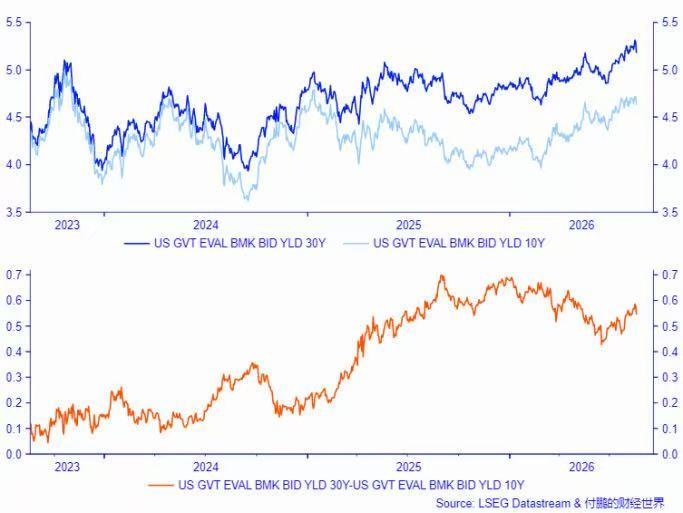
The core purpose of these two interventions is because long-end US Treasuries have already triggered micro-liquidity alarms of the "debt interest spiral". Excessively high long-end yields make global investors uneasy. If 30-year yields are not suppressed through fiscal administrative means (such as forcibly swapping short for long, tactical long positioning on the long end), the uncontrollable surge in long-end risk-free rates will directly severely impact nationwide mortgage rates and corporate refinancing costs. Ultimately, market maker congestion and basis deleveraging at the micro level will rapidly transform fiscal deficit problems into a collateral liquidity crisis across the entire market;
The Treasury Department itself entered the market to act as the buyer of last resort to "absorb old bonds", centrally buying back 10 to 30-year old bonds, equivalent to injecting continuous certain buying demand at the long end. This effectively absorbed the stagnant stock on market makers' balance sheets, directly compressing the Term Premium and Liquidity Discount of long-end bonds, driving long-end yields downward.
The 3-month to 2-year short-end Treasury yields are essentially risk-free discounts on the future path of the Federal Reserve's Federal Funds Rate (FFR). Against the background of sticky inflation, the Federal Reserve standing still or maintaining restrictive high interest rates, this forms support for short-term bond yields;
When the short end is rigidly "pinned down" by the central bank and inflation, while the long end is forcibly intervened by the Treasury, long-end yields move closer to the high short-end yields, leading to a significant compression of the 10Y-2Y and 30Y-10Y spreads, forming a typical flattening of the interest rate curve;
Historically, curve flattening or even inversion was mostly the market spontaneously trading economic recession; however, this current flattening carries strong "traces of fiscal administrative intervention"—the short end reflects the game between inflation and the central bank, the long end reflects the Treasury Department's liability management defense, and long-end interest rates have lost part of their function as an economic forward-looking barometer;
10-year/30-year risk-free benchmark rates were artificially suppressed (such as the 10-year pressed back to near 4.6%, 30-year falling back), directly alleviating the fatal valuation kill of discounted future cash flows (the denominator end of the DCF model), forming a valuation bottom support for large technology and AI leaders with extremely strong cash flows, shifting more volatility to their own fundamentals;
The US-Japan joint intervention overlaid with hot money inflow, the flattened long-end US Treasury yields reduced the attractiveness of overseas capital cross-border carry trade (such as longing long-end US Treasuries, shorting yen/euro), prompting overseas officials and institutions to reduce marginal allocation willingness for long-term US Treasuries.