Alea Research Report: Underlying Yield Spread Doubles, How Can On-Chain USD Outperform Tokenized US Treasuries?
Author: Alea Research
Compiled by: TechFlow
TechFlow Brief: This in-depth research report thoroughly unpacks the shifting landscape of the on-chain USD yield market in Q3 2026: the scale of on-chain USD pools has exceeded $39.2 billion, significantly outperforming tokenized US treasuries. Aave raised its interest rate curve, Maple offered the highest base spread, Sky and Ethena experienced capital reshuffling, and decentralized USD assets are undergoing a profound evolution from passive returns to active yield competition.

Key Takeaways

The spacing between the lines represents the yield generated by reward tokens. Approximately half of the increase in base yield is attributed to the lagged response of US Treasury funds to rate hikes, while the remainder is due to rising on-chain lending rates.
Borrowers paid higher costs, while US Treasury fund yields lagged behind benchmark Treasuries. Of the 0.53 percentage point widening in the spread, base yield contributed 0.40 percentage points. Approximately half of this stems from US Treasury funds trailing the 3-month Treasury yield prior to the Fed's September 16 rate hike; the remainder comes from protocol rate resets and the launch of higher-yielding new pools. Reward tokens accounted for 60% of the excess yield that on-chain USD earned over US Treasury funds.
Maple delivered the highest base yield above US Treasury funds with zero reward tokens. Its three core pools paid yields exceeding US Treasury funds by $14.4 million in Q3, achieving an average spread of 1.43 percentage points. Its September 17 memo introduced three new strategies, each capped at 5% of total deposits.
Aave reset its stablecoin interest rate curve, causing depositor yields to rise. The risk management team raised the first-slope rate curve three times between August 27 and September 9, pushing the USDC deposit rate on Ethereum from 3.15% in June to 3.61% in September. Over the full quarter, although Aave v3 paid $9.3 million less in base yield than US Treasury funds, $11.5 million in reward tokens bridged the gap and secured an overall outperformance.
A combined $1.29 billion flowed out of Sky’s sUSDS and Ethena’s sUSDe, with most outflows occurring during periods when rates were flat or rising. By July 22, sUSDS had lost $824 million despite rates holding at 3.60%. The sUSDe pool shed $348 million as rates rose, after which Aave initiated a reset for USDe borrowing rates on August 28. Four weeks after ENA holders passed the fee switch, Ethena terminated USDe token incentives on September 30.
Depositors in Robinhood Earn are effectively lending their funds to holders of USDe and syrupUSDG. Launched on July 1, Robinhood Earn saw its Morpho vault reach a size of $514 million by quarter-end. Borrowers collateralize with USDe, syrupUSDG, and two minor coin pairs, with reward tokens accounting for 46% of the vault's 6.98% blended APY.
Rising Borrowing Costs, Lagging US Treasury Fund Yields

The lending market started below the zero axis because its borrowing rates temporarily fell below those of US Treasury funds. Credit and real-world asset pools rely on interest payments, while basis trades depend on funding rates.
On-chain USD pools and tokenized US Treasury funds essentially both sell dollar yields retained on-chain. Treasury funds pass through Treasury yields net of management fees, while on-chain pools pay interest borne by borrowers, minus protocol take rates: including borrowers in Aave's $9 billion lending market, institutional borrowers in Maple's $3.9 billion credit pools, and profits from perpetual contract basis arbitrage and select strategies involving reward tokens. In short, tokenized Treasuries have capped but safe yields; on-chain pools can offer higher yields precisely because they lack such caps, and the premium comes at the cost of assuming credit risk from the paying counterparties.
The tracked on-chain USD pools reached a scale of $39.2 billion, more than four times the baseline composed of 27 publicly listed tokenized US Treasury funds ($8.6 billion). Calculated using a 30-day rolling rate, 82.9% of on-chain USD outperformed Treasury funds at quarter-end, up from 65.4% on June 30.
Borrowers absorbed higher interest costs. By late August, USDT borrowing utilization on Aave's Ethereum market exceeded 92%, the inflection point level cited by the management team on August 27, with USDC utilization also at similarly high levels. The Aave management team raised the first-slope rate curve for both markets on August 27, followed by further hikes on September 2 and September 9, pushing rates from 4.00% to 4.40% within 13 days.

USDT borrowing volume had been climbing consecutively for two months prior to the first rate hike, followed closely by the subsequent three staggered increases.
Rate adjustments brought substantial returns to depositors, triggering a surge of capital. Aave's Ethereum USDC and USDT markets grew by a net $470 million in size during the quarter, with deposits increasing by $355 million and borrowings rising by $185 million between August 28 and September 13. On September 15, TokenLogic paused further first-slope increases and proposed reducing the target allocation for USDT from 94% to 93%, citing it as a temporary measure addressing USDe debt migration.
Aave's rates were lower than Treasury funds early in July, causing Aave v3 to lag Treasury funds by $9.3 million in base yield for the full quarter.
A significant portion of the spread widening was due to blunting in the comparison benchmark. The 30-day average yield of the 3-month US Treasury rose by 0.28 percentage points during the quarter, while tokenized Treasury funds only rose by 0.07 percentage points. This 0.21 percentage point transmission lag was the primary driver of the spread expansion. After remaining unchanged in July amid three votes supporting a rate hike, the Treasury market rallied in advance of the Fed's 25-basis-point rate increase on September 16. Meanwhile, the total size of tokenized Treasury funds shrank from $9.9 billion to $8.6 billion, primarily dragged down by redemptions from Circle USYC on BNB Chain, BlackRock BUIDL on Ethereum, and a Centrifuge fund. Nevertheless, BlackRock still launched two new stablecoin reserve funds on August 3.

Among pools surviving at quarter-end, the on-chain USD spread narrowed from 1.43 percentage points above Treasuries in early October 2025, falling to 0.65 percentage points below them in March. The 0.40 percentage point figure in September sits at the midpoint of this range.
Looking strictly at base yields, on-chain USD averaged 3.92% in September, sitting 0.17 percentage points below Treasuries. Reward tokens accounted for the entirety of its lead over Treasuries. Among pools active across both periods, the spread relative to Treasury funds widened from 0.52 to 0.90 percentage points, with the launch of new pools making up the remaining gain. Since April, spreads had only reached these heights once in mid-May, peaking at 1.13 percentage points.
$740 Million Drained from High-Yield Pools, $270 Million Flown into Low-Yield Pools
At the individual pool level, capital showed low sensitivity to spreads; among the 135 pools open across both periods with sizes exceeding $25 million, the rank correlation coefficient was merely 0.19. In absolute terms, two major redemptions completely overturned conventional patterns. On June 30, pools yielding above Treasury funds saw a combined outflow of $740 million, while pools yielding equal to or below Treasury funds actually gained a net $270 million. The two high-yield pools, sUSDS and sUSDe, contracted by a combined $1.29 billion. The remaining pools in this cohort netted +$545 million, led primarily by the Steakhouse Sirloin USDC vault on Base, the Aave USDe market on Plasma, and USD.AI sUSDai on Arbitrum. Reward tokens covered roughly half of Sirloin's yield and accounted for the vast majority of the Plasma market's yield. By asset type, USDT deposits decreased by $1.18 billion on a comparable basis, while USDC increased by $630 million.

SparkLend's USDS market topped inflows, despite paying rates approximately 1.2 percentage points below Treasury funds. The Aave USDm market on MegaETH, primarily driven by leveraged loops, and Spark's USDT savings vault collectively evaporated $977 million.
For the full quarter, sUSDS contracted by $880 million, most of it occurring while Sky held rates at 3.60% in July. On July 13 alone, outflows hit $523 million. The rate dipped to 3.52% on July 23, before Sky hiked it back to 3.60% on September 3. Galaxy deposited $100 million into sUSDS on September 23 and accepted it as loan collateral. Spark's savings vault saw outflows of $651 million, predominantly from its USDT vault, while SparkLend's USDT market also shrank by $244 million. On September 10, Spark raised the USDT vault rate from 3.25% to 3.5%, just edging above Treasury funds. Meanwhile, SparkLend's USDS market, part of the same Sky ecosystem, surged by $895 million.

The USDe supply reclaimed its July ground by mid-September, while dollars staked in sUSDe hit a new quarterly low of $1.27 billion at quarter-end.
The size of Ethena's sUSDe pool continued to shrink despite its own 30-day yield climbing from 3.86% to 4.23% by late August. Aave's base USDe borrowing rate touched 6.3% on September 15. USDe circulation fell from $4.45 billion in July to $3.85 billion, then rebounded strongly to $4.87 billion on September 30, yet the sUSDe scale kept contracting. Aave's USDe markets on Plasma and Ethereum expanded by $378 million over the quarter. ENA holders unanimously passed the fee switch proposal on September 2. Under the plan, the switch will activate once USDe circulation hits $7.5 billion, directing 5% of net revenue to buy back ENA, scaling progressively with circulation until hitting a 25% buyback ratio at $25 billion.
Spreads Widen for Large Positions, Advantage for Small Funds Narrows
On June 30, small positions sized at $1 million yielded 2.09 percentage points more than large whale positions. By quarter-end, this gap narrowed to 1.49 percentage points. Core pools are defined as pools with a single-pool size exceeding $100 million, a history of over six months, and base yield comprising at least 80% of the total rate.

Whale positions at the $1 billion level exhibited the most dramatic shifts, with their spread relative to Treasury funds jumping from 0.69 percentage points in June to 0.97 percentage points at quarter-end.
Ultra-large positions captured higher yields as their core allocations repriced. The rates paid in September by Maple's USDC pool, sUSDe, and Aave markets were all higher than in June. At quarter-end, a $1 billion portfolio maintained a 0.97 percentage point spread, requiring the total pool rate to drop by approximately 22% across the board to erase this premium. This spread translates to an extra $9.7 million in net annual yield per $1 billion of capital.
Maple Borrowers Deliver Highest Native Base Yield
Among the top six protocols by supply size, Maple paid the purest base yield beating Treasury funds without using any reward tokens. Including reward tokens, Morpho's vault paid yields exceeding Treasury funds by $15.8 million, but only $3.4 million came from native base yields. Aave v3's native base yield trailed Treasury funds, but achieved overall outperformance through compensatory reward tokens. SparkLend remained below Treasury funds even when including reward tokens.
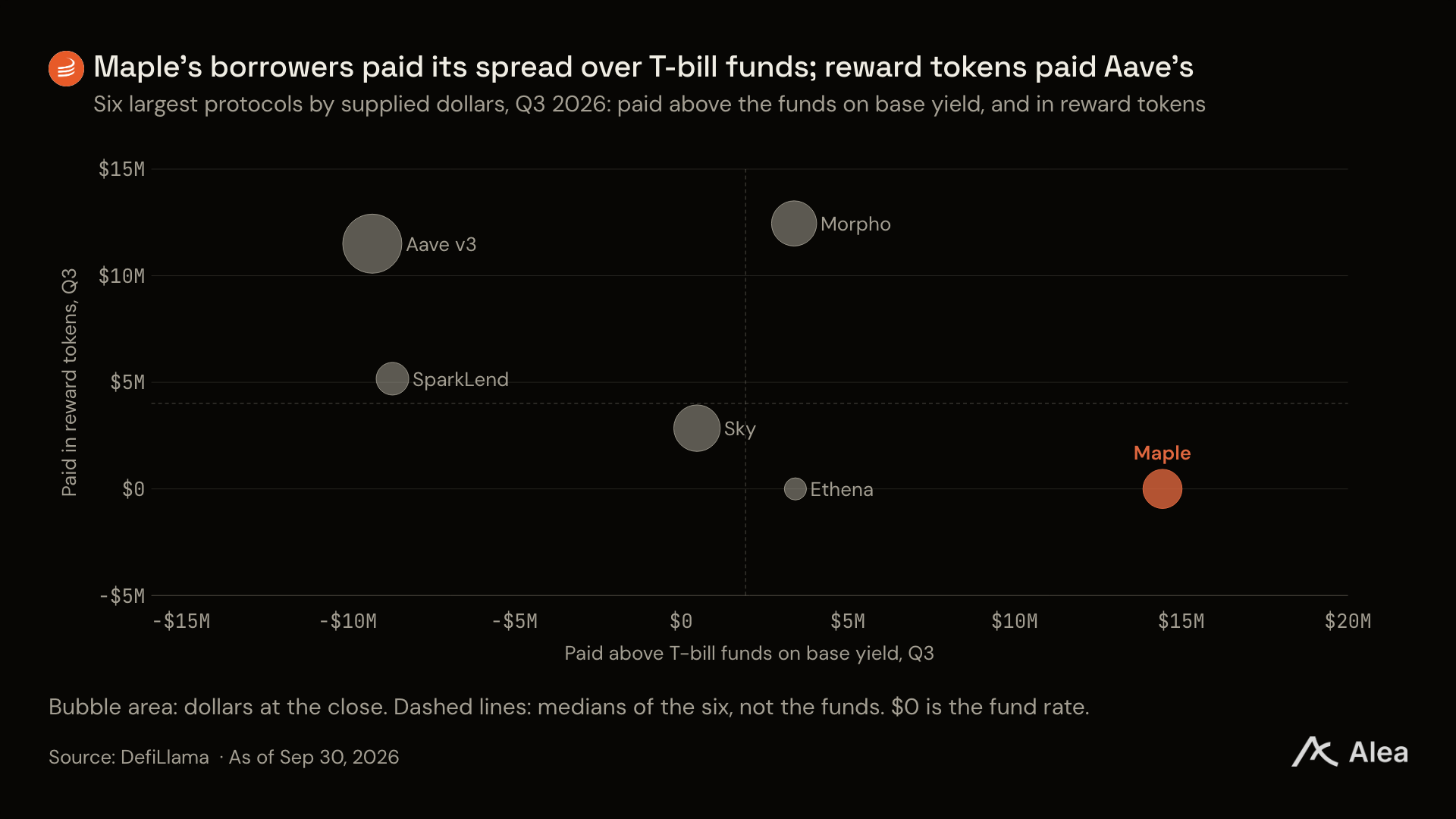
The x-axis represents the base yield paid by borrowers to depositors that exceeds Treasury funds, while the y-axis represents yield paid by reward tokens. Maple stands isolated on the right, leading with zero reward tokens and $14.4 million in excess base interest.
Four of the six protocols provided yields beating Treasury funds every single one of the 92 days in the quarter. Aave v3 outperformed on 63% of trading days, including a continuous stretch from August 19 to September 16, whereas SparkLend only won out on 4% of days. SparkLend's primary USDS market keeps 31% of reserves idle, and reward tokens account for 34% of SparkLend's actual distributed yield.
New Public Chains Absorb Liquidity, Leveraged Loops Accelerate Unraveling
Robinhood Chain started from scratch with its mainnet launch on July 1, while lockups on Monad more than doubled. Aave began deployment the day after Monad went live, securing a $15 million incentive commitment from the Monad Foundation for one year. Monad's incremental capital is primarily driven by these new markets. The Aave management team raised the first slope on Monad to 5.00% on September 11.
Meanwhile, the Aave USDm loop lending market on MegaETH plummeted from $568 million in supply to $6 million. Net deposits on the chain (after deducting borrowings) fell from $101 million to $22 million. Most funds fled on July 9 and 10, coinciding with mass liquidations in stablecoin leverage arbitrage related to Ethena. Circle's Arc chain launched its mainnet on September 16, integrating Aave V4 and Morpho on day one. Its pools only opened two weeks before quarter-end and are not fully reflected in this quarter's yield statistics.
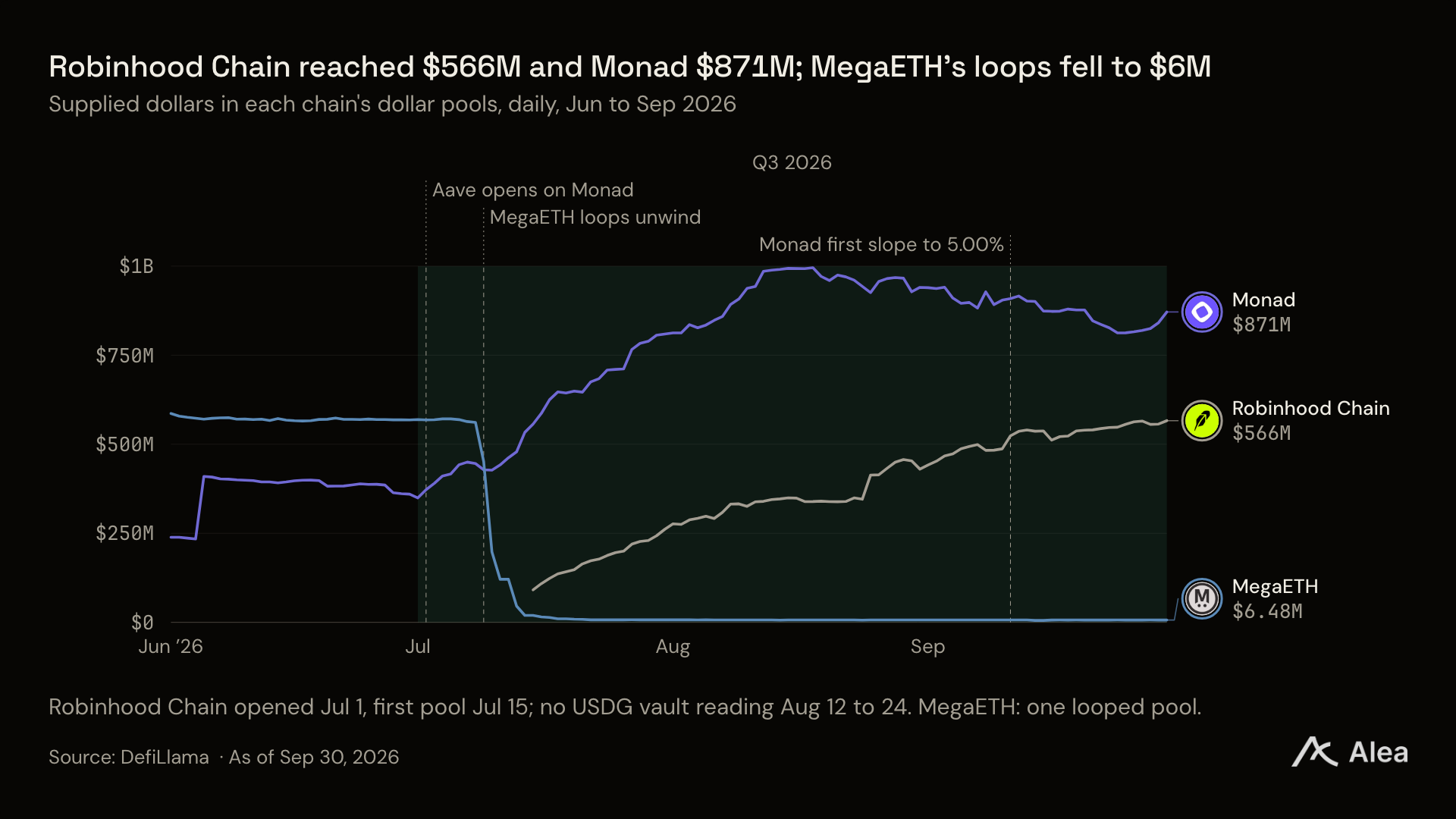
Monad's pool size peaked at $995 million on August 18, closing at $871 million at quarter-end. Robinhood Chain climbed steadily in September, while MegaETH faced complete liquidity drains in July.
Of the $566 million trapped on Robinhood Chain, the vast majority sits in the Earn vault, which focuses on providing bridge financing for Ethena and Maple positions. Its lending market for USDe accumulated $342 million by late September, with borrowing rates stabilizing near 4%. The 5% incentive Ethena offers for USDe collateral effectively covered the financing costs, though this token incentive was officially terminated on September 30.
Reward tokens account for 45% of total yield across Robinhood Chain's pools, 22% on Monad, and a mere 11% on the Ethereum mainnet.
Across all chains, curated managed vaults netted $781 million on a comparable basis. Coinbase Lend, relying on the Steakhouse vault on Morpho, broke past $500 million in early September. Uniswap launched its vault yield product, Earn, managed by Gauntlet, at the end of July. Two early Steakhouse USDC vaults on Base saw outflows of $312 million, with $213 million concentrated during Steakhouse's self-directed migration to its second-generation vault on July 29, while the receiving new Sirloin vault saw a net inflow of $341 million.
Meanwhile, regulatory shadows are gradually approaching. SEC Commissioner Hester Peirce noted on July 22 that automated vaults may fall under securities regulation depending on their architecture and operational models. On August 23, a malicious governance proposal took control of Term Finance's Meta vault, resulting in losses of approximately $8.5 million. During the attack, about $6.8 million was urgently withdrawn from Morpho's Parity Core ETH vault, where Term's ETH Meta vault had previously parked some funds.
Maple Withstands Bank Run Shocks, Maintains Robust ~4.8% Yield
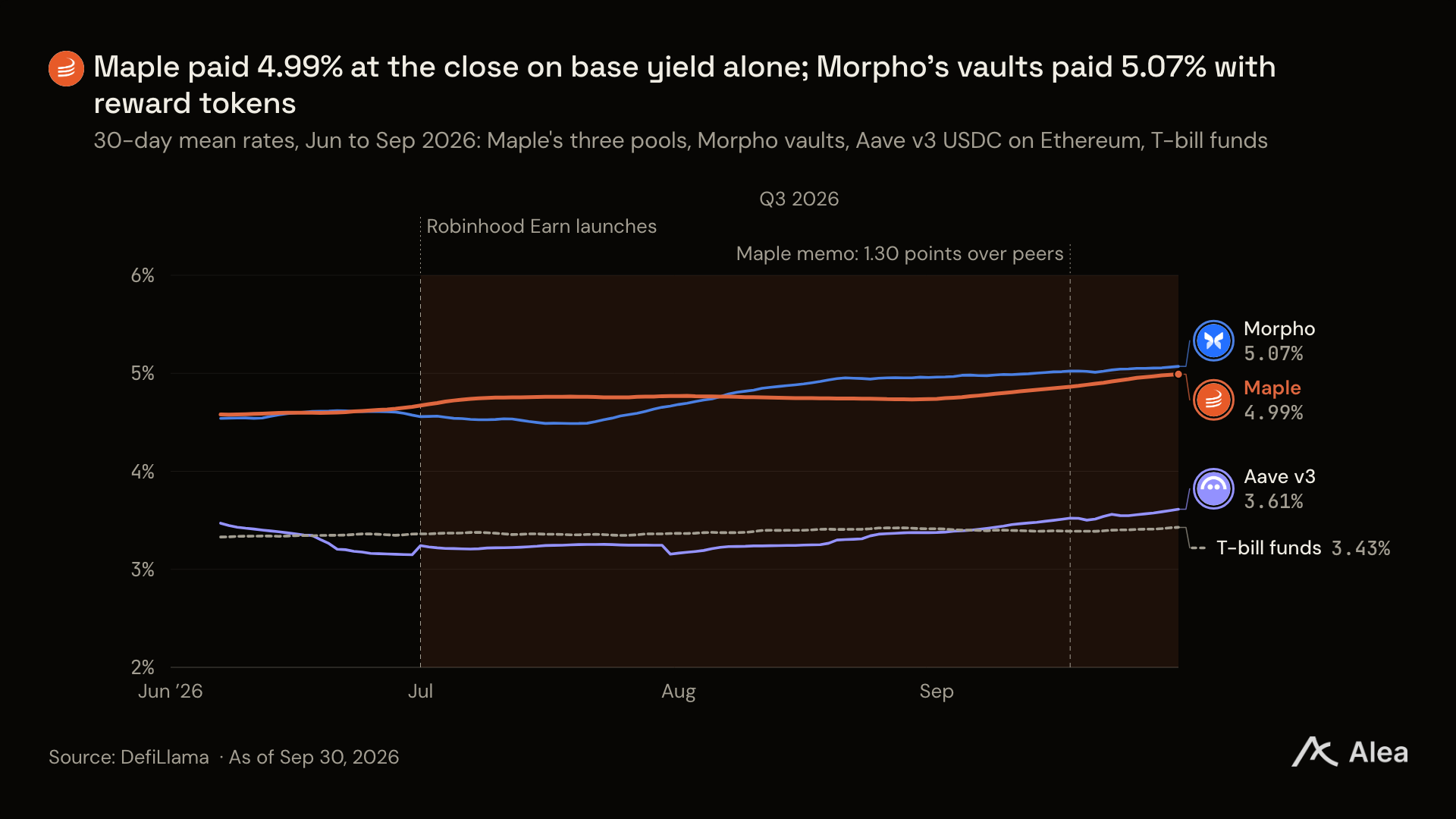
Throughout the entire quarter, Maple consistently outperformed Aave's USDC market, ending with a spread 1.38 percentage points higher. Morpho's vault only briefly surpassed it in August, buoyed by reward tokens.
Maple focuses on providing "fixed-rate, overcollateralized commercial loans" to institutional borrowers. All three of its dollar pools outperformed Treasury funds every single one of the 92 days in the quarter, without relying on any reward tokens. Deposits underwent two major reallocations. The syrupUSDC pool lost $872 million from its peak on July 15 to July 24, yet its base rate held firm near 4.8%. The pool closed at $2.87 billion at quarter-end, down $141 million from June 30. Across the quarter, syrupUSDT shrank by $434 million, mostly in September; meanwhile, syrupUSDG, eligible as collateral for Earn vaults, expanded counter-trend to $441 million. The three major pools collectively net-reduced by $213 million. Its three newly added strategies (direct lending backed by rated securities, asset-backed securitization, and cash-futures basis trading) strictly cap allocations at 5% of total deposits each until sufficient historical performance is established. Under normal conditions, withdrawals are processed in real time, and per its terms, the maximum withdrawal window does not exceed 30 days.
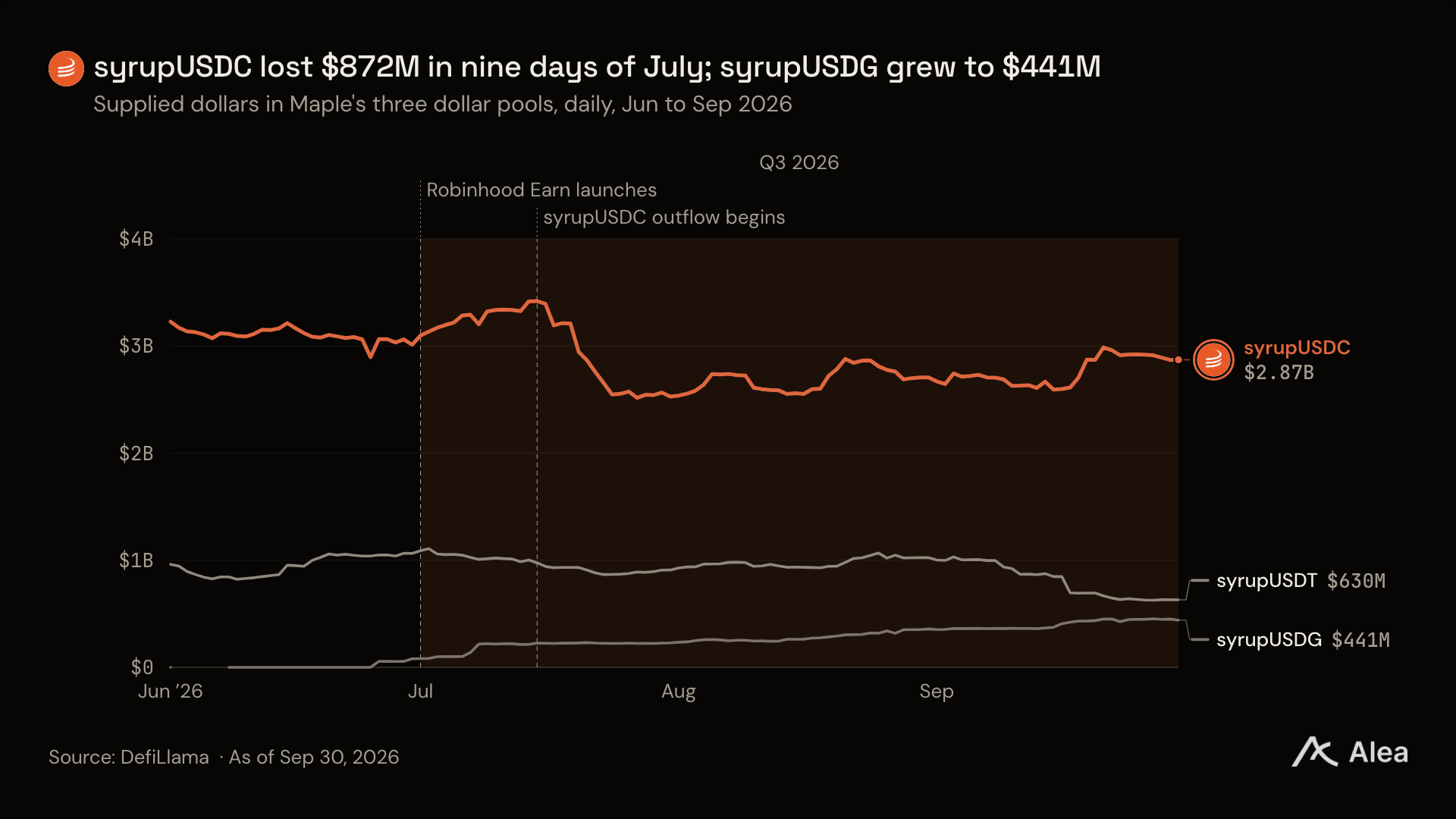
syrupUSDT faced $313 million in redemptions between September 5 and 18, primarily concentrated in three batch withdrawals on September 9, 11, and 17.
Looking across the entire market pool, on-chain spreads doubled in Q3, with the most sustainable driver being the active narrowing of base yield versus Treasuries. Through rate resets by lending protocols and the emergence of higher-return new pools, base rates improved by 0.19 percentage points relative to the benchmark Treasuries themselves. Meanwhile, as Treasury funds gradually swap into newly issued high-yield bonds, their 0.21 percentage point transmission lag effect will be gradually smoothed out. Although reward tokens still contribute 60% to the excess spread of on-chain USD, uncertainty remains high since protocols can unilaterally terminate incentives at any time (as seen with Ethena's exit on September 30). Even stripping away all reward tokens, on-chain USD currently enjoys a pure native base yield premium of 0.49 percentage points over tokenized Treasury funds.
Join TechFlow official community to stay tuned
Telegram:https://t.me/TechFlowDaily
X (Twitter):https://x.com/TechFlowPost
X (Twitter) EN:https://x.com/BlockFlow_News
 @AleaResearch