Nomura Securities Research Report Analysis: Unitree Robotics, the No. 1 Humanoid Robot Company in Global Shipments, Cost Advantage Builds Moat
By: Rita
While the humanoid robot industry is still struggling in a quagmire of losses, Unitree Robotics has achieved profitability first.
In its initial coverage report released on August 19, Nomura Securities gave Unitree Robotics a buy rating and a target price of 370 yuan, representing 145% upside potential compared to the current stock price of 151 yuan. Nomura believes Unitree is the global leader in humanoid robot shipments, with pure humanoid robot shipments exceeding 5,500 units in 2025, far surpassing peers, and is one of the few embodied AI companies globally to achieve profitability. Its moat is the cost advantage built on full-stack in-house hardware R&D, compressing the cost of externally purchased components to 14% to 18% of total costs.
However, policy risks in the U.S. market are the biggest variable.
Cost Control is Unitree's Core Moat
Unitree's core competitiveness lies in hardware; algorithms are not its strongest link.
For the four core components of robot joint modules (motors, reducers, drivers, encoders), Unitree develops and produces all in-house, and even develops LiDAR independently. Nomura estimates that in-house developed components account for 80% to 90% of core component costs, with external purchases accounting for only 14% to 18%. This vertical integration directly translates into pricing power: the quadruped robot Go2 sells for less than 10,000 yuan, and the humanoid robot R1 launched at only 29,900 yuan.
The financial result of this cost advantage is profitability rare in the industry. Unitree's gross margin on main operations increased from 44% in 2022 to 60% in 2025, with adjusted net profit reaching 590 million yuan in 2025 (net profit margin of approximately 35%). During the same period, global humanoid robot peers generally incurred losses.
Nomura expects this cost advantage to be further strengthened with scale expansion. The material cost of the complete humanoid robot unit has already fallen below 100,000 yuan. With the smart manufacturing base funded by the 2027 IPO put into production, capacity release will continue to drive down unit costs. Nomura predicts Unitree's revenue from 2026 to 2028 will reach 2.69 billion, 5.4 billion, and 13.18 billion yuan respectively, representing year-on-year growth of 58%, 101%, and 144%, driven mainly by sales volume with limited price impact.
Product Iteration Speed and Full Matrix Layout Constitute First-Mover Advantage
Unitree possesses the most complete product matrix globally.
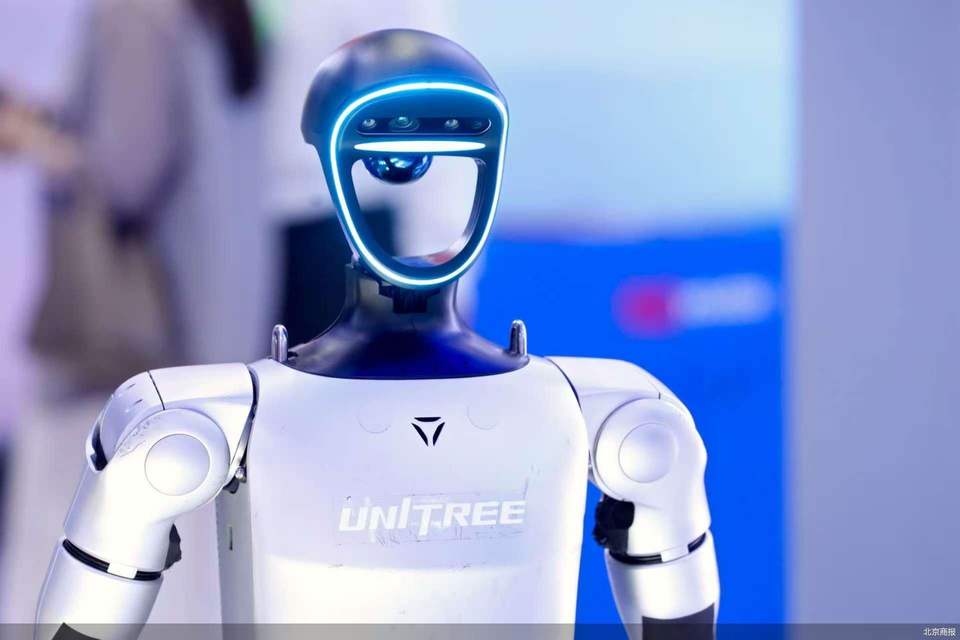
From quadruped robots to humanoid robots, and then to robotic arms, dexterous hands, and LiDAR, Unitree covers the complete technology stack of "locomotion + manipulation + interaction". In 2025, humanoid robot shipments exceeded 5,500 units, and quadruped robot shipments exceeded 26,000 units, both ranking first globally.
Product iteration speed is another key advantage. Unitree achieved the world's first full-size electric-driven humanoid robot backflip (March 2024), humanoid robot running speed breakthrough of 10 meters/second (early 2026), and four gold medals at the 2025 World Robot Conference. Nomura believes that in the process where the valuation anchor of embodied AI shifts from "physical capabilities" to "brain + cerebellum", Unitree's massive real-world robot data collection capability will become a barrier that software and model vendors cannot replicate.
FCC Restricted List is the Biggest Policy Risk
In June 2026, the U.S. Department of Defense listed Unitree on the Section 1260H Chinese Military Companies List. Subsequently, on July 28, the Federal Communications Commission included "foreign-produced advanced robotic equipment" in the restricted list, covering all mobile robots not produced in the United States. Unitree's main models currently on sale have obtained FCC authorization and can continue to be sold, but new models will be prohibited from entering the U.S. market.
Nomura estimates that Unitree's U.S. revenue accounted for 13% to 19.5% of total revenue from 2023 to 2025, with overseas revenue reaching 730 million yuan in 2025, accounting for 43.6% of main operating revenue. The restricted list does not apply retroactively to existing models, but authorization periods may be limited to within 10 years, and new models will be unable to obtain certification. For a company with a product iteration cycle of about one year, this means the incremental space in the U.S. market will be gradually narrowed.
Nomura believes this risk is structural, not cyclical. Compliance paths may involve U.S. domestic manufacturing, but for Unitree, which has already been listed on the 1260H list, this path is almost infeasible.
Valuation Anchored on Sales Volume and Revenue Growth Rate
Nomura prices Unitree based on an expected price-to-sales ratio of 25 times for 2027, with a target price of 370 yuan. This valuation multiple is significantly higher than the average level of Chinese robot component suppliers (approximately 9 times), but Nomura believes the premium is reasonable. Unitree's growth curve is steeper; Nomura predicts a revenue compound annual growth rate of 122% from 2026 to 2028, far exceeding the growth expectation of approximately 30% for Chinese peers in 2027. Unitree achieved profitability in 2025 with a gross margin of 60%, while some peers still remain at negative net profit margins in 2026.
The target price corresponds to 145% upside potential. Key catalysts include: commercialization of in-house World Model/VLA Model, humanoid robot quarterly shipments continuously exceeding expectations, and the volume release pace of new products such as R1 and H2.
Downside risks listed by Nomura include: overseas growth slowdown due to the FCC Restricted List, industrial scenario implementation falling short of expectations (currently over 70% of humanoid robot revenue comes from research buyers), and price pressure caused by intensified competition.
Unitree's path is a continuation of Chinese manufacturing's vertical integration capabilities in the robotics track. The moat is full-chain cost control, not a single technological breakthrough. Nomura's core judgment is: in the process of embodied AI moving from laboratories to factories and homes, whoever reduces costs to a usable level first will be the first to get the ticket to scale.

Disclaimer
This article is a compilation and interpretation by TechFlow Research of a third-party securities firm research report (Nomura Securities, August 19, 2026), combined with a compilation of public market information.
The ratings, target prices, earnings forecasts, and related judgments cited in the article are the views of the securities firm's analysts, represent only the position of their affiliated institution, do not represent the views of TechFlow Research, and do not constitute any investment advice.
The market involves risks, decisions must be independent. This article should not be used as a basis for buying or selling any securities.
Join TechFlow official community to stay tuned
Telegram:https://t.me/TechFlowDaily
X (Twitter):https://x.com/TechFlowPost
X (Twitter) EN:https://x.com/BlockFlow_News
 @chaoxiangooo