Doing the Hardest Work, Earning the Least Money: Stripe's $7 Billion Acquisition Reveals the Truth About AI Profit Distribution
By: Thejaswini M A
Translated by: Saoirse, Foresight News
In 2017, developer Alex Atallah believed the crypto industry lacked a user-friendly front-end trading portal. Hoping to solve this pain point and capture business value, he founded OpenSea. This is a platform aggregating trades for unique digital collectibles, and it was the darling of the 2020 NFT boom.
When the industry downturn arrived, Alex Atallah did not dwell on disappointment. As the open-source AI wave rose, he once again saw the fragmentation problem he had once tried to solve. A massive amount of raw supply emerged in the AI field, and developers were overwhelmed by fragmented APIs and inconsistent billing systems. The time was ripe to build a unified front-end portal.
So Alex Atallah founded OpenRouter, calling it the "Stripe for AI." Stripe provides a unified API for software developers to handle all payment processes in one stop; OpenRouter does exactly the same for AI models, which is the origin of the title "Stripe for AI."
I do not believe in the idea of wishes coming true, so I call it a self-fulfilling prophecy: today Stripe has acquired it for over $7 billion.
OpenRouter completed a $113 million Series B financing round in May this year, with a post-money valuation of $1.3 billion. This acquisition by Stripe directly quintupled its valuation.
This article will analyze what Stripe actually bought and why real profits are generated at the interface layer.
What Exactly Does OpenRouter Do?
Generally, if an enterprise wants to use AI models from OpenAI, Anthropic, and Google simultaneously, it needs to register accounts separately and write exclusive code for each. After integrating OpenRouter, enterprises and developers only need to integrate one set of APIs to call all models simultaneously. When an application initiates a request, OpenRouter will automatically forward the request to the supported 500 AI models, selecting the one with the lowest cost, fastest response, best data privacy, or current availability.
Platform business volume surged fivefold in six months, currently routing 25 trillion tokens weekly for 8 million users.
OpenRouter charges developers the raw cost of the models themselves, with a 5.5% fee for credit card payments and a 5% fee for cryptocurrency payments. Research firm Sacra estimates that in March 2026, the platform's $900 million total gross volume corresponds to an annualized revenue of $50 million. Since then, business traffic has continued to rise, so Stripe paid a high premium of 50-140 times price-to-sales ratio to bring this business under its wing.
Stripe can fully afford this expense. The payment giant had revenue of $6.8 billion last year, holds $3.2 billion in cash, and reached a valuation of $159 billion in equity transactions in February. According to the public annual report for 2025, the platform's total transaction volume was $1.9 trillion, a year-on-year increase of 34%, accounting for about 1.6% of global GDP. Patrick Collison and John Collison stated that Stripe serves over 5 million enterprises, "covering all top AI companies," naming ChatGPT, Claude, Cursor, Replit, and Vercel in the text. Stripe has not disclosed overall revenue externally, nor broken down the revenue share of the AI business.

Source: stripe.com
Stripe has completed the layout of the entire product suite, filling all components needed for AI agents to pay autonomously.
At the underlying infrastructure level, it spent $1.1 billion to acquire stablecoin infrastructure company Bridge. AI agents need fund storage and management solutions, so Stripe acquired wallet service provider Privy, with the transaction amount not disclosed externally.
Next is the usage billing platform Metronome, used to calculate compute consumption; giants like OpenAI, Anthropic, and Nvidia all use it to account for resource consumption. Stripe completed the acquisition for about $1 billion in December 2025.
Afterwards, Stripe jointly incubated and launched the payment public chain Tempo with Paradigm, which officially went live in March, accompanied by a machine payment protocol, allowing software to automatically complete service payments without manual approval. Stripe also launched the x402 protocol, supporting AI agents to use cryptocurrency to purchase compute resources.
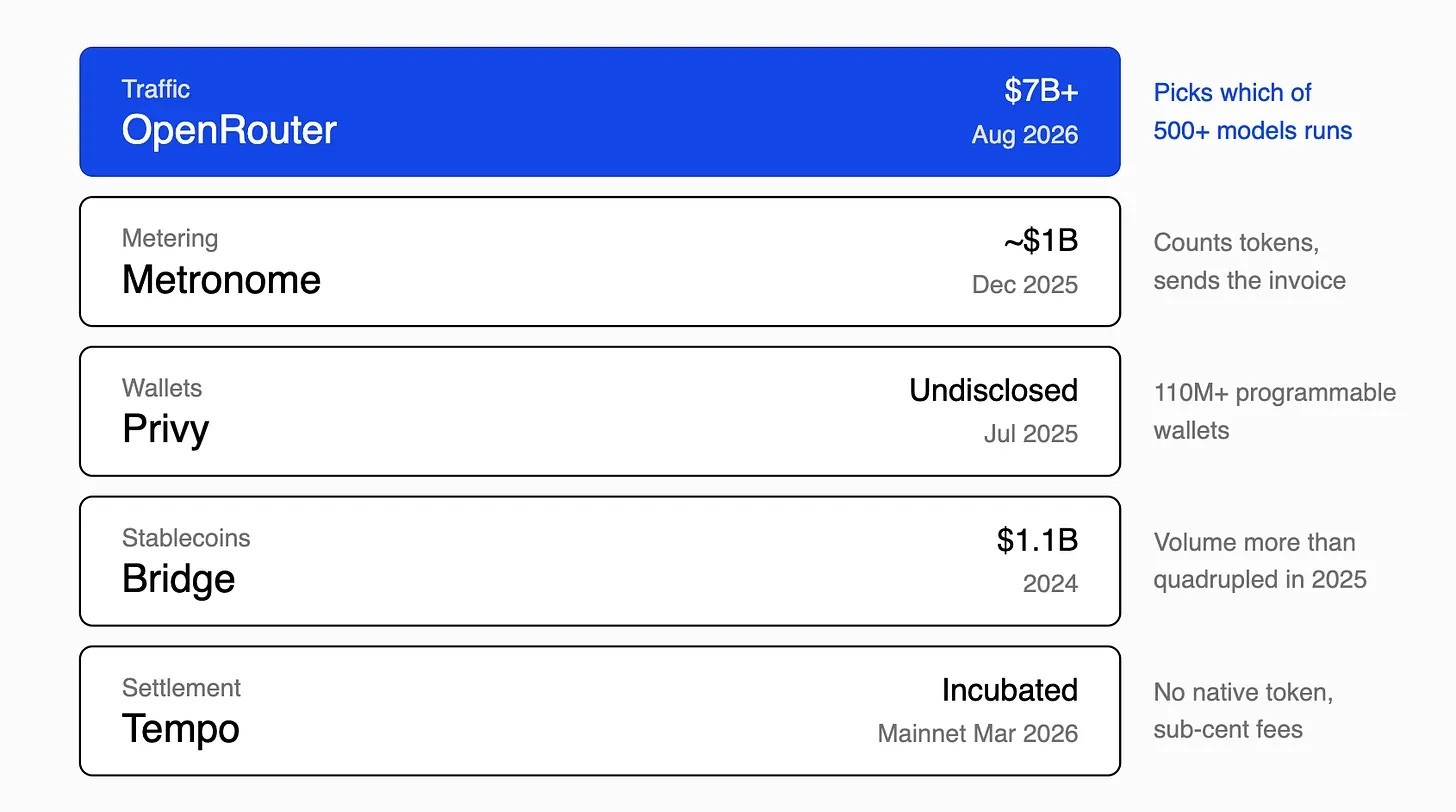
Stripe's layout for building a full-link system for AI agents
But Stripe also hopes to see the request flow and decide which model undertakes the task; the OpenRouter acquisition happens to solve this problem.
Since last December, Stripe CEO Patrick Collison has publicly stated that the AI industry is moving away from the fixed monthly subscription model and turning to a usage-based billing model where payment is made only for actual consumption. Stripe originally possessed backend usage tracking and billing systems; this new transaction allows it to simultaneously grasp the front-end portal for developers accessing models.

Digital Transaction Settlement, a Commercial Dead End
Crypto networks can complete asset transfer and settlement, but where exactly do profits come from?
Underlying technology bears the heavy work and invests huge costs, but only user-facing applications can capture profits.
Verizon, AT&T invest billions of dollars to lay pipelines and build 5G base stations to ensure data transmission, but they are essentially low-margin utilities. Profits are always generated at the interface layer: for example, Apple sells smartphones that use the network, and Meta relies on applications within the platform to earn advertising revenue.
Such cases are everywhere. 94% of Circle's revenue comes from investing customer deposits in US Treasury bonds; even though its routing protocol handles 60% of cross-chain USDC circulation, the direct revenue generated is almost zero because the underlying settlement blockchain belongs to third parties. Circle launched Arc (mainnet will go live on September 16), hoping to migrate to the upper layer of the stack, rely on interfaces for monetization, and no longer lose transaction fees in vain. Simply doing circulation and settlement is hard to scale unless a monopoly is formed. Visa and Mastercard are also only responsible for data circulation and settlement, yet can earn huge profits; the root lies in operating a closed system. Unlike public chains and the open internet, Visa belongs to a private network; merchants wanting to accept bank cards must use this infrastructure, paying a 2-3% fee for every swipe.
The figures for AI payments look massive in volume, but lack practical significance. The x402 protocol has processed over 153 million transactions since May 2025, with a total volume of $40 million, averaging only $0.26 per transfer. Even on low-cost public chains like Base and Solana, paying network fees again for a $0.26 payment is not economically viable. In the Web3 field, hundreds of millions of small transactions are often Sybil attacks — that is, bots repeatedly making small transfers to inflate data, in order to get future token airdrops, or developers cyclically running stress test scripts.
Compare OpenRouter: annual gross volume of $900 million, steadily extracting a 5% share. The underlying payment network bears more work, but the value actually circulated is lower, earning only meager profits of a few cents.
Even dedicated public chains like Tempo did not issue native tokens upon launch. This means it voluntarily gave up the huge token speculative returns usually available to crypto networks. This trade-off was made to provide enterprise clients with a stable, predictable fee mechanism.
Although Stripe founders hope to build infrastructure capable of processing millions of transactions per second, Tempo's current actual utilization is extremely low. Since going live in March, the network averages less than 1 real transaction per second. Stress tests prove the network capacity can break through 18,000 TPS, but daily fees generated by real business are only $5.34, with total fees for thirty days around $620. On-chain locked assets reach $40 million, but the economic return brought by settlement business is negligible.
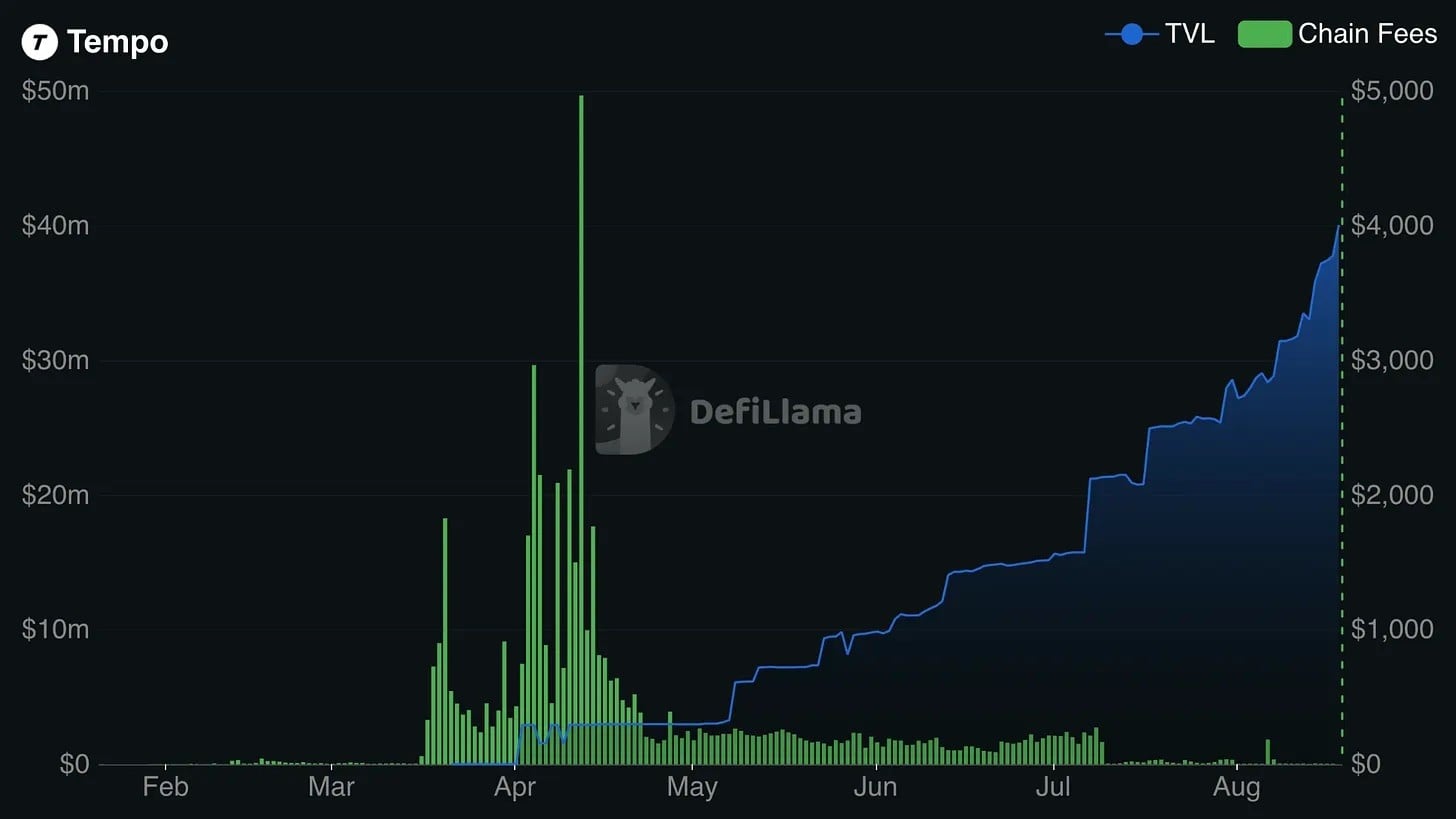
Data Source: defillama
Only platforms that directly connect with customers can earn handsomely. The original assumption of the crypto industry was: crypto protocols aggregate AI models, relying on token discounts to offer unbeatable low prices, but this path is heading towards failure. Crypto protocols can obtain cheap compute, but those controlling users and capturing profits are centralized enterprises.
The decentralized compute network Chutes built on Bittensor has cumulatively processed 9.1 trillion tokens, covering 400,000 users. During the business peak in May-June, Chutes output nearly 22 billion tokens daily via the OpenRouter interface. But up to a quarter of its daily traffic relies on OpenRouter for distribution. io.net outputs 4 billion tokens daily, also relying on this centralized platform for traffic distribution.
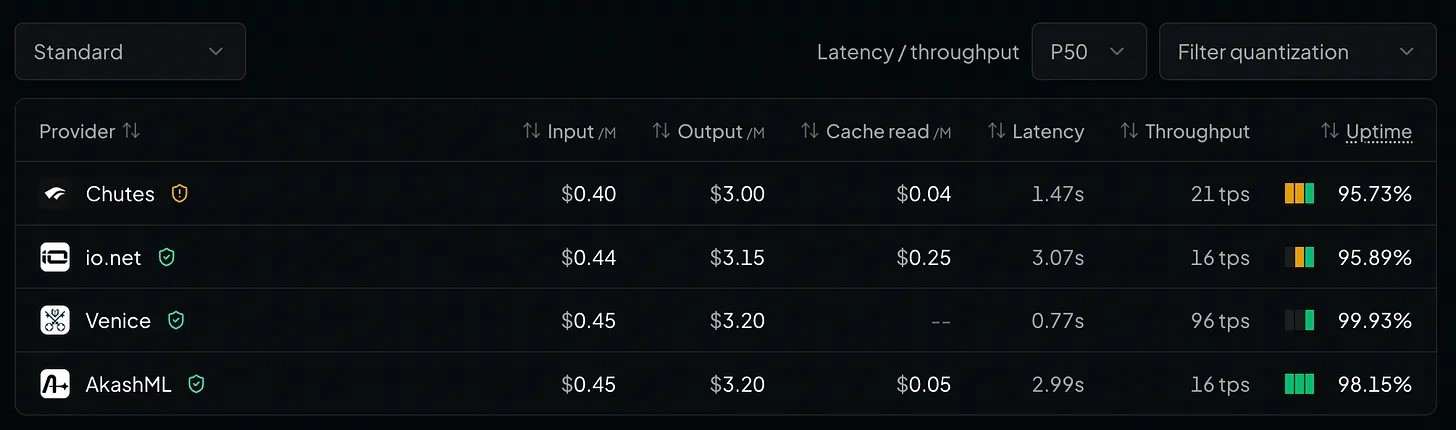
Data Source: openrouter.ai
Decentralized networks like Chutes do not need to bear expensive data center and corporate labor costs; compute is provided by ordinary individuals, and participants receive crypto tokens as compensation, so quotes can be far lower than large tech vendors. The cost advantage is very obvious, but the shortcoming lies in trust, and trust is exactly the entire value of the interface layer.
Quality control is a huge challenge OpenRouter faces. When an application initiates a call, OpenRouter will forward the request to the lowest-cost available independent server. But servers vary in quality; some devices will downgrade hardware or tamper with model parameters to compress costs. A survey of 42 servers shows that nearly one-third of servers completely hide their configuration parameters. For this, OpenRouter plans to launch a "Certified Zone" for trusted service providers. For crypto networks, this problem is even more thorny: malicious nodes, out of profit-seeking motives, will actively run downgraded versions of models to inflate profits.
Although projects like DGrid and Bittensor are researching theoretical solutions to detect model output degradation, large-scale real-time verification remains an unsolved problem to this day.
Service availability is another major realistic obstacle. Unlike large tech companies that possess huge elastic server clusters, networks like Chutes are extremely prone to downtime when traffic surges. To ensure stability, developers still need to treat centralized aggregation platforms as a fallback solution, and in the end, still have to pay the toll fees they intended to avoid.
At the revenue level, there is a discrepancy between the income projects announce externally and real market demand. Bittensor externally claimed subnet revenue of $43 million in the first quarter, but independent analysis verification shows real external paid income is at most only $15 million, of which Chutes' actual income is less than $2.5 million. Chutes can receive newly minted crypto tokens worth $54,000 daily; it relies on token inflation to maintain operations, rather than a steady stream of real paying users.
DGrid built a gateway compatible with OpenAI standards, connecting to over 200 models, completing settlement via x402, and relying on a "Proof of Quality" mechanism to audit outputs. The platform externally claimed that 13,000 users brought $20 million in revenue in the first six months after launch, paving the way for the DGAI token issuance. But this revenue is essentially selling lifetime memberships at a unit price of $1,580; members can obtain future token shares, belonging to disguised token presales, not continuous interface call consumption.
Of course, decentralized networks can also handle real traffic; Dippy is an example. This AI character application with 8.6 million users gave up traditional cloud service providers and migrated entirely to Bittensor's Targon network. Although on-chain financial revenue is difficult to fully verify, this is already a major breakthrough, proving consumer-grade applications can completely run on decentralized infrastructure.
When the platform remains independent, it can schedule traffic fairly. Once it falls into the hands of enterprises like Stripe, conflicts of interest will appear. Stripe holds its own payment tools, wallets, and blockchain products, and will naturally tend to direct traffic to its own system, squeezing competitors.
The biggest selling point of the crypto narrative is no single entity control. Decentralized systems will not be acquired by enterprises, nor will they modify rules behind the scenes to favor their own applications. Stripe can develop excellent software, but can never provide a truly neutral, unbiased underlying pathway.
The business logic of the interface layer is completely valid, but the crypto industry is still very far from controlling the interface layer.
This Stripe transaction is equivalent to marking a public market price for the business of "standing in the middle of traffic." Reports say it paid $7 billion to acquire a business with annualized revenue of about $50 million, the reason being: this platform connects 8 million developers and about 500 AI models, this business is hugely valuable. If you are developing an open-source model routing project, you can now completely take this valuation data to connect with venture capital.
But the situation has also become awkward. In the past, decentralized compute networks relied on accessing OpenRouter to save the trouble of customer acquisition and achieve growth. Now this traffic gate belongs to Stripe, and this enterprise has full business motivation to prioritize traffic to its own products. If you originally chose OpenRouter, it was precisely for its neutrality, for example, hoping to call cheap Chinese models without interference, then it is inevitable to feel worried.
Only a router that truly does not belong to any party will not deliberately bias traffic. But to achieve commercial implementation, three major hurdles must be overcome simultaneously: proving the code actually running on nodes is trustworthy; achieving high availability without relying on centralized backups; building a business model that can survive without relying on token subsidies. The industry has not yet achieved this.