Trump's Truth API Starts Making Money, But Bitcoin Treasury Suffers Huge $500 Million Loss
By: Blockhead
Compiled by: Luffy, Foresight News
The Truth API, a data licensing product launched by Trump Media Group, has attracted paying institutional clients just one week after going live; however, at the same time, the company's Bitcoin treasury assets have lost over $500 million. Congress has submitted two letters to the SEC regarding this matter but has yet to receive a substantive response.
Bitcoin Assets Shrink Significantly
According to data from Arkham cited by on-chain analysis firm Lookonchain, last weekend, wallets associated with Trump Media Group transferred 2,628 Bitcoins to Crypto.com, worth approximately $165 million. Lookonchain statistics show that since the company launched its Bitcoin treasury plan, a cumulative total of 7,281 Bitcoins have been transferred out, valued at approximately $545 million based on an average selling price of $74,855.
Trump Media Group does not agree with this interpretation. A company spokesperson told The Block that these Bitcoins were merely "transferred, not sold," the same explanation the company gave when similar on-chain anomalies occurred in May this year. On-chain data can only confirm the transfer of assets to Crypto.com and cannot prove that the assets have been sold off for cash.
This conceptual distinction has substantive significance. The remaining Bitcoins in wallets labeled with the company's tag are approximately 4,261, which almost perfectly matches the 4,260.73 Bitcoins disclosed in its Q1 10-Q financial report as collateral for convertible notes as of March 31. According to this filing, before satisfying loan covenant terms, the company cannot withdraw or dispose of these pledged Bitcoins; the relevant restrictions will be lifted no later than when the notes mature on May 29, 2028. If the assets in this labeled wallet are indeed the pledged collateral, then Trump Media Group's freely disposable Bitcoin position may already be close to zero.
However, the entry cost is an undisputed fact. As Blockhead reported in May 2025 when the treasury plan was just announced: Trump Media Group raised $2.5 billion ($1.5 billion in stock, $1 billion in convertible notes), fully referencing the model of Michael Saylor's Strategy, buying 11,542 Bitcoins with a total cost of approximately $1.37 billion, at an average price of $118,522 per coin. Its Q1 financial report shows that as of March 31, it held 9,542.16 Bitcoins on the balance sheet with a cost of $1.13 billion; another 2,000 Bitcoins were used for covered call option collateral.
Since then, the Bitcoin price has fallen from a high of approximately $126,080 in October 2025 to about $63,000, nearly halving. CoinDesk on-chain calculations estimate that Trump Media Group's Bitcoin holdings have realized losses of approximately $318 million and unrealized losses of $237 million, falling within the same range as Lookonchain's combined estimate of approximately $555 million. Neither set of data has been confirmed by the company; both assume that exchange transfers were sold off at market price, which Trump Media Group denies.
Regardless of how the recent transfers are ultimately characterized, the Q1 financial report clearly reflects the asset impairment. Trump Media Group disclosed a net loss of $405.9 million for Q1 2026. According to the 10-Q filing, $243.96 million of this was recorded as "unrealized losses on digital assets and pledged digital assets," covering Bitcoin, Cronos, and all pledged collateral, not just Bitcoin alone. Revenue for the quarter was only $871,200, up only 6% year-over-year, enough to show that: compared to the violent fluctuations of treasury assets, the company's main business volume is very small.
Truth API Has Generated Actual Business Revenue
Truth API officially went live on August 1 and had paying clients from the start. For a company whose core media business quarterly revenue is still less than $1 million, this is rare. The product targets hedge funds and algorithmic trading institutions, capable of pushing content from Trump's personal account and 9 other top Truth Social accounts within milliseconds of post publication. The product's maximum monthly subscription fee is $100,000; if a three-year contract is signed, the monthly fee can drop to $60,000. At least five institutional clients had signed up before launch, reportedly including trading companies and financial news organizations.
Simply doing the math: one full annual fee subscription is as high as $1.2 million, exceeding the company's entire quarterly revenue. If there are five full-paying clients, it can bring $500,000 in monthly income, $6 million annually. The absolute value is not huge, but this is Trump Media Group's first product whose growth logic does not depend on cryptocurrency market conditions.
The market has given feedback. The DJT stock price has cumulatively risen about 48% from the historical low of $6.96 on June 26, closing at $10.38 on July 30. Forbes estimates that this rally added $600 million to Trump's net worth, largely from his equity in Trump Media Group held through the Donald J. Trump Revocable Trust, with Donald Trump Jr. serving as trustee of the trust; Forbes calculates his total personal wealth to reach $6.5 billion.
The pace of the stock price rise is highly correlated with the announcement and launch of Truth API, diverging from the downward trend of Bitcoin prices. This indicates that market pricing logic has already viewed this data business, rather than the Bitcoin treasury or the social platform itself, as the company's next core catalyst.
Insider Trading Controversy Surfaces
Truth API is not an ordinary market data product. It sells the privilege of priority access to posts from the current president and his core allies' accounts, and statements from these accounts have repeatedly stirred market conditions in the past. On June 10, Trump posted citing Citigroup's stock ticker, and Citigroup's stock price outperformed the market that day; in July, he posted that negotiations for a memorandum of understanding with Iran broke down, followed by a decline in Bitcoin; in April 2025, he posted about suspending tariffs, directly driving fluctuations in major indices.
Democratic members of both the Senate and the House of Representatives have requested the SEC to investigate this, but neither has received a substantive response. On July 20, Representative Ritchie Torres wrote to SEC Chairman Paul Atkins, requesting the commission to evaluate the product based on rules related to insider trading, market manipulation, and broker-dealers, and to work in coordination with the CFTC and the Office of Government Ethics; this was only four days after the Truth API announcement. On July 28, Senator Elizabeth Warren and Senator Adam Schiff followed up with a joint letter, calling the product "an egregious act of abusing presidential office for personal gain."
Both letters cite the same key fact: Trump holds approximately 41% of Trump Media Group shares, a figure directly confirmed by 10-Q financial report documents. The Donald J. Trump Revocable Trust has held 114.75 million shares steadily since December 2024; the cover of the financial report shows that as of May 6, 2026, the total outstanding shares were 276.953828 million, calculating to a shareholding percentage of 41.4%. The 52% shareholding percentage circulating in the market is outdated data; that was the trust's shareholding percentage before the equity financing diluted the share capital in 2025, and it was that round of financing that provided funds for the Bitcoin treasury. This means that every Truth API subscription income will have a portion flowing back to the trust.
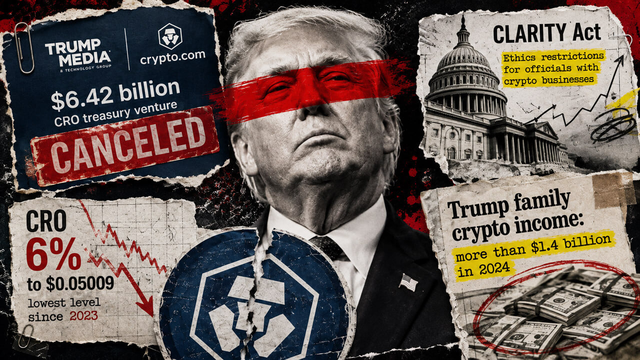
This is also not the first time Trump's personal crypto interests have conflicted with his official position. Blockhead reported in May this year that during the CLARITY Act negotiations, ethical clauses constraining the president's personal crypto business were the focus of contention among all parties. Documents disclosed in the same month show that from the TRUMP meme coin to World Liberty Financial related business, the Trump family's crypto sector earnings have exceeded $1 billion.
The SEC confirmed receipt of the two letters from members of Congress, but one week after the product launch, there was no further public statement. This is consistent with the situation Blockhead observed at the beginning of the year: Paul Atkins was appointed by Trump, the SEC's last Democratic commissioner resigned shortly before this, and within the agency, there are no longer dissenting voices regarding crypto-related rulemaking.
The two letters did not prevent the product from landing; Truth API went live as scheduled and has already signed clients. Trump Media's General Counsel denied insider trading-related allegations, stating that the service merely accelerates the transmission speed of public information. But this argument does not address the core questions of the members of Congress: the key point of the problem lies not in whether the information is confidential, but in the time difference in information reaching different groups.
There are two closest reference cases in the history of regulatory agencies, with identical outcomes. In 2013, Thomson Reuters Group pushed the University of Michigan Consumer Sentiment Index to paying premium clients two seconds early, with a monthly fee of up to $6,025; subsequently, the New York State Attorney General Eric Schneiderman's office halted the business. In February 2014, under similar pressure, Business Wire terminated direct data stream services for high-frequency trading institutions.
The pricing of Truth API is approximately 16 times that of the University of Michigan data business; and unlike past cases, the party selling the preemptive information flow is precisely the highest person in charge of the regulatory agency.
Two Big Bets, Two Completely Different Outcomes
Trump Media Group is staging a real-world control experiment, testing how to commercialize the president's social influence.
The Bitcoin treasury bets on an asset that the company itself cannot control, with book losses exceeding $500 million. Moreover, if the collateral calculation holds, the company will have almost no remaining Bitcoin to sell before 2028.
Truth API bets on something the company can influence: the frequency of Trump's posts, and the market impact the posts can bring. This business has landed; it represents a more sustainable narrative, and its ultimate direction will most likely be decided by the SEC rather than the market.
Join TechFlow official community to stay tuned
Telegram:https://t.me/TechFlowDaily
X (Twitter):https://x.com/TechFlowPost
X (Twitter) EN:https://x.com/BlockFlow_News
 @blockhead_co