Morgan Stanley Research Report Analysis: Software Sector Overly Pessimistic, New Framework Uncovers High-Quality AI Software Targets
TechFlow Selected TechFlow Selected
Morgan Stanley Research Report Analysis: Software Sector Overly Pessimistic, New Framework Uncovers High-Quality AI Software Targets
The core value of AI should lie in the workflow layer.
 Navigating Web3 tides with focused insights
By: Rita
TechFlow Guide
Over the past two years, the software sector has underperformed the Nasdaq by 40% and the S&P 500 by 30%. Expectations of AI reshaping the industry continue to gain momentum, yet market valuation of software stocks remains pessimistic; capital considers only survival value, ignoring long-term growth potential.
Morgan Stanley released a 170-page in-depth report on the software industry, judging that current pessimistic expectations are overdone, and maintains an "Attractive" rating for the software industry.
The report builds a new analytical framework: Moat measures the company's current competitive foundation, Journey measures long-term growth potential. Companies possessing both advantages have higher allocation value. Morgan Stanley screened eight high-conviction overweight targets: Microsoft, Palo Alto Networks, CrowdStrike, Shopify, Cloudflare, ServiceNow, Datadog, Snowflake. Adobe and Workday were downgraded to underweight; the firm predicts the AI commercialization cycle for these two companies will be longer than market expectations.
The focus of AI value should lie at the workflow layer. This is the core conclusion of this report.
Offense-Defense Dual-Dimension Framework: Identifying Core Competitiveness of Software Enterprises in the AI Era
This analytical framework has clear logic and can effectively distinguish corporate growth prospects.
Moat represents short-term defensive capability. Evaluation dimensions include whether the business is mission-critical, whether it serves as a system of record, customer switching costs, proprietary data reserves, and industry expertise. High-quality targets exhibit outstanding customer stickiness; systems are deeply embedded in corporate operations, and service interruptions will directly affect daily operations.
Journey represents long-term growth potential. Evaluation dimensions cover modern product architecture, clear and feasible AI development roadmaps, space for pricing model transformation towards usage-based billing, and agent ecosystem layout capabilities.
Past market investment decisions mostly focused only on the Moat; a single existing barrier is difficult to support valuation in the long term. In the environment of AI industrial transformation, only companies with deep barriers and the ability to iterate continuously meet the conditions for sustained value realization. Among the 81 targets covered by the firm, only 5 meet both standards simultaneously: Microsoft, Palo Alto Networks, CrowdStrike, Shopify, ServiceNow. The aforementioned companies have solid operational foundations and possess long-term growth space.
Analysis of Core High-Quality Targets: Sorting Out Growth Logic of High-Conviction Assets
Morgan Stanley listed eight companies as highest-conviction overweight targets; the growth logic of each varies significantly.
Microsoft possesses both a solid Moat and growth potential. Morgan Stanley judges that Azure's growth bottleneck comes from capacity supply, while market demand remains strong. Enterprise-side Copilot deployment willingness continues to rise; 88% of CIOs plan to implement M365 Copilot in the next 12 months, higher than last year's level of 72%. The market underestimates Microsoft's AI commercialization space; revenue is not just model API sales, but also covers the complete platform ecosystem of databases, storage, development tools, and Azure AI Foundry. The company's FY28 P/E ratio is 16 times, corresponding to over 20% sustainable EPS growth rate; valuation is attractive.
Palo Alto Networks and CrowdStrike are the two leaders in cybersecurity. AI spawns new security threats, protection demand continues to rise, enterprises simultaneously promote vendor consolidation, tending to purchase integrated platform services. Palo Alto's platform strategy is steadily implemented; platform customer net retention rate is about 120%, significantly higher than ordinary customers. CrowdStrike's Falcon Flex ARR broke through $1.9 billion, a year-over-year increase of 99%.
Shopify is the only e-commerce SaaS vendor on the list. Relying on the Sidekick AI website building tool, the threshold for entrepreneurship continues to lower, and the service group extends from mature merchants to individual entrepreneurs. The company's FY27 free cash flow corresponds to a valuation of 46 times, matching 25% revenue CAGR and 30% free cash flow CAGR; valuation has not yet fully reflected business upgrade value.
Snowflake and Datadog are positioned in the infrastructure sector. Snowflake, as a data cloud platform, undertakes enterprise AI transformation data construction needs. Datadog focuses on observability business, matching operations and maintenance needs after large-scale agent deployment; massive agents continue to generate logs and tracking data, driving stable growth in O&M demand.
Underlying Industry Logic: Workflow as the Core Carrier of AI Value
This is the most underlying judgment of the entire report.
Morgan Stanley cites the joint research conclusion of Harvard Business School and BCG, Jagged Frontier. The study set up a controlled experiment, assigning business analysis tasks to consultants; one group was equipped with AI tools, the other was not. The experiment showed that the team equipped with AI tools had a 19 percentage point decrease in conclusion accuracy. AI excels at text creation, brainstorming, and structured writing, but is prone to deviations when facing complex business scenarios requiring cross-verification of information and multi-dimensional trade-offs; users tend to blindly follow output results.
Frontier model capabilities continue to iterate, but implementation progress facing enterprise complex business scenarios has entered a plateau. Models adapt to standardized tasks such as code development and general content creation; these scenarios have sufficient data and results are easy to verify. Enterprise workflow scenarios differ significantly; processes lack standardized documentation, evaluation criteria tend to be subjective, and there is no unified standard answer.
Workflow carries the core of AI value realization. Proprietary data, permission control, audit tracking, business process systems, and industry knowledge jointly constitute the value system. Enterprises that grasp workflow dominance can continuously grasp pricing initiative.
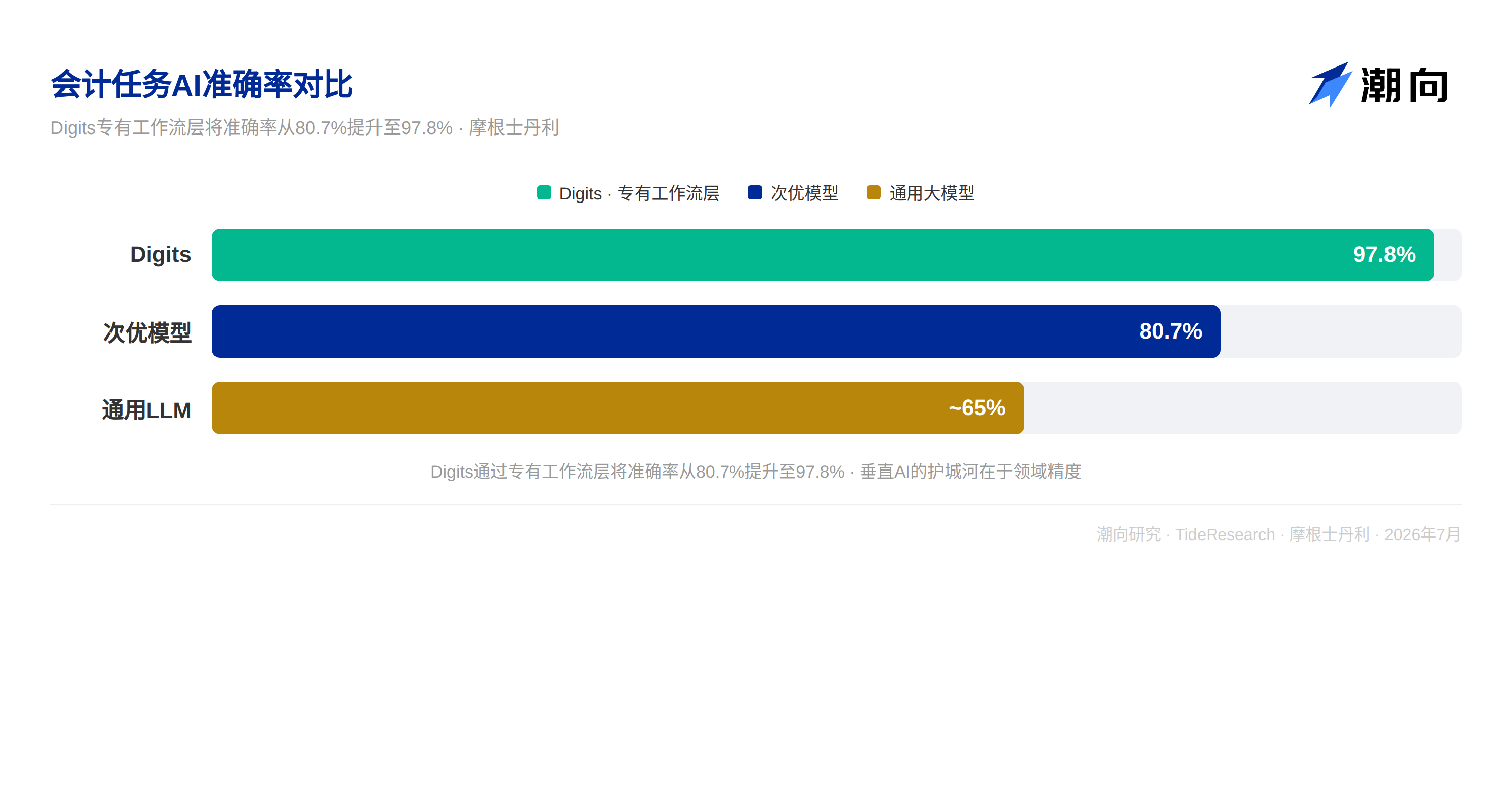
This logic supports the firm's optimism on Shopify, ServiceNow, Datadog, Snowflake; these four enterprises grasp key nodes of industry workflows.
Industry Cycle Rotation: Infrastructure Realizes First, Applications Await Turning Point
Morgan Stanley reviewed the cloud computing development path; the industry successively experienced SaaS popularization, cloud solution piloting, architecture standardization, and self-developed application stages.
The AI industry has currently entered the self-construction stage. Infrastructure software harvests demand increments first; new orders from data and O&M vendors such as Snowflake, Datadog, MongoDB continue to improve. Cybersecurity follows closely; AI spawns new security risks, and platform integration pace continues to accelerate.
Application software performance realization pace is relatively slow. ServiceNow is closer to the industry turning point; Shopify's AI commercialization process continues to advance. Salesforce, Workday, Intuit require longer adjustment cycles; enterprises need to cope with multiple challenges such as pricing model transformation, AI-native vendor competition, and gross margin pressure.
Within the application track, Adobe and Workday received underweight ratings. Adobe faces lightweight customers being diverted by various AI tools, compounded by pressures such as executive turnover and business model transformation. Workday AI commercialization progress is relatively slow; HR and financial process compliance requirements are high, customers will not replace core systems based solely on AI capabilities.
TechFlow Perspective
The core signal of this report is that the investment logic of the software industry is undergoing a systemic switch. In the past, the market pursued high-valuation, high-growth star targets; at the current stage, composite assets with both offense and defense have more certainty. This is a systemic revaluation of the industry valuation system, far more than simple sector sentiment repair.
The common characteristic of the eight high-conviction targets is that they all stand at the middle layer of AI implementation. Relying on their accumulated customer, data, and process advantages, they become necessary nodes for enterprise AI transformation; value will continue to be released as AI applications deepen.
Industry differentiation will further intensify. Enterprises possessing both deep barriers and continuous evolution capabilities can continue to expand advantages in this round of industry reshuffle. Enterprises excelling in a single dimension will gradually weaken in long-term competitiveness.
The underweight conclusion for Adobe and Workday conveys an important investment implication. In the AI era, time cost is also a core valuation variable. Growth expectations priced in advance by the market, if unable to be realized into real performance for a long time, waiting itself will consume substantial returns. The measurement standard for quality assets depends on both long-term growth space and performance realization pace.

Disclaimer
This article is a compilation and interpretation by TechFlow Research of a third-party brokerage research report (Morgan Stanley, July 21, 2026). The ratings, target prices, earnings forecasts, and related judgments cited in the text are the views of the brokerage analysts, representing only their affiliated institution's stance, not representing the views of TechFlow Research, nor constituting any investment advice. The market carries risks; decisions must be independent. This article should not be used as a basis for buying or selling any securities.
Join TechFlow official community to stay tuned
Telegram:https://t.me/TechFlowDaily
X (Twitter):https://x.com/TechFlowPost
X (Twitter) EN:https://x.com/BlockFlow_News
 @chaoxiangooo