Bernstein Research Report Analysis: Market Overly Pessimistic About Storage Industry LTAs, Current Round of Contracts Has Substantial Bottom-Supporting Capability
TechFlow Selected TechFlow Selected
Bernstein Research Report Analysis: Market Overly Pessimistic About Storage Industry LTAs, Current Round of Contracts Has Substantial Bottom-Supporting Capability
Structural AI demand combined with new LTAs back-end protection, plus supply discipline, jointly drive cycle lengthening and volatility narrowing.
 Navigating Web3 tides with focused insights
Written by: Rita
TechFlow Guide
Bernstein recently released the third report in its memory LTA series, believing there is a significant deviation in the market's pessimistic expectations regarding LTAs. The new generation of contracts relies on back-end weighted security deposits to form a bottoming mechanism. Although there are divergent views within institutions, there is a consistent judgment that the pressure at the bottom of this storage industry cycle will be alleviated. The report gives four outperforming stocks: SanDisk, Samsung Electronics, SK Hynix, Micron; KIOXIA receives an underperform rating. Among them, SanDisk's NAND value revaluation logic has not been fully priced by the market.
Security Deposit Structure Reconstructed, Changing Industry Contract Logic
The bearish view believes that the protective strength of LTAs is overestimated by the market. The total disclosed security deposit is approximately $33 billion, which is limited in scale relative to the trillions of dollars in revenue that need protection. To truly support peak profit levels, customers would need to prepay security deposits at the level of hundreds of billions of dollars, which is difficult to operate in practice.
The bullish response states that the reason why Hemlock and Microchip's LTAs ultimately failed historically lies in the lack of substantive financial binding force in the contracts. After customer default, suppliers could only seek compensation through legal channels, and the counterparty might have already fallen into bankruptcy during the litigation cycle.
The mechanism of the new generation of memory LTAs has essential differences, the core lies in the back-end weighted security deposit structure. Cash security deposits paid by customers in advance are basically not deducted in the early stage of the contract, and are gradually returned only towards the later stage. As the contract progresses, the proportion of security deposits to remaining purchase obligations continues to increase, up to 100%, and the customer default cost increases accordingly. If market prices fall significantly only after two years, the exit threshold faced by customers at that time will be at a high level.
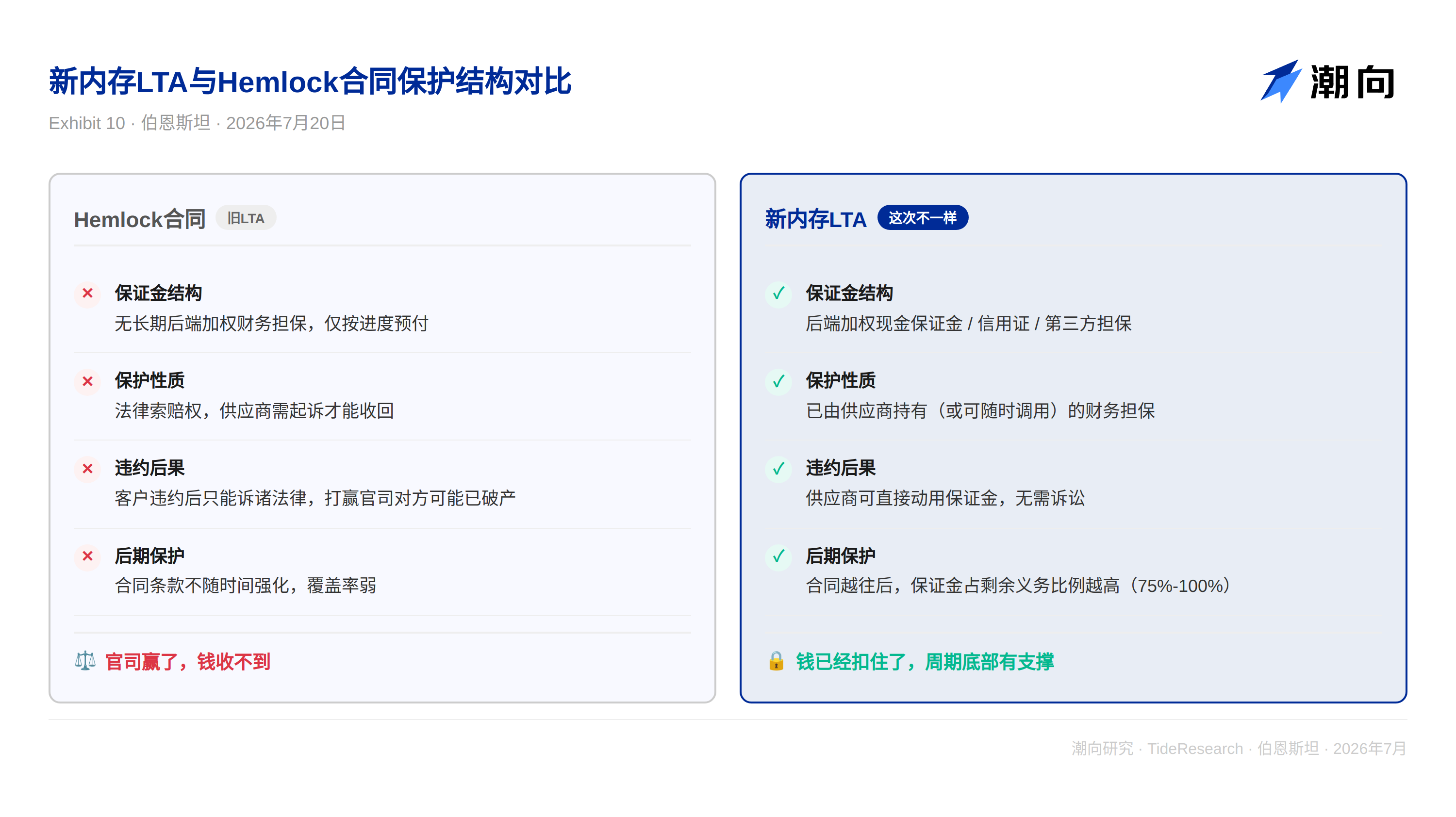
Bernstein's research report judges that the core protective value of LTAs is reflected in the second half of the contract, which corresponds exactly to the cyclical downturn phase where the industry needs support the most.
Contract Fulfillment Capability of Signing Customers in This Round Significantly Improved
Historically, Hemlock's customers were mainly solar module manufacturers. Such enterprises have thin profit margins, rely on subsidies, and have weak financial risk resistance. SolarWorld AG eventually went bankrupt, and Hemlock found it difficult to recover funds even if it won the lawsuit. Microchip's PSP customers were relatively dispersed, mainly consisting of industrial manufacturers, OEMs, and distributors, with generally low willingness to fulfill contracts when demand weakened.
The core customers signing LTAs in this round are hyperscale cloud providers and AI infrastructure providers. Such enterprises have robust balance sheets and diversified businesses, and AI infrastructure investment belongs to strategic-level layout. For them, the cost of AI computing power deployment being hindered due to memory shortage is far higher than the cost of fulfilling the contract. Even if market prices fall below the contract price, the decision logic of such customers is also "whether default affects their own AI competitiveness".
NAND Supply and Demand Pattern is Core Divergence Point for Institutions
The Asian research team holds a relatively cautious attitude towards NAND. The core logic lies in: AI demand mainly benefits DRAM and HBM, and NAND benefits relatively limitedly. The threat from Chinese manufacturers in the NAND field is also greater than DRAM, because NAND expansion does not require EUV equipment, and the technology catch-up threshold is lower. Micron has also stated that the end point of NAND supply and demand shortage will be earlier than DRAM.
The US research team has a different view. It believes the AI industry is entering a new stage: early AI training and basic inference indeed mainly consume DRAM and HBM, but current AI applications are evolving towards complex reasoning, long context windows, agents, and other directions. To improve model performance, the system needs to store previously searched context information (i.e., KV Cache), this part of data was originally mainly stored in HBM and DRAM, and has currently started to overflow to NAND flash. NVIDIA Vera Rubin platform's single GPU NAND capacity increased from 4TB to 20 to 21TB, an increase of five times.
The NAND industry cycle lags behind DRAM by about one cycle. During the same period last year, the DRAM industry gross margin had reached 60%, while NAND was still in a loss state. NAND prices did not start rising until August last year and are still in the recovery phase. On the supply side, various manufacturers' capital expenditures prioritize guaranteeing DRAM, and NAND expansion plans have been postponed to after 2028. This means NAND's supply constraints may be tighter than market expectations and last longer.
Overview of Core Investment Logic for Each Storage Stock
SanDisk is the most aggressive in LTA layout, having currently signed 5 LTA agreements, covering about one-third of capacity demand for FY27. The company CEO is not from a traditional storage industry background, having hard drive, Cisco, and software industry background, with relatively flexible strategic thinking. Bernstein uses 11 times FY28 earnings per share or 14 times cyclical average earnings per share for valuation, believing NAND's structural opportunities have not been fully priced.
Samsung Electronics and SK Hynix are core holding stocks for the DRAM track, Bernstein gives 6.2 times forward earnings per share valuation. The execution power of the two enterprises on supply discipline, and natural immunity to competitive landscape, are core support logic. Micron also benefits from DRAM logic, 7.7 times forward earnings per share valuation level is slightly higher than Korean manufacturers. The research report believes Micron is also relatively active in LTAs, having signed 16 contracts, but performance elasticity is weaker than Samsung and SK Hynix.
KIOXIA is the only storage stock given an underperform rating by Bernstein, main reasons include: least active LTA layout, highest valuation level, relatively worst NAND competitive landscape. When Mark Newman was asked in the Q&A session "why recommend SanDisk and be bearish on KIOXIA", the core response was: both are at two ends of the industry in terms of LTA layout.
TechFlow Perspective
Analysts from the US and Asia of the same institution have almost opposite judgments on NAND. Mark Newman sees the demand increment of NAND capacity doubling five times on the Vera Rubin platform, Mark Li sees the supply threat of Chinese NAND expanding without EUV. Both judgments have factual support, the core difference lies in the time dimension. One side focuses on changes happening on the demand side, the other side looks at potential impacts on the supply side two or three years later.
The structural design of back-end weighted security deposits is worth investigating. The downturn cycle usually arrives truly after two years, at which time the security deposit coverage rate is already at a high level. But if the cycle turns ahead of time, the protective strength will be discounted accordingly. The protective effect of LTAs has lagging nature rather than pre-positioning, what really needs to be alert is the risk of the cycle arriving early.
HBM pricing logic is also undergoing subtle changes. Traditional DRAM has experienced four rounds of price increases, current production profit margin of traditional DRAM is instead higher than HBM, suppliers are pushing HBM prices upward. Bernstein calculation assumption, 2027 HBM price is 2 to 2.5 times of 2026, traditional DRAM increase may reach 5 times, HBM instead becomes relatively "cheap" resource. If this judgment holds, HBM suppliers' profit elasticity may be greater than market expectations.
Bernstein's overall judgment on the storage industry can be summarized as: structural AI demand superimposed on new LTA back-end protection, plus supply discipline, jointly promote cycle extension and volatility narrowing. Mark Newman's core logic bet is NAND demand will gradually catch up with DRAM, while Mark Li thinks Chinese supply will impact the NAND market first. The final direction of their judgments directly determines the rationality of SanDisk's $3000 target price.
Disclaimer
This article is TechFlow Research's organization and interpretation of a third-party broker research report (Bernstein, July 20, 2026). The ratings, target prices, earnings forecasts and related judgments cited in the text are the views of the broker's analysts, only represent their affiliated institution's stance, do not represent TechFlow Research's views, nor constitute any investment advice.
The market has risks, investment needs caution. This article should not be used as a basis for buying or selling any securities. Investors should make investment decisions based on their own independent judgment.
Join TechFlow official community to stay tuned
Telegram:https://t.me/TechFlowDaily
X (Twitter):https://x.com/TechFlowPost
X (Twitter) EN:https://x.com/BlockFlow_News
 深潮TechFlow