
JPMorgan Research Report Analysis: AI Sell-off is Technical Overshoot, Semiconductors Near Bottom, Buy on Dips
TechFlow Selected TechFlow Selected
JPMorgan Research Report Analysis: AI Sell-off is Technical Overshoot, Semiconductors Near Bottom, Buy on Dips
Prices will eventually revert to earnings, making an upward stock price repair more likely.
 Navigating Web3 tides with focused insights
By: Rita
TechFlow Insight
Over the past few weeks, AI-related stocks have experienced a fierce sell-off. The South Korean stock market fell 25% from its highs, the Philadelphia Semiconductor Index dropped 20%, and individual stocks like Samsung and Micron fell between 20% and 50%.
There are two things the market should truly be worried about and is currently worried about.
The core driver of this decline is technical factors and position clearing; fundamentals have not deteriorated. New supply in the semiconductor industry will not be released until 2028, earnings remain strong, and technical indicators are approaching oversold levels. Prices will eventually revert to earnings, making an upward repair of stock prices more likely.
Divergence Between Stock Prices and Earnings
JPMorgan showcased a key comparison in the report: the gap between the relative price trend of the semiconductor sector and the relative earnings trend continues to widen.
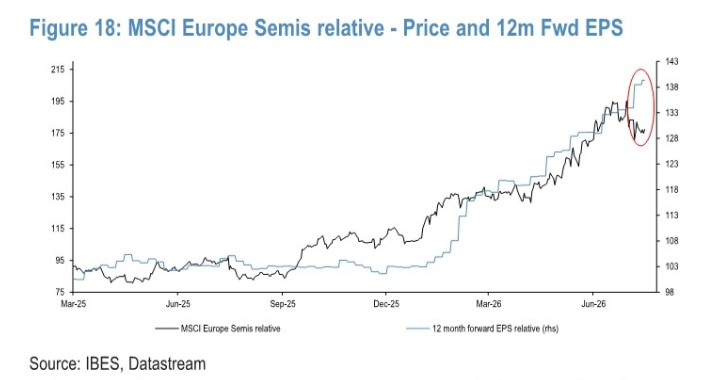
Stock prices continue to probe lower, but consensus market earnings expectations have not been lowered synchronously. This valuation divergence is difficult to sustain long-term; the subsequent repair direction is likely prices converging towards fundamentals.
Supply and demand dynamics also support this judgment. The tight balance status of DRAM and NAND will continue until 2028. AI server demand continues to surge, coupled with HBM prioritizing wafer capacity occupancy, traditional memory chip supply remains constrained. Current DRAM spot prices remain high, without the significant decline feared by the market. Micron recently also raised performance guidance, believing the tight supply-demand situation will continue at least until 2027.
JPMorgan's technology team maintains a bullish stance on semiconductors; the three underlying logics have not changed: the core position of semiconductors in the technology industry chain, the continuous increase in chip installation per vehicle/unit, and continuous improvement in corporate earnings and free cash flow. The sustainability of the data center capital expenditure upward cycle is underestimated by the market.
Technically, the Philadelphia Semiconductor Index RSI has quickly approached the oversold zone, momentum gains accumulated within the year have been mostly given back, and prior crowded trade positions have been fully cleared. Institutions judge that once the oversold signal is confirmed, a rebound window will open, suggesting investors allocate in batches during the summer.
Nature of the Decline: Structural, Not Systemic
Individual stocks in the AI industry chain fell drastically, but the MSCI World Index retreated only 1% to 2% from historical highs, a detail easily ignored.
Weighted sectors declined unilaterally, but overall market resilience remains, indicating this decline belongs to structural position adjustment. JPMorgan points out that volatility will rise short-term during the momentum unraveling phase, but this does not represent a bearish turn in the overall market trend.
The South Korean market needs to be viewed separately.
The scale of local single-stock leveraged ETFs expanded rapidly, amplifying the index oscillation magnitude. The difference between South Korean stock volatility and the US VIX continues to widen, indicating local adjustments are mixed with more disturbances brought by local tools, and should not be directly extrapolated to other global markets.
Inflation Peaks, Rotation Window Opens
JPMorgan previously continued to predict inflation decline, and the latest economic data verified this logic. The US three-month annualized CPI fell from 8.2% in May to 2.8% in June, and Eurozone month-on-month inflation cooled synchronously. Brent crude oil fell about 25% quarter-on-quarter, and the transmission effect of declining oil prices has appeared in inflation data.
The report emphasized distinguishing the environmental differences between the current period and 2022. Current wage growth rate is falling, corporate pricing power is marginally weakening, and more critically, long-term inflation expectations are stably anchored. The US 5-year 5-year inflation forward rate never broke through 2.60% during geopolitical conflicts, preserving policy space for the Federal Reserve.
Institutions judge that the 90 basis points rate hike expectation priced by the market in June may be the high point of this tightening expectation, and subsequent pricing will be gradually corrected.
Proportion of Earnings Beats Increases, Stock Price Feedback Positive
The Q2 earnings season started strong, with the proportion of companies beating expectations among those disclosed reaching 97%, higher than the long-term average of 76%. More importantly, the market gave positive stock price feedback to earnings beats.
Among S&P 500 components, companies beating earnings expectations rose an average of 1.6% on the earnings day, with excess returns relative to the broad market of 1.7%. The corresponding data for Europe Stoxx 600 is 2.1% and 1.9%.
During the earnings outlook phase, JPMorgan specifically highlighted the semiconductors and banks sectors as two high prosperity tracks. TSMC order demand is robust, releasing positive signals for 2027 capacity planning. Bank net interest income possesses resilience, and investment banking income performance is brilliant. As remaining enterprises disclose sequentially, the strong earnings trend is expected to continue.
Asset Class and Industry Allocation Ideas: Increase Equity Allocation, Semiconductors as Independent Preferred Choice for AI Sector
The report provided a clear allocation plan. On the asset class side, stock allocation was raised from a benchmark 60% to 65%, bonds neutral allocated, reducing cash holdings. On regional allocation, the Eurozone ratio was increased from 8.7% to 11%, US and Japan maintained neutral, underweight UK market. At the industry level, recommend Mining, Capital Goods, Semiconductors, Automobiles, Insurance, Banks; underweight Energy, Utilities, Media, Software, Telecommunications.
Internal AI sector needs strict differentiation. Semiconductors possess overweight value, earnings are stable, new capacity cannot be released short-term, this technical correction provides an allocation window. In contrast, Software, Business Services, Media sectors are suppressed by AI substitution long-term, institutions classify them as the "AI Cannibalization Group".
Regarding geopolitical conflicts, the Iran situation belongs to secondary influence variables. JPMorgan observed that the impact intensity of geopolitical shocks on the market continues to weaken, and the "Buy on Dip" strategy since the end of March remains effective. The two major premises for the strategy's establishment have not changed: inflation expectations are stable, and central banks do not need to passively tighten monetary policy.
TechFlow Perspective
The core value of this JPMorgan report lies in accurately defining the nature of this decline.
In strategist Mislav Matejka's view, the root cause of the AI sector correction is technical chip clearing, not a fundamental turning point. The severe divergence between semiconductor stock prices and earnings is the current market's most core pricing error. Individual stocks generally retraced 20% to 50%, but earnings expectations were not adjusted, and the supply constraint logic also did not change. Once this gap is repaired, the direction is most likely an upward regression of stock prices.
But JPMorgan's optimistic stance has clear premises.
Semiconductors and Software are two completely different logic lines; the former has real supply-demand barrier support, the latter's value is being continuously eroded by AI.
This judgment forms an interesting divergence with Goldman Sachs Group. Goldman Sachs believes software vendors can rely on the "Orchestration Layer" to hold value, while JPMorgan judges that the downward pressure on application layer software has long-term nature. Although the two institutions have different views on the software industry, their stance is highly consistent on the point that semiconductor fundamentals have not deteriorated.
Disclaimer
This article is organized and interpreted by TechFlow Research based on a third-party broker research report (JPMorgan, July 20, 2026). Ratings, target prices, earnings forecasts, and related judgments cited in the text are the views of the broker's analysts, representing only their affiliated institution's stance, not representing TechFlow Research's views, nor constituting any investment advice.
Market involves risks, decisions need independence. This article should not be used as a basis for buying or selling any securities.
Join TechFlow official community to stay tuned
Telegram:https://t.me/TechFlowDaily
X (Twitter):https://x.com/TechFlowPost
X (Twitter) EN:https://x.com/BlockFlow_News
 @chaoxiangooo