
a16z: Software Development Jobs Rise 14.6% Against Trend After Claude Code Launch, Market Proves AI Makes People More Valuable
TechFlow Selected TechFlow Selected
a16z: Software Development Jobs Rise 14.6% Against Trend After Claude Code Launch, Market Proves AI Makes People More Valuable
From skyrocketing internship positions to teenage wage growth leading the pack, the signal from the labor market is clear: people who can use AI are becoming hot commodities.
 Navigating Web3 tides with focused insights
Author: a16z
Compiled by: TechFlow
TechFlow Editor's Note: When the entire tech industry lays off 7%, software development roles instead grow by 14.6%—the reason is AI tools enable novices to write production-level code. This is not a story of "AI taking jobs," but evidence of tools making people more valuable. From internships surging to teenage wage growth leading the pack, the labor market signal is clear: people who can use AI are becoming hot commodities.
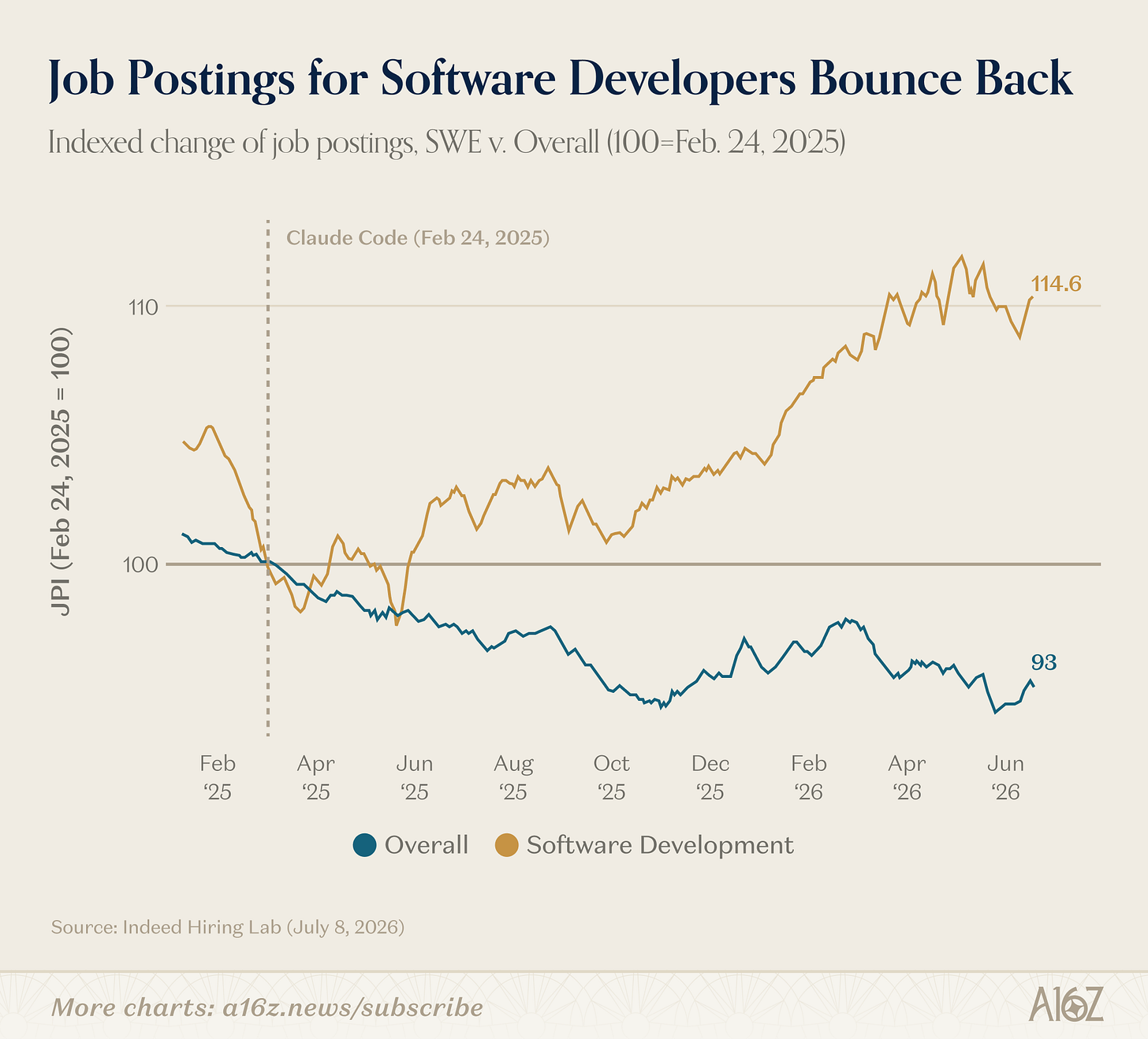
Figure: Software development job postings rebounded to 114.6 since the launch of Claude Code, while the overall market fell to 93. Source: a16z
Selective Sell-Off in Software Stocks
The plight of publicly traded software companies continues, but as we previously stated, the current situation is not an indiscriminate "massacre."
The software stock sell-off is also not a reflection of current or recent performance, but rather the market's collective doubt on whether these companies can sustain performance in the long term:
Valuation multiples for the next twelve-month free cash flow are at or below 2014 levels. In other words, the premium investors are giving for software companies' cash generation capability is the lowest in over a decade.
The point is, even though evidence that "SaaS is dead" is still weak, investors' job is to have a view on the future, and the future looks a bit dim in their eyes.
However, not all software companies have dim prospects. Differentiation and discernment are increasingly becoming the rules of the game. You can see this from several different angles.
First, look at the gap between the median, top, and bottom quartile performance in the IGV index:
Over the past 30 trading days, both the top quartile and median IGV stocks outperformed the overall ETF—it was the bottom quartile (including some of the largest companies) that dragged down overall performance.
Looking back annually, the situation is quite different:
Over the past year, the median more closely tracked the overall ETF performance—until around the beginning of the year, performance quartiles began to diverge (now there is about a 50 percentage point gap between the top and bottom).
Returning to the 30-day view, clearly fundamental performance is not a strict driver of recent stock price performance:
From a revenue growth perspective, there is basically no correlation between growth and recent performance (though fairly speaking, much can be explained by changes in growth rather than growth levels). Divided by performance quartiles, the same pattern appears: there are many software companies clustered in the 10-20% revenue growth range, but performance is almost vertically distributed, with some of the fastest revenue growing (and also the largest in the ETF) companies located in the bottom performance quartile.
More important than growth is perceived long-term durability. Here is the same chart divided by industry:
Although it is difficult to clearly classify every company, performers in the top and second quartiles are often dominated by (1) cybersecurity/observability; and (2) vertical SaaS. In contrast, the bottom two quartiles are some combination of horizontal SaaS, cloud/infrastructure, and an "other" category, which includes marketplaces, ad tech, and point solutions (and companies like MicroStrategy that are hard to classify).
The point is clear. Whether right or wrong, the market has perceived clear differences between software companies—those that seem to have some AI defensiveness and/or tailwinds (and those that do not).
For cybersecurity and observability, AI is expected to increase buyer urgency (and existing vendors have a trust premium that AI newcomers find harder to disrupt).
For vertical SaaS, specialized information around workflows, data, and customer relationships is seen as a barrier to entry for AI challengers (whereas horizontal platforms cannot say this).
But for everyone else, the message is clear: software itself is not a moat.
Years of sticky and accumulating ARR, huge feature sets, and widespread adoption are just—yesterday's news. Likely a few quarters of stable and/or improving growth would turn things around, but currently the market is not buying it, nor is it convinced.
AI Demand Growth > AI Spending Growth
You may have recently heard about the perceived shift from token-maxxing to token-optimizing, which is a big deal.
The gist is as follows: although training costs for frontier models are getting higher and higher, the marginal benefits of these frontier improvements may not be enough to convince customers to bear the additional cost. Customers may not maximize use of the latest and greatest tokens, but instead downgrade to cheaper, weaker models (including open-weight models) where possible.
For some, they think this shift questions the sustainability of frontier model development—if customers do not support the cost of the latest and greatest models, what about the labs? Fair, although this objection is a bit ironic, because the rapid obsolescence of non-frontier models was also originally thought to threaten the sustainability of frontier model development...... and now non-frontier models are becoming less obsolete, which is obviously still a bad thing. Okay.
Without delving into the rights and wrongs of that debate, we just observe that intelligence costs are indeed rapidly declining, which seems to have a positive impact on AI demand. In other words, Jevons-style dynamics continue to hold: the cheaper AI becomes, the more people/companies want to use it (for more things).
Expanding the demand side is exactly what you want to see.
Let's start with another innovation precedent, which also started concentrated and expensive, then became distributed and cheap: computers. Compared with the last technological leap driven by PCs, in terms of AI, intelligence costs are falling faster:
It took PCs nearly twenty years to achieve the affordability gains that AI achieved in about 3 years.
This is an extraordinary trajectory, and like computers, cost declines seem to be helping drive AI demand up and to the right (there is still much room for development).
On the consumer side, according to PNC Bank data, paid penetration is still small, but is indeed growing:
The household share of paid AI and their average monthly spending are both continuing to climb—monthly spending growth is steeper, increasing about 25% since the beginning of the year.
They are obviously not perfect comparisons, but as some perspective, in 1997 only about 45% of adults aged 35-54 reported owning a PC (decades after computers were commercially released, mainly on the enterprise side). Currently, the household share owning computers is about 90%, and if including smartphones it is close to 97%—the point is mass market adoption takes some time, it scales with utility and cost.
There is also other data showing AI demand rising with cost efficiency.
According to YipitData's analysis of OpenRouter data (which only measures a subset of total token consumption), frontier token usage continues to grow, while open-weight tokens continue to rapidly gain share:
The share of "Asian suppliers" of total tokens (a proxy for open-weight alternatives) has grown to about 60%, triple that of the beginning of the year. OpenRouter's sample may be biased towards open-weight users at least to some extent, but this is indeed consistent with the price differentiation story, and also consistent with the Jevons-style story.
Similarly, according to OpenRouter, while both tokens per user and spending per user are growing rapidly, the former has grown much faster than the latter since the beginning of the year:
Again, OpenRouter can only see what it can see, and this pattern is very consistent with the Jevons setting (demand grows in sync with AI's rapid cost efficiency gains).
At least for now, it is clear that as intelligence becomes cheaper, it pushes the demand curve further up and to the right. Cheaper tokens from sub-frontier models are indeed gaining share, but the net effect is driving overall spending to rise exponentially. This is hardly a bearish story.
Bears may still claim open-weight models are cannibalizing frontier, but alternative scenarios where efficiency gains have no obvious impact on demand and/or are driving total spending down, would actually be closer to a doom scenario. In contrast, Jevons is exactly what bulls hope for.
Tailwinds for Entry-Level Roles
Speaking of AI demand, while AI is said to be not useful enough to generate meaningful ROI, yet so useful as to eliminate all jobs, we are happy to report that there is currently almost no evidence that AI is actually producing any job killing effects.
In fact, even a weak spot in the labor market (i.e., entry-level hiring) has recently gained some momentum, if anything, AI seems to be helping, not hurting.
First, according to Revelio data, tracking for 2026 summer internships is far higher than previous years:
Internships are not equal to jobs, but they are at least some signal of demand for young people, the 2026 cycle far exceeds '25 and '24 (though not '23).
Better than this, wage growth for teenagers and young adults also seems to be rising:
According to ADP data, wage increases for young workers (16-24 years old) have rebounded from 2025 lows. Wage increases are almost certainly a demand signal, if wages are rising, it is reasonable to infer entry-level job prospects are also improving.
As for the impact of AI (if any), the situation is even better. AI seems to be significantly accelerating entry-level hiring:
According to analysis of Revelio's job data and Ramp's spending data, "high-intensity AI adoption" corresponds to an increase of about 6 percentage points in the number of entry-level employees after two years of adoption. In contrast, "low-intensity" AI adoption corresponds to a decrease of about 0.5 percentage points.
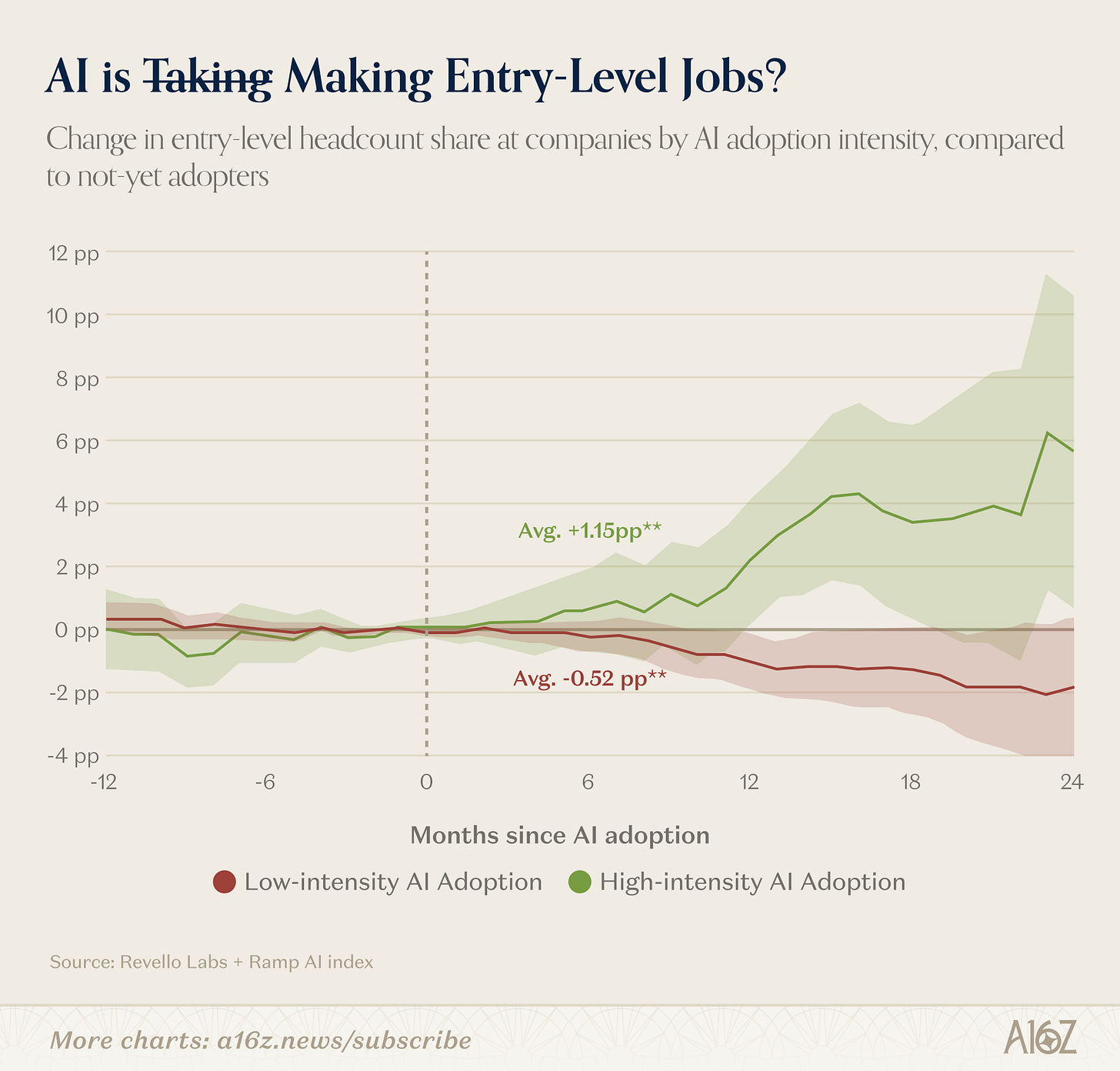
Figure: The proportion of entry-level employees at companies with high-intensity AI adoption increased by an average of 1.15 percentage points after two years, while companies with low-intensity adoption saw a decrease of 0.52 percentage points, indicating AI is 'creating' rather than 'taking away' entry-level jobs. Source: a16z
This can be interpreted in several ways, from "AI is creating entry-level hiring," to "AI adopters are growth companies, so of course they are hiring," to "Ramp data may not represent the overall economy, so it is hard to draw any conclusions." These all make sense, but one interpretation that is almost certainly not valid is "AI is killing entry-level jobs."
Maybe someday (though there are good reasons to think not), but not today.
Overall, although the decline of "AI-exposed" roles in the post-zero-interest rate era is widely discussed, there is relatively less discussion about the fact that "AI-exposed" roles are recently leading the recovery:
According to Indeed Hiring Lab data, since May 2025, in terms of job vacancies, the higher the AI exposure, the greater the recovery magnitude. This is especially obvious for software engineers, job postings increased by about 15%, while overall decreased by about 7% (counting from the launch of Claude Code).
From a broader level, it is too early to draw conclusions now, but as for those inclined to declare "AI is causing human obsolescence," the data simply does not support them. If anything, the situation is quite the opposite—AI exposure seems to be positively correlated with employment growth.
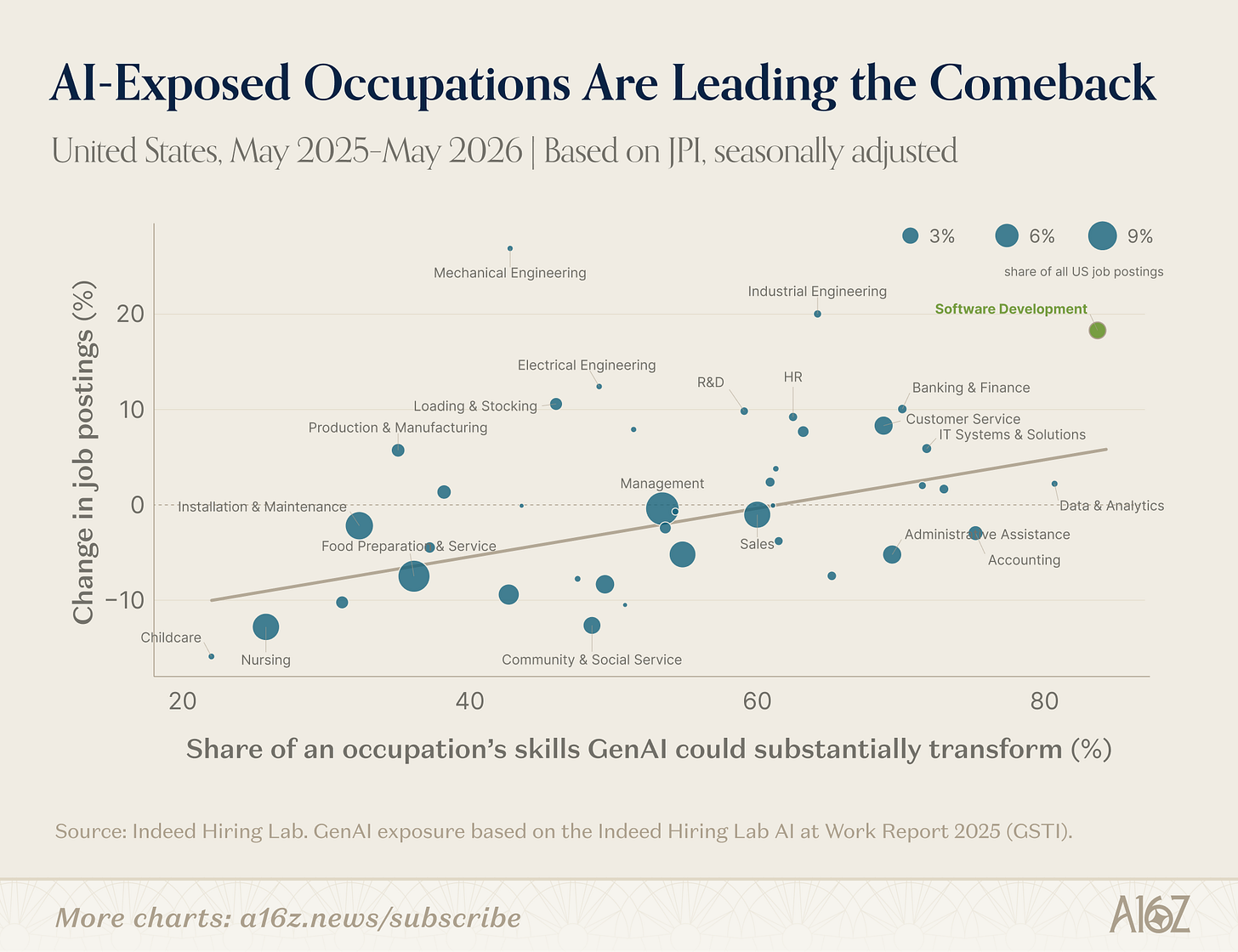
Figure: Since May 2025, job postings for occupations with higher AI exposure have rebounded more significantly, with software development jobs increasing by nearly 15%, leading the overall market. Source: a16z
Fairly speaking, it is currently unclear how much meaning the "AI exposure" category actually has, because there is almost no consensus on what or who is exposed to AI (and to what degree):
It turns out, the higher the average "AI exposure" level for any given occupation, the greater the disagreement on the degree of exposure.
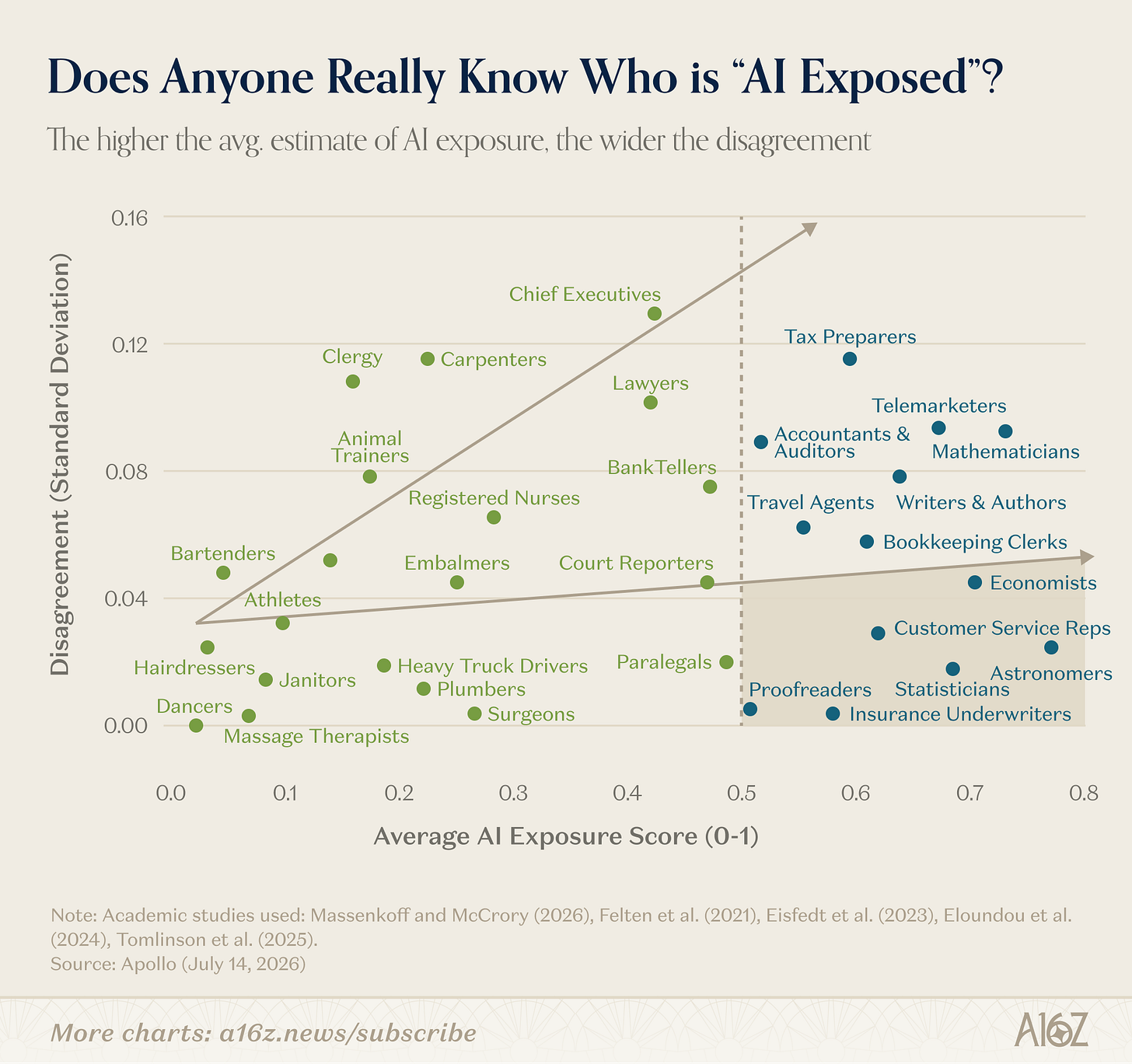
Figure: The higher the average AI exposure score for an occupation, the greater the disagreement in academia regarding its exposure level, indicating a lack of consensus on this concept. Source: a16z
As expected, when predicting the future impact of new technologies, rational people may have different views.
Of course there are some exceptions. Everyone seems to agree that proofreaders, insurance underwriters, statisticians, and interestingly, economists, are very exposed to AI. If AI ultimately replaces human economists, will it admit this crime, or will there be no economists left to tell the story?
Data Centers Make Energy Cheaper
Earlier this week, New York Governor Hochul announced a one-year moratorium on data center development. Among other things, the stated goal of the moratorium is to "protect electricity users... because data center development has the threat of driving up utility bills." Without intending to disparage her, the Governor provided more explanation for her reasoning on the Odd Lots podcast, go listen to it.
That said, this is still a puzzling statement.
Although data centers are indeed increasing electricity demand, evidence shows that data centers are actually helping to lower user costs:
Based on research from Berkeley National Laboratory and The Brattle Group, at the state level, electricity price increases are negatively correlated with demand increases. Consume more, pay less—strange but true.
Indeed, over the past 6 years, some states with the fastest load growth (most data center development), such as Texas and Virginia, have seen almost no price increases. On the other hand, states with the largest price increases (few new data centers), such as California and New York, have seen load growth decline—California electricity demand decreased by about 5%, while price increases exceeded anywhere else in the nation, about 33% higher than the second highest state.
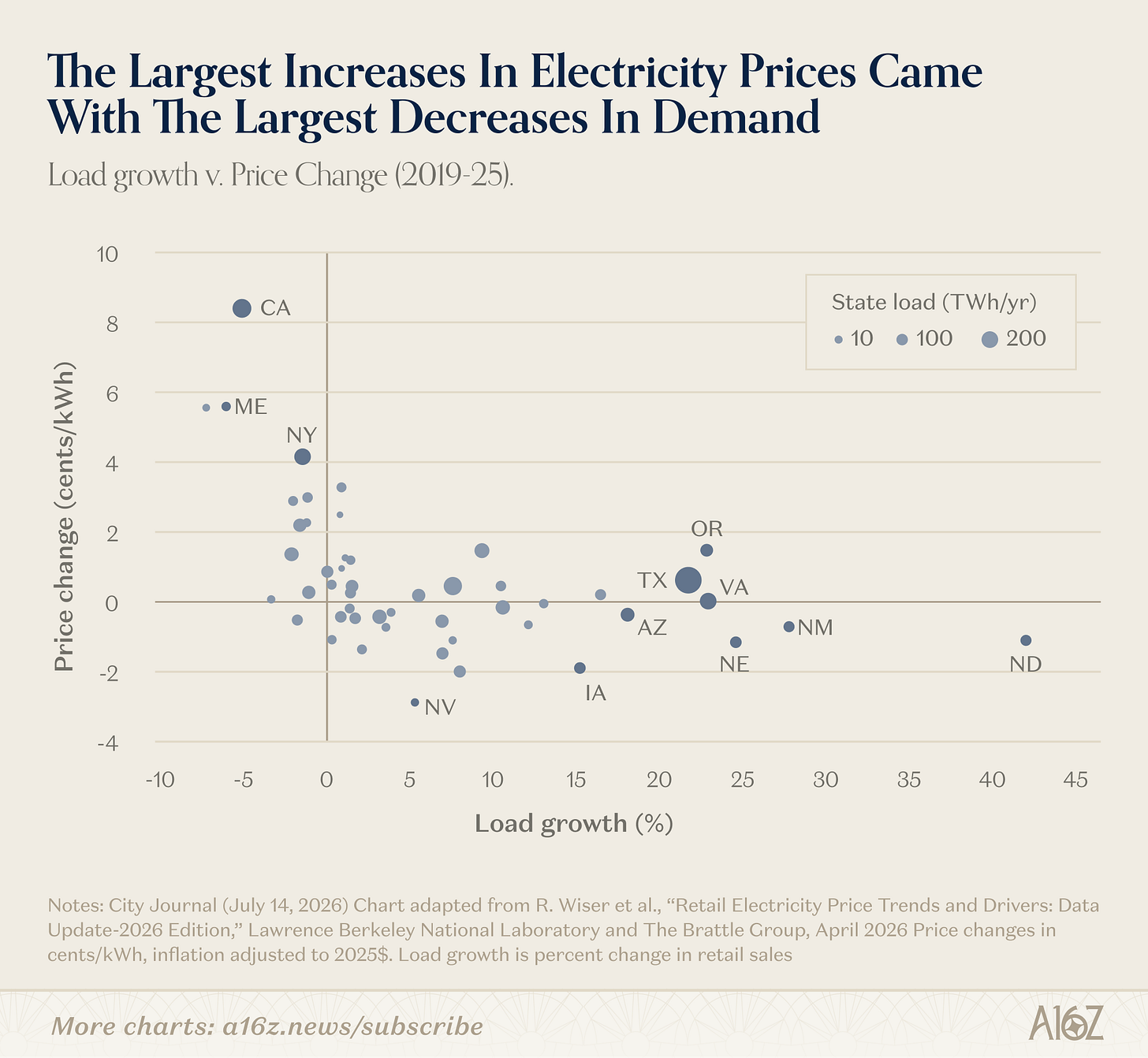
Figure: From 2019-2025, electricity load growth and electricity price changes across US states were negatively correlated, with California and New York seeing demand declines but the highest price increases. Source: a16z
Not only that, the inverse relationship between energy demand and energy prices also seems to hold in Europe:
According to EIA data, except for Ireland, the EU countries with the largest price increases also had the largest declines in electricity demand.
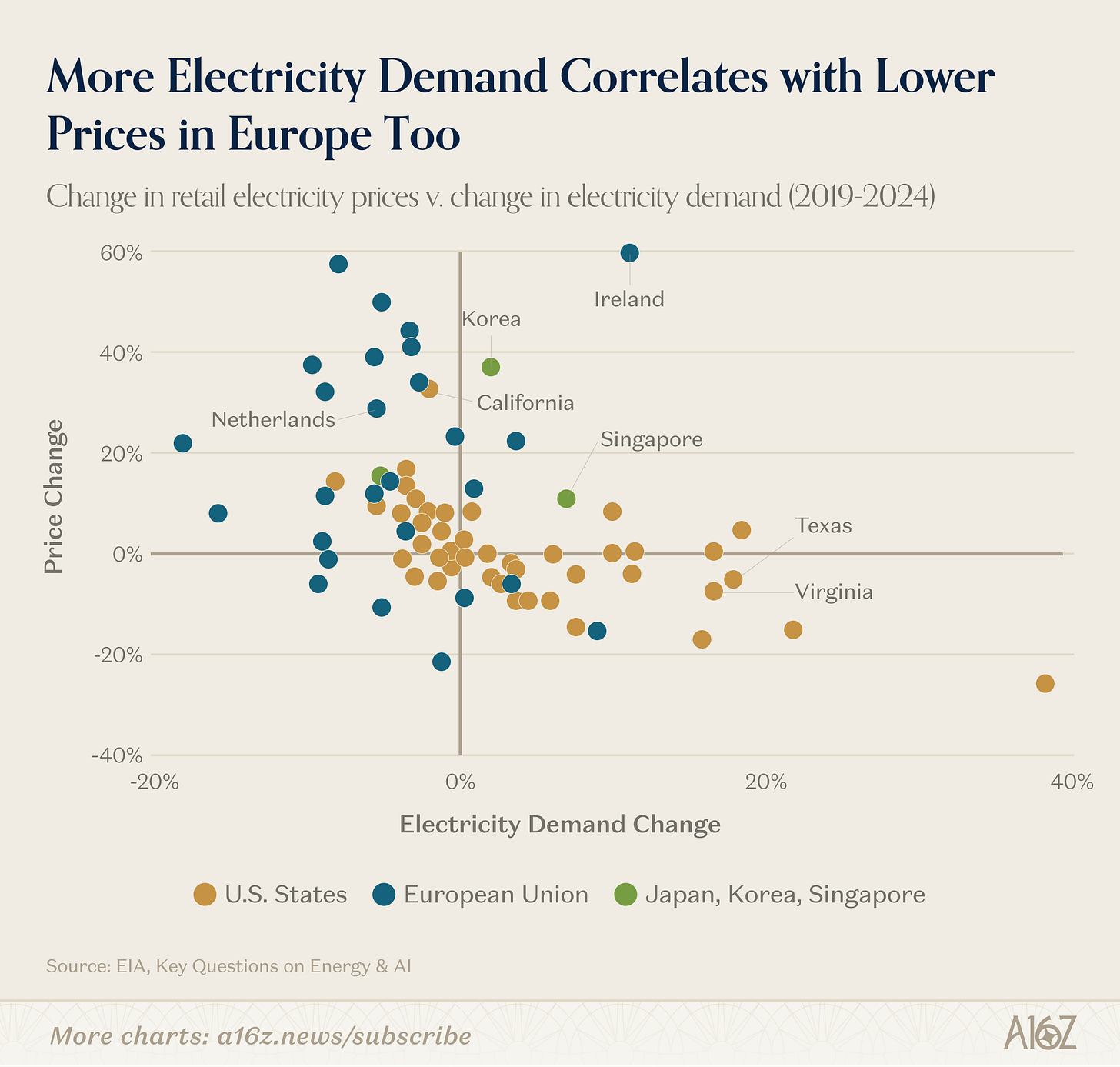
Figure: From 2019-2024, changes in electricity demand and electricity prices in major US and European economies were also negatively correlated, with Texas and Virginia seeing demand growth but largely stable prices. Source: a16z
Again, consume more, pay less. This is counterintuitive, right?
We all know that, all else being equal, more demand should drive up prices, not the opposite (as Governor Hochul claimed). But in terms of the grid, the situation is exactly the opposite. The reason demand and costs are inversely related is that grids tend to benefit from economies of scale: the more electricity demand, the more dispersed fixed infrastructure costs are spread, resulting in lower overall prices for users.
In other words, Hochul's data center moratorium may not only fail to "protect electricity users," but instead produce the opposite effect: electricity price increases may be far higher than in scenarios where data centers help share grid fixed costs. Maybe this relationship will not continue to hold, but this is the situation so far.
Apart from energy costs, there are broader economic impacts to consider. The reality is, without AI-related infrastructure investment, there is almost no investment growth:
Tech-related investment is the only investment category growing, so the moratorium hits exactly where it hurts most.
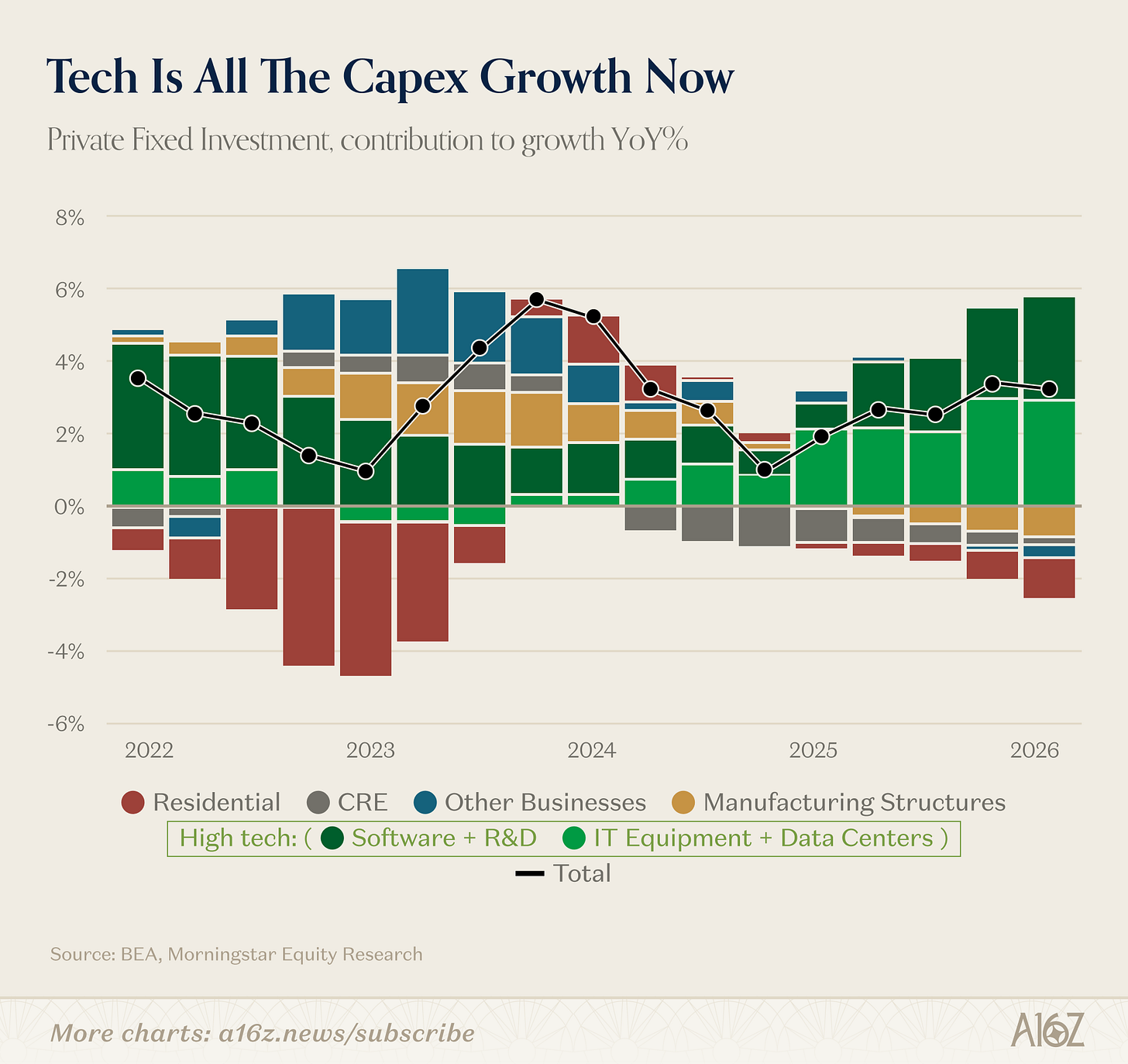
Figure: Since 2022, tech-related investment (software, R&D, IT equipment, and data centers) has been almost the sole positive contributor to private fixed investment growth. Source: a16z
The Governor certainly has her reasons, but a policy that may both (a) increase electricity prices (as part of an effort to "protect electricity users"); and (b) deprive New York of its most important investment tailwind, is indeed difficult to understand.
Join TechFlow official community to stay tuned
Telegram:https://t.me/TechFlowDaily
X (Twitter):https://x.com/TechFlowPost
X (Twitter) EN:https://x.com/BlockFlow_News
 a16z
a16z