Bernstein Research Report Analysis: Every 1GW Increase in AI Data Centers Requires $8 Billion in Semiconductor Equipment; Sector Valuation May Be Undervalued
TechFlow Selected TechFlow Selected
Bernstein Research Report Analysis: Every 1GW Increase in AI Data Centers Requires $8 Billion in Semiconductor Equipment; Sector Valuation May Be Undervalued
Bernstein is overall bullish on the equipment sector, with Applied Materials (AMAT) as the top pick.
 Navigating Web3 tides with focused insights
By: Rita
TechFlow Guide
Semiconductor equipment stocks have fallen 30% from their highs but are still up 80% year-to-date.
Bernstein provides an answer using a bottom-up calculation. For every additional 1GW of computing capacity built in AI data centers, an extra $8 billion must be spent on equipment. Based on an annual addition of 50GW, cumulative equipment spending from 2027 to 2029 will exceed $700 billion, with annualized WFE heading straight for $300 billion.
This figure carries significant weight. The current market pricing for equipment stocks implies an annual WFE spending of only $120 billion to $150 billion, a full twofold difference. If the pace of AI construction remains unchanged, current equipment stocks are not only not expensive, they may be very cheap.
Bernstein is generally bullish on the equipment sector, favoring Applied Materials (AMAT) the most. DRAM and HBM account for more than half of the incremental wafer demand, and Applied Materials has the largest exposure in this field. Applied Materials, Lam Research, KLA, ASML, Tokyo Electron, Kokusai, and Lasertec all outperformed the market, while Screen was flat.
The $8 Billion Equipment Bill Behind 1GW of Computing Capacity
Bernstein breaks it down in detail. One Vera Rubin rack consumes 65 wafers, covering logic, HBM, DRAM, and NAND. Outside the rack, there are server CPUs, supporting memory, and storage, all representing incremental demand.
In total, for every additional 1GW of annualized computing capacity, 46,000 wafers/month of wafer capacity is required. Half is DRAM and HBM, 20% is NAND, and 10% is advanced logic. Converted into equipment investment, this equals exactly $8 billion.
This figure does not include old equipment replacement. A batch of old computing capacity will need upgrading between 2027 and 2029, so actual demand will only be higher.
50GW Scenario: Annual WFE Spending Heads Straight for $300 Billion
If 50GW of computing capacity is added annually by 2030, that is 50GW more than the 2026 baseline, and cumulative WFE spending over three years will exceed $700 billion. Adding non-AI baseline demand of about $120 billion annually, annualized WFE jumps from $200 billion to nearly $300 billion.
What if the pace is faster? At 75GW or 100GW, $300 billion is just the starting point.
Current market expectations are far off. Consensus implies annual WFE spending of only $120 billion to $150 billion, a difference of more than twofold. If Bernstein's baseline scenario materializes, there is significant room for valuation repair in equipment stocks.
Doing the Math: Are Equipment Stocks Actually Expensive Now?
Bernstein calculated three scenarios, directly comparing current valuations.
50GW scenario. Applied Materials' 2028 EPS rises from the consensus $18.7 to $24.3, up 30%. In 2029, it rises to $30.6, up 60%. The corresponding P/E ratio drops from 23x to 15x, leaving only 11x in 2029.
75GW scenario. 2028 EPS reaches $34.2, up more than 80%. In 2029, it reaches $46.7, up more than 100%. P/E ratio is 11x in 2028 and 8x in 2029.
100GW scenario. 2028 EPS reaches $44.7, up more than 100%. In 2029, it reaches $62.4, up more than 200%. P/E ratio is 8x in 2028 and 6x in 2029.
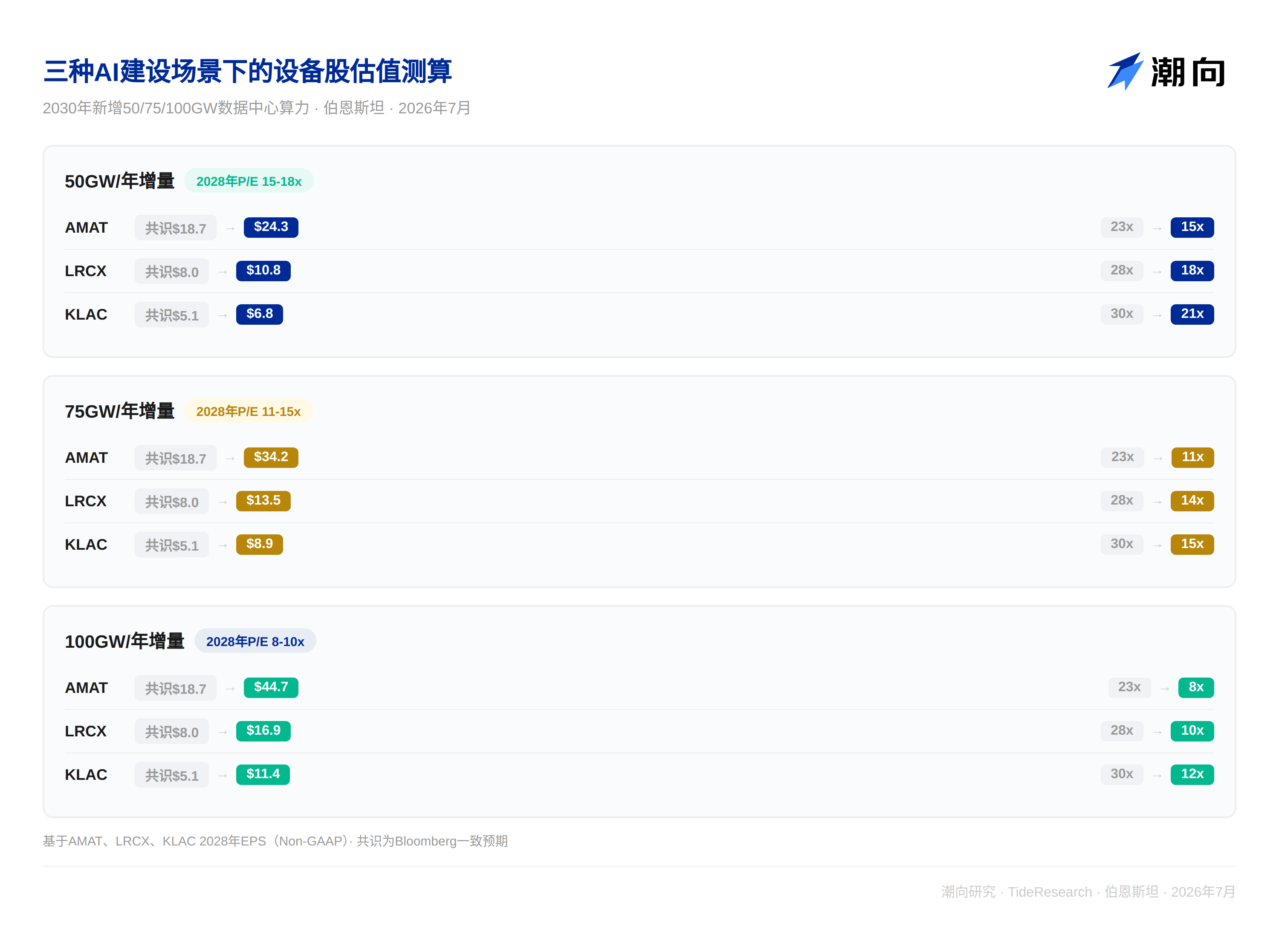
Lam Research and KLA have similar elasticity. The conclusion is direct. As long as AI construction does not stop, current equipment stocks are much cheaper than the market thinks.
Why Applied Materials
In incremental wafer demand, DRAM and HBM account for 55%. Applied Materials has the highest exposure in the DRAM and HBM equipment field across the entire sector. This is the core reason Bernstein favors it the most.
Ratings for other targets remain unchanged. Lam Research, KLA, ASML, Tokyo Electron, Kokusai, and Lasertec all outperform the market, while Screen maintains market performance.
TechFlow Perspective
The market knows AI requires building data centers, data centers require chips, and chips require equipment. But no one has seriously calculated exactly how much equipment is needed, corresponding to how much revenue, and corresponding to how much valuation.
Bernstein has calculated it. 1GW corresponds to $8 billion in equipment, 50GW corresponds to $300 billion in WFE, corresponding to 15x P/E for equipment stocks. The pricing currently given by the market implies $150 billion in WFE and 20-plus times P/E.
The twofold difference in between is the expectation gap.
Risks are also very real: will the construction pace slow down, can equipment capacity keep up, will customers cut orders during a cyclical downturn? Each is a variable. The volatility of equipment stocks has always been greater than that of semiconductors themselves.
But one thing is clear. If the narrative of AI computing capacity construction remains, the valuation of equipment stocks has not yet peaked. Whether the current pullback is a risk or an opportunity ultimately depends on whether investors believe in the speed of AI construction.
Disclaimer
This article is a compilation and interpretation by TechFlow Research of a third-party brokerage research report (Bernstein, July 20, 2026). The ratings, target prices, earnings forecasts, and related judgments cited in the text are the views of the brokerage analysts, represent only the position of their affiliated institution, do not represent the views of TechFlow Research, and do not constitute any investment advice.
The market involves risks, and investment requires caution. This article should not be used as a basis for buying or selling any securities. Investors should make investment decisions based on their own independent judgment.
Join TechFlow official community to stay tuned
Telegram:https://t.me/TechFlowDaily
X (Twitter):https://x.com/TechFlowPost
X (Twitter) EN:https://x.com/BlockFlow_News
 @chaoxiangooo