JPMorgan Research Report Analysis: Samsung Earnings Strong but Under Short-Term Pressure, TSMC A14 Certification is Key Catalyst for Equipment Chain
TechFlow Selected TechFlow Selected
JPMorgan Research Report Analysis: Samsung Earnings Strong but Under Short-Term Pressure, TSMC A14 Certification is Key Catalyst for Equipment Chain
For the equipment chain, focus on domestic substitution; for the manufacturing chain, focus on breakthroughs in advanced process nodes; for the terminal, focus on passive component spillover.
 Navigating Web3 tides with focused insights
By: Rita
TechFlow Guide
J.P. Morgan Asia-Pacific Technology Sales & Trading Briefing on July 8, covering core topics such as Samsung Electronics, TSMC, Japanese semiconductor equipment, passive components, etc. Samsung's 2Q profits are strong but faces short-term leveraged ETF liquidation pressure, TSMC A14 process certification becomes a key catalyst for the equipment chain, MLCC shortage may occur in 2027, ABF substrate replacing BT is becoming an industry trend. This briefing comes from the sales & trading department, not a formal research report, but holds important reference value for understanding the global semiconductor cycle position and key variables.
Samsung Electronics: Strong Profits but Short-Term Pressure
Samsung Electronics 2Q26 preliminary profit 89.4 trillion KRW, a year-on-year increase of 1810%, hitting a historic high. However, investor models show market expectations in the 95-100 trillion KRW range, meaning the actual sentiment behind the surface "beat" may be closer to "in line but not surprising enough".
Investor feedback from J.P. Morgan's sales & trading department shows the market is concerned about two short-term issues. First, Korean retail investors are clearing leveraged ETF positions, Samsung's 30-day volatility has risen to 107, Kioxia even rose to 127, high volatility limits fund managers' ability to re-leverage. Second, employee bonus provisions are about 15 trillion KRW, covering two quarters in the first half of 2026, the market is waiting for clear guidance after the full financial report disclosure on July 30.
But J.P. Morgan's judgment on the memory cycle remains positive. NAND pricing may exceed market expectations (QoQ growth of 20%), mainly driven by hyperscale vendors' demand for enterprise SSDs for KV cache offloading. Memory vendors need to continuously increase capital expenditure to meet customer demand, Tokyo Electron and Screen Holdings gained shares from Samsung and Micron in DRAM etching and cleaning equipment fields respectively.
TSMC: A14 Process Certification is Key Catalyst
Before TSMC's 2Q26 financial report, investors are most concerned about the mass production certification timeline for the A14 process. J.P. Morgan expects this certification may be completed between late 2026 and early 2027, Lasertec is a direct beneficiary.
In terms of the equipment chain, Ebara's CMP tools gained share growth at TSMC, investors expect its Q1 orders may exceed expectations. Advantest and Disco are consensus choices for long-term investors, but Disco's valuation multiple is already relatively high.
Regarding capital expenditure, investor models have already factored in higher 2026/27 capital expenditure expectations, the market expects TSMC to give positive guidance in the financial report to meet customers' backlog order demand.
Japanese Semiconductor Equipment: Memory Cycle Position Decides Stock Price Direction
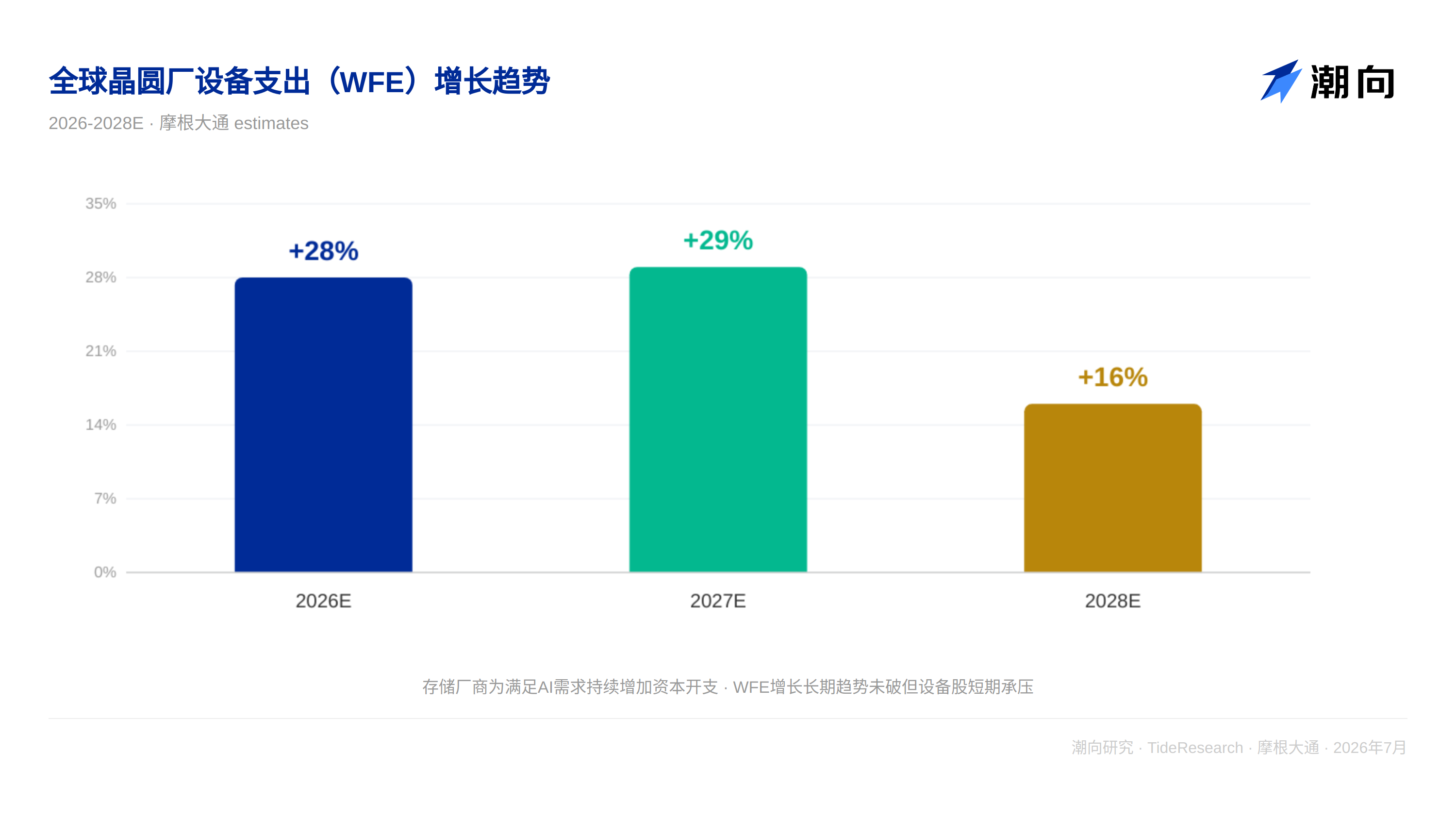
J.P. Morgan team expects global Wafer Fabrication Equipment spending (WFE) to grow by 28%, 29%, and 16% in 2026-2028 respectively. Investors agree memory vendors need to increase capital expenditure to meet AI demand, but semiconductor equipment stocks often perform weakly under expectations of memory prices peaking.
Tokyo Electron (TEL) is the focus of attention, market expects its gross margin may reach 50% within two years. Advantest's further earnings upside comes from CPU and CPO (Co-Packaged Optics) testing demand. Nittobo benefits from the adoption of M9 and T-glass in multilayer ceramic substrates, potential market space is expanding.
MLCC: 2027 May Enter Shortage Cycle
J.P. Morgan passive components team expects MLCC shortage may occur in 2027, prices will start to rise during the October-December negotiation period when customers realize the shortage.
Murata Manufacturing Q1 operating profit expected 86.5 billion JPY, but may reach 90 billion JPY or higher under yen depreciation and strong market conditions. Taiyo Yuden Q1 operating profit expected 5 billion JPY, but there is uncertainty about the end time of the South Korea MLCC factory strike. TDK Q1 operating profit expected 67.4 billion JPY, if exceeding 70 billion JPY it will be a positive surprise.
Rohm's discrete semiconductors are also considered to have tightening supply and demand.
Substrates: BT Exit, ABF Becomes Trend
Supply chain checks show multiple Asian substrate suppliers are planning to convert BT substrate capacity to ABF substrate. ABF substrate revenue and profit margins are significantly higher than BT, the conversion result will be net positive.
Unimicron plans to stop half of BT substrate production by 2028, may eventually exit completely. This trend is clear incremental demand for ABF substrate equipment suppliers and material suppliers.
TechFlow Perspective
The most valuable point of this sales & trading briefing is not what it said, but that it captured what the market is currently thinking. Samsung short-term pressure but cycle direction unchanged, TSMC A14 certification is the next step for equipment chain, MLCC shortage may materialize in 2027, these are marginal variables the market is pricing.
But there is one judgment worth questioning separately: If NAND pricing indeed exceeds expectations QoQ +20%, is Samsung's short-term volatility a buy window amplified by sentiment? Leveraged ETF liquidation is a trading structure issue, not a fundamental issue. The direction of the memory cycle hasn't changed, and the market is being forced to reduce positions due to rising volatility, this itself is a reflexive opportunity.
For investors, the real value of this briefing is breaking down the global semiconductor cycle into three layers: upstream equipment (WFE growth), midstream manufacturing (TSMC A14), downstream terminal demand (MLCC shortage). Equipment chain looks at domestic substitution, manufacturing chain looks at advanced process breakthroughs, terminal looks at passive component spillover. Three layers of logic have different driving factors, but the time window is narrowing synchronously.
Disclaimer
This article is TechFlow Research's organization and interpretation of a third-party broker sales & trading briefing (J.P. Morgan, July 8, 2026). Ratings, target prices, earnings forecasts and related judgments cited in the text are the views of the broker's analysts, represent only their affiliated institution's position, do not represent TechFlow Research's views, nor constitute any investment advice.
Market involves risks, decisions need independence. This article should not be used as a basis for buying or selling any securities.
Join TechFlow official community to stay tuned
Telegram:https://t.me/TechFlowDaily
X (Twitter):https://x.com/TechFlowPost
X (Twitter) EN:https://x.com/BlockFlow_News
 @chaoxiangooo