
JPMorgan Research Report Analysis: Broadcom AI Custom Chip Orders Fully Booked, TPU v9 On Track
TechFlow Selected TechFlow Selected
JPMorgan Research Report Analysis: Broadcom AI Custom Chip Orders Fully Booked, TPU v9 On Track
JPMorgan maintains an overweight rating on Broadcom, defining it as the world's second-largest AI semiconductor supplier, the largest custom chip ASIC supplier, and the largest network semiconductor supplier.
 Navigating Web3 tides with focused insights
By: Rita
TechFlow Guide
JP Morgan held a Broadcom management investor meeting on July 7, with CEO Hock Tan leading the attendance. The core information revealed at the meeting was very dense: Google TPU v9 roadmap is proceeding as planned, Apple ASIC partnership extended to 2031 with new AI accelerator projects added, OpenAI's next-generation chip is about to tape-out, and Tomahawk 6 switch chips are in short supply. JP Morgan maintains an Overweight rating on Broadcom, defining it as the world's second-largest AI semiconductor supplier, the largest custom chip ASIC supplier, and the largest network semiconductor supplier.
AI Custom Chips: Inference Demand Is Reshaping the Market Landscape
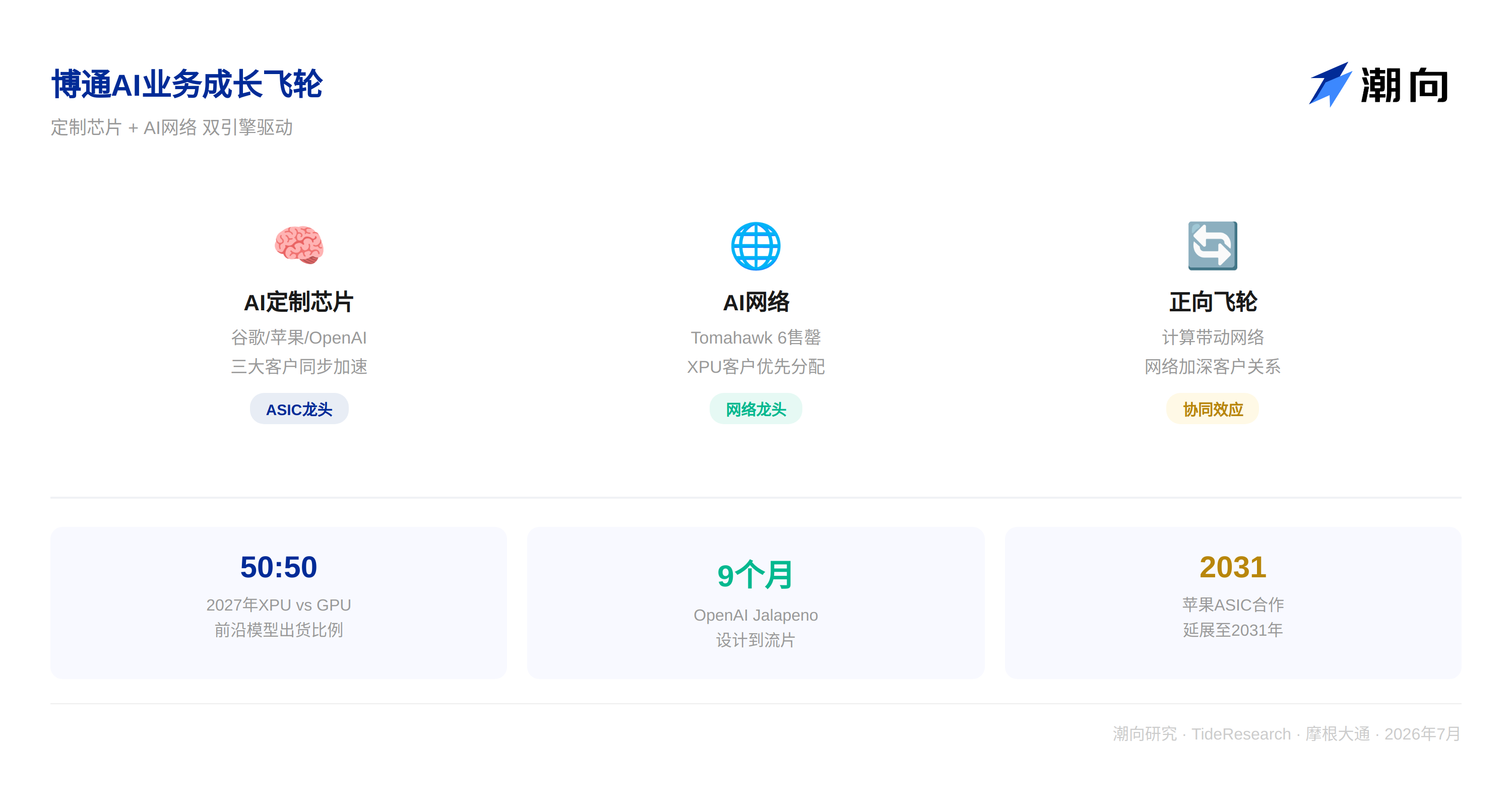
Broadcom management made a judgment: the rapid growth of inference workloads is accelerating the adoption rate of custom XPUs. Among the most cutting-edge large model builders, the shipment ratio of XPUs to GPUs may approach 50/50 next year. This means custom chips are moving from a "supporting role" to "on par with GPUs".
Customers are requesting accelerated tape-out schedules for next-generation ASICs and pursuing more chip design variants. The evolution of inference workloads from single inference to inference chains, and then to AI agents, has significantly increased the strategic value of custom chips optimized for workloads. Competition on cost per token is becoming the new battlefield for AI compute competition.
Broadcom's first-generation XPU with OpenAI, "Jalapeno", took only 9 months from design to tape-out, validating Broadcom's execution capabilities in complex multi-chip design, advanced packaging, high-speed SerDes, and other fields. The next-generation OpenAI chip will tape-out "soon". Management particularly emphasized that these cutting-edge XPUs are "pushing the limits" in multiple dimensions such as bandwidth, SerDes, power consumption, and packaging, and their complexity is often underestimated by the market.
Regarding the competitive landscape of custom chips, management gave a clear judgment on the threat of hyperscale customers' in-house chips (COT): Modern XPUs are no longer simple single-chip designs; increasingly adopting multi-chip configurations, advanced packaging, and high-speed SerDes, internal teams face significant technical barriers in mass production capabilities. 6-chip and 8-chip configurations have become industry standard configurations, which is precisely Broadcom's core moat.
Google TPU and Apple ASIC: Two Long-Term Growth Lines
There were previously rumors in the market that Google's next-generation TPU project might be delayed or canceled. Broadcom management clearly responded: the roadmap is "proceeding fully as planned", and 400G SerDes silicon has been developed and is running. Broadcom also confirmed that TPU revenue in the five-year agreement with Google is growing year by year, and maintaining a majority share is the key premise for Broadcom signing the agreement, which is a direct response to the market's previous concern about "share loss".
On the Apple side, Broadcom's partnership with Apple has exceeded ten years, involving multiple ASIC categories such as touch controllers and wireless charging. The latest agreement extends the design partnership to 2031, covering new design sockets (JP Morgan believes including AI/datacenter ASICs), and includes an RF supply agreement. Broadcom's wafer fab expansion in Fort Collins, Colorado also confirms the company's confidence in long-term opportunities. The significance of this agreement lies not only in the long-term visibility of revenue, but also in Apple, as one of the world's most demanding chip customers, continuing to choose Broadcom as an ASIC partner is itself an endorsement of Broadcom's technical strength.
AI Compute and Networking Dual-Engine Drive
Broadcom management does not believe AI compute will become oversupplied in 2027 or 2028. Tomahawk 6 switch chips are sold out, with major customers being cutting-edge large model builders. When allocating Tomahawk and Jericho switch products, Broadcom will prioritize the needs of XPU customers.
Broadcom's competitive barrier in the AI networking field is deeper than the market recognizes. Tomahawk 6's pricing power comes from two levels: one is the technical leadership of the switch chip itself, and the other is the deep binding relationship with custom chip customers. This "compute + networking" combination strategy is forming a positive flywheel; success in custom computing drives network share, and the scarcity of networking反过来 deepens the cooperative relationship with XPU customers. After customers procure Broadcom's custom chips, they naturally tend to use Broadcom's networking solutions to form a complete AI compute stack, with extremely high switching costs.
On the cost side, Broadcom stated it will maintain stable ASIC gross margins through technical leadership, not allowing cost increases in wafers, substrates, HBM, etc., to erode profit margins. Management pointed out that "no matter what" ASIC gross margins will be kept within the target range. Technical leadership is the fundamental source of pricing power. Management also clearly refuted the claim that customers procure HBM themselves, emphasizing that HBM is an integral part of XPU design and must be closely connected with the core logic chips to guarantee performance; customers cannot strip HBM out of Broadcom's design to procure it separately.
TechFlow Perspective
The signals released from Broadcom's management meeting are very concentrated: demand for custom AI chips is expanding from "Google alone" to "multiple top-tier customers". Google, Apple, and OpenAI, three major customers, are accelerating simultaneously, each line being a long-term cooperation of several years. Apple's entry is particularly noteworthy; Apple previously focused mainly on in-house development in the AI chip field. This time, procuring AI accelerator ASICs through Broadcom indicates that Apple's AI compute strategy may be shifting from "full in-house" to "partial outsourcing". This is an important structural expansion signal for the total addressable market of the entire custom chip industry.
Broadcom's current valuation logic is shifting from "semiconductor cyclical stock" to "core supplier of AI infrastructure". Tomahawk 6 sold out, ASIC customers queuing, long-term agreements extended to 2031; these signals叠加 together point to a situation where demand visibility far exceeds any previous cycle.
Validation points are in the second half of the year. The mass production cadence of TPU v9, the tape-out progress of OpenAI's next-generation chip, and the specific implementation time of Apple's AI accelerator project will be the key variables determining Broadcom's growth curve post-2027.
Disclaimer
This article is an organization and interpretation by TechFlow Research of a third-party brokerage research report (JP Morgan, July 7, 2026). The ratings, target prices, earnings forecasts, and related judgments cited in the text are the viewpoints of the brokerage analysts, representing only the stance of their respective institutions, not representing the viewpoints of TechFlow Research, and do not constitute any investment advice.
The market involves risks, decisions must be made independently. This article should not serve as the basis for buying or selling any securities.
Join TechFlow official community to stay tuned
Telegram:https://t.me/TechFlowDaily
X (Twitter):https://x.com/TechFlowPost
X (Twitter) EN:https://x.com/BlockFlow_News
 @chaoxiangooo