SpaceX Added to Nasdaq 100 Today, $800 Billion in Passive Buying Enters Market, But History Pours Cold Water on Bulls
TechFlow Selected TechFlow Selected
SpaceX Added to Nasdaq 100 Today, $800 Billion in Passive Buying Enters Market, But History Pours Cold Water on Bulls
Previously, Strategy peaked around the inclusion date.
 Navigating Web3 tides with focused insights
Author: Claude, TechFlow
TechFlow Editor's Note: SpaceX was officially included in the Nasdaq 100 before the market opened on July 7. Over $800 billion in index-tracking funds were forced to rebalance for it, with QQQ alone buying approximately $4.3 billion. However, this stock, listed for less than a month, has fallen 28% from its high of $225. Starting in August, up to 44% of insider shares will gradually become unlockable. Whether index inclusion is a buying point or a top signal, Wall Street is rarely so divided.
SpaceX officially joined the Nasdaq 100 index today. The tech and rocket launch company was included at Tuesday's open. Calculated at three times its original float market cap of $75 billion, this corresponds to an index weight of about 1.3%. Less than a month has passed since its IPO listing on June 12, making it one of the fastest inclusion cases in Nasdaq 100 history.
Mechanical buying by passive funds is the core of this story. However, regarding exactly how large this buying pressure is and which direction the stock price will go, Wall Street has given almost opposite judgments.
$800 Billion in Index Funds Forced to Rebalance, But Disagreement Exists on Actual Buying Scale
SpaceX was able to enter the index just 15 trading days after listing, thanks to the "fast track" rule newly established by Nasdaq specifically for large-cap IPOs. In contrast, S&P 500, S&P Dow Jones refused to establish a similar fast-track process, so SpaceX still cannot enter the S&P 500, stuck outside the index's separate profitability and listing duration thresholds.
Over $800 billion in funds benchmarked to the Nasdaq 100 all have to make room for Musk's rocket company. However, estimates vary on the specific amount forced to buy. Passive investors may buy up to $4.3 billion worth of stock due to Nasdaq 100 inclusion, with another approximately $3 billion coming from Russell Index rebalancing. If all mechanical buying from Nasdaq 100 and Russell tracking products is totaled, estimates fall in the $22 billion to $27 billion range.
These numbers sound considerable, but many analysts believe their actual pull on the stock price is overestimated. A 1.3% weight would place SpaceX around 21st in the index, behind companies like Nvidia, Walmart, Intel, and Tesla, meaning passive buying pressure on the stock price may be quite limited in the early stage of inclusion. A technology research director stated plainly that the significance of index inclusion is far less than people expect, because the rules are formulaic, and everyone knows the formula. There are similar views at the derivatives strategy level, believing the actual buying volume required for inclusion is likely far lower than initial market guesses.
For those holding positions or considering building positions, the implication here is: do not treat "index passive buying" as an independent catalyst that can push the stock price higher on its own; it is more like public information already priced in by the market.
Small Float Amplifies Volatility, $20 Swing Possible in Next 11 Days
The peculiarity of SpaceX's inclusion this time lies in the extremely small float. Only about 4% of shares were available for trading during the IPO, although the allocation to retail investors was higher than average. A small float combined with large passive demand will amplify price volatility rather than smooth it out.
ETFs and mutual funds will seek to buy a significant portion of the tradable shares; this dynamic may self-reinforce during rises but become fragile once reversed. In other words, a thin float can amplify gains when demand is strong, but also exacerbate declines when sentiment reverses.
Risks have been put on the table. An exchange executive hinted that investors need to prepare for a $20 swing in the stock within the next week and a half. The market knows volatility is high; some views suggest volatility could increase further. Investors must ask themselves if they can accept an expected $20 swing over the next 11 days. People often only think the stock price can rise $20, but it can equally fall $20.
For short-term traders, this means position management is more important than direction judgment; for long-term holders, it requires being able to withstand severe intraday volatility in the early stage of inclusion.
Historical Samples Vary: Index Inclusion Is Not the Deciding Factor for Stock Price Direction
If passive buying is a short-term positive, then the historical analogies commonly cited by the market actually point to a more complex conclusion: the trend after inclusion varies among three high-profile individual stocks.
The closest to "inclusion marks the top" is Strategy (formerly MicroStrategy). The stock entered the Nasdaq 100 on December 23, 2024, but its intraday historical high of $543 appeared in November, a month before inclusion. At the time of inclusion, the stock price was already on a downward path. It subsequently continued to fall along with Bitcoin and is now around $102, a drawdown of about 81% from the peak.
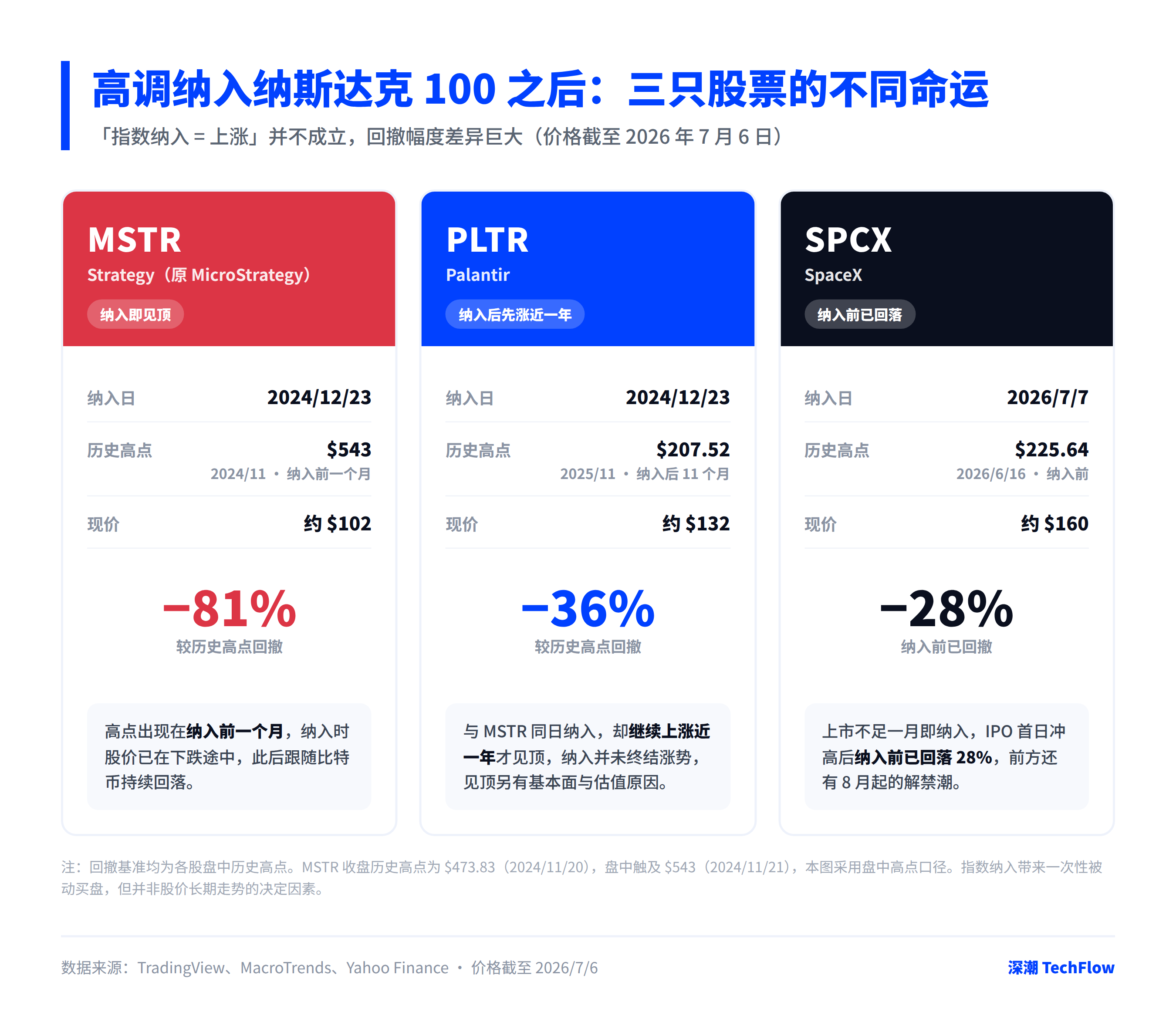
Palantir, included on the same day as Strategy, took the opposite path. It did not peak after inclusion but rose all the way, touching a historical high of $207.52 on November 3, 2025, nearly 11 months after inclusion. It has now fallen back to around $132, a drawdown of about 36% from the high. Palantir's peak had other reasons at the fundamental and valuation levels, with no direct causality to the index inclusion itself.
SpaceX's position is different again. After surging 50% on the first day of its IPO, it touched a historical high of $225.64 on June 16. It had fallen about 28% before inclusion. At the moment of inclusion, the stock price was not at the starting point or the peak, but in the midst of a pullback.
Real Short Pressure Is Behind: Unlocking Tide Queues Up Starting August
More worthy of attention than index inclusion is the ensuing unlocking tide. SpaceX's 180-day lock-up period expires on December 8, 2026. The first selling window opens after Q2 earnings (end of July to August). Musk's 6.4 billion shares are locked until June 12, 2027.
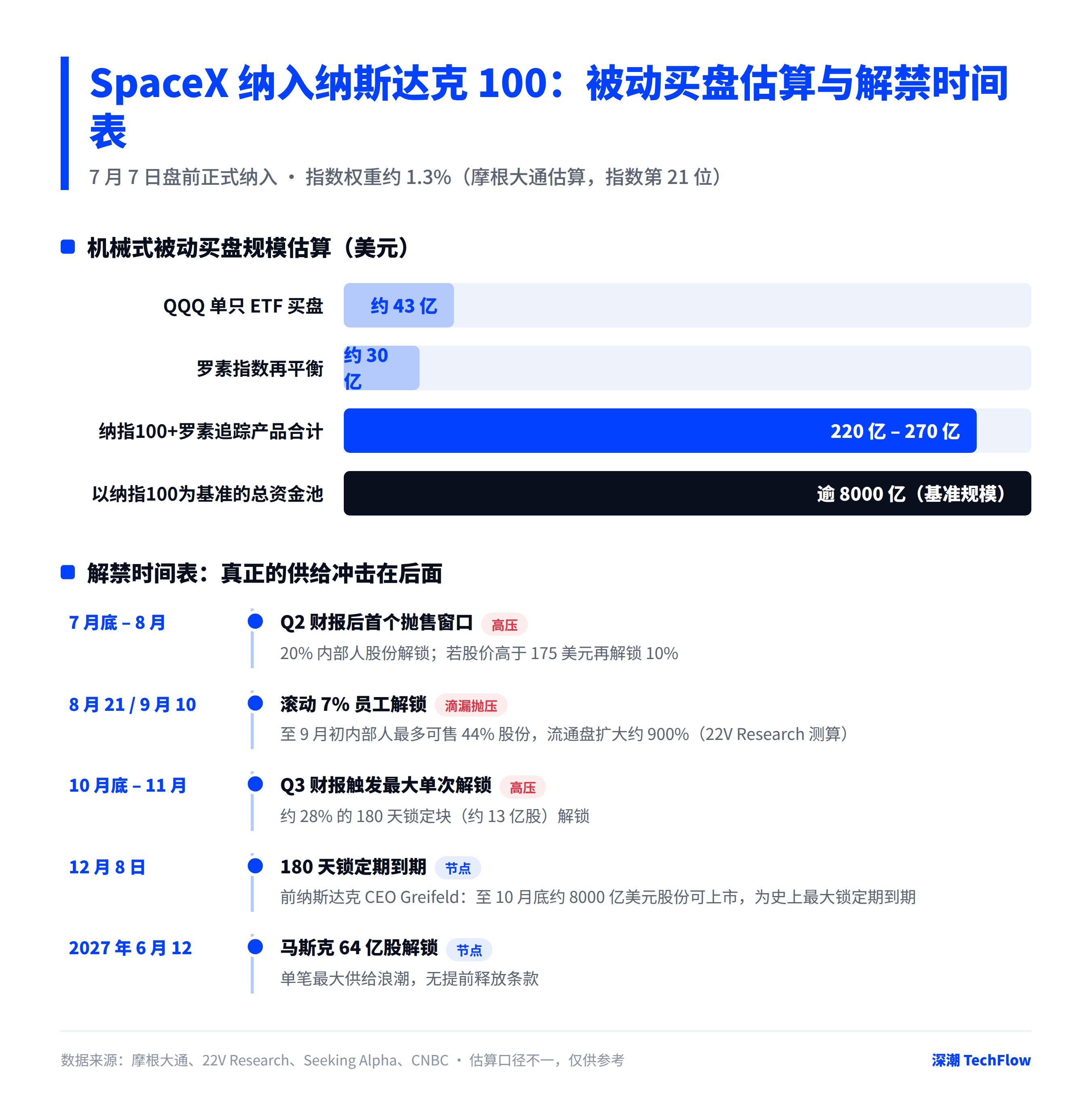
Unlocking is not released all at once, but trickles in batches. After earnings are announced in early to mid-August, 20% of insider shares for SpaceX will unlock. If the stock price rises 30% compared to the IPO price (i.e., higher than $175), another 10% will unlock. Additionally, 7% will unlock around August 21 and around September 10 respectively. By early September, insiders may sell up to 44% of shares, expanding the current float by about 900%.
Warnings from senior market figures are even stricter: This is the largest lock-up expiration in the history of the U.S. capital market. Although SpaceX is the largest IPO in history, it has operated for 23 or 24 years, so this is even more the largest lock-up expiration in history. From now until the end of October, about $800 billion worth of shares can enter the market, which is unprecedented.
A balanced perspective worth noting is that although unlocking increases selling pressure, it may also suppress the extreme volatility of this stock. These large-scale unlocks may not only form considerable pressure on the stock price, but the added float may also reduce the stock's overall daily volatility.
For holders, this means the Q2 earnings window from late July to August, and the Q3 unlocking window from late October to November, are the two supply shock nodes that need the most monitoring in the near term.
Outlook: High Short-Term Noise, Direction Depends on Fundamental Realization
Putting all viewpoints together, a relatively clear judgment emerges: index inclusion itself is closer to a scheduled event that has been fully priced in, rather than a catalyst that can independently drive the stock price. Index membership supports liquidity and credibility, but it reflects past achievements rather than a guarantee of future strong performance. Investors evaluating SpaceX should focus more on the company's operational milestones and cash flow trajectory, rather than the temporary tailwinds brought by index-driven capital inflows.
Supporting the long-term narrative are the fundamentals of SpaceX's three business segments. Starlink is currently the largest revenue source, contributing $11.4 billion to SpaceX's total revenue of $18 billion last year. Its subscriber count has surged from 2.3 million three years ago to over 10 million today. The cost advantage of rocket launches and the AI layout of space data centers constitute longer-term imagination space.
In the short term, the support of passive buying, the amplification effect of a thin float, the warning of historical patterns, and the upcoming unlocking tide intertwine, pushing this stock into a high volatility state. Interest rates remain the ceiling; if yields rise significantly, valuation-stretched growth stocks will bear duration pressure. SpaceX cannot offset this gravity, but a brand new large-cap story may maintain risk appetite in a bumpy macro environment. Spillover to the crypto market is also worth noting; when large-cap tech capital flows dominate the market, Bitcoin and Ethereum often follow broader risk sentiment fluctuations.
The final authority on direction lies not in the event of index inclusion itself, but in whether fundamentals can withstand the supply shock in the August Q2 earnings and subsequent unlocking windows.
Join TechFlow official community to stay tuned
Telegram:https://t.me/TechFlowDaily
X (Twitter):https://x.com/TechFlowPost
X (Twitter) EN:https://x.com/BlockFlow_News
 深潮TechFlow