
Goldman Sachs Research Report Analysis: LEO Satellite Deployment Accelerating, Over 300,000 in Orbit by 2031
TechFlow Selected TechFlow Selected
Goldman Sachs Research Report Analysis: LEO Satellite Deployment Accelerating, Over 300,000 in Orbit by 2031
Goldman Sachs believes LEO satellites are shifting from "the Starlink story" to an industry-wide opportunity, with approximately 70,000 satellites awaiting launch over the next five years.
 Navigating Web3 tides with focused insights
By: Rita
TechFlow Guide
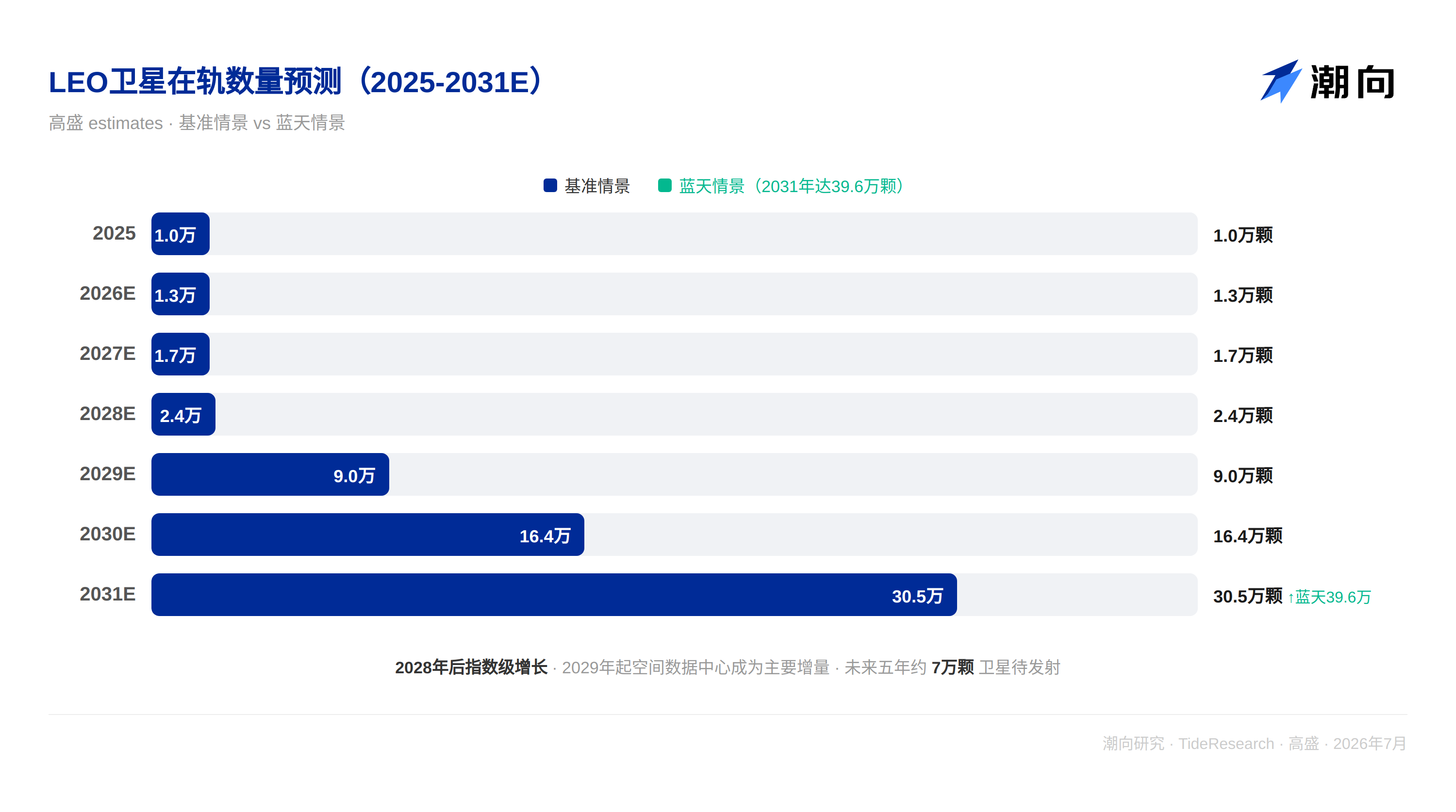
Goldman Sachs updated its global LEO satellite industry forecast on July 8, with the number of LEO satellites in orbit reaching 10,000 in 2025. Goldman Sachs expects this to reach 24,000 by 2028 and surge to 305,000 by 2031, reaching 396,000 by 2031 under the blue sky scenario. Driving factors include accelerated rocket launch frequency, maturation of reusable technology, and commercialization of new application scenarios such as space data centers. Global operators such as SpaceX and Amazon are accelerating deployment to seize orbital resources. Goldman Sachs believes LEO satellites are shifting from the "Starlink story" to an industry-wide opportunity, with about 70,000 satellites awaiting launch in the next five years.
Satellite Numbers Are Growing at an Exponential Rate
According to Goldman Sachs data, the number of LEO satellites in orbit reached about 10,000 in 2025. It is expected to reach 13,000 and 17,000 in 2026 and 2027 respectively. The real explosion point is after 2028; Goldman Sachs expects 24,000 by 2028 and 305,000 by 2031.
Under Goldman Sachs' blue sky scenario, the number of LEO satellites in orbit could reach 396,000 by 2031, about 90,000 more than the baseline scenario. The core assumption is that large-scale deployment in China can be realized. China has submitted applications for over 200,000 medium and low orbit satellites to the International Telecommunication Union. Although technical feasibility remains to be verified, Goldman Sachs believes new application scenarios such as space data centers may accelerate the commercialization process.
From an application perspective, almost all LEO satellites will be used for satellite internet before 2028. Starting in 2029, space data centers will become the main source of incremental growth. Goldman Sachs expects space data centers to account for 79% of the total LEO satellites by 2031, with satellite internet dropping to 21%.
Rockets: The Key Bottleneck for Accelerated Deployment
Goldman Sachs points out three driving factors. The first is accelerated launch frequency. In 2025, Starlink launched once every three days; in April 2026, SpaceX completed two launches within 19 hours, indicating there is still room for efficiency improvement.
The second is improved rocket capacity. The current mainstream reusable rockets have an LEO payload capacity of about 17.5 tons, while next-generation rockets can reach 100 to 150 tons.
The third is the breakthrough in reusable technology. For China's LEO satellites, successful development of domestic reusable rockets will significantly accelerate deployment. In February 2026, Long March 10 successfully completed the first stage offshore soft landing splashdown test; LandSpace, i-Space, and others also plan to conduct their first launches in 2026. The cost reduction effect of reusable rockets on launch costs is exponential; once the launch cost per kilogram drops low enough, the business model of satellite constellations will shift from "burning money" to "printing money".
Global Operators Rushing: SpaceX, Amazon, China SatNet
SpaceX's Starlink is in an absolute leading position, launching satellites on average once every three days in 2025. In another report, Goldman Sachs covered SpaceX for the first time and gave a Buy rating with a target price of 205 USD. Among US stock targets covered by Goldman Sachs, Amazon's Project Leo is catching up; the FCC approved its additional deployment of 4,500 satellites in February 2026, with a planned scale of about 7,700 satellites, and plans for over 20 launches in 2026. Boeing also has layouts in the fields of LEO satellite manufacturing and launch services. Kratos focuses on satellite ground systems and space defense solutions. Eutelsat's OneWeb is also advancing LEO constellation upgrades.
On the China side, the GW Constellation plans 12,992 satellites, G60 (SpaceSail) plans 15,000 satellites, and the Honghu Constellation plans 10,000 satellites. China has submitted spectrum applications for over 200,000 satellites to the ITU, which is essentially a strategic orbital resource positioning.
Supply Chain Opportunities: US Stocks, A-Shares, HK Stocks Fully Benefit
Goldman Sachs believes that the global LEO satellite supply chain is welcoming a historic opportunity.
In terms of US stock targets, SpaceX covered by Goldman Sachs is a core beneficiary on the launch end, with Starlink deployment being its largest internal demand source. Amazon forms a complete closed loop from user terminals to cloud services through Project Leo. Boeing and Kratos benefit in the satellite manufacturing and ground system segments respectively. These targets cover the full chain from launch, satellite manufacturing to ground terminals.
In terms of A-shares, Tongyu Communications received a Buy rating with a target price of 79 yuan, covering the ground equipment demand for China's three major LEO satellite constellations.
In terms of Hong Kong stocks, ZTE Corporation is a key supplier of LEO satellite ground equipment, benefiting from the continuous progress of China's satellite internet networking.
Goldman Sachs believes that from RF chips, phased array antennas to space-grade materials, the Asian supply chain is supporting the hardware foundation of global satellite deployment, yet valuations are discounted by 60% compared to global peers. With 70,000 satellites awaiting launch in the next five years, the manufacturing industry has entered a production expansion cycle during the delivery period.
TechFlow Perspective
The core logic of this Goldman Sachs report is: LEO satellites are shifting from the "Starlink story" to an "industry-wide story". Global satellite launches exceeded 4,400 in 2025, a year-on-year increase of 65%. About 70,000 satellites await launch in the next five years. This order of magnitude means that continuous order drivers will appear in all links such as satellite manufacturing, rocket launches, ground terminals, and chip devices.
For investors, the core characteristics of this track are "long cycle, high threshold, strong certainty". A 14-year deployment cycle means this is not a short-term theme. Satellite operator licenses are limited, capital requirements are extremely high, and the industry landscape is relatively stable. Technology iterations such as reusable rockets are continuously reducing entry costs and expanding the profit space of the entire industry.
For US stocks, focus on SpaceX and Amazon; for A-shares, focus on Tongyu Communications; for Hong Kong stocks, focus on ZTE Corporation. These targets cover the three links of launch, operator, and ground equipment respectively, and are core beneficiaries of China and global LEO satellite deployment.

Disclaimer
This article is a compilation and interpretation by TechFlow Research of a third-party brokerage research report (Goldman Sachs, July 8, 2026). The ratings, target prices, earnings forecasts, and related judgments cited in the text are the views of the brokerage analysts, represent only the position of their affiliated institutions, do not represent the views of TechFlow Research, and do not constitute any investment advice.
The market has risks, decisions need to be independent. This article should not be used as a basis for buying or selling any securities.
Join TechFlow official community to stay tuned
Telegram:https://t.me/TechFlowDaily
X (Twitter):https://x.com/TechFlowPost
X (Twitter) EN:https://x.com/BlockFlow_News
 @chaoxiangooo