Fake Growth Is Dead: 2026, Crypto Marketing Only Values Hard Cash
TechFlow Editor's Note: When one dollar is thrown into growth channels, what quality of users come back? Green Dots founder Stacy Muur answers this question in a whole article. Her judgment is that in 2026, distribution will become increasingly impatient with false demand; for example, surface numbers like impressions, clicks, installs, and wallet connections are becoming ineffective. Whether it can bring users who complete KYC, deposit real money, trade repeatedly, and are willing to stay is the only yardstick for channels. Paid advertising, PR, KOLs, display ads, task airdrops—every channel has been reweighed by her. For teams building financial products, this is an actionable guide shifting from vanity metrics to user quality.
Author: Stacy Muur
Compiled by:TechFlow
Source: Green Dots Research
Distribution for Fintech and Web3 is shifting from cheap surface metrics to empirical user quality. In 2026, stronger teams will measure channels by these standards: verified users, funded accounts, active wallets, repeat transactions, fee generation, retention.
At Green Dots Research, we always circle back to the same distribution question: When a Fintech or Web3 product spends one dollar on growth, what quality of users come back?
For many years, distribution was treated as a channel mix problem. Teams tested paid ads, KOLs, PR, tasks, airdrops, referral loops, Discord events, community promotion—almost every growth mechanism you can think of.
The problem is, many teams measure the numbers easiest to inflate: impressions, clicks, installs, wallet connections, or task completion counts.
By 2026, this logic no longer works.
The harder filter is not "can this channel create activity," but "can this activity turn into users who trust the product, complete activation, retain, and generate revenue."
For financial applications, this is even more critical.
A Fintech product requires users to bind identity, transfer funds, hold balances, trade assets, assume risk, or trust a protocol. A Web3 product often requires users to connect wallets, deposit funds, bridge across chains, sign transactions, or interact with smart contracts.
So, a cheap install or wallet connection says almost nothing—users may never complete KYC, never deposit, never trade, and disappear after claiming rewards.
My judgment: 2026 will be a year where distribution becomes increasingly impatient with false demand.
The Market is Shifting from 'Quantity' to 'Quality'
Distribution for Fintech and Web3 is shifting from growth based on quantity to growth based on quality.
The question is no longer just: How many users can this channel bring?
The better question is: Among these users, how many will verify identity, deposit, trade, retain, pay fees, refer others, or return on their own without spending money to acquire them again?
There is also less and less room for marketing budgets to be wasted on false efficiency.
Gartner 2025 CMO Spend Survey found that marketing budgets flattened at 7.7% of overall company revenue, while 59% of CMOs said budgets were insufficient to execute their strategies. Paid media still eats up 30.6% of marketing budgets, but media inflation means less is bought for every dollar spent.
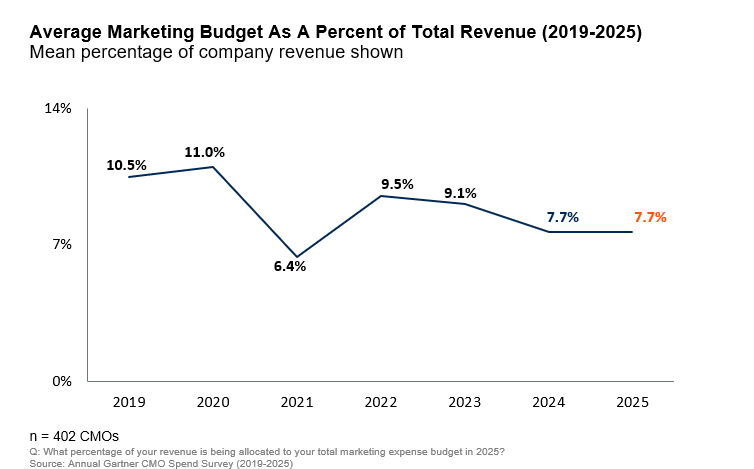
Caption: Marketing budget as a percentage of revenue, peaking at 11.0% in 2020, dropping to 6.4% in 2021, returning to 9.5% in 2022, then falling back and flattening at 7.7% in 2024 and 2025. Source: Gartner 2025 CMO Spend Survey
At the same time, digital advertising is still expanding.
IAB and PwC reported that U.S. digital ad revenue reached $294.6 billion in 2025, up 13.9% year-over-year. Social media ads $117.7 billion, search $114.2 billion, display ads $81.6 billion, digital video $78.0 billion, programmatic ads $162.4 billion.
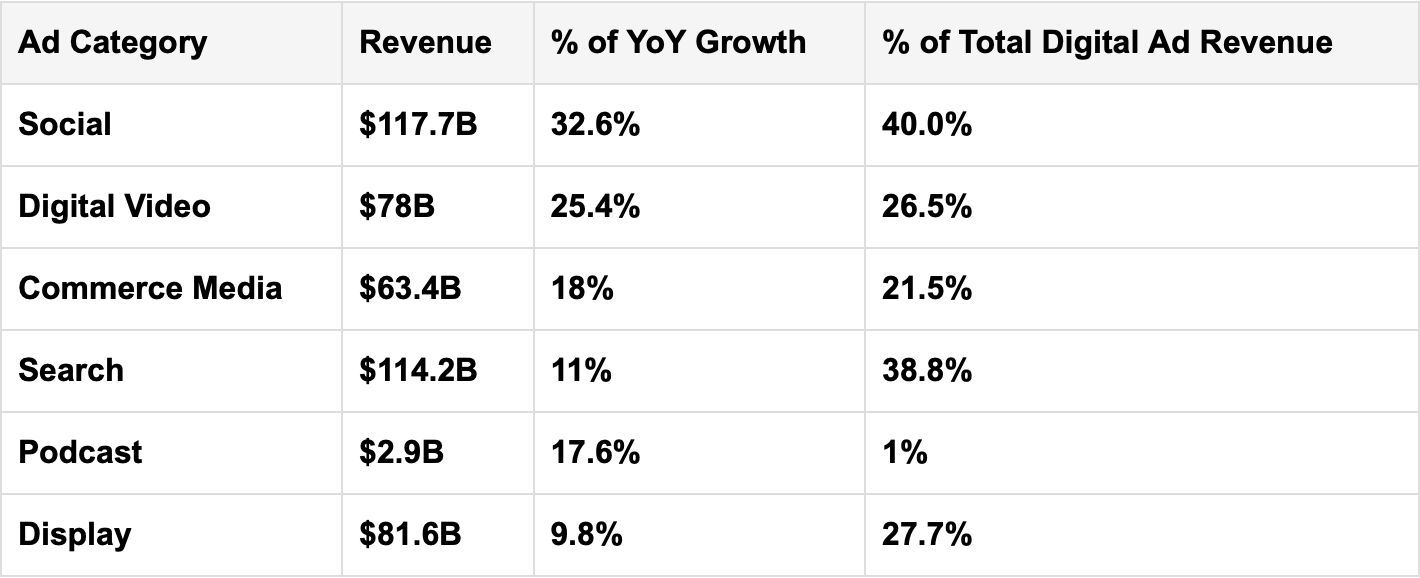
Caption: 2025 U.S. digital ad revenue breakdown by category. Social media highest at $117.7 billion; followed by search $114.2 billion, display $81.6 billion, digital video $78.0 billion, e-commerce media $63.4 billion, podcasts $2.9 billion. Social media YoY growth fastest at 32.6%. Source: IAB / PwC
So the market is squeezed on both ends.
More money is flowing into digital channels, but teams have less and less room to waste on low-quality users.
This is why the core distribution question for 2026 is simple: Among acquired users, how many stay, trade, deposit, pay fees, refer others, or return on their own without spending money?
Paid Advertising Remains the Foundation
Paid media remains the most controllable way for scaled distribution. It allows teams to test messages, capture demand, and push traffic into measurable funnels.
But in Fintech and Web3, paid acquisition must look much deeper than CPC, CPI, CPL.
For example, search ads still have value because they capture explicit intent.
WordStream 2026 Google Ads Benchmarks based on over 13,000 campaigns from April 2025 to March 2026, reported average search CPC at $5.42, average CPL at $66.69. For the Finance & Insurance industry, average CPC is $3.39, average CPL is $74.44.
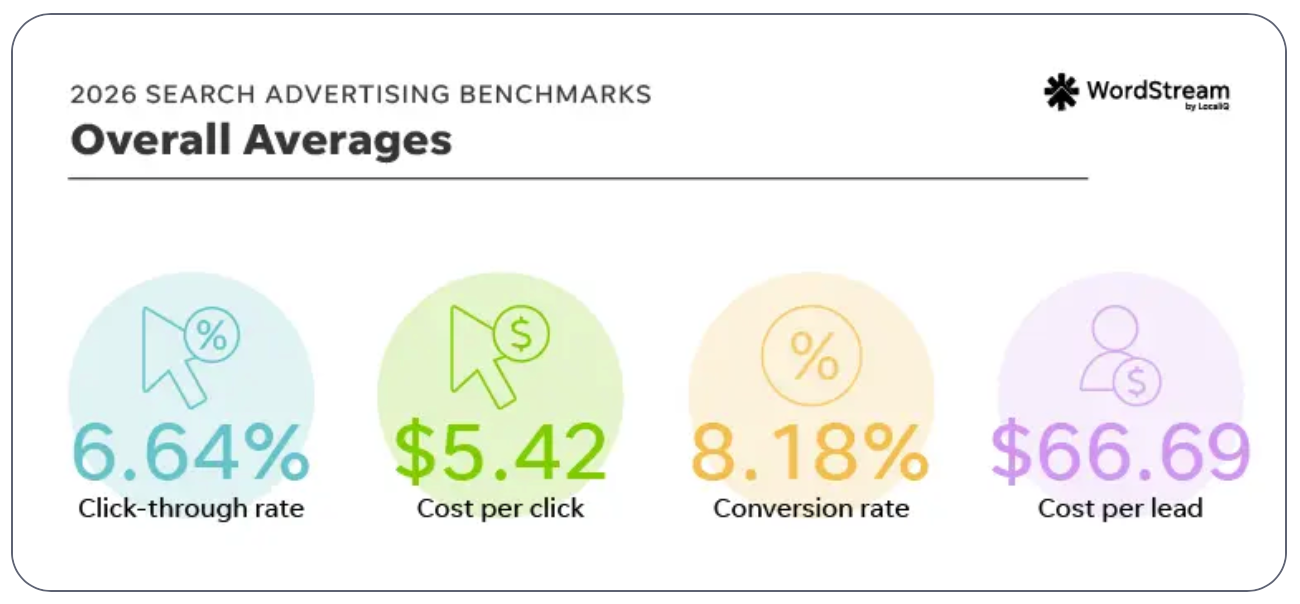
Caption: Search ads overall averages—CTR 6.64%, CPC $5.42, conversion rate 8.18%, cost per lead $66.69. Source: WordStream 2026
Useful numbers, but just the starting point.
For Fintech, the real paid acquisition metrics are KYC completion rate, first deposit, first trade, funded accounts, retained balances, revenue per user, fraud rate, payback period.
Given the data for financial applications, this is even more important—this category is still growing, but competition is becoming more refined. Adjust reported:
- Finance app sessions in H1 2025 up 16% YoY
- LatAm finance app installs up 59%
- Global finance app CPI dropped from $1.51 to $1.13
- Banking apps had the highest Day 1 retention in finance subcategories, at 20.6%
Paid social plays another role. It is usually stronger than high-intent conversion for education, retargeting, message testing, and creator amplification.
Gupta Media 2025 Social CPM Tracker reported average CPMs: Meta $8.19, TikTok $4.82, YouTube $4.99, Snapchat $8.60, Pinterest $4.67. You do the math for the back end of the funnel.
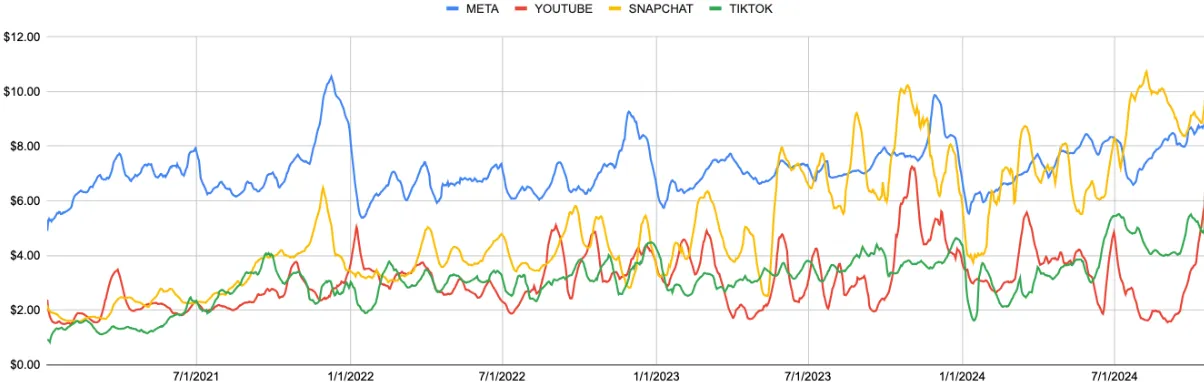
Caption: Meta highest most of the time, around $6 to $9 range; Snapchat saw spikes over $10 in 2023, 2024; TikTok and YouTube lower, mostly fluctuating between $2 to $5. Source: Gupta Media 2025
My judgment: The best Fintech and Web3 teams will optimize towards quality evidence—verified users, funded accounts, active wallets, repeat transactions, revenue.
PR Becomes 'Trust Distribution'
PR is often treated as a launch channel. For financial products, I think understanding it as trust distribution is more accurate.
Journalists are still willing to take useful PR, but the bar is higher. Cision 2025 State of the Media Report found that 86% of journalists will immediately reject pitches that do not match their beat or audience. At the same time, 72% of journalists still list press releases as the most useful PR resource, and 85% say the best way to build relationships is a simple introductory email.
For Fintech and Web3, the strongest PR assets are substantive: exclusive data, security practices, regulatory clarity, proof of reserves, risk frameworks, market maps, founder commentary.
Generic launch announcements have weak distribution power unless they carry real market signals.
However, PR is rarely the cheapest acquisition channel. Its value is spread across the funnel. A credible article can improve search visibility, investor confidence, partner conversion, landing page trust, creator narratives, founder authority. So I expect more financial companies to invest in research-driven PR in 2026.
KOL Marketing Becomes an Operational Layer
Creator marketing is becoming a legitimate budget line.
CreatorIQ reported:
- Average annual KOL marketing budget up 171% YoY
- 71% of agencies increased spending
- Nearly two-thirds of new spending came from traditional paid and digital channels
IAB also reported creator ads reached $37 billion in 2025, expected to reach $44 billion in 2026.
For Fintech and Web3, this makes sense. Financial products require repeated explanation. Users need to understand use cases, risks, mechanisms, and why they should trust the product. Good creators often explain clearer than brand-owned channels.
But this channel has a very clear failure mode.
A creator with reach can still bring low-quality users, compliance risks, or pure attention without any activation. This is especially true in crypto—audiences are long accustomed to sponsored posts, token incentives, and short-term narratives.
Stronger creator strategies in 2026 will be more selective.
📎 Further Reading: Why Most KOL Campaigns Fail | Green Dots Research (Most KOL campaigns fail not because creators are useless, but because teams bought attention before fixing positioning, audience matching, campaign architecture, trust, and product maturity.)
I expect better results to come from expert micro-creators, vertical analysts, founder collaborations, product explanations, long-term ambassador programs, and creator content that can be repurposed into paid ads.
Key metrics should shift from 'Reach' to 'Actions that Remain'.
- For Fintech, this could be funded accounts, deposits, card usage, transfers, or subscription revenue.
- For Web3, this could be swaps, deposits, staking, lending, governance participation, fee generation, or repeat wallet activity.
Display Advertising Still Has a Place, But Not as Cheap Noise
Display ads are easily dismissed, but this category remains large.
IAB and PwC reported display ads reached $81.6 billion in 2025, up 9.8% YoY. Programmatic ads reached $162.4 billion, up 20.5%.
The problem is quality.
ANA Q3 2025 Programmatic Transparency Benchmark reported nominal CPM for web and mobile is $4.27, while TrueCPM is $6.66. This difference matters—once quality, viewability, and supply chain efficiency are accounted for, cheap inventory can hide waste.
ANA also reported in Q2 2025 that $26.8 billion in global media value is still lost annually to programmatic inefficiency.
For Fintech and Web3, broad cheap display ads as direct response channels are usually weak. They can still be used in specific roles: retargeting, trusted financial media placements, newsletter sponsorships, native advertising, B2B account-based marketing, and contextual placements around market events.
Higher quality context is the bet for display ads in 2026.
Web3 Enters the 'Post-Task Era'
Web3 has a distribution advantage most Fintech products do not: public behavioral data.
A wallet can show what users actually did. This makes tasks, points, airdrops, whitelists, and wallet-based campaigns powerful growth tools.
But the market has also learned the weaknesses of this model. Many protocols acquire users who never retain, never generate revenue, just inflate metrics while waiting for airdrops. The initial logic was close to "fake it till you make it": create visible activity, show traction, attract capital, then hope real usage follows.
When everyone does this, the system starts to break. Airdrop hunters simulate demand, teams report inflated growth, token rewards are sold off, and the next protocol has to pay more for lower quality activity.
We don't yet have a clean public time series proving entire market spend on task platforms is declining. But evidence from 2025-2026 explains why protocols are becoming increasingly skeptical of "using tasks as the primary acquisition engine."
DappRadar found that since 2017 projects have distributed over $20 billion via airdrops, and 88% of airdropped tokens lose value within three months. It also found activity often falls back to baseline within weeks, with many users cashing out after claiming.
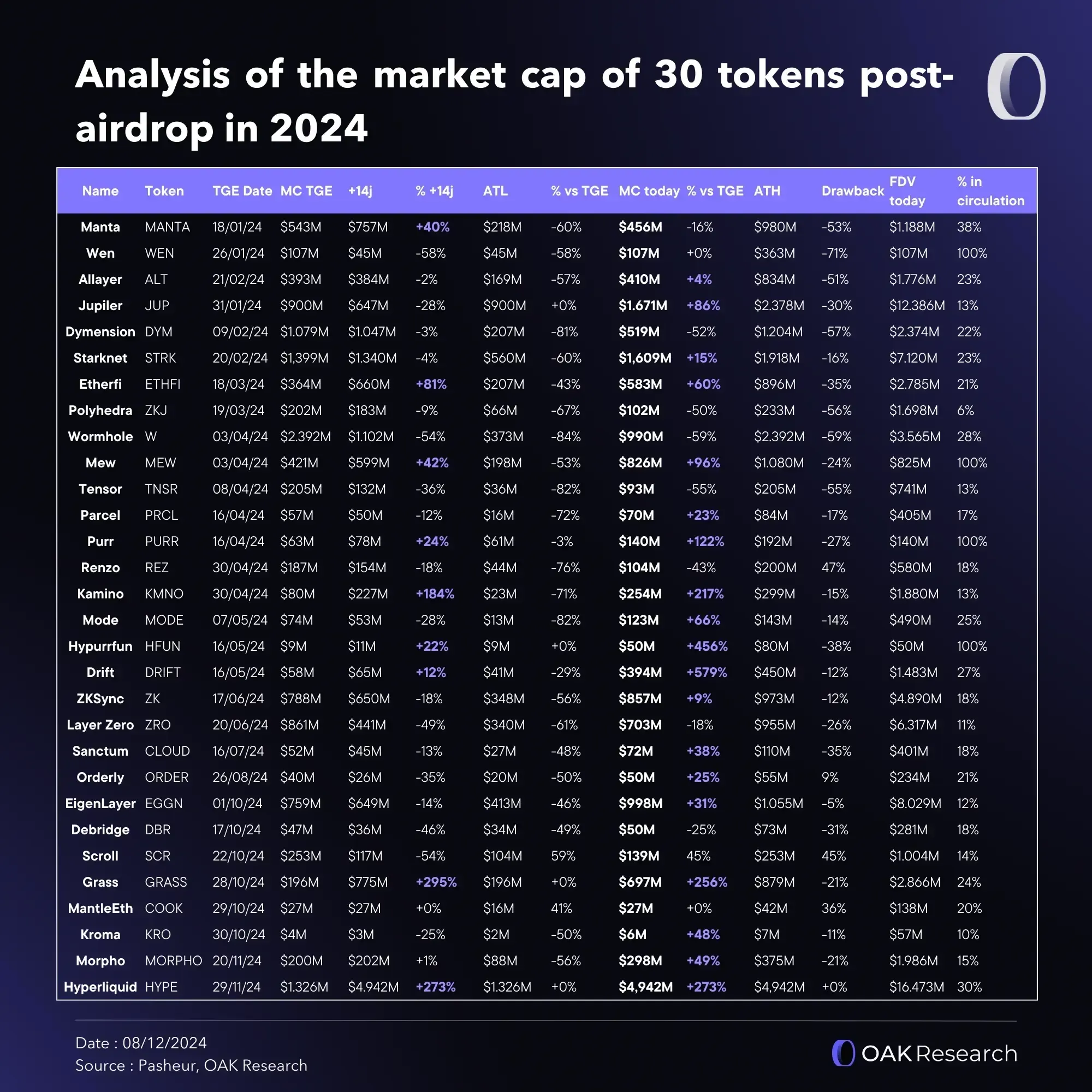
Caption: Comparing TGE market cap, 14-day performance, historical highs/lows, current market cap, drawdown, FDV, and circulation for 30 airdropped tokens in 2024. Performance varies greatly—Hyperliquid, Drift, Grass, Kamino, Hypurrfun etc. far above TGE levels, many others still significantly below issuance valuation. Source: DappRadar
Decrypt's Review of the Top 5 Airdrops of 2025 shows the market is colder than 2024. Top 5 airdrops in 2025 peaked at $4.5 billion, while 2024 airdrops distributed over $19 billion to users at historical highs. Several major 2025 airdrop tokens subsequently fell significantly from peaks.
Another 2025 Paper on Sybil Detection analyzed 193,701 addresses, including 23,240 Sybil addresses, showing how big the fake user problem has become.
Practical conclusion: Tasks won't disappear, but their job has changed. I would treat them as a filtering layer or educational layer, not a primary acquisition engine.
A stronger approach is to let users prove they are fit through meaningful behavior: deposits, swaps, holding periods, governance, fee generation, referrals, wallet history, retention.
The same logic applies to DeBank-style targeting, wallet-based outreach, and cold DMs. Broadcasts carry reputation risk and quality is usually low.
Narrow, wallet-aware outreach may be useful when user on-chain behavior already clearly shows product relevance. But this is still experimental. Public conversion benchmarks for this approach in 2025-2026 are weak, so I treat it as some guerrilla marketing tactics.
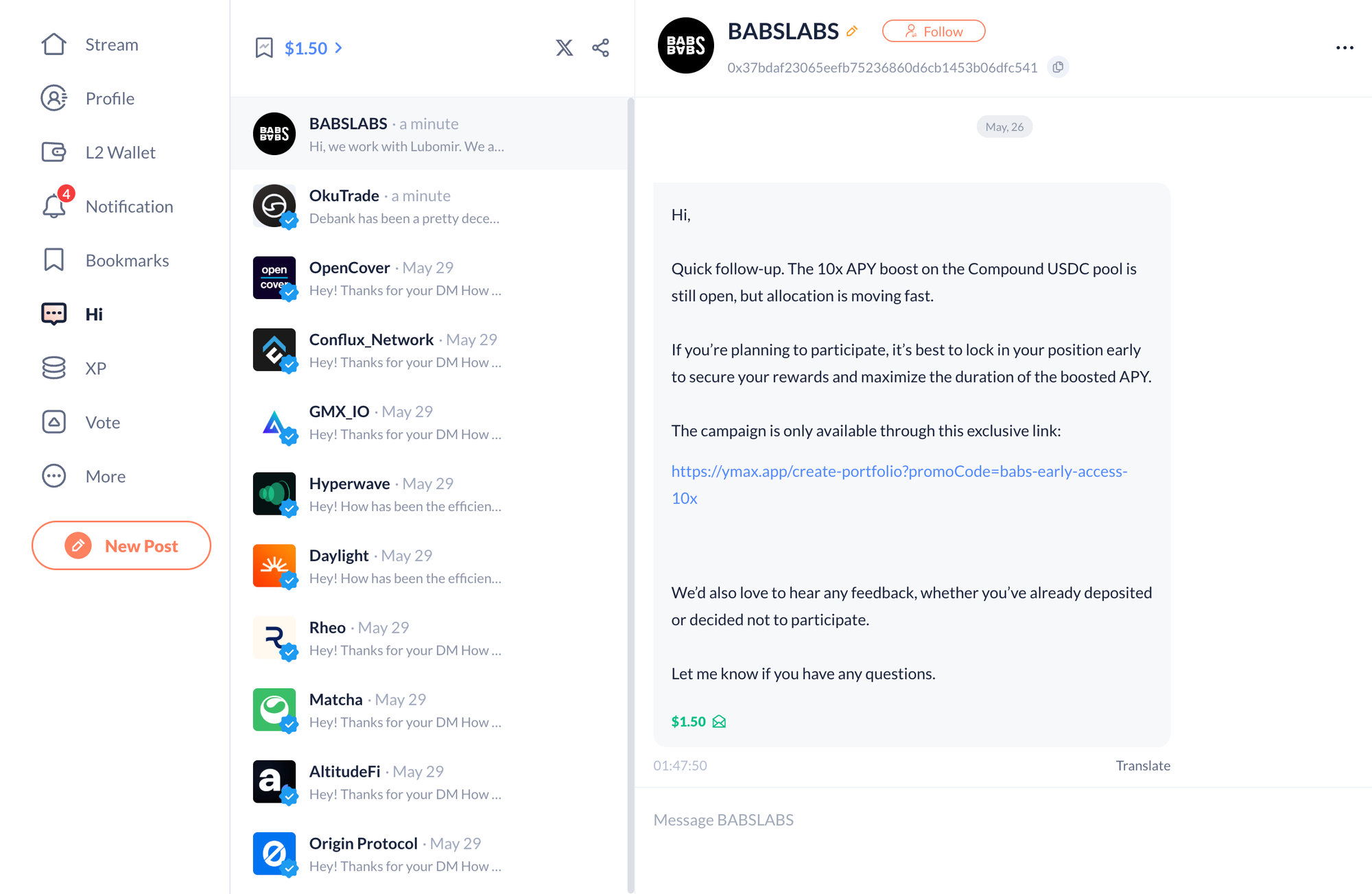
Caption: This DM follows up on a 10x APY boost for a Compound USDC pool, claiming allocation is being grabbed quickly, and includes an exclusive early access event link. Source: DeBank
What Teams Should Measure in 2026
Old growth dashboards reward surface activity. 2026 dashboards need to reward user quality.
For Fintech, useful metrics are: verified users, KYC completion, first deposit, funded accounts, first trade, repeat trades, retained balances, revenue per user, fraud rate, payback period, referral quality.
For Web3, useful metrics are: active wallets, real liquidity, repeat usage, fee generation, deposits, swaps, staking, lending, wallet history, retention after incentive decay.
This doesn't mean every channel must be judged by last-click revenue. PR, creator marketing, search, paid social, display ads, wallet-based campaigns, each does their own job.
But every channel should connect to a quality signal somewhere in the funnel.
A distribution system that cannot distinguish between "retained users" and "paid tourists" is a reporting problem waiting to become a budget problem.
The Distribution Stack We Believe Will Win
The strongest Fintech and Web3 teams will build a stack.
PR creates authority. Founders turn authority into narrative. Creators translate narrative into education. Paid social tests and amplifies messages. Search captures intent. Display and native ads support retargeting. Wallet-based campaigns filter users. Lifecycle marketing turns acquisition into activation and retention.
This is the shift we care about most at Green Dots.
Distribution is becoming increasingly impatient with false demand.
The teams that win in 2026 will be those that actively stop treating activity volume as growth before the market forces them to.
If you need help designing distribution strategies, welcome to contact us.
Author's Note: The author of this article Stacy Muur is the founder of Green Dots. Green Dots works with Web3 teams on GTM strategies, creator-driven distribution, founder growth, and launch architecture.
Join TechFlow official community to stay tuned
Telegram:https://t.me/TechFlowDaily
X (Twitter):https://x.com/TechFlowPost
X (Twitter) EN:https://x.com/BlockFlow_News
 @stacy_muur