Bitcoin Tollbooth at the Strait of Hormuz
TechFlow Selected TechFlow Selected
Bitcoin Tollbooth at the Strait of Hormuz
A comprehensively sanctioned country has established a Bitcoin toll station on the world’s most critical oil shipping route.
 Navigating Web3 tides with focused insights
By Xiao Bing, TechFlow
On April 8, the Financial Times published a report stating that Iran has demanded bitcoin payments from tankers transiting the Strait of Hormuz.
The source is Hamid Hosseini, spokesperson for the Iranian Union of Oil, Gas, and Petrochemical Exporters. He told the FT that tankers must first email their cargo details; Iran then assesses and quotes a fee—$1 per barrel of crude oil. A fully loaded VLCC (very large crude carrier), carrying two million barrels, would thus pay $2 million in transit fees.
Payment method: bitcoin. According to Hosseini, “Payments are completed within seconds, ensuring they cannot be traced or seized due to sanctions.”
The consequences of nonpayment are explicit. Per the FT’s reporting, VHF radio broadcasts inside the strait warn: “Any vessel attempting passage without authorization will be destroyed.”
A fully sanctioned nation has erected a bitcoin tollbooth on the world’s most critical oil shipping lane.
How the Tollbooth Was Built
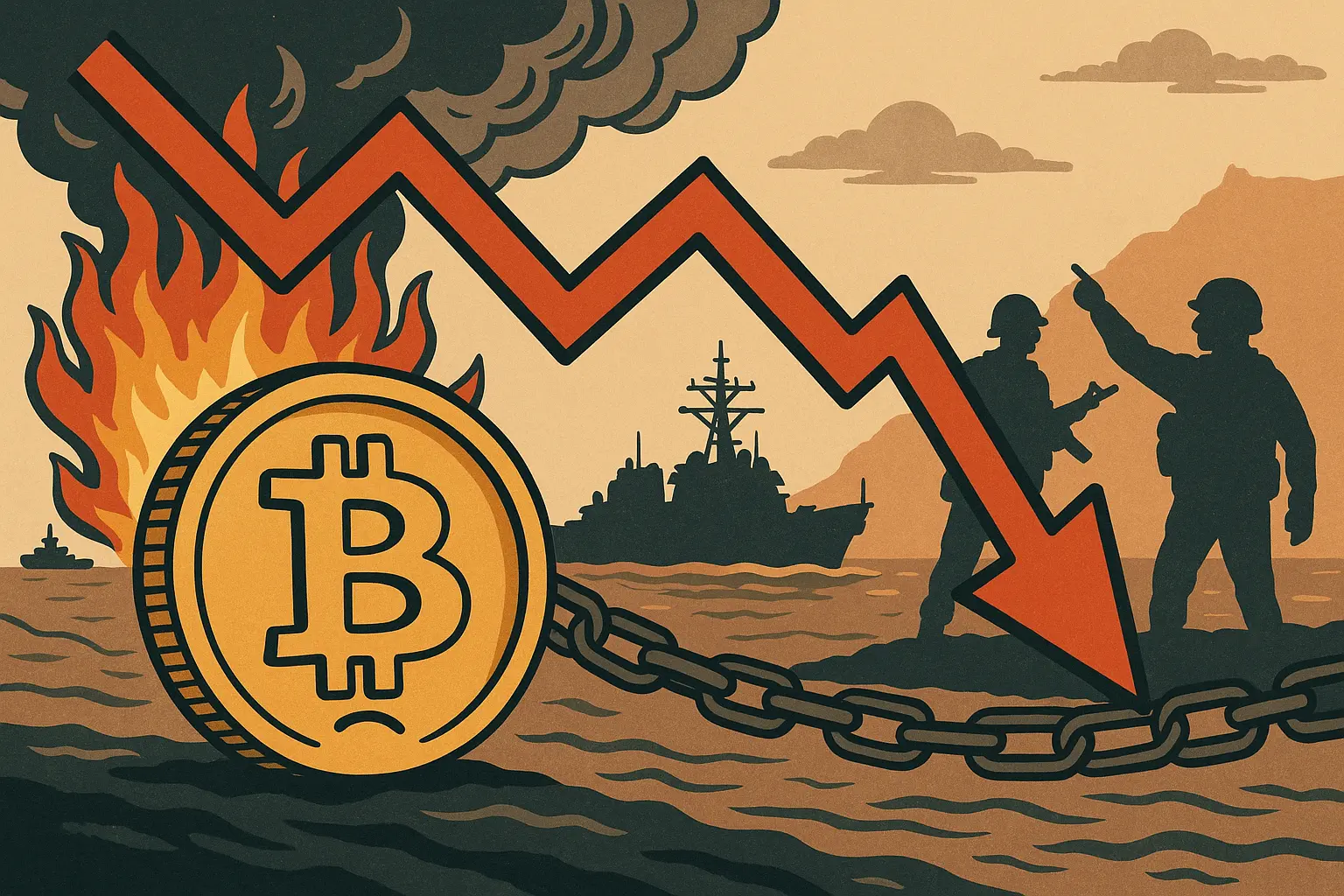
In late February 2026, the U.S. and Israel jointly struck Iran; Iran responded by closing the Strait of Hormuz. S&P Global data shows tanker traffic through the strait plummeted by 97%.
To grasp the strait’s significance: Prior to the conflict, 100–120 merchant vessels passed through daily—carrying roughly one-fifth of the world’s crude oil. Closure sent oil prices soaring and rattled the global economy.
But as the closure dragged on, Iran realized “closing” was less effective than “charging.”
Beginning mid-March, the Islamic Revolutionary Guard Corps (IRGC) had already implemented an informal transit-fee system in practice. Shipowners were required to submit detailed information—including vessel ownership records, flag registration, cargo manifests, destination ports, crew lists, and even AIS tracking data—to an IRGC-linked intermediary. Upon approval, the IRGC issued a one-time password permit and route instructions, guiding vessels northward along Iran’s coastline under escort by patrol boats.
On March 30–31, Iran’s parliament formally adopted the “Strait of Hormuz Management Plan,” codifying this system into law. Fees are denominated in rials but authorized to be paid in “digital currencies.”
By April 7—the day the U.S. and Iran announced a two-week ceasefire—this system had already been operational for at least three weeks.
Within hours of the ceasefire announcement, Hosseini disclosed new details to the FT: Tolls must be paid in bitcoin. His stated rationale: “to ensure payments cannot be traced or seized due to sanctions.”
BTC or USDT: A Sovereignty Choice
Hosseini’s statement contains two technical inaccuracies. Bitcoin transaction confirmation takes minutes—not “seconds.” And every bitcoin transaction is publicly visible on-chain; firms like Chainalysis and TRM Labs specialize precisely in tracing Iranian on-chain funds. OFAC sanctioned Iranian bitcoin wallets as early as 2018.
Yet he got one thing right: Bitcoin settlements bypass the U.S. correspondent banking system; OFAC cannot freeze such transactions at the moment they occur. Post-hoc tracing is one matter; real-time interception is another. For a $2 million toll payment, “post-hoc” is already too late.
A TRM Labs report provides fuller context. Over recent years, the IRGC has relied far more heavily on stablecoins like USDT in daily operations. Just two exchanges—Zedcex and Zedxion—sanctioned by OFAC in January 2026, processed approximately $1 billion in IRGC-linked funds. Chainalysis’ *2026 Crypto Crime Report* states that in Q4 2025, IRGC-linked addresses accounted for over half of Iran’s total cryptocurrency inflows—exceeding $3 billion.
The problem? Stablecoins have backdoors.
Both Tether and Circle can freeze addresses. In mid-2025, Tether executed its largest-ever freeze of Iranian-linked funds.
This explains the logic behind choosing bitcoin for the Hormuz tollbooth. Stablecoins work fine for routine trade settlement—smaller amounts, higher frequency, faster execution. But for a single $2 million toll payment, using a tool whose issuer can freeze funds with a keystroke is unacceptable to Iran.
Bitcoin has no administrator, no freeze button. A slogan chanted by crypto enthusiasts for fifteen years has become, on the Strait of Hormuz, a sovereign state’s practical necessity.
A prior Bloomberg report also cited a third payment option: renminbi, routed via昆仑 Bank (Kunlun Bank) through China’s Cross-Border Interbank Payment System (CIPS), bypassing SWIFT. In practice, Iran offers shipowners a menu: renminbi for those with strong ties to China; bitcoin for everyone else.
Iran has also introduced a five-tier national classification system—“friendly” nations receive lower rates, while vessels linked to the U.S. or Israel are outright denied passage. Some operators have already reflagged their vessels under Pakistan to qualify for transit permits.
$800 Million Monthly—Rivaling the Suez Canal
TRM Labs estimates that, if traffic normalizes, tankers alone could generate $20 million per day—$600 million to $800 million monthly. Including LNG carriers and other cargo ships, revenue exceeds $800 million.
For comparison: The Suez Canal’s peak-year monthly revenue reaches about this level.
Iranian officials themselves invoke the Suez precedent. When Nasser nationalized the Suez Canal in 1956, Egypt collected tolls for seventy years, earning up to $9.4 billion annually in its best years. Iran’s parliament explicitly referenced the Suez precedent—and even cited Denmark’s historical tolls on the Øresund Strait—while defending the “Strait of Hormuz Management Plan.”
The core logic is identical: A nation situated at a strategic chokepoint monetizes geography.
But key differences exist. Egypt’s sovereignty over the Suez Canal rests on international law—the canal is man-made and lies entirely within Egyptian territory. The Strait of Hormuz is a natural strait classified under international law as a “strait used for international navigation.” Under UNCLOS, coastal states may not levy transit fees on passing vessels.
Iran’s response: “We never ratified UNCLOS.”
A Foreign Policy analysis published April 7 put it bluntly: If Iran transforms its wartime, ad hoc toll system into a permanent peacetime institution, it will mark the Middle East’s largest economic-geopolitical event since Nasser’s nationalization of the Suez Canal.
What Did Markets Read Into This?
Following the ceasefire announcement, bitcoin surged from near $68,000 to above $72,000. After the FT’s tollbooth report, it climbed further to $73,000.
Markets are pricing in two things.
One is familiar: bitcoin as a safe-haven asset. Since the U.S.-Iran war began, bitcoin has outperformed physical gold—reviving the “digital gold” narrative after a period of dormancy.
The other is novel: bitcoin as an international settlement instrument. A sovereign state collecting payments in bitcoin at the world’s largest energy chokepoint. This isn’t a whitepaper scenario—it’s the reality discovered by a nation backed into a corner: when the dollar system shuts down, bitcoin remains one of the few channels still capable of receiving payments.
Crypto communities have debated for fifteen years, “What is bitcoin actually for?” Hormuz delivered an answer no one anticipated: When two countries go to war, sanctions go full throttle, SWIFT gets cut off, and stablecoins get frozen—bitcoin is the last payment channel still open.
This use case is undeniably real—but deeply uncomfortable.
On April 8, Trump told ABC News the U.S.-Iran joint tollbooth was a “beautiful thing” and expressed interest in forming a “joint venture.” The White House press secretary quickly clarified that ceasefire conditions require the strait’s “immediate, complete, and safe reopening—with no tolls.” Contradictory messaging followed.
Even more nuanced is Trump’s own position. His family’s project, World Liberty Financial, launched the dollar-pegged stablecoin USD1, currently partnering with Aster DEX to list crude oil futures settled in USD1. Meanwhile, Bloomberg previously reported that Iran accepts dollar-pegged stablecoins—including USDT and USDC—as payment. A subtle intersection thus emerges between the Trump family’s stablecoin business and Iran’s sanctions-avoidance needs—all centered on the word “stablecoin.”
After the Tollbooth
FXStreet’s analysis highlights a follow-on risk: If the model of military coercion + crypto payments proves viable in Hormuz, imitators may emerge at the Strait of Malacca or the Bosporus. The U.S. Navy’s 80-year stewardship of the principle of freedom of navigation does not automatically enforce itself on paper—and cryptocurrencies happen to provide the technical means for toll collection to circumvent financial sanctions.
During the 1956 Suez Crisis, Nasser prevailed—not because Egypt’s military defeated the Anglo-French alliance, but because the U.S. refused to support the invasion. The fait accompli thus became entrenched. Seventy years later, at Hormuz, the question remains political: How high a price is the U.S. willing to pay to reopen the strait?
Current signs are not optimistic. The ceasefire hadn’t lasted 24 hours before Israel bombed Lebanon—and Iran promptly suspended strait transit again. Maersk stated it was still “urgently confirming terms” and dared not dispatch vessels. A shipping executive bluntly told CNBC: “We have received no information on how to pass safely.”
The ceasefire may not survive two weeks. Yet Iran has already demonstrated one thing: A nation expelled from SWIFT, with its dollar assets frozen and all traditional financial channels severed, can—using bitcoin and stablecoins—build a toll-collection system at the world’s most vital maritime chokepoint, generating up to $800 million monthly in potential revenue—and already collecting payments.
The cryptocurrency industry spent fifteen years trying to prove the value of “decentralized payments.” Its strongest validation ultimately came not from Silicon Valley startups or Wall Street institutions—but from the Islamic Revolutionary Guard Corps on the Persian Gulf.
This is likely not the scenario Satoshi Nakamoto envisioned when writing the whitepaper—but it is the reality of 2026: Technology does not discriminate among users.
Join TechFlow official community to stay tuned
Telegram:https://t.me/TechFlowDaily
X (Twitter):https://x.com/TechFlowPost
X (Twitter) EN:https://x.com/BlockFlow_News
 深潮TechFlow