What does Polymarket think about the volatile situation in the Middle East?
TechFlow Selected TechFlow Selected
What does Polymarket think about the volatile situation in the Middle East?
"The promise of prediction markets is to harness the wisdom of the crowd to make accurate, impartial forecasts about the most important events in society."
 Navigating Web3 tides with focused insights
Author: Pzai, Foresight News
Recently, news about the conflict between Iran and Israel has dominated headlines worldwide. For people living in war zones and users across the global information network, a real-time and reliable source of information holds immense value. As prediction markets have gradually drawn public attention in recent years—especially gaining prominence during the 2024 U.S. election—the perspectives offered by these markets are increasingly shaping their reference value for decision-making. This article offers a brief review of sentiment shifts surrounding the latest conflict.
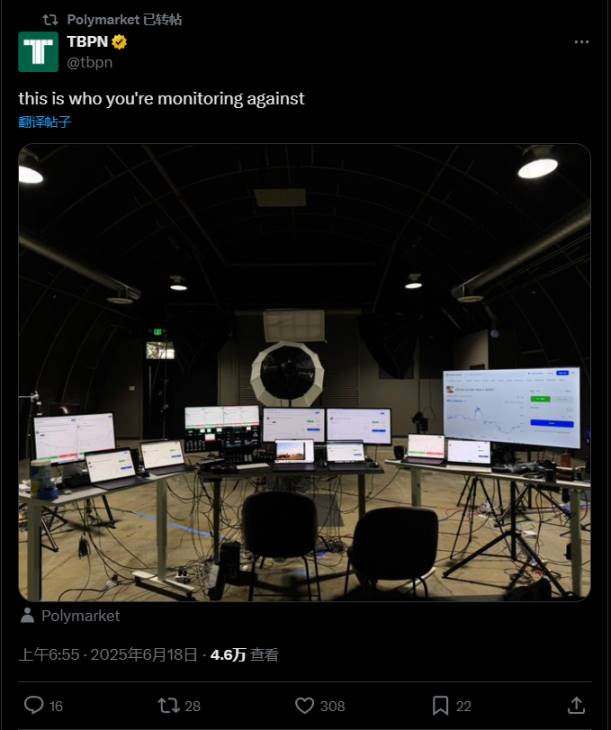
On the morning of June 18, social media widely circulated claims that "a huge surprise is coming—one the world will remember for centuries"—though no details were provided. Meanwhile, International Atomic Energy Agency (IAEA) Director General Rafael Grossi stated on Wednesday that Iran’s stockpile of 409 kilograms (902 pounds) of highly enriched uranium may have already been moved, sparking market speculation about the possibility of Iran retaliating with nuclear weapons. However, on Polymarket, traders showed limited confidence in such an outcome. The probability of Iran using a nuclear weapon in 2025 briefly spiked to 20% on June 18 but quickly dropped back to 13% within the following day.
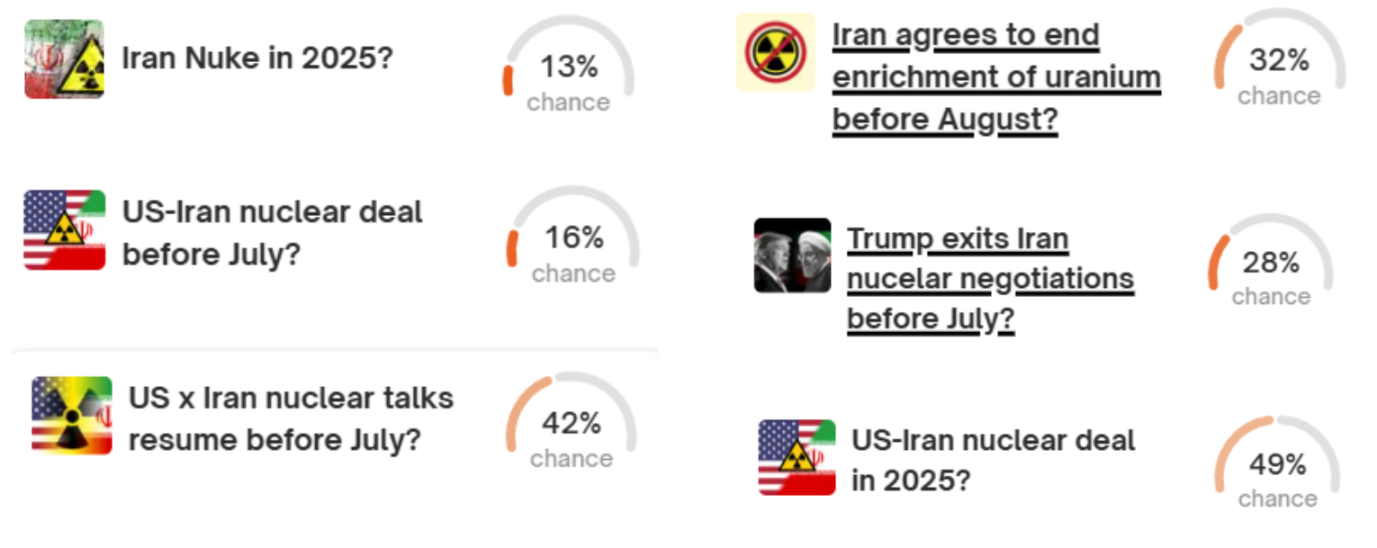
On the diplomatic front, both Israel and the United States have varying plans to strike Iranian nuclear facilities, while European senior diplomats are scheduled to hold nuclear talks with Iran in Geneva, somewhat alleviating fears of escalation. However, U.S. engagement in nuclear negotiations appears lukewarm: the probability of restarting talks before July stands at 42%, the chance of reaching a new Iran nuclear deal before July is only 16%, and the likelihood of striking a deal this year is 49%. Meanwhile, the probability that Trump will withdraw from Iran nuclear talks before July reaches 28%. Against this backdrop of ongoing conflict and hopes for diplomacy, traders estimate a 32% chance that Iran will cease uranium enrichment before August, and a roughly 22–23% chance of a ceasefire between Israel and Iran before July.

As tensions escalate, maritime authorities have advised vessels to avoid Iranian waters when passing through the Strait of Hormuz. On June 19, former Iranian Economy Minister Ehsan Khandouzi stated, “Starting tomorrow, for 100 days, no oil tanker or liquefied natural gas vessel shall pass through the strait without Iran’s approval.” Although not an official declaration, the timing and his high-level status may reflect broader sentiments within Iran’s leadership—or serve as a warning about future actions. Traders currently assign a 21% probability to Iran blocking the Strait of Hormuz before July, and a 37% chance of such a blockade occurring within the year.

On June 16, Trump issued a statement demanding Iran’s “unconditional surrender” and warned of potential strikes against Iranian Supreme Leader Khamenei. On June 17, Iranian state media reported that Khamenei had not made any public appearances for five consecutive days and had begun secretly transferring supreme authority to the Revolutionary Guard’s highest council—not, as previously speculated, to his son Mojtaba. This move suggests that the 86-year-old leader, facing unprecedented military pressure from the U.S. and Israel, is preparing for worst-case scenarios to ensure regime continuity should he be incapacitated. Nevertheless, Trump stated he currently has no plans to eliminate Iran’s top leader. In trader predictions, the probability of Khamenei stepping down this year stands at 61%, with a 23% chance of resignation before July.

Israeli officials estimated that the U.S. might join the war against Iran on the evening of the 17th. However, on June 18, President Trump declined to confirm whether the U.S. planned to participate in Israeli military operations against Iran, noting instead that Tehran had reached out to Washington regarding possible negotiations. On the betting front, traders are heavily buying contracts indicating U.S. military action, pushing the predicted probability of American intervention before July to 67%. Traders even estimate a 42% chance that Iran will be overthrown in 2025. On June 17, French President Macron opposed the violent overthrow of Iran’s regime, warning it could destabilize the entire Middle East.

The Fordo enrichment facility, one of Iran’s key nuclear sites, is under strategic scrutiny from the U.S. and Israel. CNN, citing sources, reported that Trump is increasingly inclined to strike Iran’s nuclear facilities. Bloomberg noted that the U.S. is considering launching an attack on Iran this weekend, with the Fordo site as a primary target. Traders now assign a 61% probability that the U.S. will strike the Fordo facility before July, and a 60% chance that the site will be destroyed by then.

The recent surge in tensions between Iran and Israel has triggered a chain reaction and drawn intense international attention. Prediction markets and unfolding developments suggest that core risks now center on the possibility of direct U.S. military action against Iran’s critical nuclear infrastructure—particularly the Fordo facility—and the rising likelihood of a broader confrontation in the near term. At the same time, signs of preemptive power transition within Iran’s leadership reflect deep concerns over regime survival amid mounting pressure.
While the prospect of direct nuclear weapon use has been assessed by markets as relatively low in the short term, and a full closure of the Strait of Hormuz does not appear imminent, the spiraling conflict and potential threats to vital energy corridors have sharply elevated regional security risks. Overall, the situation is trending toward intensified direct military confrontation between the U.S. and Iran, coupled with growing challenges to Iran’s regime stability. The international community remains on high alert for further escalation.
Join TechFlow official community to stay tuned
Telegram:https://t.me/TechFlowDaily
X (Twitter):https://x.com/TechFlowPost
X (Twitter) EN:https://x.com/BlockFlow_News
 Foresight News