84% of Polymarket traders are losing money, while 0.033% capture most of the profits.
TechFlow Selected TechFlow Selected
84% of Polymarket traders are losing money, while 0.033% capture most of the profits.
Who Are Prediction Markets Really Serving?
 Navigating Web3 tides with focused insights
Author: TechFlow
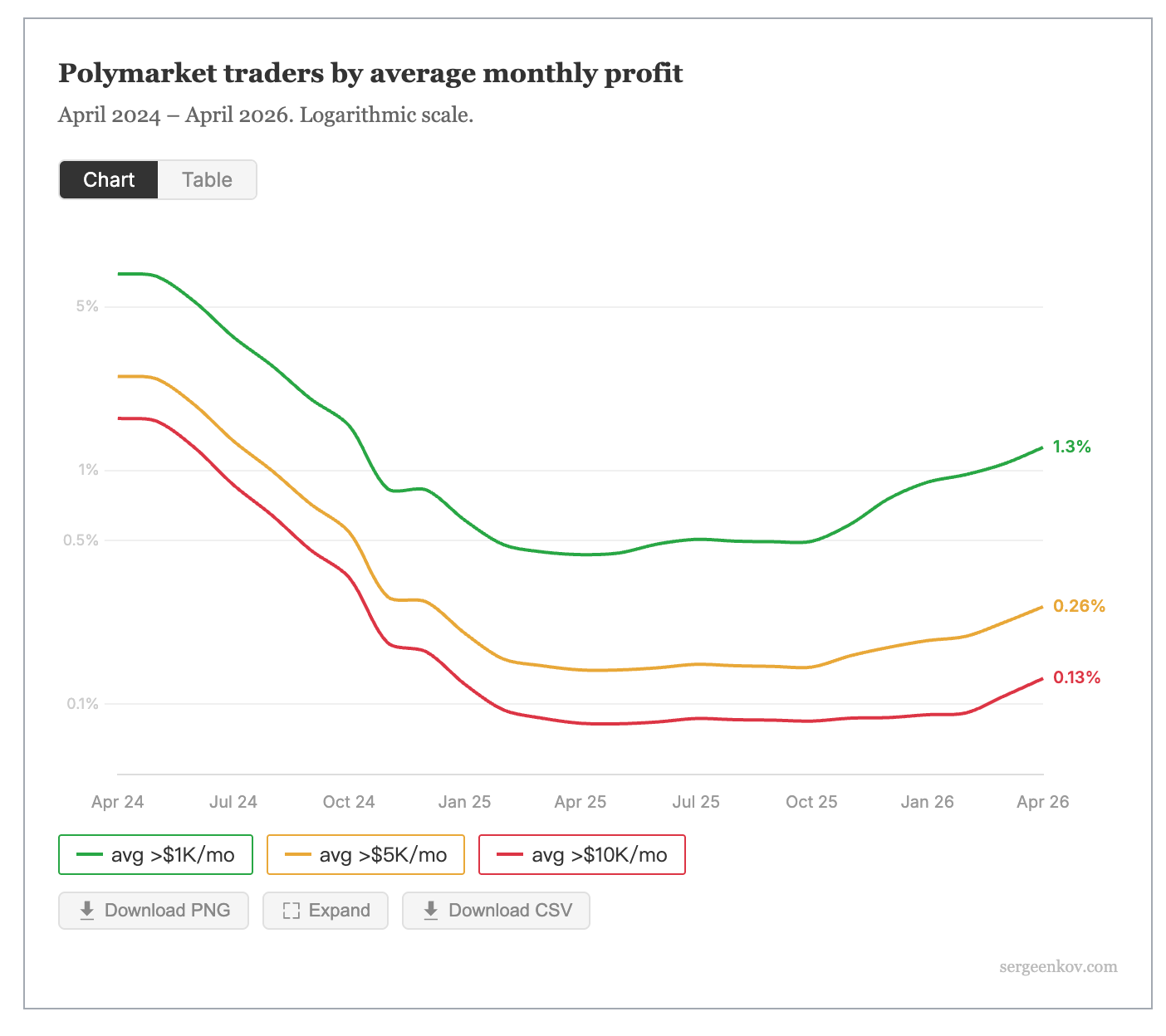
TechFlow Introduction: A recent analysis by on-chain researcher Andrey Sergeenkov of 2.5 million Polymarket wallet addresses reveals that 84.1% of traders are unprofitable; only 2% of addresses have accumulated profits exceeding $1,000; and just 840 addresses (0.033%) have earned over $100,000. The timing of this report is particularly noteworthy—Polymarket has just secured MLB’s exclusive prediction market partnership at a valuation of up to $300 million and is aggressively pursuing retail user growth.
Wealth distribution in on-chain prediction markets is even more brutal than most imagine.
According to a report by The Defiant on April 6, independent on-chain researcher Andrey Sergeenkov published an profitability analysis covering 2.5 million Polymarket wallet addresses, with data current as of April 1, 2026. Key finding: 84.1% of traders lost money, while fewer than 16% achieved any positive return.
This is not the first such study. In December 2025, blockchain analyst DeFi Oasis analyzed 1.7 million addresses and 124 million transactions, concluding that 70% of traders were unprofitable. Sergeenkov’s dataset is larger and his methodology improved—capturing token splits and merges previously missed—causing the loss rate to jump from 70% to 84%.
The Top of the Pyramid: Fewer Than 0.26% Earn Over $5,000 Per Month
Sergeenkov conducted a full-scale analysis of trading data from two smart contracts—CTF Exchange and NegRisk CTF Exchange—by tracking all USDC cash flows on the Polygon chain, including buys, sells, redemptions, splits, and merges.
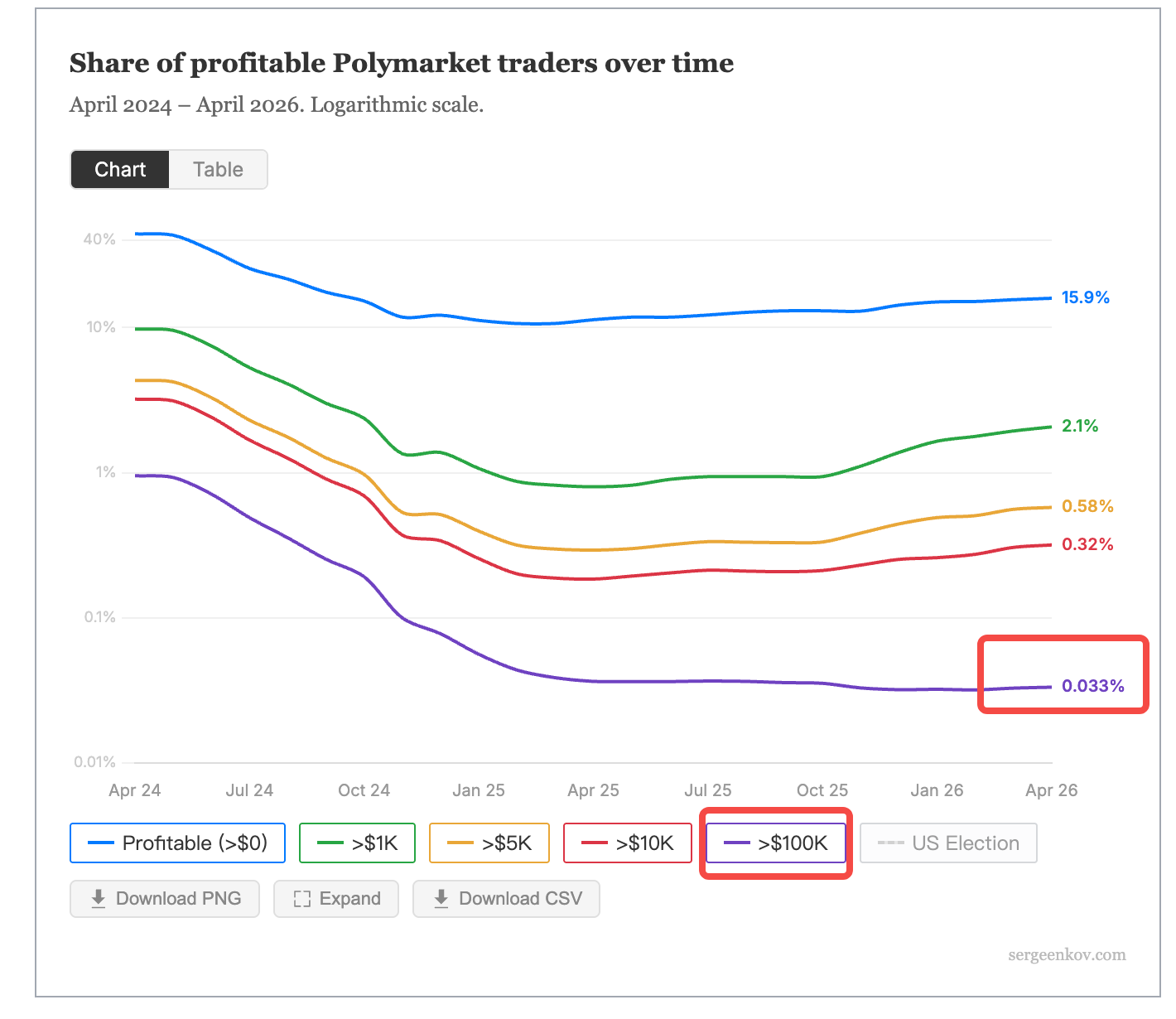
The figures for high-profit tiers are stark: only 1.25% of addresses earned over $1,000 per month on average; just 0.26%—about 6,600 addresses—earned over $5,000; and only 3,250 addresses (0.13% of all traders) earned over $10,000 per month.
Even more critical is the issue of sustainability. Among those 6,600 addresses earning over $5,000 per month, 53% were active for only one month before disappearing; only 2.6% traded continuously for over a year. Sergeenkov summarizes in his report: “Most traders arrive, trade for a while, then leave.”
In contrast, bottom-tier arbitrageurs consistently extract value. An academic paper from Spain’s IMDEA Networks Institute analyzing 86 million on-chain trades between April 2024 and April 2025 found arbitrage traders captured roughly $40 million in profit solely from price spreads. A single wallet earned as much as $2 million across 4,049 trades—averaging $496 per trade.
Retail Traders’ Manual Execution Cannot Compete With Bots; Informational Advantage Is Highly Concentrated
The root cause of losses is straightforward. IMDEA’s research shows the largest profits accrue to wallets employing automated strategies: arbitrage bots, market-making algorithms, and high-frequency trading systems. Retail traders executing manually typically enter positions only after prices have already adjusted.
This is the essential distinction between prediction markets and traditional gambling. Polymarket’s order book is fully public, and on-chain data is transparent—but this transparency actually enables professional traders to build systemic advantages. A quantitative wallet equipped with low-latency APIs and probabilistic models operates on an entirely different playing field from an ordinary user who opens the app and places a bet only after reading the news.
According to Token Terminal data, Polymarket’s nominal trading volume over the past 30 days was approximately $9.8 billion, with around 462,600 monthly active traders. Platform growth itself is not in question—but there is an inverse relationship between user growth and user profitability. Sergeenkov’s data shows that the decline in the proportion of profitable traders directly coincides with peaks in user growth, especially the surge following the U.S. presidential election in November 2024.
An Information-Aggregation Tool—or a Zero-Sum Game?
This report rekindles an old debate: Who, exactly, do prediction markets serve?
Proponents emphasize information aggregation. Polymarket’s official data claims its price forecasts achieve over 94% accuracy one month before outcomes are resolved. In other words, even if 84% of traders lose money, the market as a whole continues generating valuable probabilistic signals. Unprofitable retail traders, in essence, pay for information pricing.
Critics argue that when 84% of participants lose money and profits concentrate heavily among automated traders, the distinction between such a platform and a casino is merely semantic—a regulatory classification exercise. This blurring is especially pronounced in sports markets, where the line between prediction markets and sports betting is being deliberately eroded.
Polymarket’s valuation has surpassed $20 billion. Intercontinental Exchange—the parent company of the NYSE—invested $2 billion in October 2025. Capital markets are clearly betting on the growth narrative of prediction markets.
Yet Sergeenkov’s report poses a simple question: When the next wave of 2.5 million users arrives, how will their fate differ from that of the previous wave?
Join TechFlow official community to stay tuned
Telegram:https://t.me/TechFlowDaily
X (Twitter):https://x.com/TechFlowPost
X (Twitter) EN:https://x.com/BlockFlow_News
 深潮TechFlow