U.S. Soldier Arrested for Insider Trading on Polymarket, Netting $400,000 Betting on Maduro’s Ouster
TechFlow Selected TechFlow Selected
U.S. Soldier Arrested for Insider Trading on Polymarket, Netting $400,000 Betting on Maduro’s Ouster
This is the first case in which the U.S. Department of Justice has filed charges for insider trading in prediction markets.
 Navigating Web3 tides with focused insights
Author: Claude, TechFlow
TechFlow Digest: On Thursday, the U.S. Department of Justice arrested U.S. Army Special Forces Staff Sergeant Gannon Ken Van Dyke, charging him with using classified information obtained during a military operation targeting Venezuelan President Nicolás Maduro to place bets on Polymarket—investing $33,000 in principal and netting over $409,000 in profit. This marks the DOJ’s first prosecution of insider trading in prediction markets—and the first time the Commodity Futures Trading Commission (CFTC) has invoked the “Eddie Murphy Rule” to charge misuse of nonpublic government information.

A U.S. special operations soldier involved in the mission to capture Maduro profited $400,000 by betting on prediction markets using classified intelligence—and is now himself a defendant.
According to a Department of Justice announcement dated April 23, Army Special Forces Staff Sergeant Gannon Ken Van Dyke (38, stationed at Fort Bragg, North Carolina) was arrested and federally charged for allegedly trading on Polymarket using classified information. The indictment states that Van Dyke participated in the planning and execution of “Operation Absolute Resolve,” the January 3, 2026, pre-dawn raid in Caracas that resulted in the arrest of Venezuelan President Maduro and his wife.
The indictment further alleges that Van Dyke created a Polymarket account on December 26, 2025, and placed 13 bets between December 27, 2025, and January 2, 2026—totaling approximately $33,034 in principal—all on the “Yes” side of four contracts: “Will Maduro be removed from office before January 31?”; “Will the U.S. invade Venezuela?”; “Will U.S. troops enter Venezuela?”; and “Will Trump invoke the War Powers Resolution against Venezuela?”
His total net profit amounted to approximately $409,881. His largest single bet—a $32,537 wager on “Will Maduro be removed from office before January 31?”—yielded a 1,242% return, generating $404,222 in profit.
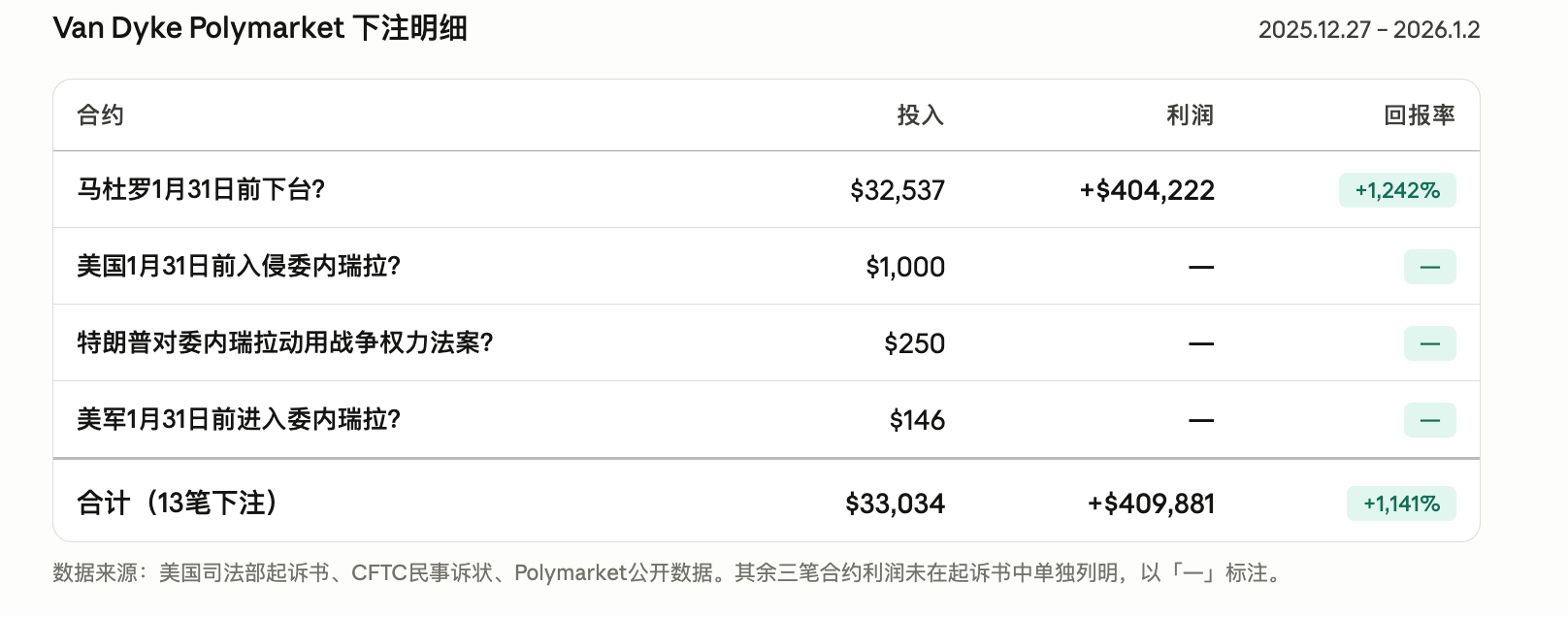
First-of-its-kind case: DOJ and CFTC act in tandem
This is the first criminal prosecution by the U.S. Department of Justice for insider trading in prediction markets—and the first time the Commodity Futures Trading Commission (CFTC) has brought charges for insider trading involving event-based contracts.
Simultaneously, the CFTC filed a civil complaint in the U.S. District Court for the Southern District of New York, seeking disgorgement of profits, civil penalties, and a permanent ban on Van Dyke’s participation in futures trading. In a public statement, CFTC Chairman Michael S. Selig said the defendant’s conduct endangered U.S. national security and placed the lives of service members at risk.
Van Dyke faces five federal charges: three counts of violating the Commodity Exchange Act (each carrying up to 10 years’ imprisonment), one count of wire fraud (up to 20 years), and one count of unlawful monetary transactions (up to 10 years).
The legal basis for this case is especially noteworthy. According to Axios, the CFTC invoked the so-called “Eddie Murphy Rule”—a provision codified in Section 746 of the 2010 Dodd-Frank Act, named after the film Trading Places, which explicitly prohibits trading commodities using stolen or misappropriated nonpublic government information.
Evidence destruction fails; Polymarket proactively cooperates with investigators
The indictment also details Van Dyke’s attempts to conceal his activity after placing the bets and collecting profits.
On the day of the operation—January 3—Van Dyke withdrew most of his Polymarket earnings and transferred them into an offshore cryptocurrency vault, then deposited the funds into a newly opened online brokerage account. On January 6, after media outlets and social platforms began reporting on anomalous trading in Polymarket contracts tied to Maduro, Van Dyke requested Polymarket delete his account, falsely claiming he had lost access to his registered email address. That same day, he changed the registered email for his cryptocurrency exchange account to an address not under his name—a mailbox that had been registered as early as December 14, 2025.
According to the indictment, several hours after the operation concluded, a photo of Van Dyke was uploaded to his Google account. It shows him wearing U.S. military combat gear and holding a rifle alongside three other soldiers on the deck of a naval vessel, with a sunrise over the ocean in the background.
Polymarket issued a statement on X stating that, upon discovering a user had traded using classified government information, it voluntarily referred the matter to the Department of Justice and fully cooperated with the investigation. Neal Kumar, Polymarket’s Chief Legal Officer, emphasized that the platform is not anonymous—and users like Van Dyke can indeed be identified.
Insider trading risks in prediction markets extend far beyond the Maduro case
The Van Dyke case is not isolated. Systemic scrutiny surrounding insider trading on Polymarket is mounting.
In February, Israeli authorities arrested and charged a reservist soldier and a civilian, accusing them of profiting on Polymarket using classified information about Israel’s military operation against Iran.
In March, an account named “Magamyman” began placing bets approximately 71 minutes before a U.S.-Israeli joint air strike on Iran—and ultimately earned roughly $553,000.
And just yesterday, someone used a hair dryer to heat a temperature sensor near France’s Charles de Gaulle Airport, thereby manipulating weather station readings for Paris—and profited from corresponding bets on weather forecasts in prediction markets.
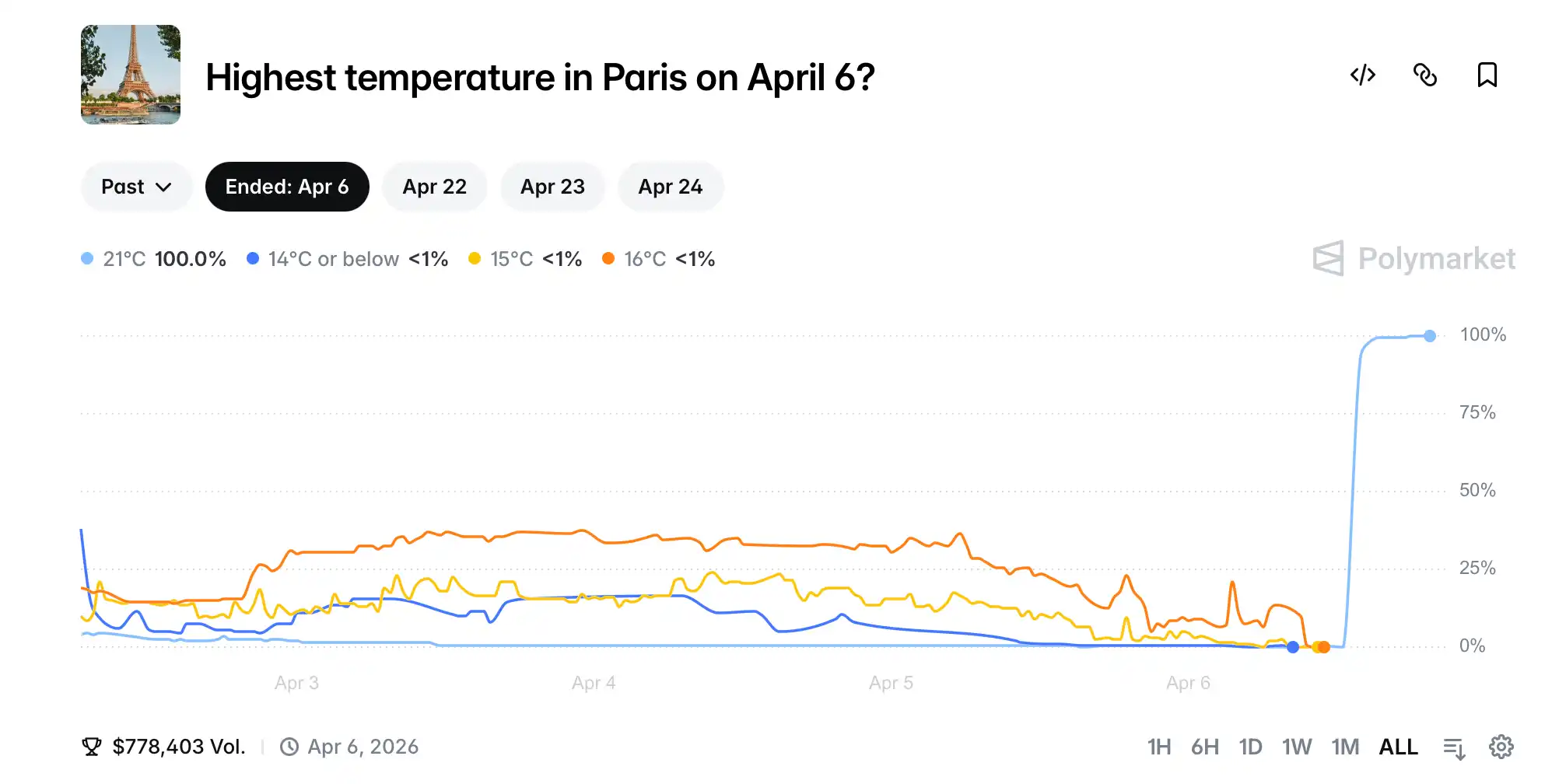
When asked about the case by reporters at the White House on Thursday, President Trump compared it to Pete Rose betting on his own team. He added that “unfortunately, the whole world has become some kind of casino,” and expressed dissatisfaction with such wagers on prediction markets.
The regulatory challenge facing prediction markets lies in Polymarket’s operational structure: its international site runs on the Polygon blockchain, outside the reach of U.S. regulators, and users can access it via VPN. Although the CFTC approved Polymarket’s operation within the United States last year, its U.S.-based platform has yet to launch fully.
The Trump family also maintains commercial ties to Polymarket. President Trump’s son, Donald Trump Jr., serves as a Polymarket advisor, and his venture capital firm, 1789 Capital, has invested several million dollars in the platform.
Join TechFlow official community to stay tuned
Telegram:https://t.me/TechFlowDaily
X (Twitter):https://x.com/TechFlowPost
X (Twitter) EN:https://x.com/BlockFlow_News
 深潮TechFlow