Uniswap Fee Switch Implemented: Is This DeFi Revolution Delivering Results?
TechFlow Selected TechFlow Selected
Uniswap Fee Switch Implemented: Is This DeFi Revolution Delivering Results?
DeFi is gradually transitioning toward a "fee-pegged" token model.
 Navigating Web3 tides with focused insights
Author: Tanay Ved
Translation: Saoirse, Foresight News
Key Takeaways
- Uniswap’s fee switch links the UNI token supply to protocol usage through a token burn mechanism. Currently, fees generated by the protocol are used to reduce the UNI supply, transforming UNI from a governance-only token into an asset capable of direct value accrual.
- Early data indicates the protocol generates approximately $26 million in annualized fees, with a revenue multiple of around 207x; roughly 4 million UNI tokens will be burned annually, a move that has already priced high growth expectations into UNI’s $5.4 billion valuation.
- DeFi is gradually shifting toward “fee-pegged” token models. Mechanisms such as token burning, staker revenue distribution, and “vote-escrowed (ve)” locking aim to better align token holders with the protocol economy, reshaping valuation frameworks across the sector.
Introduction
At the end of 2025, Uniswap’s governance body passed the “UNIfication” proposal, officially activating the long-awaited protocol “fee switch.” This marks one of the most significant tokenomic transformations among blue-chip DeFi projects since 2020—a period when market focus has increasingly shifted toward “real yield” and “sustainable, fee-driven value accrual.” The fee switch now establishes a more direct link between the UNI token and Uniswap’s revenues and trading activity, positioning Uniswap as one of the largest decentralized exchanges (DEXs) in the cryptocurrency ecosystem.
In this article, we will analyze Uniswap’s tokenomics following the activation of the fee switch, assess the dynamics of UNI burns, fee mechanisms, and their impact on valuation, and explore the broader implications of this shift for the entire DeFi landscape.
The Disconnect Between DeFi Tokens and Protocol Value
One core challenge in DeFi is the growing disconnect between “strong protocols” and “weak tokens.” Many DeFi protocols have achieved clear product-market fit, high usage, and stable revenue streams, yet their native tokens often serve only governance purposes, offering token holders little to no direct access to protocol cash flows. As a result, capital increasingly flows into Bitcoin, base-layer blockchains (L1s), and meme coins, while most DeFi tokens trade at valuations severely disconnected from the actual economic growth of their underlying protocols.
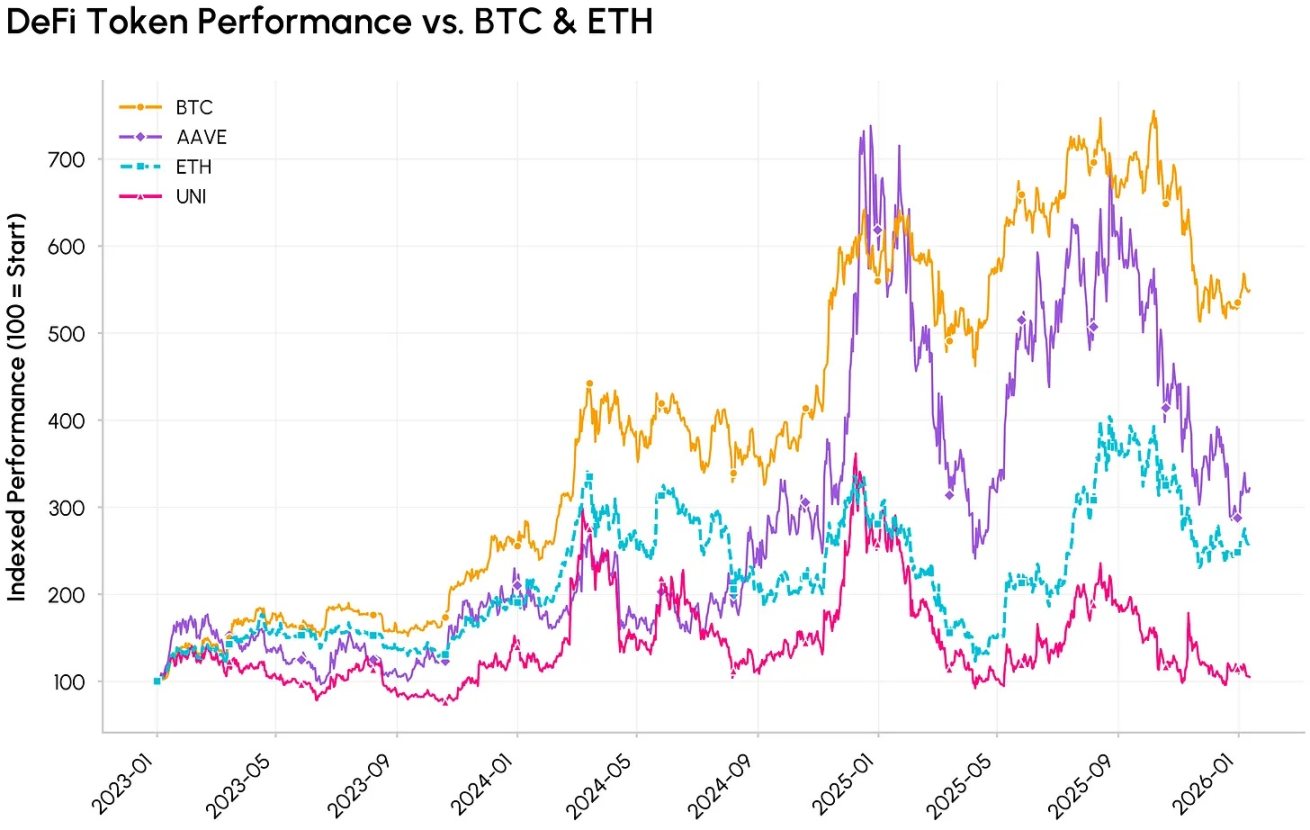
Indexed performance comparison of DeFi tokens (AAVE, UNI) versus major cryptocurrencies (BTC, ETH)
Uniswap launched in November 2018 as a decentralized exchange (DEX) on Ethereum, designed to enable order-book-free, intermediary-free swaps of ERC-20 tokens. In 2020, Uniswap issued the UNI token as a governance instrument—a model shared by other blue-chip DeFi protocols like Aave, Compound, and Curve, whose primary goals were governance voting and user incentives.
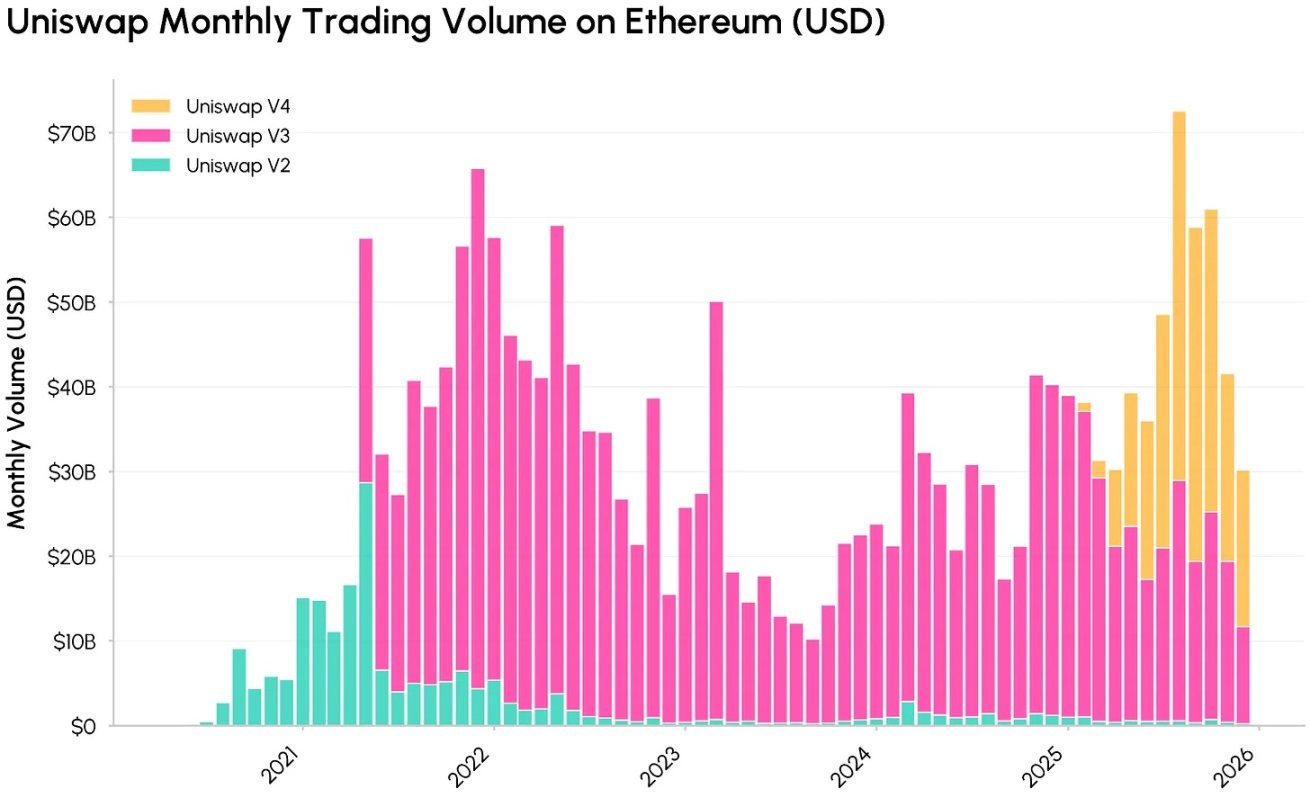
Monthly trading volume trends (in USD) for Uniswap versions V2, V3, and V4 on Ethereum. Source: Coin Metrics Network Data Pro
Through iterative upgrades, Uniswap has become a core component of on-chain financial infrastructure, processing billions of dollars in trading volume and generating substantial fee income for liquidity providers (LPs). However, like most DeFi governance tokens, UNI holders previously had no direct claim on protocol revenues—leading to an increasing misalignment between the scale of the protocol’s cash flows and the economic interests of token holders.
In practice, the value created by Uniswap primarily flowed to liquidity providers (LPs), borrowers, lenders, and development teams, while token holders received only governance rights and inflationary rewards. This tension between “governance-only” tokens and the demand for value accrual laid the foundation for the introduction of Uniswap’s fee switch and the “UNIfication” proposal—an initiative explicitly tying the value of the UNI token to protocol usage and better aligning token holders with the DEX’s economic model.
Uniswap Fee Switch: Fees and Burn Mechanics
With the passage of the “UNIfication” governance proposal, Uniswap introduced the following key changes:
- Activation of protocol fees and UNI burn mechanism: The protocol’s “fee switch” is turned on, directing protocol-level fee revenue from Uniswap V2 and V3 on Ethereum mainnet into a UNI token burn process. By programmatically linking “protocol usage” to “token supply,” UNI’s economic model shifts from “governance-only” to “deflationary value accrual.”
- Retrospective treasury token burn: A one-time burn of 100 million UNI tokens from the Uniswap treasury compensates token holders for years of missed fee accrual.
- Inclusion of Unichain revenue: Sequencer fees generated by the Unichain network—after deducting Ethereum Layer 1 data costs and Optimism’s 15% share—are fully funneled into the aforementioned “burn-driven” value capture mechanism.
- Restructuring organizational incentives: Most functions of the Uniswap Foundation are consolidated into Uniswap Labs, which receives an annual growth budget of 20 million UNI tokens to focus on protocol adoption; simultaneously, its fee share from interfaces, wallets, and API services is reduced to zero.
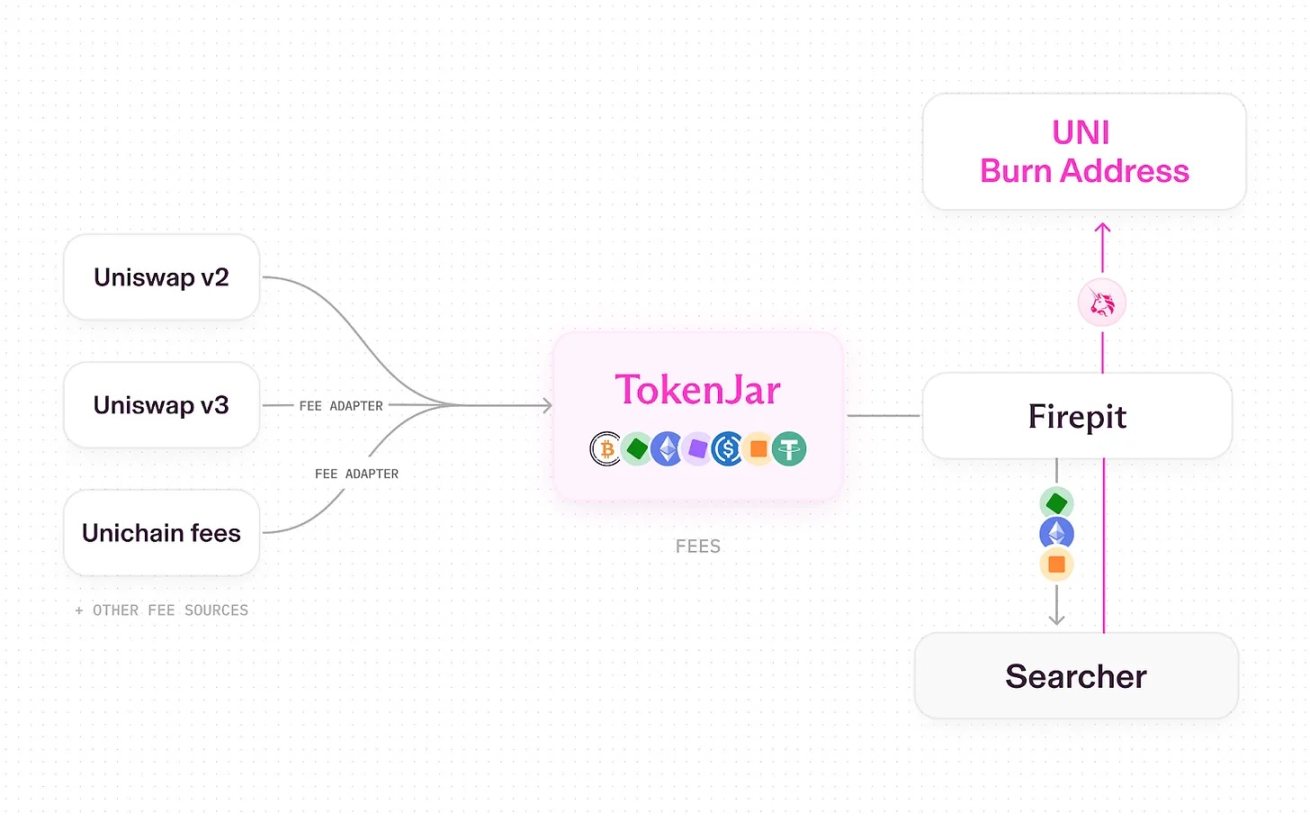
Full flow of how protocol fees are converted into UNI token burns post-fee switch activation. Source: Uniswap UNIfication
Currently, Uniswap operates in a “pipeline” fashion, using dedicated smart contracts to manage the release and conversion of assets (e.g., UNI token burns). The process works as follows:
- Trading on Uniswap V2, V3, and Unichain generates transaction fees;
- A portion of these fees goes to the protocol (the remainder is allocated to liquidity providers);
- All protocol-level fees flow into a single treasury smart contract called “TokenJar” on each chain;
- The value held in TokenJar can only be released when UNI tokens are burned via the “Firepit” smart contract.
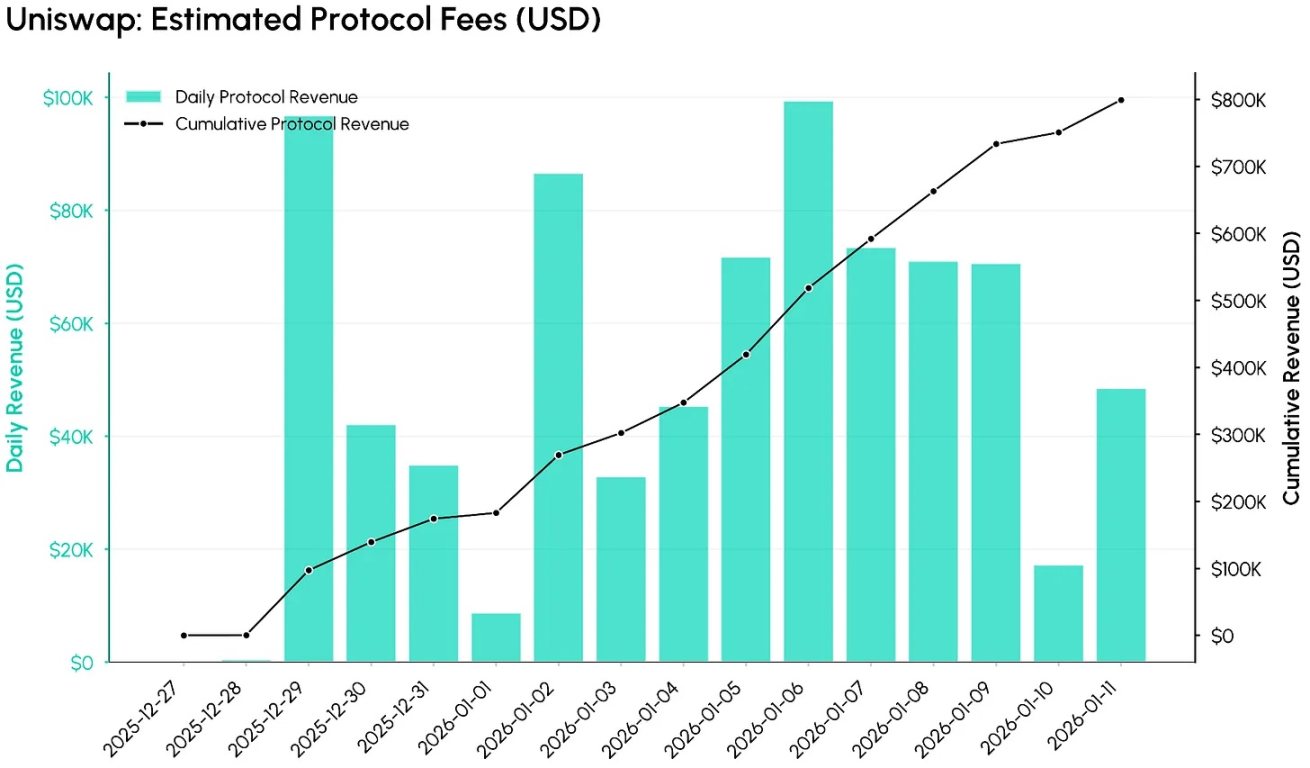
Protocol fee data after the Uniswap fee switch activation (from December 27, 2025). Source: Coin Metrics ATLAS
According to Coin Metrics ATLAS data, a significant amount of protocol fees entered the system within the first 12 days after the fee switch was activated. The chart above tracks daily estimated protocol fees (in USD) and cumulative totals, showing that under initial configurations, the fee switch rapidly monetized Uniswap’s trading volume—accumulating approximately $800,000 in protocol fees within just 12 days.
If current market conditions remain stable, the protocol’s annualized revenue is expected to reach approximately $26–27 million (for reference only), though actual revenue will depend on market activity and the pace of fee mechanism rollouts across pools and chains.
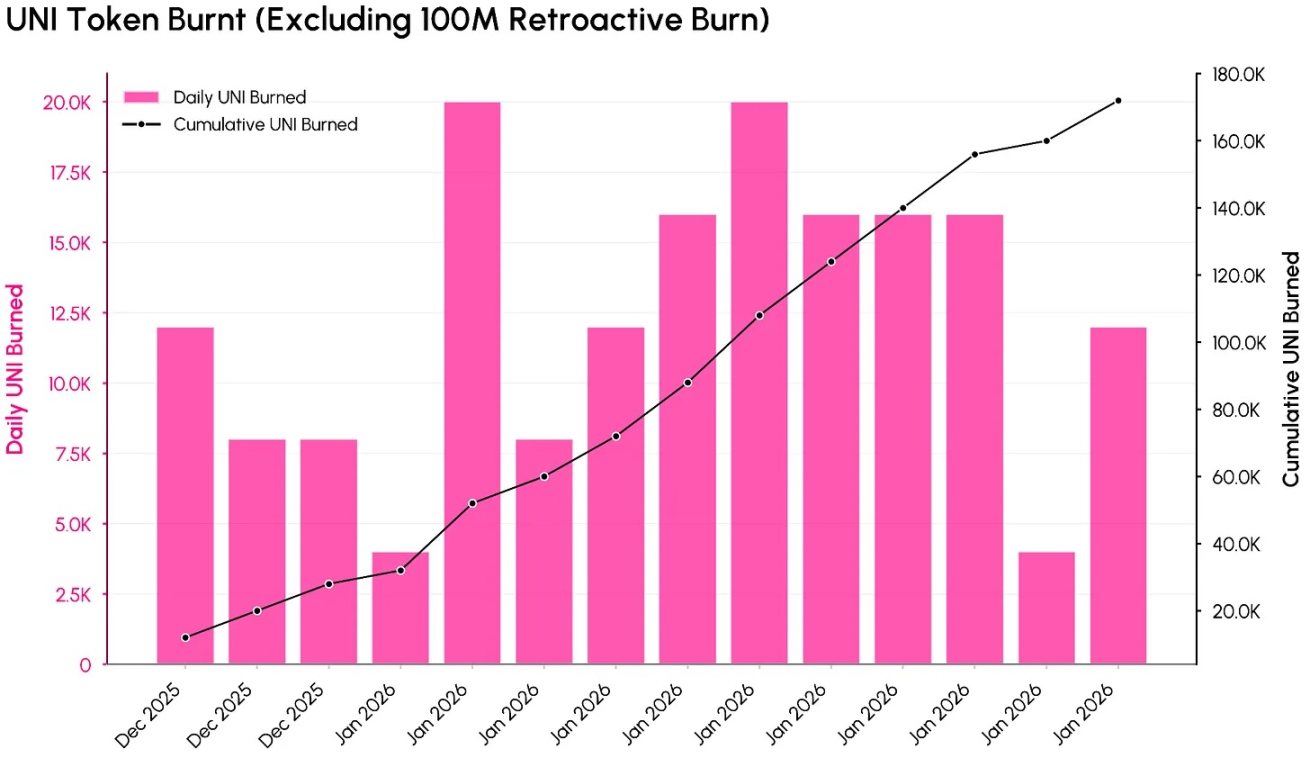
UNI token burn data post-fee switch activation (excluding the 100 million retroactive burn). Source: Coin Metrics ATLAS
The chart above illustrates how protocol fees translate into reductions in UNI token supply (excluding the 100 million retroactive burn). At the time of reporting, total UNI burned reached approximately 100.17 million tokens (worth about $557 million), representing 10.1% of the initial 1 billion total supply.
Based on burn data from the first 12 days after the “UNIfication” proposal took effect, the annualized UNI burn rate is estimated at 4–5 million tokens. This highlights that protocol usage now drives “cyclical, programmatic” UNI burns, replacing purely inflationary token issuance.
Valuation and Broader DeFi Implications
With the fee switch active, UNI’s valuation can now extend beyond governance utility and be assessed through a “cash flow lens.” With a current market cap of $5.4 billion and early TokenJar data indicating approximately $26 million in annualized protocol fees, the revenue multiple stands at about 207x—more aligned with high-growth tech assets than mature decentralized exchanges (DEXs). Excluding treasury burns, the annualized UNI burn is approximately 4.4 million tokens, or just 0.4% of the current supply, indicating a relatively low “burn rate” relative to its valuation.
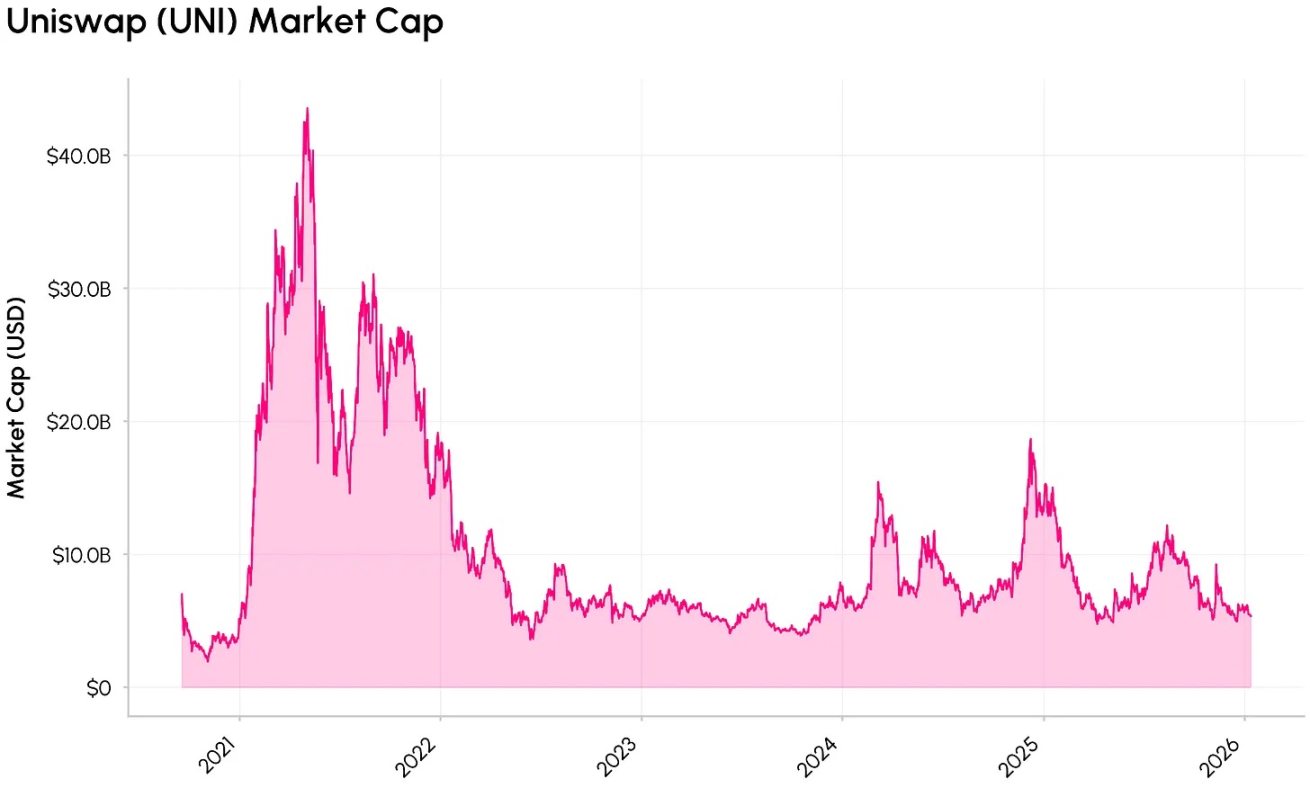
Market capitalization trend for Uniswap’s UNI token. Source: Coin Metrics Network Data Pro
This situation reveals a new trade-off: while clearer value capture enhances UNI’s investment appeal, current metrics suggest the market is pricing in extremely high future growth expectations. To lower this revenue multiple, Uniswap must pursue multiple strategies: expanding fee capture (e.g., covering more pools, launching V4 “hook” features, implementing fee discount auctions, optimizing Unichain), sustaining trading volume growth, and offsetting the annual 20 million UNI growth budget and other token emissions through deflationary mechanisms.
From an industry structure perspective, the “UNIfication” proposal pushes DeFi toward a model where governance tokens must be explicitly tied to protocol economics. Whether it’s Uniswap’s token burn, Ethena’s “direct fee distribution to stakers,” DEXs like Aerodrome adopting “vote-escrowed locking + fee/bribe sharing,” or hybrid models like Hyperliquid’s perpetuals framework, these are all variations of “protocol fee sharing,” aimed at strengthening the alignment between tokens and protocol economics. As the world’s largest decentralized exchange (DEX) adopts a “fee-pegged + burn-driven” design, future market evaluations of DeFi tokens will shift beyond “total value locked (TVL)” or “narrative momentum” toward assessing “how efficiently protocol usage translates into durable value for holders.”
Conclusion
The activation of Uniswap’s fee switch marks a pivotal turning point: the UNI token has evolved from a “pure governance asset” into one explicitly linked to protocol fees and usage. This transformation makes UNI’s fundamentals more analyzable and investable, but also subjects its valuation to greater scrutiny—the current price already reflects strong expectations for future fee capture and growth potential.
Looking ahead, two key variables will shape UNI’s long-term trajectory: first, the extent to which Uniswap can increase protocol-level fees without undermining LP economics or trading volume; and second, how regulators respond to “fee-pegged tokens” and “buyback-and-burn” token models. These two factors will jointly define UNI’s long-term risk-return profile and provide critical insights for other DeFi protocols seeking to share value with token holders.
Join TechFlow official community to stay tuned
Telegram:https://t.me/TechFlowDaily
X (Twitter):https://x.com/TechFlowPost
X (Twitter) EN:https://x.com/BlockFlow_News
 @coinmetrics