
Bernstein report: Upgrades Pinduoduo rating to "Outperform", target price $110.00
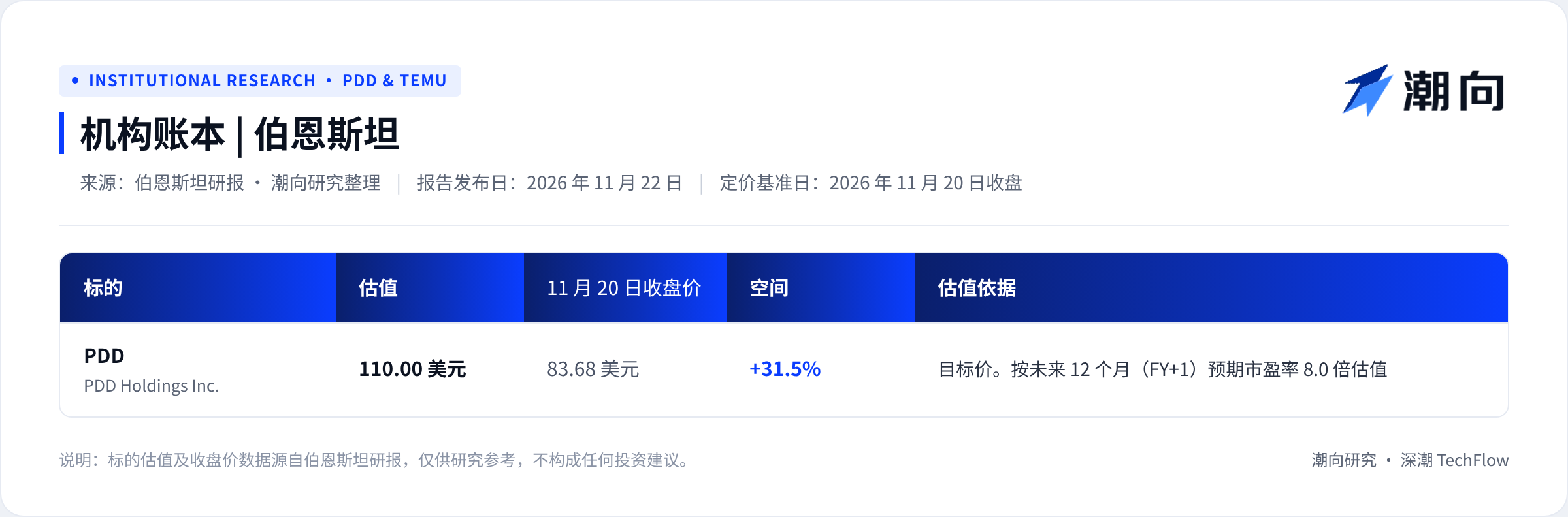
On November 22, 2026, foreign investment bank Bernstein released its latest research report. Analyst Robin Zhu's team officially upgraded PDD Holdings’ (PDD.US) rating from “Market Perform” to “Outperform.”
Bernstein simultaneously maintained its $110.00 price target for PDD. Based on the closing price of $83.68 on November 20, 2026, this target implies a 31% potential upside.
Over the past year, PDD’s stock performance has been weak. As of November 20, 2026, PDD had declined 25.9% over the trailing 12 months, underperforming the S&P 500 index by 31.6 percentage points. This rating upgrade marks a reconfirmation by major foreign banks of a fundamental inflection point for PDD.
Stock Price Stagnant for Four Years as Hundreds of Billions in Overseas Growth Remain Unpriced
Since late 2022, PDD’s stock price has almost returned to its starting point after experiencing significant volatility. At the end of 2022, its cross-border e-commerce platform, Temu, was still in its infancy.
However, over four years, Temu has grown into a massive business with an annual Gross Merchandise Volume (GMV) nearing the $100 billion mark. Bernstein calculates that Temu’s GMV is expected to reach $92 billion in 2026.
Meanwhile, PDD’s stock has long been constrained by a lack of communication and geopolitical regulatory concerns. Approximately one year ago (November 19, 2025), Bernstein downgraded the stock citing slowing growth and management’s refusal to engage with investors.
In its November 22, 2026 report, Bernstein stated bluntly that market pessimism regarding PDD is already fully reflected in the valuation. Currently, PDD’s stock trades at an implied forward P/E ratio of just 6.9x for 2027 (6.8x on an adjusted basis), the lowest among the Chinese internet names covered by the firm.
Consumption Pressure Cycle Continues as Main Platform’s Value Proposition Outperforms the Market
Bernstein believes the macro consumption environment in China will likely resemble 2026 in 2027. Under the firm’s model assumptions, China’s total retail sales of consumer goods will grow by only 1% in 2027, while the overall e-commerce industry growth will range from 3% to 5%.
Against the backdrop of tight consumer budgets, the main PDD platform’s focus on high cost-performance offers significant defensive attributes. Compared to peers engaging in fierce battles in existing markets, PDD’s deep cultivation of lower-tier markets and county-level rural infrastructure results in relatively lower direct competitive intensity.
Base effects will also help PDD display more favorable year-over-year data in the coming quarters. After a low-growth cycle from H2 2025 to 2026, YoY revenue growth for the main platform’s Online Marketing Services (OMS) showed signs of recovery in Q3 2026.
Bernstein forecasts that domestic GMV on PDD’s main platform will grow 8.6% YoY in 2027, significantly outpacing the broader e-commerce market. As the main platform’s monetization rate (Take Rate) stabilizes, OMS revenue will maintain high single-digit growth.
Additionally, PDD management has adopted a more positive tone during earnings calls. After several quarters of “strategic silence,” management has resumed substantive communication with the market regarding operational details, effectively alleviating institutional investors’ information anxiety.
European and American Regulatory Headwinds Price Out as Temu Steps Up to New Hundred-Billion-Dollar Milestone
Regarding overseas operations, European and U.S. tariff and parcel regulations that have plagued Temu over the past two years are gradually becoming clearer. Bernstein notes that with U.S. import regulations stabilizing and European parcel/customs fee policies taking effect, the marginal impact of the global regulatory environment on Temu has greatly weakened.
Looking back at mid-2025, severe fluctuations in U.S. tariff policy forced Temu to temporarily halt local marketing spend, causing a phased dip in U.S. user engagement. However, after Temu resumed spending, the U.S. market quickly stabilized and has since become a highly mature “core” market for Temu.
The European market experienced similar pain mid-2026. Impacted by new parcel and customs fees, Sensor Tower data shows that Temu’s European Daily Active Users (DAU) were cut in half from their peak since mid-2026, falling from over 30 million to approximately 16.5 million.
However, high-frequency data monitored by Bernstein indicates that Temu’s European DAU and session duration have shown stabilization signals. The firm expects that European customs clearance and tax costs will ultimately pass through to end consumers over time, avoiding drastic volatility like that seen in the U.S. market in 2025.
In emerging markets such as Latin America and the Middle East, Temu maintains robust expansion momentum. The Latin American market currently contributes about 15% of Temu’s global GMV, while in the Middle East, Temu’s user base has reached parity with local giants Amazon and noon.
Across regions, Bernstein forecasts Temu’s global GMV will grow 16.3% from $92 billion in 2026 to $107 billion in 2027, and further increase to $120 billion in 2028.
Customer Acquisition Shifts to Retention-Driven as Marketing Spend Contraction Unleashes Profit Flexibility
As Temu reaches critical mass user scale in major global end markets, its growth logic is shifting from “aggressive customer acquisition” to “monetizing existing retained users.”
Sensor Tower data shows that after peaking in 2025, Temu’s global new app downloads have gradually declined, but the platform’s 90-day rolling Monthly Active User (MAU) retention rate has consistently remained above 80%. A highly sticky user base has enabled the platform to significantly reduce external user acquisition budgets.
Data monitored by Pathmatics indicates that Temu’s global digital advertising spend, after peaking at over $140 million monthly in 2024, has continued to trend downward. Average monthly ad spend in Q3 2026 has fallen back to the $50–60 million range.
Driven by both contraction in overseas user acquisition and adjustments to domestic accounting standards, PDD Group’s overall selling and marketing expense ratio dropped to approximately 23.4% in Q3 2026 (estimated based on chart trends), marking a new low since 2024.
Regarding logistics costs, international air freight prices remained elevated in 2026, with total air freight rates per kilogram on Shanghai-to-Los Angeles and New York routes maintaining the $6–8 range. Bernstein believes that 2026’s high oil and freight costs set a higher baseline for logistics expenses, and cost pressures are expected to ease marginally in 2027.
On Temu’s profitability, Bernstein argues that achieving a 1% to 2% operating margin on GMV entirely depends on management’s trade-off between “profit extraction” and “growth investment.” The company will continue to invest in self-operated businesses (such as “new brand” related supply) and domestic and overseas logistics infrastructure.
Robust Dual Growth in Revenue and Profit, 2027 Revenue Forecast Raised to RMB 479.3 Billion
Driven by the dual forces of main platform stability and Temu expansion, Bernstein has updated PDD’s three-year financial forecast model.
On group revenue, Bernstein projects PDD’s total revenue to be RMB 449.029 billion in 2026, up 4.0% YoY. Total revenue is expected to reach RMB 479.292 billion in 2027, up 6.7%; and increase to RMB 510.845 billion in 2028, up 6.6%.
On profitability, Bernstein anticipates the group’s Non-GAAP operating profit to be RMB 110.933 billion in 2026, up 8.2% YoY, corresponding to a profit margin of 24.7%. Non-GAAP operating profit for 2027 is expected to grow 6.7% to RMB 118.314 billion, with the margin holding steady at 24.7%.
By 2028, as scale effects further materialize, Non-GAAP operating profit is projected to surge 18.6% to RMB 140.304 billion, lifting the margin to 27.5%.
Regarding net profit attributable to shareholders, Non-GAAP net profit is estimated at RMB 102.752 billion in 2026, rebounding to RMB 123.460 billion in 2027, and reaching RMB 143.612 billion in 2028. This corresponds to Non-GAAP earnings per ADS (EPADS) of RMB 69.52, RMB 81.80, and RMB 92.70 for 2026 through 2028, respectively.
Over RMB 500 Billion in Cash on Books Makes Shareholder Returns a Potential Revaluation Option
PDD’s balance sheet continues to maintain a very high margin of safety. As of the end of 2025, the company’s book cash and cash equivalents reached RMB 422.308 billion, with no long-term or short-term interest-bearing debt.
Bernstein’s model estimates that PDD’s cash and cash equivalents will rise to RMB 504.334 billion by the end of 2026, and further climb to RMB 634.639 billion by the end of 2027, while maintaining zero interest-bearing debt.
On the highly watched issue of substantial cash dividends or share buybacks, Bernstein remains restrained in its base-case scenario. The firm believes that at this stage, discussions on shareholder returns are likely still theoretical, and the company will not easily alter its capital allocation habit of refraining from dividends or buybacks in the short term.
However, Bernstein simultaneously emphasizes that precisely because the current 6.9x 2027 forward P/E completely excludes shareholder return expectations, any future positive loosening by management regarding dividends or buybacks would trigger a sharp valuation re-rating for PDD stock.
In the current environment where global tech stocks are affected by AI semiconductor cycle fluctuations and the Chinese internet sector faces multiple headwinds, PDD combines low valuation with robust cash flows, offering investors a rare defensive growth allocation choice.
Institutional Ledger
Standard Disclaimer Regarding Research Report Content (Brokerage Viewpoints, Not TechFlow Research Perspectives)
This article is a compilation and interpretation by TechFlow Research of third-party brokerage research reports. All ratings, price targets, earnings forecasts, and related judgments cited herein represent the views of the respective brokerage analysts, reflect only the stance of their affiliated institutions, do not represent the viewpoints of TechFlow Research, and do not constitute any investment advice.
Markets involve risk, and decisions require independence. This article should not be used as grounds for buying or selling any securities.
Join TechFlow official community to stay tuned
Telegram:https://t.me/TechFlowDaily
X (Twitter):https://x.com/TechFlowPost
X (Twitter) EN:https://x.com/BlockFlow_News
 @chaoxiangooo