As the hundreds-of-billion IPO concludes, how will Bitget and its RWA protocol Reality take on tokenized US stocks?
Author: Ma He, Foresight News
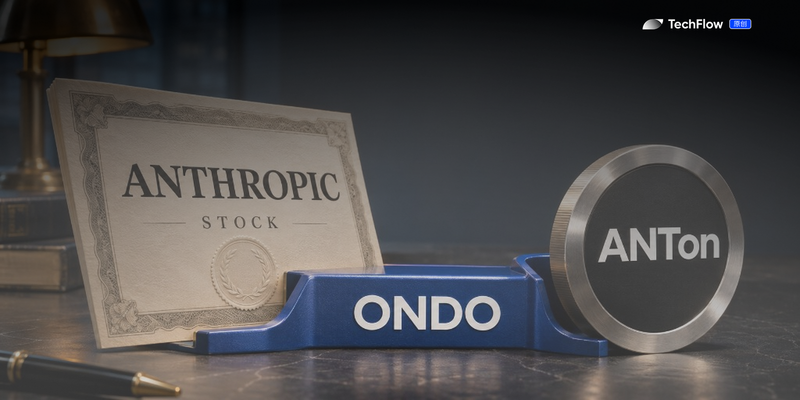
On the evening of November 18, Anthropic completed its IPO pricing at $83 per share, significantly above the previous guidance range of $70 to $78. The following day, the company officially listed on Nasdaq under the ticker symbol ANT. Based on the base offering size, this round raised approximately $81.3 billion, surpassing the $75 billion record set by SpaceX in June this year. On November 20, its underwriters fully exercised the over-allotment option, and combined with the simultaneous private placement, the overall fundraising total approached $120 billion.
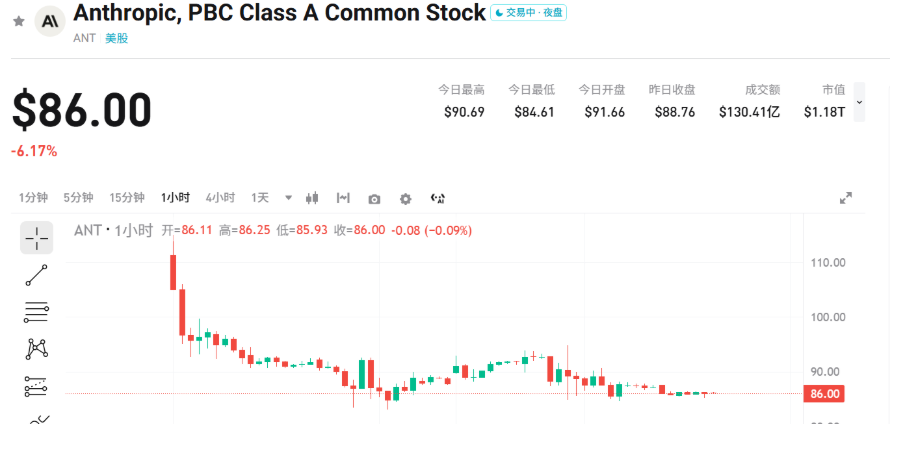
Secondary market debut showed extreme volatility: On the day of listing, ANT's intraday high briefly reached $115.1 before pulling back to close at $97.17, ending the first day up 17.1%. The next day, dragged down by a broader pullback in the AI sector, ANT fell 8.5%, hitting an intraday low of $83.05, closely approaching the offering price, but ultimately closed above the issue price. As of pre-market trading on November 24, the stock price showed signs of stabilization.
Several exchanges and token issuers simultaneously launched related subscription products ahead of the ANT listing, with some channels filling up within hours. After the listing, the on-chain issuance of ANT almost synchronized with the Nasdaq opening. It is evident that crypto capital has an urgent demand for asset allocation in the scarce primary market shares of top AI targets.
$217 Million Subscription, 10.06% Allocation Rate for VIP Round
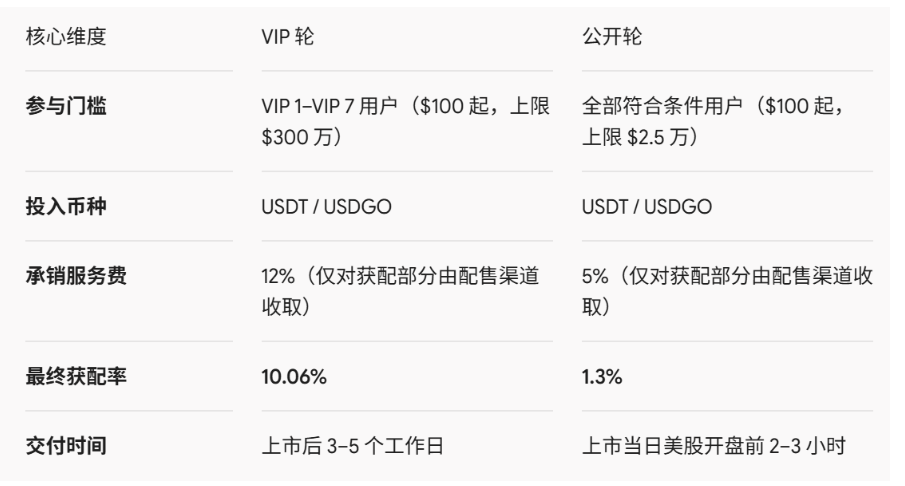
In this offering, the two rounds of subscriptions opened through Bitget's IPO Prime collectively attracted over $217 million in funds from 13,290 users. Ultimately, they were allocated 153,774 tokenized shares, valued at approximately $12.76 million at the offering price. The allocated portion was delivered in the form of rANT issued by its RWA protocol, Reality. The allocation rate for the VIP round was 10.06%, while the public round had an allocation rate of 1.3%.
For individual investors outside the United States, IPO allocations have long been primarily aimed at institutional players. Bitget participated in this offering by tapping into distribution networks connecting global funds and family offices. With a minimum subscription threshold of $100, support for fractional shares, and no need to open additional overseas brokerage accounts.
The subscription scale exceeding $217 million reflects exchange users' high demand for primary market shares of top AI companies, while Reality aims to transform this primary market allocation demand into standardized assets on-chain that are rights-clearable and tradable.
Although all branded as "tokenized Anthropic," the underlying architectures of competing products on the market differ significantly. Currently available options simultaneously include cash-settled Pre-IPO perpetual contracts, products that hold shares via SPVs before tokenization, and stock tokens with varying reserve and custody arrangements.
Evaluating a product requires answering at least three questions: Can you enter at the IPO offering price? Is the token backed directly by the stock itself? Where do the transaction prices come from? These three questions determine whether holders receive pure price exposure or economic benefits closer to the underlying securities.
Taking rANT as an example, it settles at the official offering price of $83, plus a underwriting service fee charged per round (5% for the public round, 12% for the VIP round). This fee is collected by cooperating funds, brokerages, or distribution channels on the actually allocated portion, already included in the invested amount. Unallocated funds incur no fees, and Bitget does not charge additional platform subscription fees. Regarding delivery timing, public round shares arrive 2 to 3 hours before US stock market open, allowing users to hold rANT in advance of ANT's first matching trade; VIP round shares are delivered 3 to 5 business days after listing.
On the trading side, rANT became available on Bitget approximately one hour after ANT completed its Nasdaq opening call auction. This is not the first time Reality has successfully onboarded a new stock on the same day; as early as June 12, on the day SpaceX went public, rSPCX was simultaneously listed on Bitget. By compressing the entire process from primary subscription, share delivery, to secondary circulation into a single listing day, ordinary investors can truly enter the IPO pricing window instead of being forced to chase prices at highs in the secondary market.
1:1 Full Custody, US Stock On-Chain 2.0
As a subsidiary RWA protocol of Bitget, Reality's compliance and issuance entity is BG El Salvador, S.A. de C.V., which holds a Salvadoran Category I Financial Service Provider (FSP) license.
On the asset side, each rANT corresponds 1:1 to one actual share of Anthropic held in custody by Reality.
Its underlying securities are independently segregated and held in custody by FINRA-registered, SIPC-member broker Alpaca Securities LLC, and ultimately registered within the DTCC system. To ensure ledger-to-assets alignment, Reality has commissioned the specialized digital asset accounting firm, The Network Firm, to regularly issue daily attestation reports on reserves starting August 2026. Meanwhile, the rToken utilizes a standard ERC-20 architecture, making its circulating on-chain supply publicly verifiable by the market.
Regarding underlying scalability, Reality has been deployed on Ethereum Layer 2 networks such as Arbitrum and Morph, covering over 1,000 tokenized stocks and ETFs. In October this year, the protocol further upgraded its stock split/combination mechanism to the ERC-8056 display multiplier standard and supports the direct distribution of eligible cash dividends in stablecoin form.
It is important to clarify that holding rANT provides the economic benefits of the corresponding underlying stock, rather than legal shareholder status or voting rights, and the product itself is neither issued nor endorsed by Anthropic. However, through the combination of "licensed segregated custody + daily CPA attestation," Reality grounds the core question of "whether the token is backed by real stock" on auditable financial infrastructure, rather than remaining as simple price mapping.
DMA Direct Connection to Nasdaq: Solving the Liquidity Challenge on New Stock Listing Days
On the first day of a new stock's listing, the lack of historical price anchors and continuous order book data means market maker quoting systems are still in a cold start phase, making bid-ask spreads and decoupling risks most pronounced on this day.
Reality's rTokens incorporate a DMA (Direct Market Access) architecture: during regular US stock market trading hours (RTH), user orders can be directly routed through cooperating brokers to execute against Nasdaq liquidity, with tokens minted on-demand upon actual settlement.
This means large orders can directly tap into the depth of the underlying traditional markets. Executable volumes are not limited by the displayed depth of the exchange's front-end order book, and transaction prices remain tightly anchored to Nasdaq's real-time price discovery.
The decision to open rANT trading within US market regular hours is precisely to fully leverage the advantage of DMA penetrating underlying depth. Although price formation logic changes outside regular hours, within the core US stock trading window, rANT's pricing and absorption capacity no longer rely solely on the exchange's own market-making pools.
As more tech giants move on-chain, the market's focus on tokenized US stocks is shifting from "whether you can buy them" to "what exactly you are buying."
rANT integrates entering at the offering price, 1:1 full custody, and direct Nasdaq liquidity connectivity into a single architecture, delivering what were originally institutional primary allotment shares to retail users through exchange channels.
Whether this path can become an industry paradigm for subsequent new stocks going on-chain remains subject to long-term practical testing across more targets: whether reserve custody will remain continuously transparent and auditable, whether corporate actions like dividends and stock splits can be precisely penetrated on-chain over the long term, and how to balance 7x24 on-chain continuous trading with underlying liquidity gaps during US market closures once DMA solves regular-hour depth anchoring, will be the next mandatory challenge for Reality and even the entire tokenized US stock track.
But it is certain that whoever successfully completes the loop of "primary allotment + full custody + direct liquidity connectivity" first will secure on-chain pricing power in the next wave of tech giant listings.
Join TechFlow official community to stay tuned
Telegram:https://t.me/TechFlowDaily
X (Twitter):https://x.com/TechFlowPost
X (Twitter) EN:https://x.com/BlockFlow_News
 Foresight News