Hyperliquid Added to Hong Kong Warning List, But No One Can Be Found
By Daisy, TechFlow

On November 18, 2026, the Hong Kong Securities and Futures Commission updated its “Warning List of Suspicious Virtual Asset Trading Platforms,” adding decentralized derivatives exchange Hyperliquid to it.
The form contains only a few lines of text. The name field lists Hyperliquid / Hyperliquid Hong Kong, with an added note in parentheses stating “English name only”; the website field displays its trading frontend address. However, the “Address” field, which should normally contain a location of operation or registration, is left blank, showing only a dash “-”.
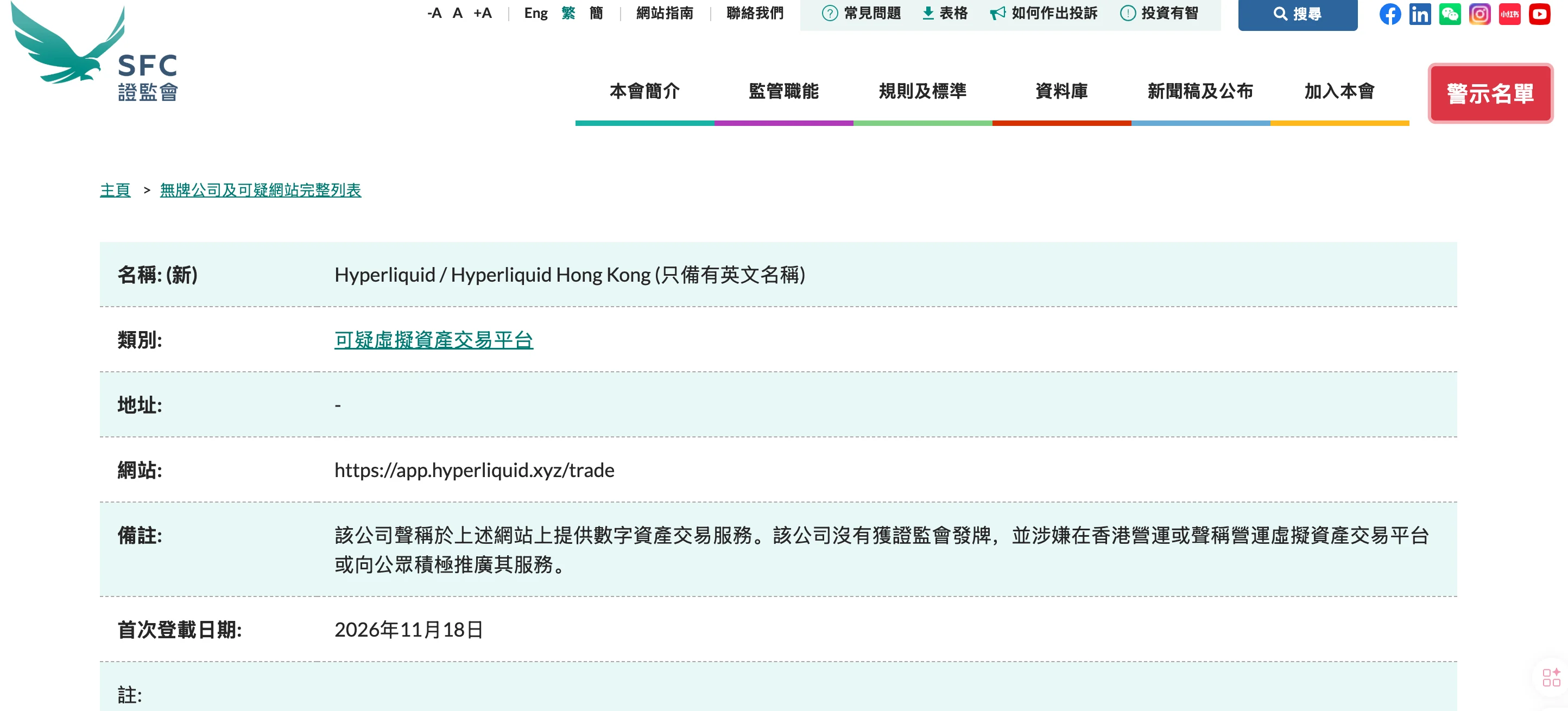
The remarks section states directly: The company claims to provide digital asset trading services on the aforementioned website without holding a license from the SFC, and is suspected of operating or claiming to operate a virtual asset trading platform in Hong Kong, or actively promoting its services to the public.
A risk alert notice that cannot even list a street address.
Regulation That Can’t Find Anyone
In traditional financial regulation, authorities typically target violations by first identifying legal entities and office addresses.
Over the past few years, regardless of which centralized trading platform was involved, the regulatory approach has remained fixed: verify the registered entity, locate the local Hong Kong representative, issue a letter demanding the takedown of non-compliant high-leverage contracts, notify local banks to cut off fiat deposit and withdrawal channels, and block the website if necessary. As long as there is an office building, a corporate bank account, and local staff, this method usually catches them every time.
But Hyperliquid simply does not have any of these.
It is a Layer 1 blockchain specifically built for high-frequency trading, with order books, matching engines, and clearing all handled through on-chain smart contracts. To trade on it, users do not need to upload identification documents or proof of residence. They simply connect their crypto wallets via a browser, deposit stablecoins, and can instantly open leveraged perpetual contracts with leverage ratios in the dozens. Throughout the entire process, user funds remain in their own on-chain addresses. The backend operates without human reviewers and has no corporate entity registered in Hong Kong.
Regulators are accustomed to issuing official correspondence to a company’s registered address, but this time they are facing nothing more than a string of code running across distributed nodes.
What Can This List Actually Control?
Without a physical office, the practical impact of this warning list actually falls on a different group of people.
Under Hong Kong’s current virtual asset licensing regime, promoting digital asset services to the public without approval—especially high-leverage perpetual contracts strictly prohibited for retail traders—already crosses the red line. Once placed on the warning list, locally licensed institutions, compliant payment gateways, and regulated media in Hong Kong must immediately sever ties. Anyone conducting offline promotion, building communities for user acquisition, or facilitating fiat on-ramps/off-ramps for it within Hong Kong will directly face enforcement risks.
The loopholes in real-world compliance have indeed been tightly sealed.
But on-chain, trading simply does not stop. A Hong Kong administrative warning cannot alter open-source code, nor can it prevent wallet addresses from continuing to send instructions to smart contracts. For veteran players who are already accustomed to trading with self-custody wallets, cross-chain bridges, and stablecoins, as long as the frontend interface remains accessible and liquidity in the pools persists, they will likely continue placing orders as usual.
The Shrinking Middle Ground
Hyperliquid’s inclusion on the list was hardly surprising in the crypto community.
Over the past two years, while Hong Kong has been issuing virtual asset trading platform licenses, it has simultaneously tightened enforcement. Its strategy has always been clear: force cryptocurrency trading that once operated in gray areas into the regulatory cage of traditional finance. Once inside this cage, strict customer identity verification is mandatory, high leverage and derivatives must be eliminated, and assets must be entrusted to licensed custodians.
Meanwhile, on-chain perpetual contract protocols like Hyperliquid follow a completely different path. They achieve matching speeds comparable to centralized exchanges while retaining permissionless, high-leverage, and non-KYC on-chain characteristics, perfectly capturing the trading capital squeezed out by compliance frameworks.
One side is tightening control into the licensing system, while the other is migrating entirely to decentralized on-chain ecosystems.
The compliance red line has now stretched all the way from centralized exchanges to the domain names hosting on-chain frontends. The tug-of-war between code freedom and real-world regulation has only just begun.
Join TechFlow official community to stay tuned
Telegram:https://t.me/TechFlowDaily
X (Twitter):https://x.com/TechFlowPost
X (Twitter) EN:https://x.com/BlockFlow_News
 深潮TechFlow