Crypto arbitrage yields fall below US Treasury yields, while US stock perpetuals offer an 11% annualized return: Arbitrage capital begins searching for new battlegrounds.
Author: Tanay Ved, CoinMetrics
Compiled by: TechFlow
TechFlow Briefing: Basis arbitrage, once a “ATM” for crypto hedge funds, is undergoing severe restructuring. With the launch of Bitcoin spot ETFs and massive institutional inflows, the annualized funding rates of traditional crypto perpetual contracts have plummeted from a lucrative era of 40% to 3%-5%, falling below current U.S. Treasury yields. Arbitrage capital is forced to seek new avenues.
In response, real-world asset (RWA) perpetual contracts backed by U.S. equities are experiencing explosive growth. Currently, global open interest has surpassed $11 billion, accounting for 18% of total positions on major platforms, with Binance and decentralized order book leader Hyperliquid virtually splitting all the liquidity.
The top ten U.S. equity perpetual contracts averaged an annualized funding rate of up to 11% in 2026, showing an overwhelming premium compared to crypto assets. As the CFTC approves single-stock perpetual contracts for trading on compliant exchanges, this cross-market capital migration led by crypto-native protocols is becoming a key trend connecting Wall Street and the on-chain world.

Key Takeaways
· Crypto basis arbitrage space is severely compressed in 2026: Bitcoin perpetual funding rates and 30-day annualized futures basis have plummeted from highs of 20%-40% in early 2024 to 3%-5%, approaching or even falling below current U.S. Treasury yields.
· RWA stock perpetual contracts are seeing exponential growth: Since October 2025, the share of stock perpetual open interest in total platform positions has surged from near 0% to 18%, exceeding $11 billion in size. Binance (39%) and Hyperliquid (38%) hold absolute dominance.
· U.S. equity perpetuals enjoy significant funding rate premiums: The volume-weighted average annualized funding rate for the top 10 U.S. equity perps in 2026 was approximately 11%, while the top 10 crypto assets sat at just 3%. The spread remains at a healthy high.
· Regulatory easing and compliance maturation will unlock a trillion-dollar blue ocean: The CFTC recently confirmed that single-stock perpetual contracts can be traded on regulated U.S. compliant exchanges. Coupled with surging trading volumes on prediction markets and derivative platforms, stock perps are poised to attract broader institutional and retail audiences.
Introduction: The Evolution of Basis Trades Post-Bitcoin Spot ETFs
Basis trades, also known as “cash and carry,” quickly became the mainstream strategy for Wall Street hedge funds following the launch of U.S. Bitcoin spot ETFs in early 2024.
The core logic of this strategy is straightforward: investors buy Bitcoin (or Bitcoin spot ETFs) in the spot market while simultaneously selling equivalent futures contracts or shorting perpetual contracts in the derivatives market. This locks in positive futures premiums or funding rate returns during market uptrends.
During peak bull market sentiment, strong demand for long positions drives up the premium of derivatives over spot prices, allowing arbitrageurs to capture low-risk annualized returns of 20% to 40%.
However, the most eternal iron law of financial markets is capital’s self-destructive nature. When massive institutional capital floods in with cheap funding to narrow spreads, traditional crypto basis arbitrage opportunities have faced unprecedented compression over the past two years.
Crypto Basis Compression: From 40% Annualized Returns to Below Treasury Yields
As institutional investors take over spot ETF trading, market pricing efficiency has significantly improved, and the previously volatile bull market sentiment premiums have gradually stabilized.
From a data perspective, the two core indicators measuring arbitrage returns—the 30-day annualized Bitcoin futures basis and centralized platform perpetual funding rates—both dropped to historical lows in 2026.
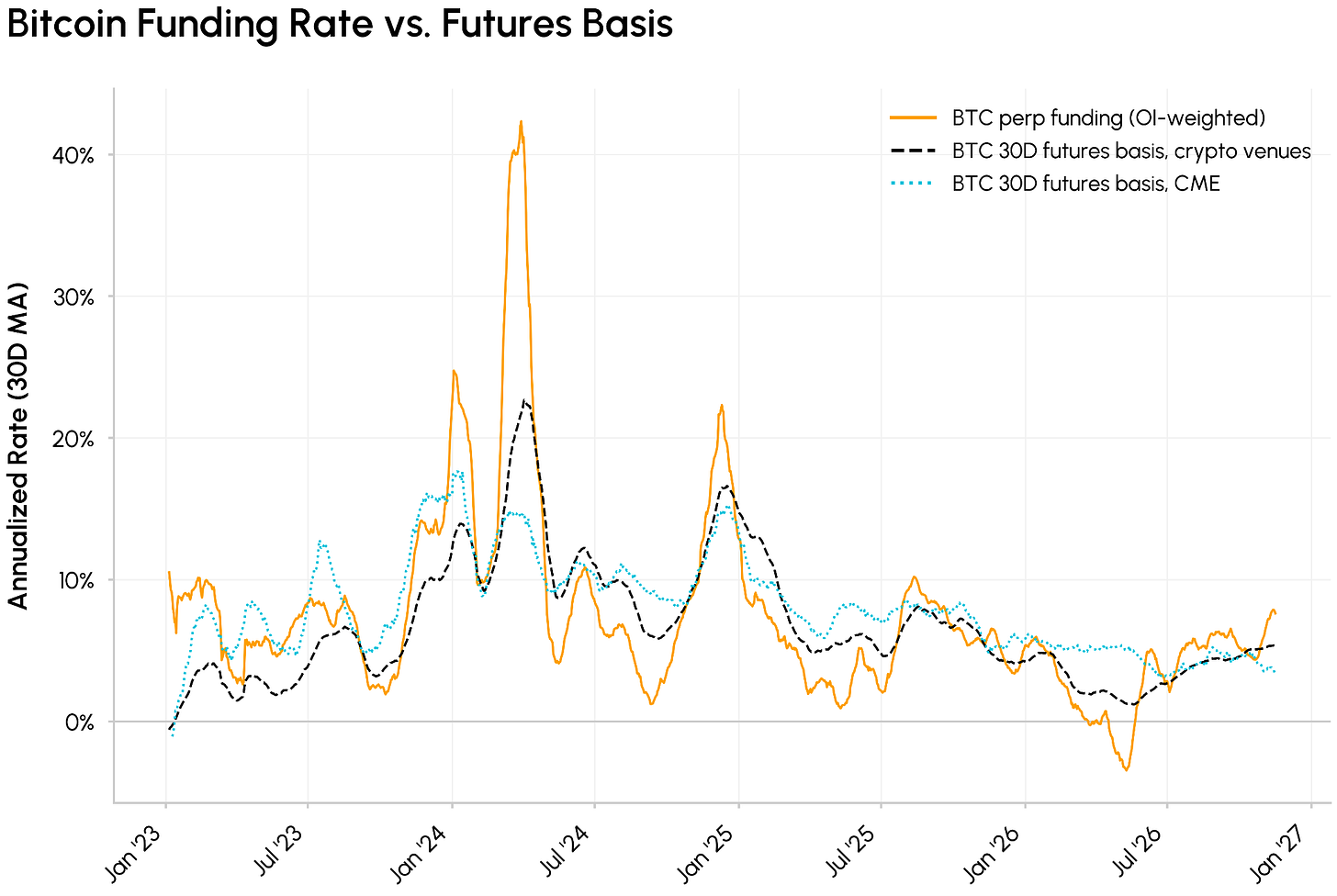
Chart: Trend of Bitcoin 30-Day Futures Annualized Basis and Perpetual Funding Rates
As shown, Bitcoin’s basis and funding rates peaked at 20%-40% in Q1 2024 before declining steadily. Entering 2026, these metrics have consistently hovered between 3% and 5%.
What does this mean? Against a macro backdrop where the Federal Reserve maintains neutral-to-high benchmark rates, a 3%-5% annualized return fails to outperform risk-free cash yields like U.S. three-month Treasuries.
Faced with inherent smart contract risks, exchange counterparty default risks, and liquidation slippage costs, numerous quantitative funds reliant on basis arbitrage have had to abandon crypto-native assets and begin searching for new targets in cross-asset markets.
The Rise of RWA Perps: Binance and Hyperliquid Split $10 Billion in Open Interest
As fee benefits from crypto-native assets fade, agile arbitrage capital has swiftly moved to another frontier opened by crypto derivatives exchanges: RWA perpetual contracts backed by U.S. equities and macro assets.
These contracts break the barriers of traditional U.S. equity trading, which is limited to specific weekday hours, requires high margin requirements, and demands strict account verification. They support global users around the clock, 24/7, using stablecoins as collateral for leveraged trading.
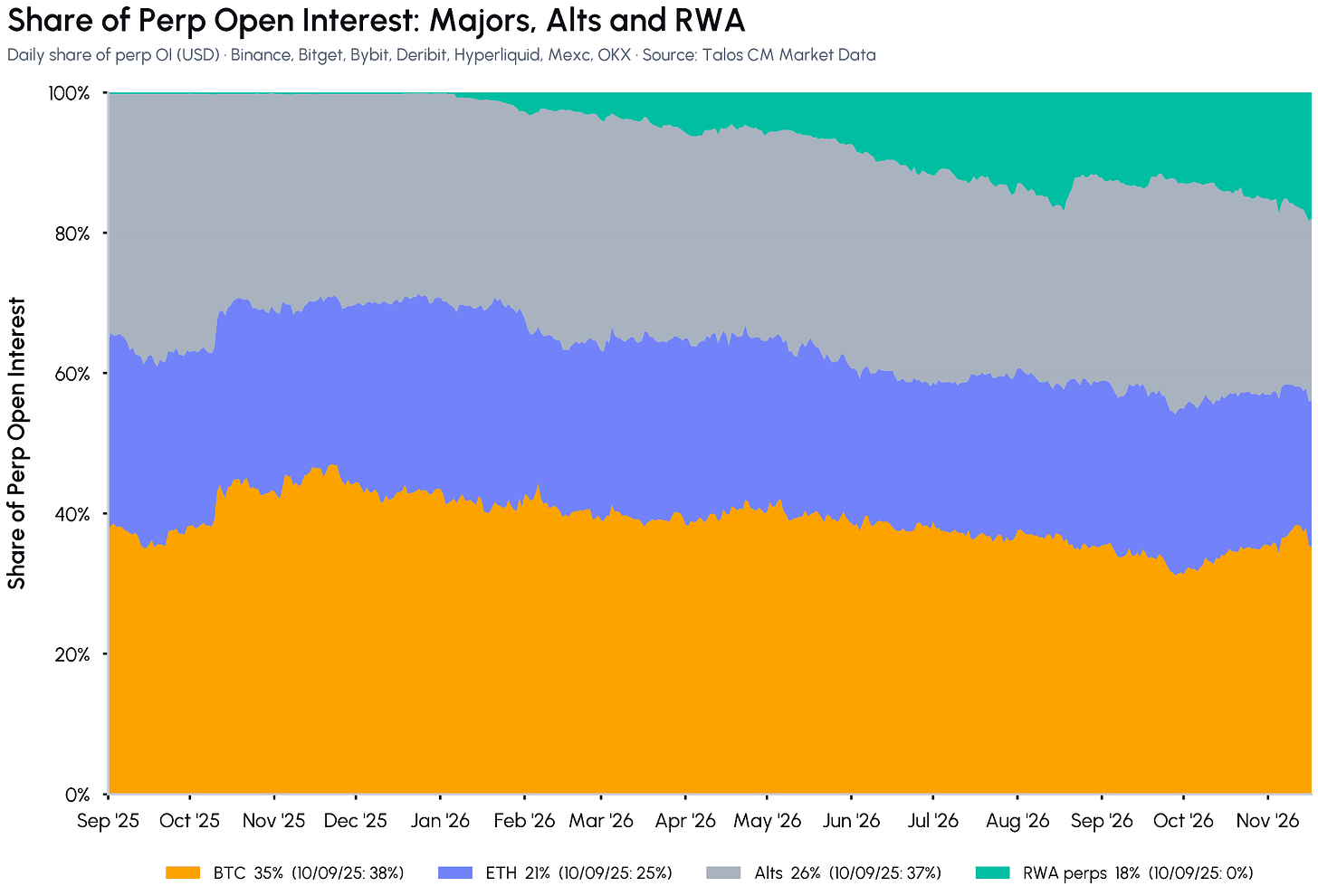
Chart: Open Interest and Market Share of RWA Perps on Major Trading Platforms
On-chain data confirms this explosive trend. Starting from early Q4 2025, RWA perpetual open interest surged from less than 1% of the total market to now surpass $11 billion, accounting for 18% of overall major derivative open interest.
In this restructuring of the market landscape, centralized exchange giant Binance and decentralized derivatives chain Hyperliquid demonstrate absolute dominance.
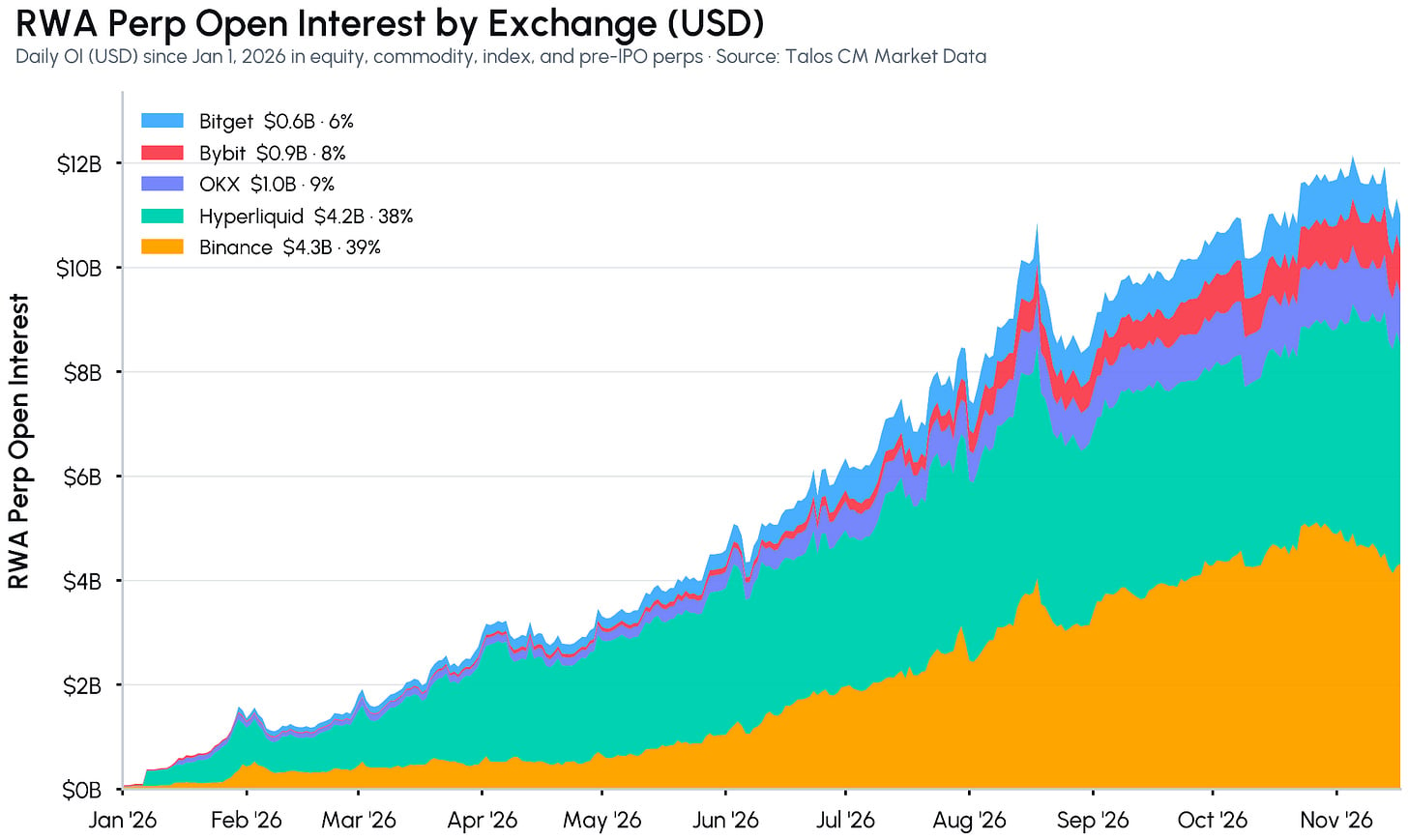
Chart: Distribution of U.S. Equity Perp Positions on Binance and Hyperliquid
Data shows Binance holds about 39% of the RWA perp market share, while Hyperliquid, built entirely on a high-performance on-chain L1, closely follows with 38%. Together, these two platforms control over 77% of the network’s liquidity.
The Funding Rate Gap: Why Do U.S. Equity Perps Command a 11% Annualized Premium?
Why is arbitrage capital so resolutely flooding into U.S. equity perps? The most direct driver is the massive gap in funding rates.
Due to the massive global retail investor base for U.S. tech giants (like Nvidia, Tesla, and Apple), leverage-fueled speculation in perpetual contracts often runs hotter than in spot markets.
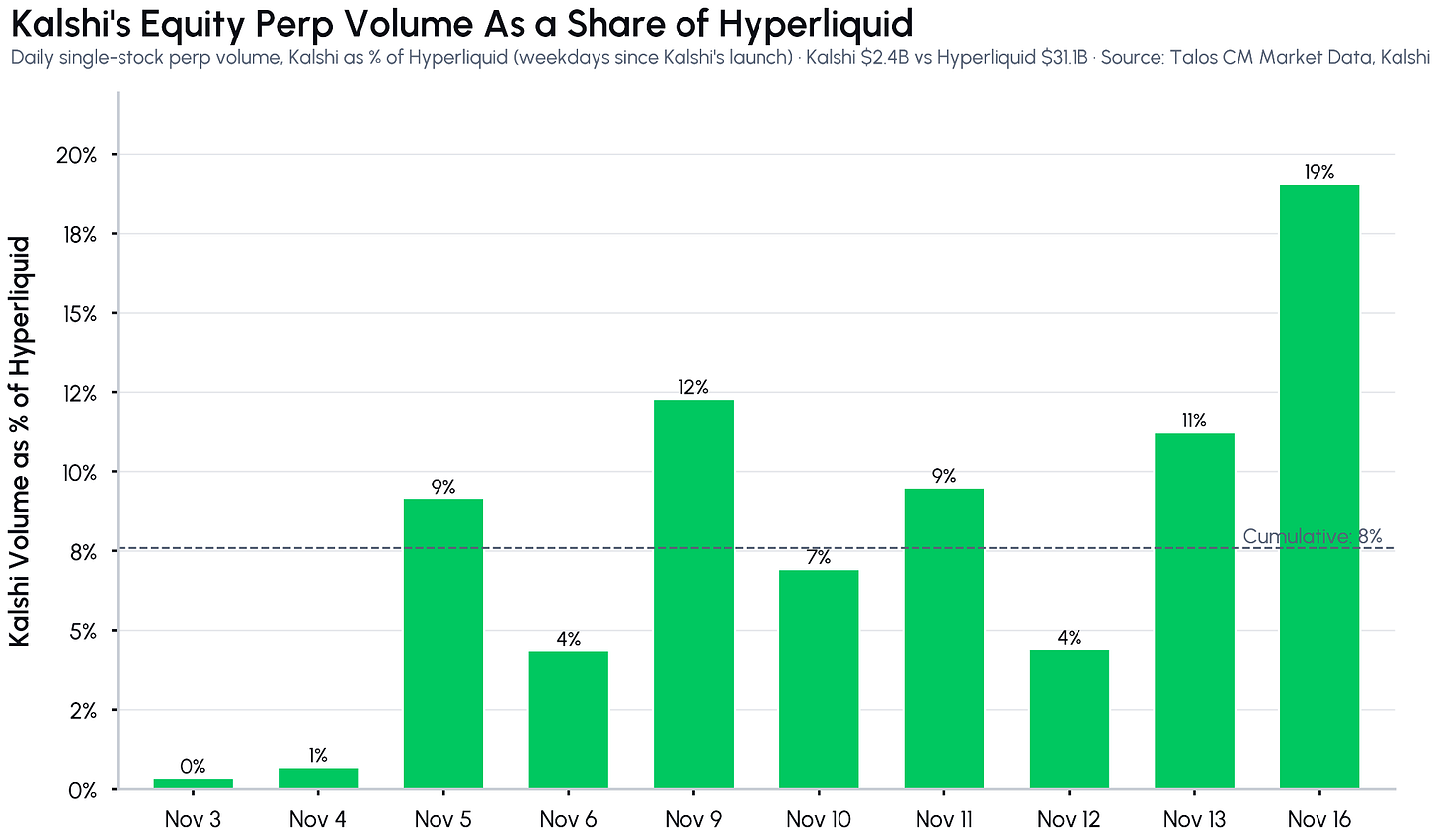
Chart: Comparison of Annualized Funding Rates Between Major Cryptos and U.S. Equity Perps
To maintain pegs between contract prices and spot indices, long traders must continuously pay high funding rates to shorts. Statistics show that in 2026, the top 10 U.S. equity perps ranked by open interest averaged an annualized funding rate of around 11%, peaking above 25% at times.
In contrast, the annualized funding rates for the top 10 crypto-native assets remained around 3% during the same period. An excess spread of up to 800 basis points provides highly attractive profit buffers for arbitrage firms.
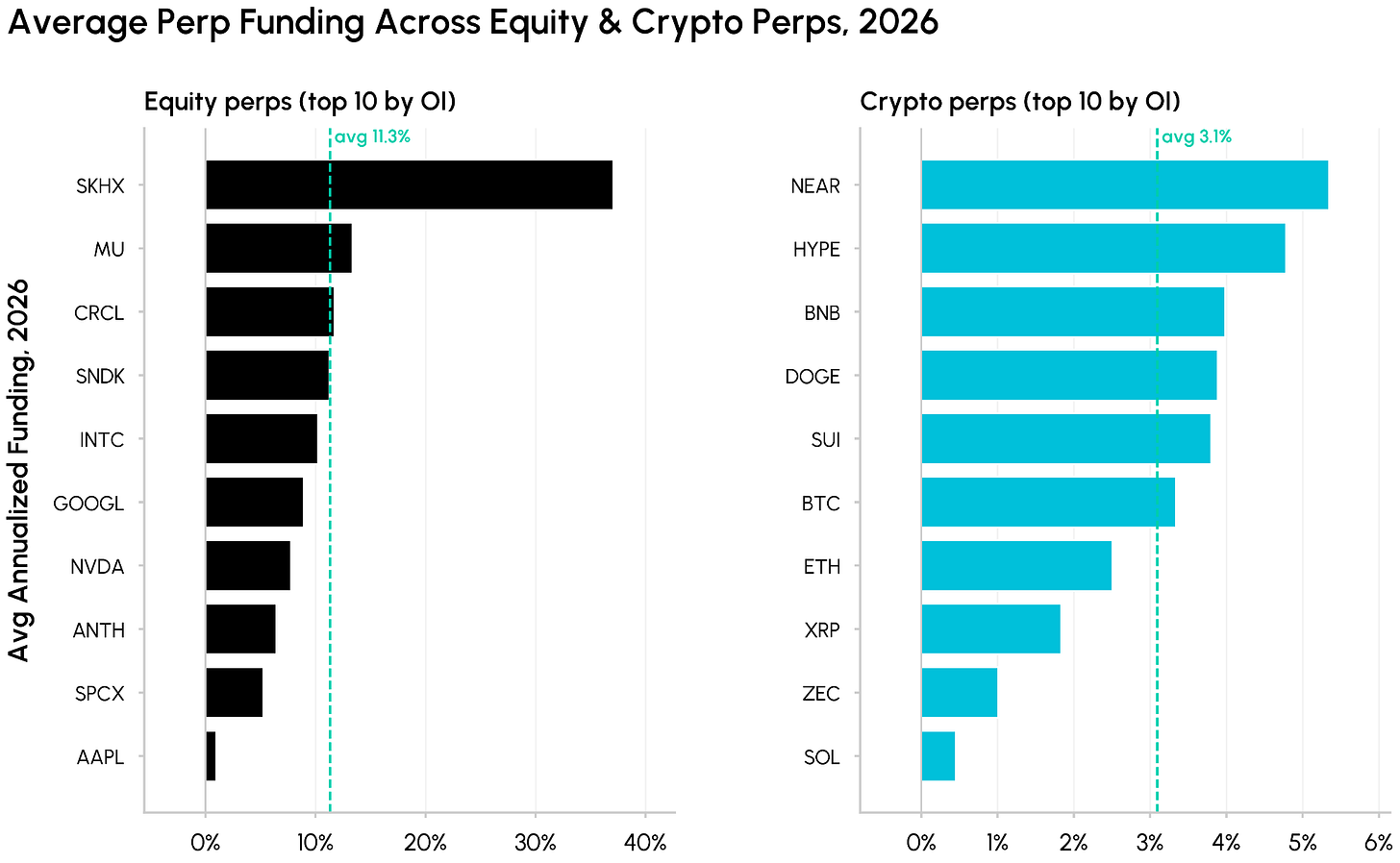
Chart: Historical Funding Rate Percentiles for Top 10 Stock Perps
Arbitrageurs’ operational models have also evolved into hybrid trading: going long on U.S. equities or baskets of stock ETFs in traditional brokerage accounts, while simultaneously shorting corresponding U.S. equity perps on Binance or Hyperliquid to passively earn an 11% annualized funding rate yield around the clock.
Market Structure Fragmentation: A Dual Game of Platforms and Asset Selection
However, stock basis trading is far from a frictionless “free lunch.” With increasing diversification of funds entering the space, arbitrage returns are becoming heavily dependent on exchange matching mechanisms and specific asset selection.
Different platforms vary significantly in funding rate calculation formulas, spot index oracle sources, funding payment frequencies (e.g., every 8 hours vs. every 1 hour), and margin liquidation rules.
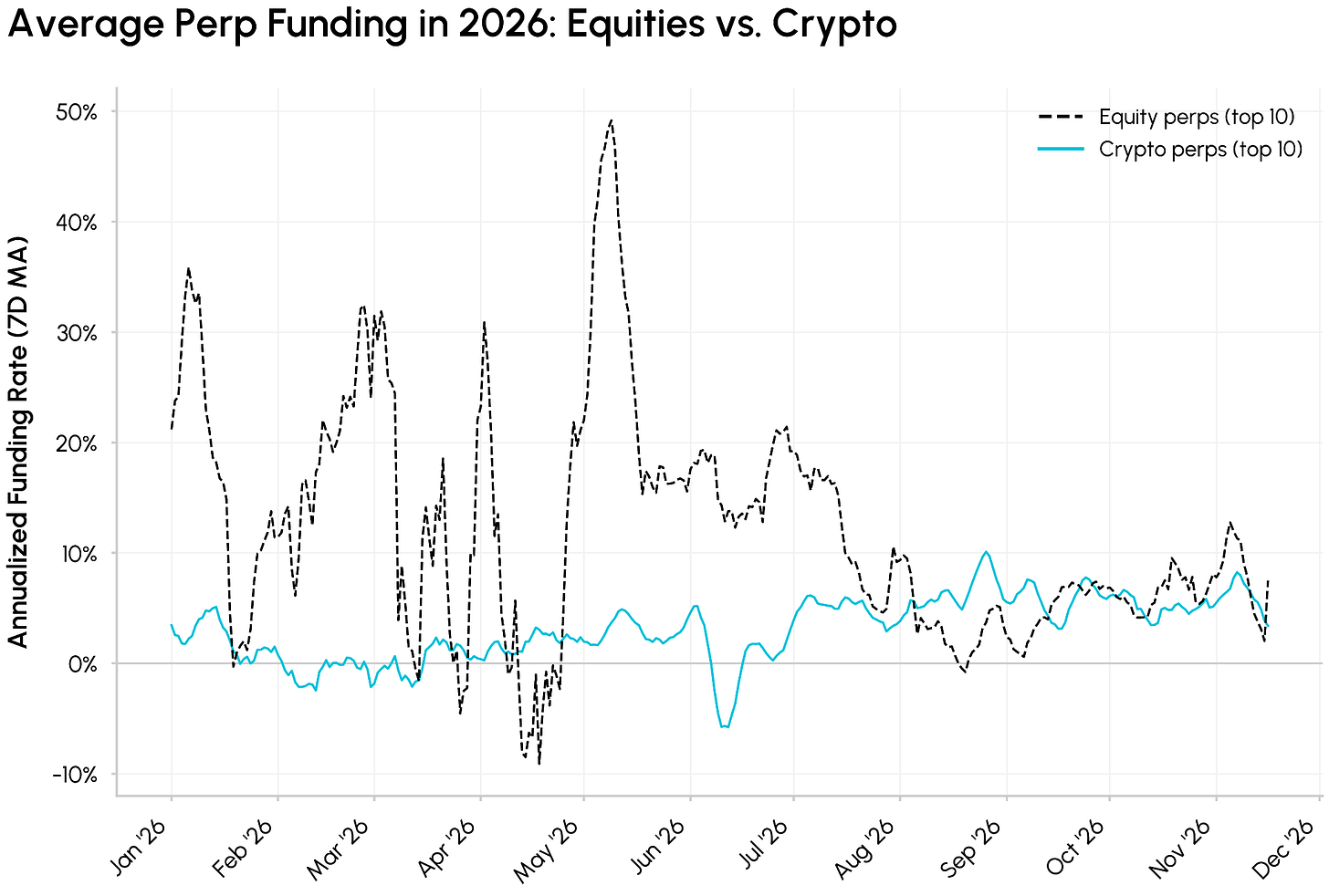
Chart: Analysis of Single-Asset Funding Rate Dispersion Across Different Trading Platforms
For example, some secondary decentralized exchanges suffer from insufficient maker depth, meaning a single large leveraged buy order can spike short-term funding rates to extreme levels, accompanied by slippage losses due to liquidity evaporation.
Furthermore, while U.S. equities have pre-market, after-hours, and closure periods, crypto derivatives platforms run 24/7. During non-trading hours for U.S. stocks, sudden macro news or earnings releases can cause drastic basis swings between perpetual prices and spot, demanding extremely high dynamic rebalancing capabilities from arbitrageurs.
Future Outlook: CFTC Regulatory Easing and Compliant Exchange Entry
The current boom in U.S. equity perpetual contracts is merely the prologue to cross-market derivative integration. Deeper transformations are accelerating within U.S. domestic regulatory frameworks.
Recently, the U.S. Commodity Futures Trading Commission (CFTC) made a key confirmation stating that single-stock perpetual contracts can be listed and traded on compliant U.S. derivatives exchanges that meet specific clearing and reporting standards.
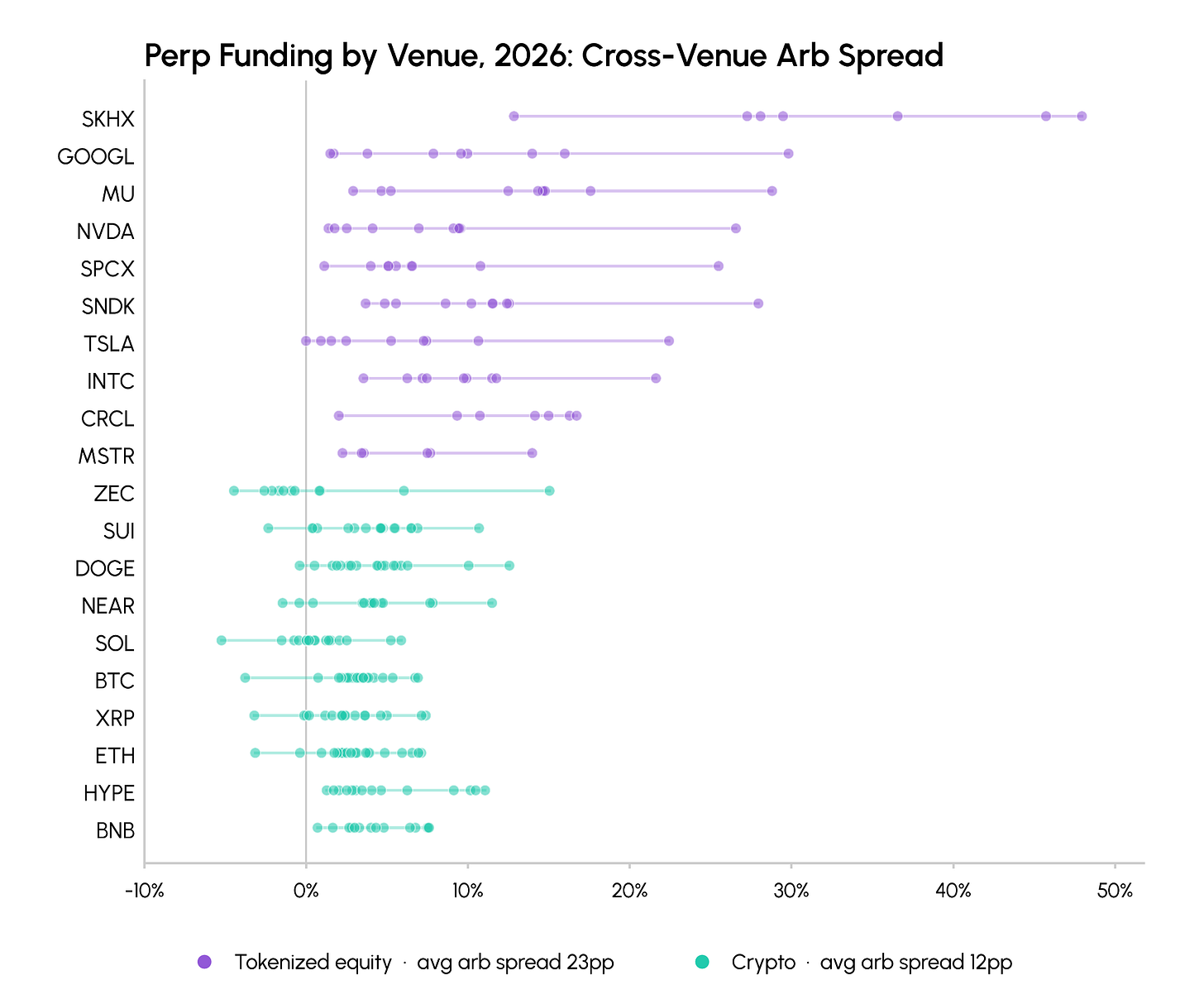
Chart: Estimated Potential Market Size for Stock Perps Under CFTC Regulatory Framework
This regulatory signal clears compliance obstacles for traditional Wall Street financial institutions to directly enter this market. Meanwhile, prediction markets like Kalshi and Polymarket have rapidly exceeded hundreds of millions in trading volume, underscoring retail users’ hunger for event-driven derivative tools.
Once regulated U.S. licensed institutions launch compliant U.S. equity perpetual contracts, capital entry barriers will completely dissolve. Market participants will expand fully from offshore hedge funds to domestic pension funds, family offices, and large market makers.
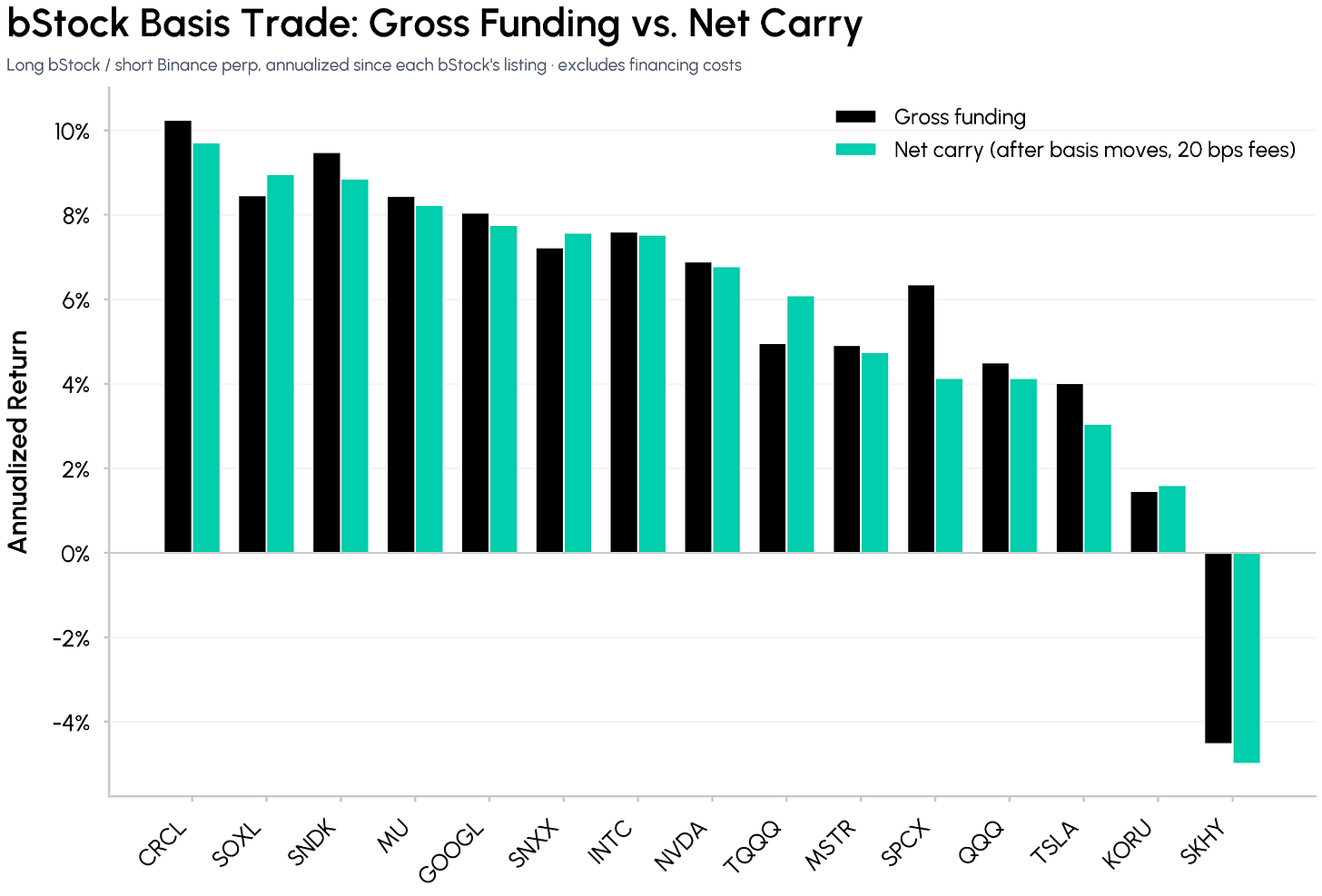
Chart: Schematic of Cross-Market Basis Arbitrage Capital Flow Paths
Conclusion and Implications
From the traditional basis booms and busts triggered by Bitcoin spot ETFs to the strong rise of RWA U.S. equity perpetual contracts, the crypto market once again demonstrates its astonishing capacity for self-evolution and asset absorption.
For professional institutions, the era of one-way arbitrage relying solely on crypto-native asset funding rates is coming to an end. Hybrid architectures bridging traditional finance and blockchain protocols are becoming the core moat for generating excess alpha.
For the industry as a whole, as real-world stock assets gain deeper, around-the-clock derivative liquidity on-chain compared to local markets, the ultimate vision of crypto infrastructure as a “global financial super hub” is gradually materializing into an irreversible reality.
Join TechFlow official community to stay tuned
Telegram:https://t.me/TechFlowDaily
X (Twitter):https://x.com/TechFlowPost
X (Twitter) EN:https://x.com/BlockFlow_News
 @coinmetrics