NVIDIA sells chips, Anthropic sells intelligence: Who will become the world's first $10 trillion company?
Author: Jon Ma, Artemis Research
Compiled by: TechFlow
TechFlow Summary: Anthropic is set to go public at approximately $85 per share with a total valuation of $1.54 trillion. Former IVP and Whale Rock investor Jon Ma writes this memorandum to systematically analyze why it has the potential to become the world's first $10 trillion market cap company within four years.
The article breaks down its penetration path from code generation to enterprise-grade agents using real-world use cases. By combining energy consumption reasoning costs, ARR growth multiples, and SaaS valuation models, it thoroughly explores its duopoly moat amid Nvidia's shifts in the post-Jensen Huang era, while objectively highlighting potential downside risks such as token commoditization and computing power nationalization.
A Letter to My Father: Why I Would Buy Anthropic on Its First Day of Listing
Anthropic is about to go public at approximately $85 per share, implying a market capitalization of around $1.54 trillion. You previously asked me whether I should buy stock on their very first day of listing.
I have been working in tech investment for over 10 years. My career began in the software investment team at Institutional Venture Partners (IVP), and I later served as a tech hedge fund investor at Whale Rock, focusing on public markets.
In August 2026, I even built two complete financial forecasting models for Anthropic, which went viral on Twitter at the time. Many tech professionals and peers were highly optimistic about our analytical framework.
In my decade-long investment career, I have never seen any company comparable to Anthropic. It is not only the fastest enterprise in human commercial history to surpass $100 billion in ARR (Annual Recurring Revenue):
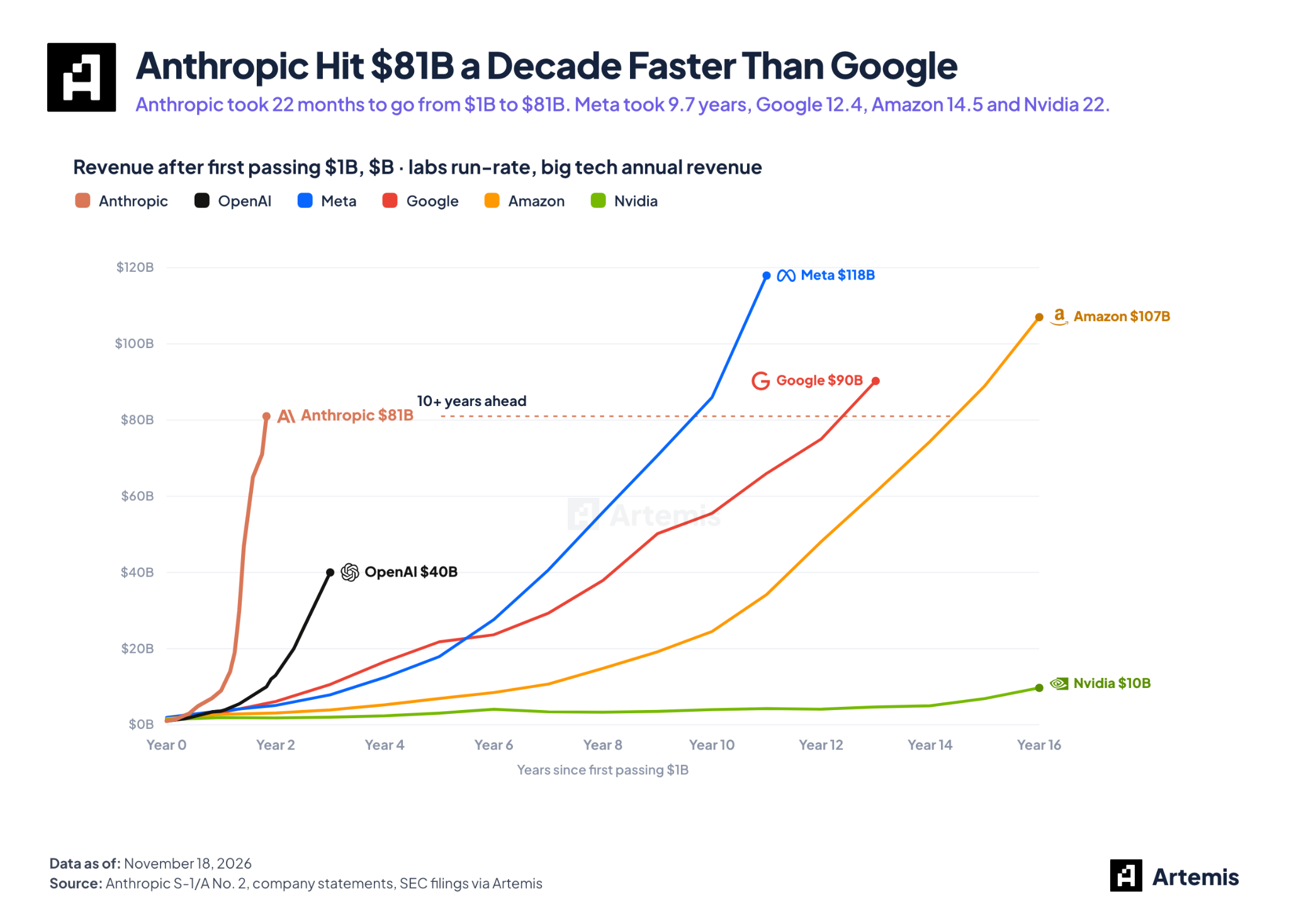
It is also the first super-giant in the public capital market with annual revenues reaching $81 billion while still maintaining a 10x growth rate. In the past 40 years of public markets, no company at this scale has possessed such explosive force.
The most fascinating aspect lies in its co-founders Dario Amodei and Daniela Amodei, along with the entire core team. The more I learn about them, the more I realize they are far from ordinary tech entrepreneurs.
Their principles rooted in effective altruism and mission-driven approach will establish Anthropic as the most reliable provider of general-purpose intelligence in the eyes of enterprise clients.
Below is my core thesis on why Anthropic has the potential to grow into a $10 trillion market cap company within the next four years. The only risk is that if Anthropic's opening-day valuation directly breaches $3 trillion (share price surpassing $160), I would choose to wait for a pullback.
Core Thesis: The Path to Becoming the First $10 Trillion Market Cap Company
Alex Sacerdote, founder of Whale Rock, once taught us to seek core assets at the very beginning of the technology adoption S-curve.
If we look at the timeline of enterprises actually using AI agents to replace human labor, current agents (Agents) are undoubtedly at the earliest, bottom stage of the adoption curve.
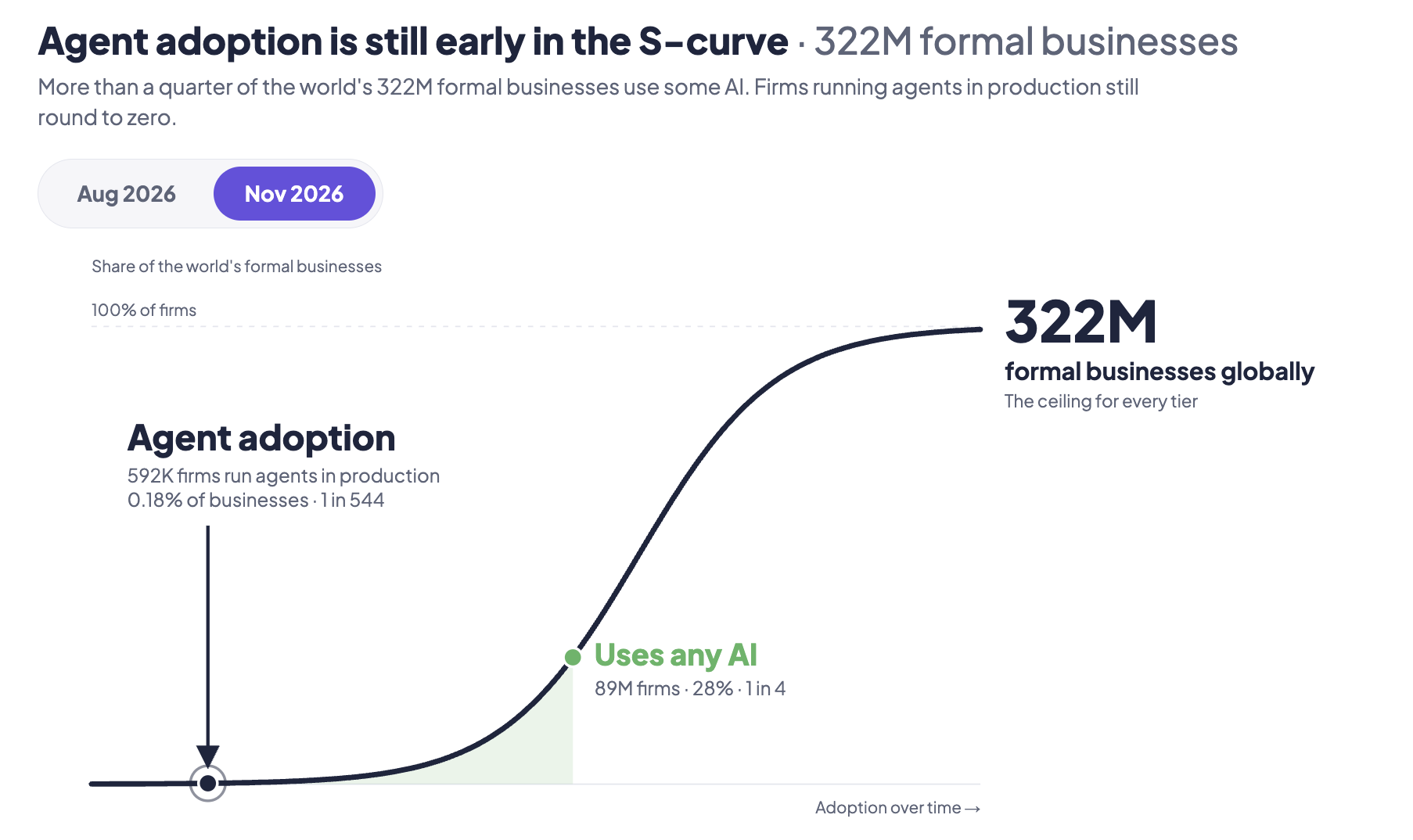
Admittedly, according to corporate payment data from Ramp, as of October 2026, 56.8% of companies across the United States are already paying for certain AI services. However, the vast majority of budgets remain stuck at the basic seat fee level of $20 per person per month.
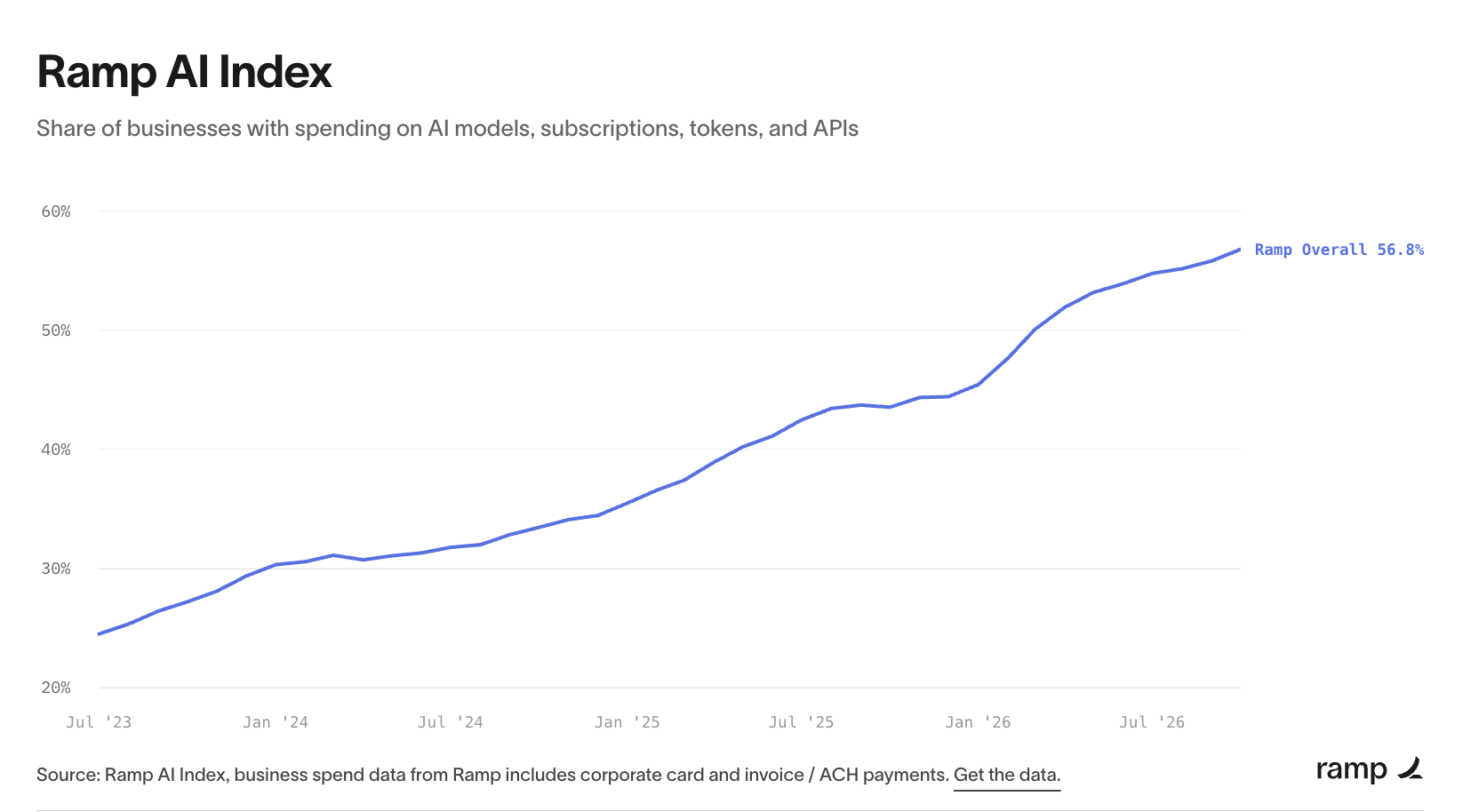
When these seat fees upgrade from auxiliary tools to enterprise-grade agents that directly replace software and human labor, the entire addressable market will experience exponential growth.
In January 2026, I fully integrated Claude Code across the Artemis team. As a non-technical founder, I almost immediately sensed a fundamental paradigm shift.
A startup project of mine, Public Comps, which used to take several years to build, can now have its core architecture rebuilt in minutes using Claude Code.
At Artemis, we streamlined our full-time headcount from 25 to 8, yet the team's product delivery and feature iteration speed actually increased more than fivefold.
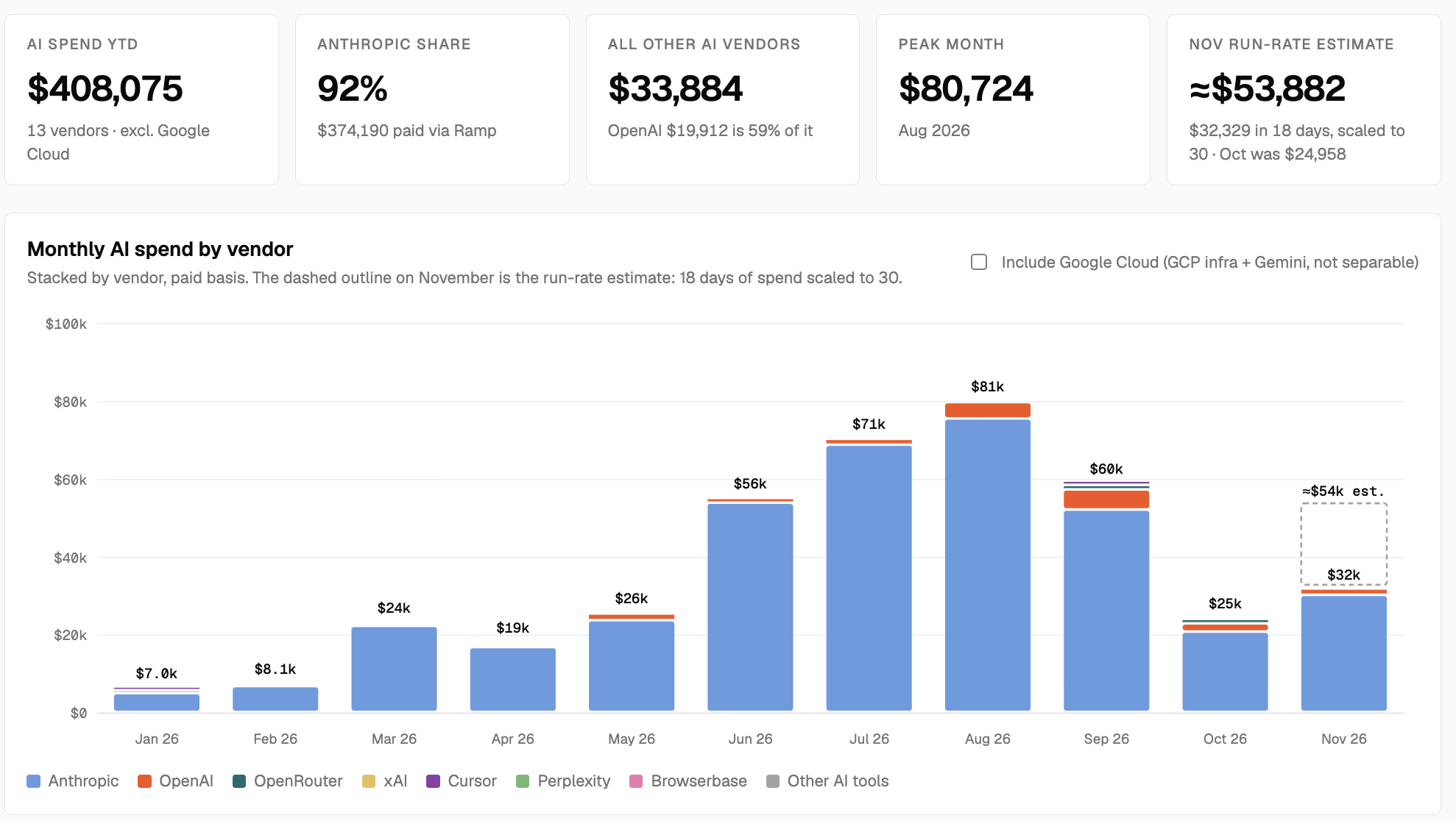
This year, our spending on token consumption amounted to approximately $400,000, with up to 92% of that budget directed entirely to Anthropic. Most enterprises and developers exhibit extremely high stickiness toward Claude in coding scenarios.
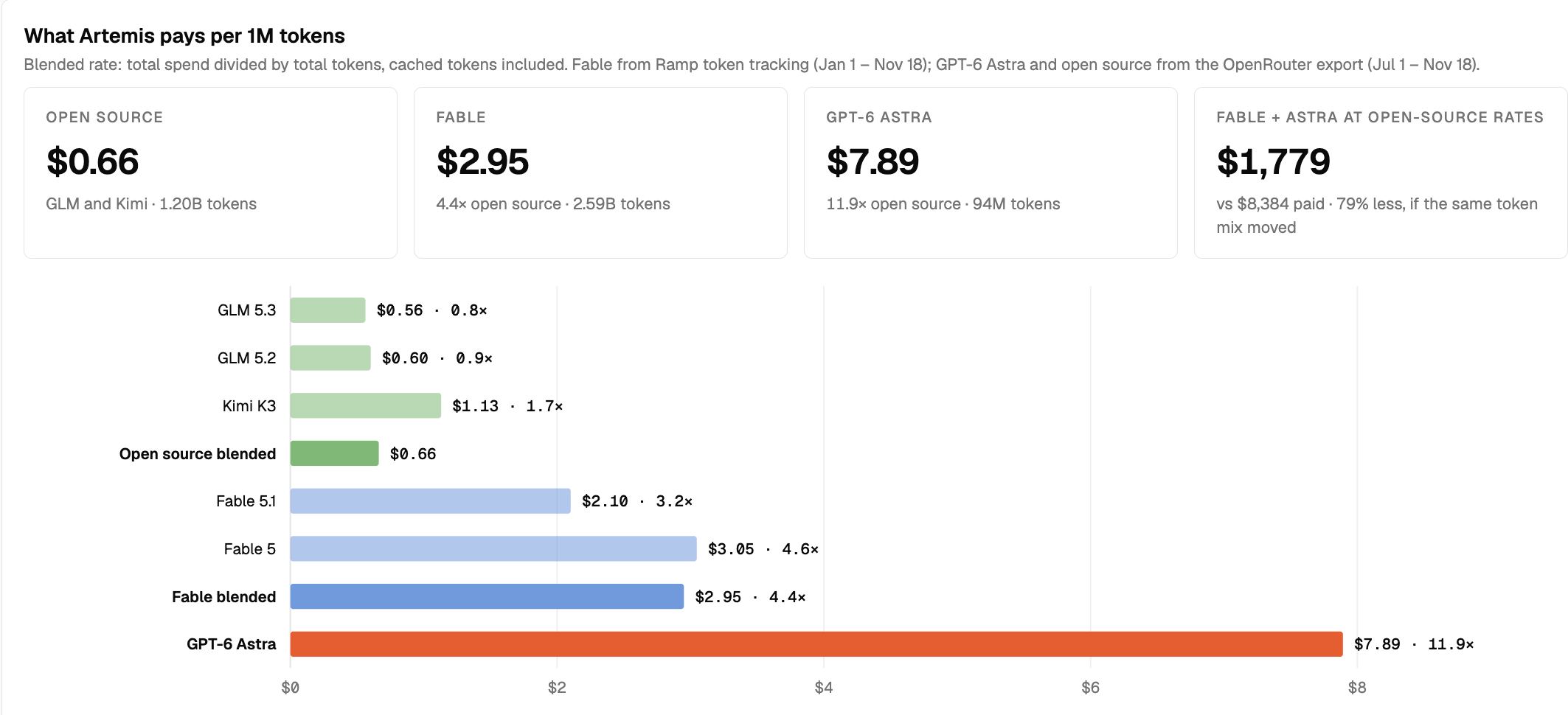
We have also attempted and deeply tested open-source models such as GLM and Kimi. However, in complex full-stack development, financial modeling, and long-context instruction following, their accuracy consistently falls short of Claude.
By relying solely on its core capability of code generation and collaboration, Anthropic has already achieved $81 billion in ARR, and this represents merely the penetration of a small fraction of the technical teams within the Fortune 500.
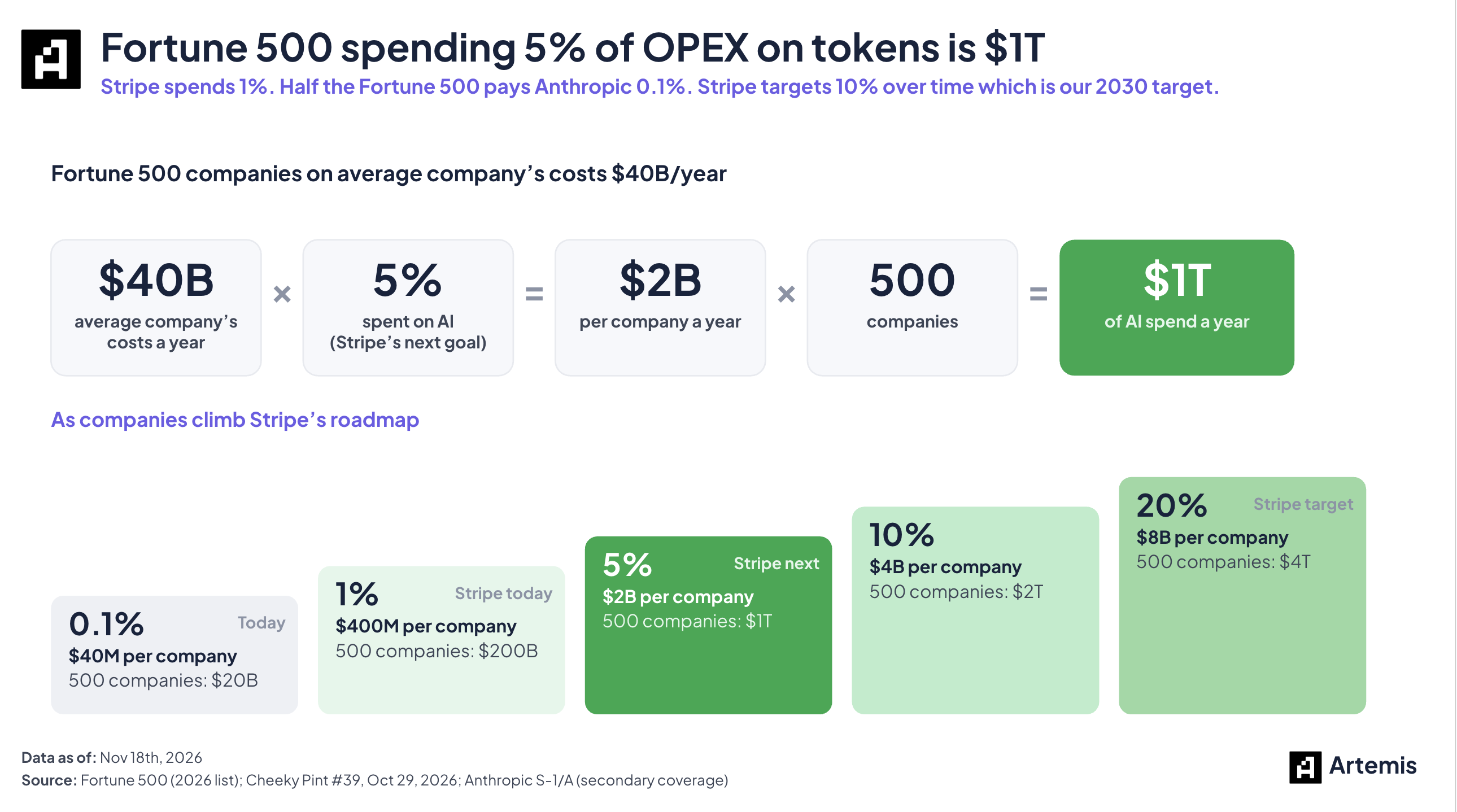
Top fintech giant Stripe currently allocates 1% of its annual technology budget to token calls, and explicitly anticipates this proportion will rise to 10%–20% in the future.
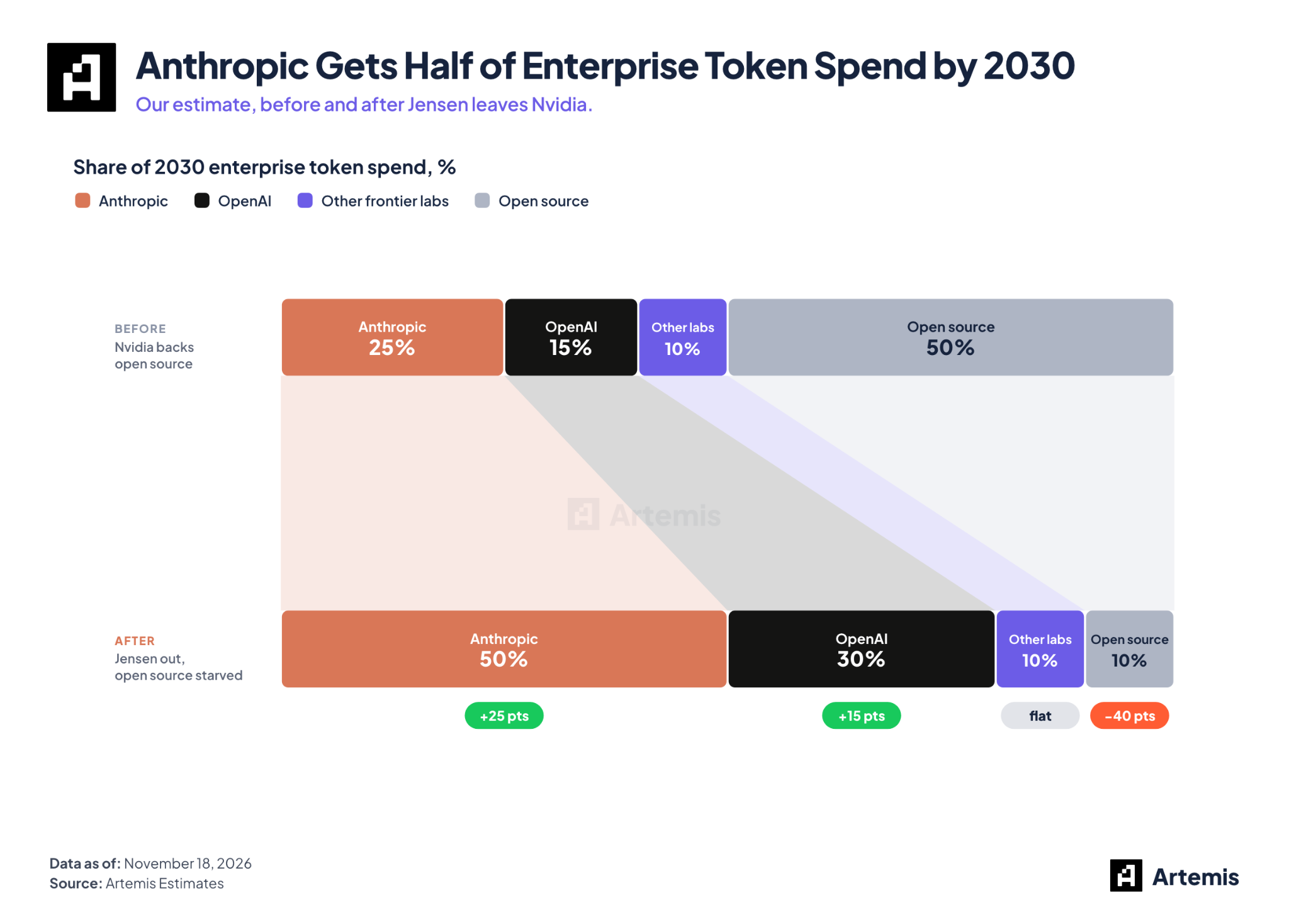
With Jensen Huang stepping down as Nvidia's CEO, we believe the dividend for the open-source camp to directly access cheap compute and algorithmic subsidies from Nvidia official channels is fading. Consequently, open-source competitive pressure targeting Anthropic will significantly decelerate.
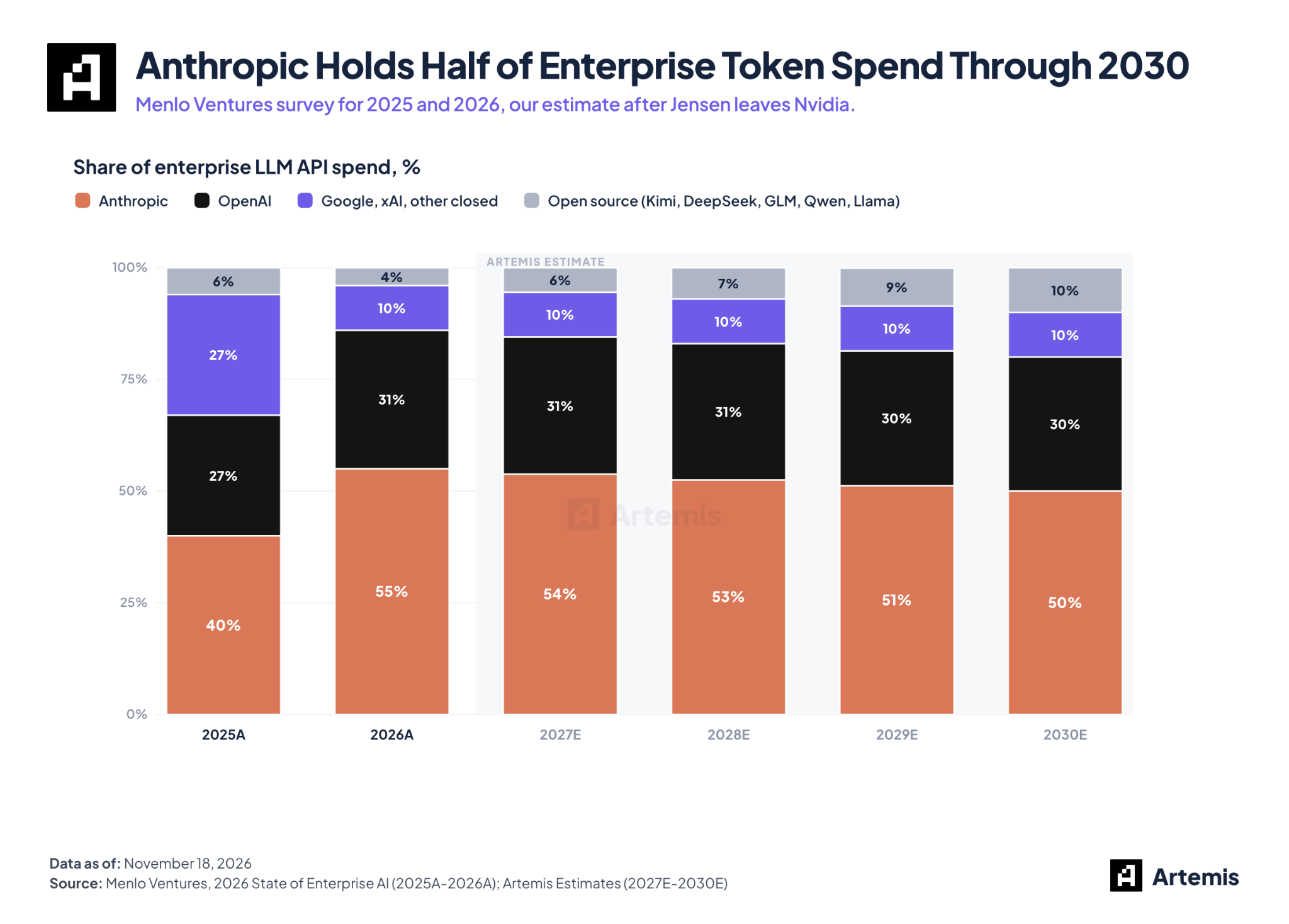
In short, Anthropic will become the most core intelligent compute provider in the global enterprise market, leveraging its unparalleled model intelligence and reasoning reliability.
As open-source frameworks like Nvidia's Nemotron face setbacks, and as open-source large models further increase their reliance on compute and custom chips, the moats of closed-source leaders are solidifying.
Many public market investors often overlook the importance of Anthropic's core mission: building safe, controllable, and business-logically intuitive general-purpose agents.
Valuation Comparison: Why Anthropic Remains Undervalued at Current Pricing
Looking back at tech commercial history, epoch-making super assets are often severely undervalued in hindsight.
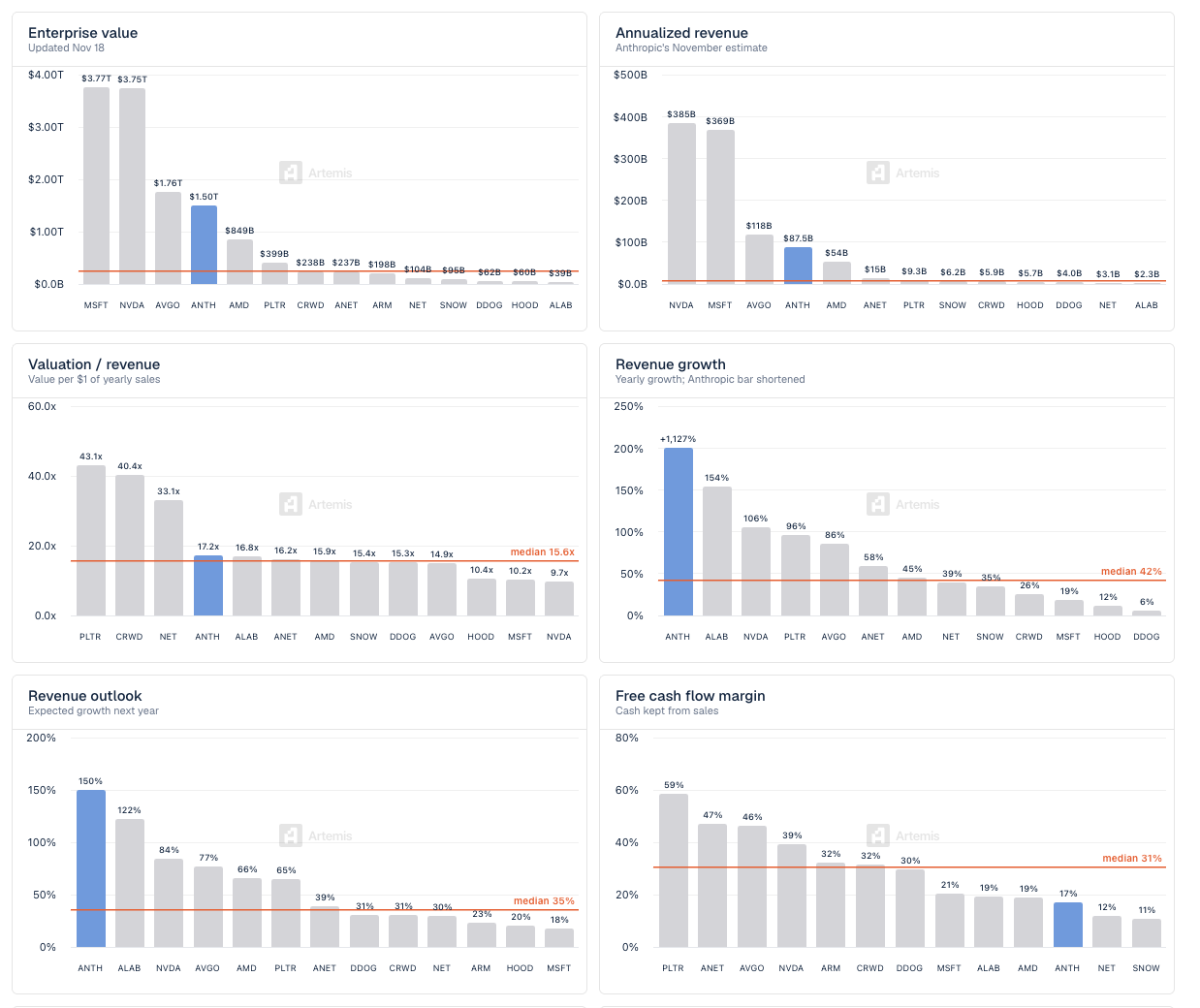
If Anthropic ultimately lists at $85, corresponding to a total market cap of approximately $1.54 trillion. Calculated against its explosive revenue growth rate, this valuation level is actually highly attractive.
Based on current horizontal market comparisons, this price implies that Anthropic trades at merely 9.8x expected 2027 revenue and 5.0x expected 2028 revenue.
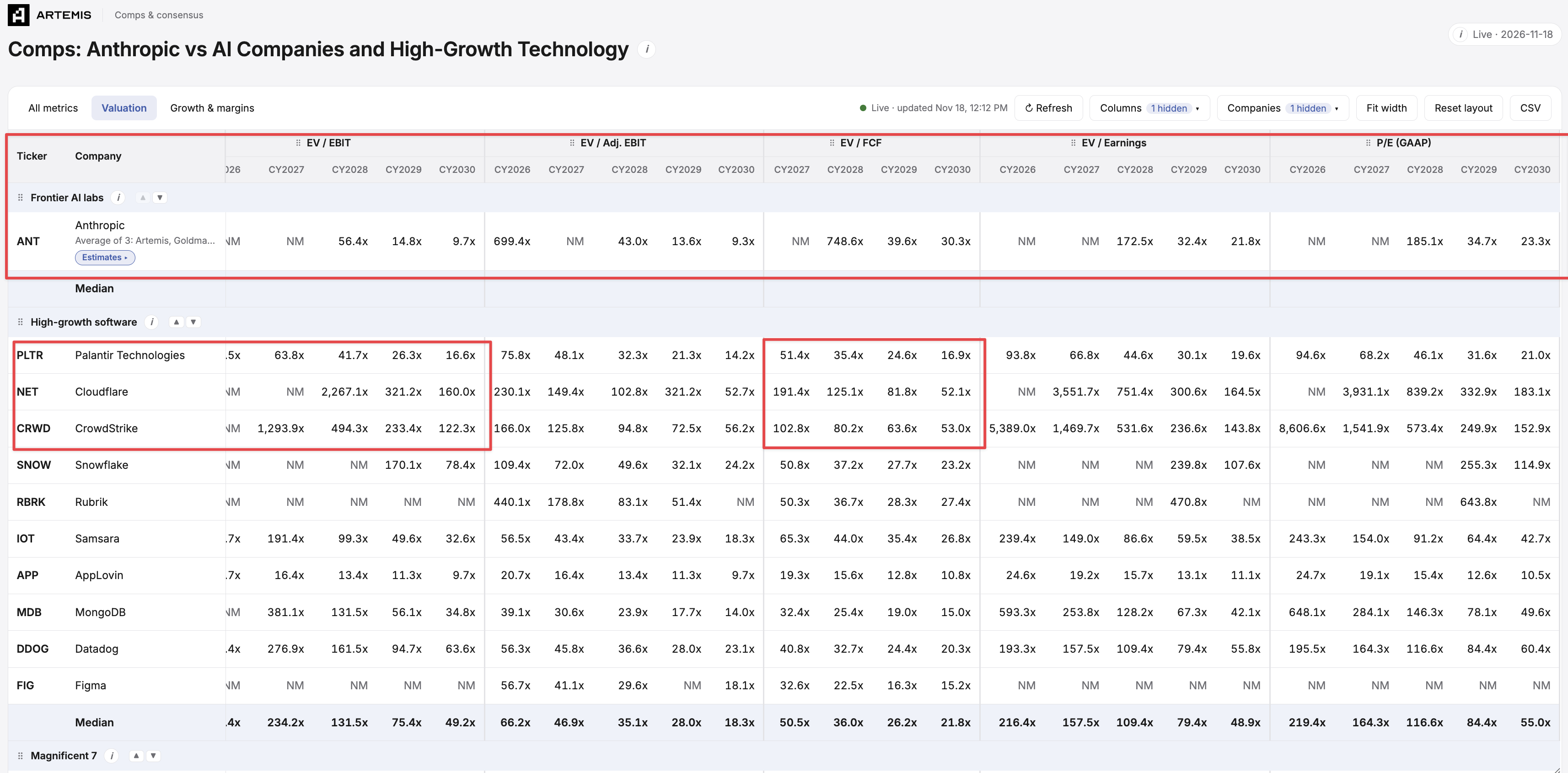
In contrast, high-growth software companies in the public market (such as Palantir, Cloudflare, and CrowdStrike) trade at valuation multiples commonly exceeding 30 to 50 times, even with revenue growth rates of only 20% to 30%.
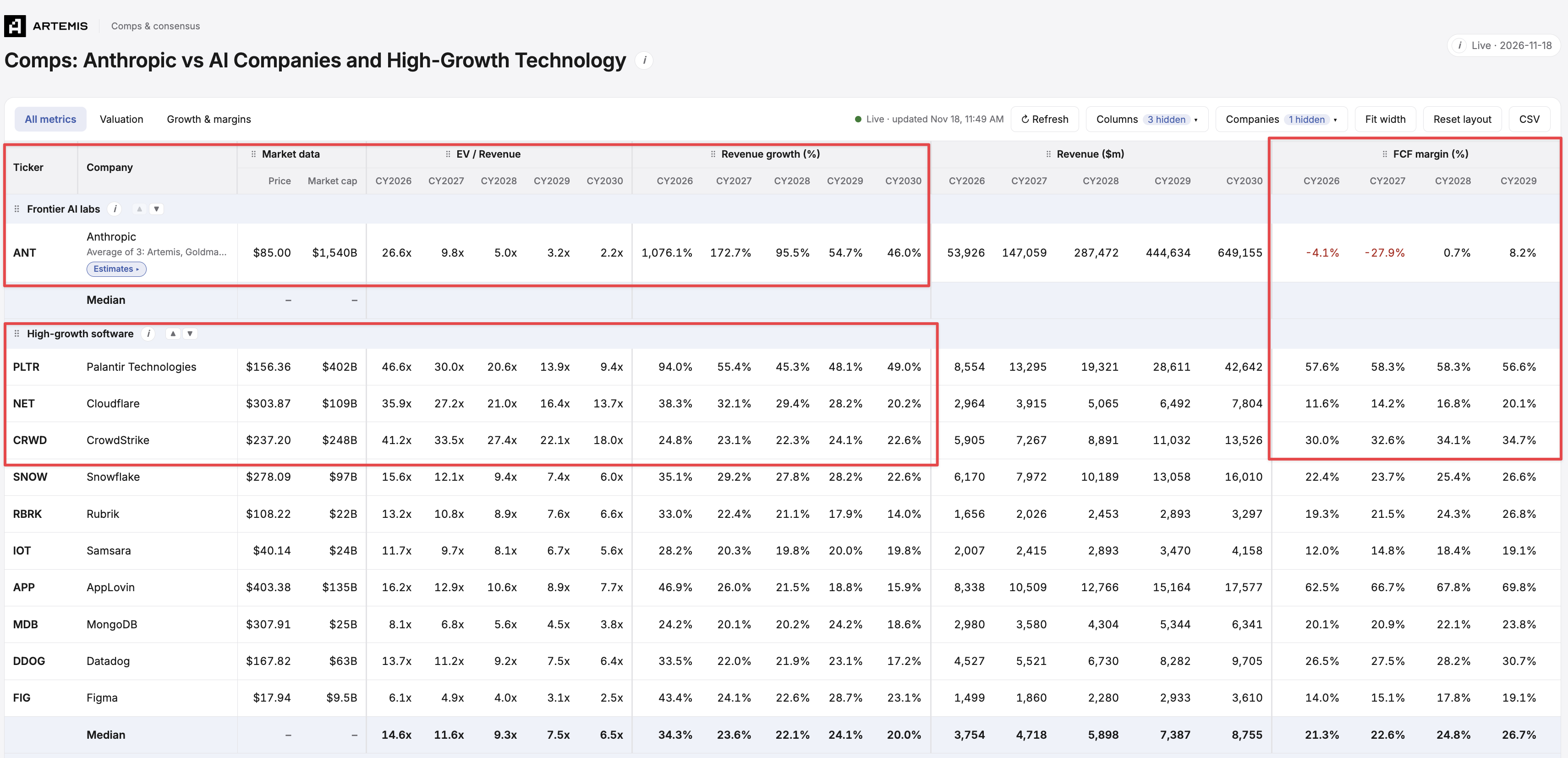
The core difference lies in the fact that Anthropic will still need to invest massive capital expenditures into reasoning infrastructure construction over the next few years, meaning its cash flow remains in a burning phase.
Free cash flow and net profitability are indeed challenging to forecast with precision, but even accounting for the full discounting of capital expenditures, Anthropic's valuation multiples remain in a reasonable, albeit discounted, range.
Financial Model: Projecting Growth and Energy Consumption Over the Next 4 Years
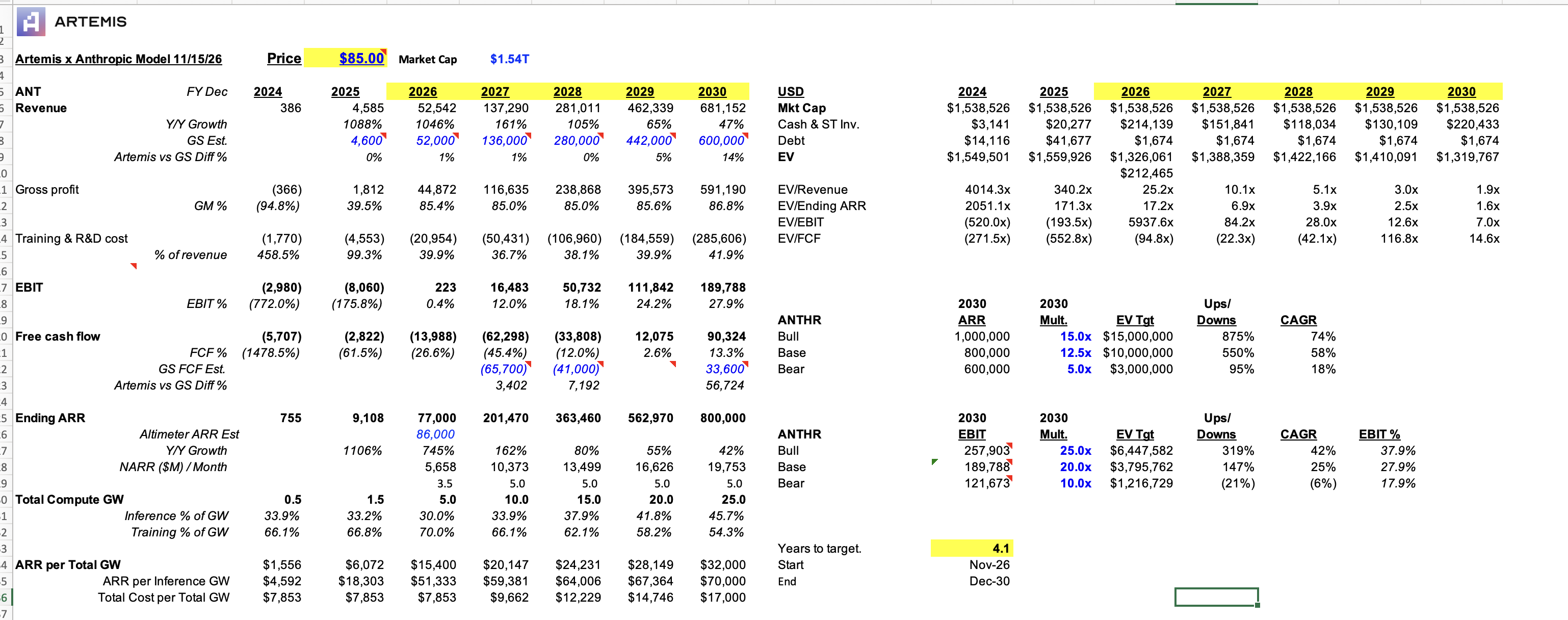
This is the detailed 4-year financial projection model I created for Anthropic. Its core logic rests on the migration of corporate IT spending and the conversion efficiency of reasoning energy consumption.
The core assumptions of the model include the following key pillars:
On the revenue side, global enterprise AI total spending is projected to reach $1.8 trillion by 2030, representing approximately a 10x increase compared to the 2026 forecast.
Regarding market share, we anticipate Anthropic will capture 50% of both US and global enterprise AI spending by 2030, establishing an exceptionally deep ecological moat.
Under compute and power consumption assumptions, each gigawatt (GW) of inference power is expected to generate approximately $70 billion in ARR by 2030 (Altimeter estimates Q4 2026 at roughly $86 billion).
Through Anthropic Direct, self-built data centers, and direct leasing arrangements, the construction cost per gigawatt is expected to compress from current peak levels to approximately $17 billion.
By the end of 2026, Anthropic has secured 5 GW of power supply, planned reserves of 11 GW, and expects its overall future operations to require approximately 14 GW.
Against the backdrop of power costs gradually declining to roughly $10 billion to $15 billion per GW, the continuous iteration of inference energy efficiency will yield remarkably astonishing marginal profit expansion for the company.
Market Panic: Why This Actually Constitutes a Major Tailwind for Anthropic
Over the past few weeks, the secondary market has been shrouded in multiple waves of panic regarding the AI sector:
On one hand, following the mid-term elections where Democrats took control of both chambers of Congress, local governments have launched stricter hearings and environmental regulations on high-energy-consumption projects for large-scale AI data centers.
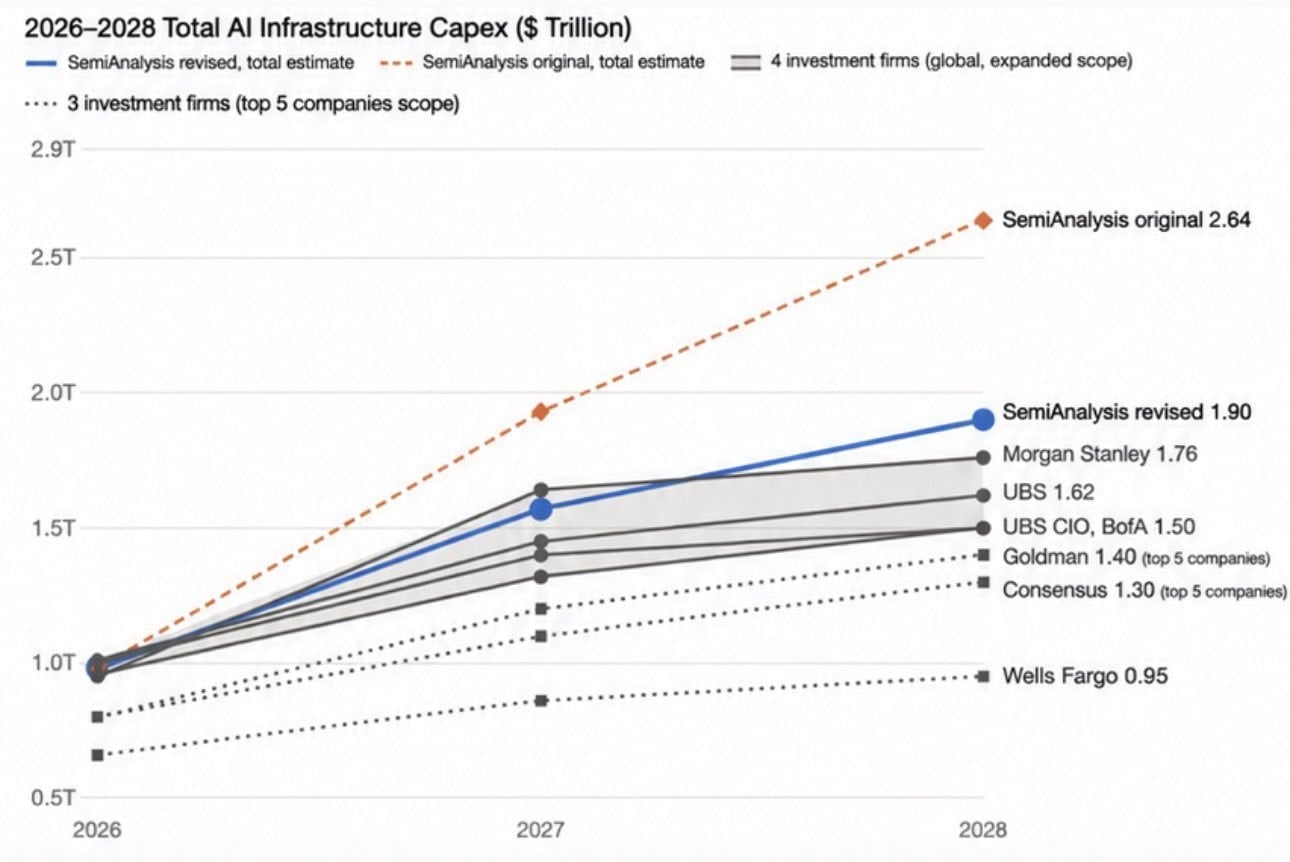
On the other hand, Jensen Huang's departure from Nvidia has sparked widespread investor concerns regarding the growth ceiling of semiconductor giants and the sustainability of hardware capital expenditures.
However, from an industrial logic perspective, these two landmark events instead constitute significant tailwinds for Anthropic.
First, the threat posed by the open-source camp to Anthropic has been substantially weakened by the personnel upheaval at Nvidia and compute restrictions. Open-source teams lacking top-tier compute support will struggle to maintain continuous iteration.
Deprived of direct procurement channels for advanced Nvidia chips, some overseas and domestic open-source teams have been forced to pivot to alternative chips, causing the fragmentation of large model ecosystem development to surge dramatically.
Second, global AI capital expenditure is accelerating towards concentration in just two leaders: Anthropic and OpenAI. Both can leverage immense scale effects to suppress hardware procurement and power acquisition costs.
Premised on antitrust regulation not effectuating actual breakups, Anthropic and OpenAI are highly likely to carve up the vast majority of profits in enterprise-grade general intelligence over the next five years.
Potential Risks: Material Downside and Black Swan Factors Cannot Be Ignored
Although Anthropic's growth trajectory is nothing short of spectacular, investors must also maintain objectivity and rationality, closely monitoring its potential downside risks:
First is the token commoditization risk: If the open-source camp can break through hardware blockades via architectural optimization, the model reasoning premium may be rapidly eroded.
Second is the founder philosophy risk: The core founding team carries a strong emphasis on technical safety and mission orientation. Should future commercialization paces clash violently with safety principles, governance friction may arise.
Third is post-IPO talent retention risk: Core researchers will become multimillionaires after cashing out during the IPO. Whether they can sustain high-intensity scientific research breakthroughs thereafter remains uncertain.
Fourth is the possibility of Jensen Huang returning to Nvidia: If his return involves restructuring Nvidia's chip ecosystem and continuing subsidies for open-source, Anthropic's competitive landscape could tighten once again.
Fifth is IPO timing at the peak risk: Capital market sentiment is currently euphoric. If Anthropic lists at the absolute zenith of industry prosperity, it may subsequently face a painful period of decelerating growth.
Sixth is government nationalization and stringent regulation: Once the revenue scale of top AI labs enters the trillions and they control critical compute, the risk of being classified as a utility and brought under state control will skyrocket.
Finally, strategic focus risk: A giant attempting to simultaneously advance code, enterprise workflows, general-purpose agents, and underlying custom chip design will face unprecedented tests in organizational execution.
Conclusion: Generational Shift in the Super Cycle
Just three weeks ago, I still briefly believed Nvidia would become the world's first tech enterprise to cross the $10 trillion market cap threshold.
Yet, Meta's Muse daily active users have just broken 10 million, and market discussions regarding the landing of AI business models are undergoing profound qualitative shifts.
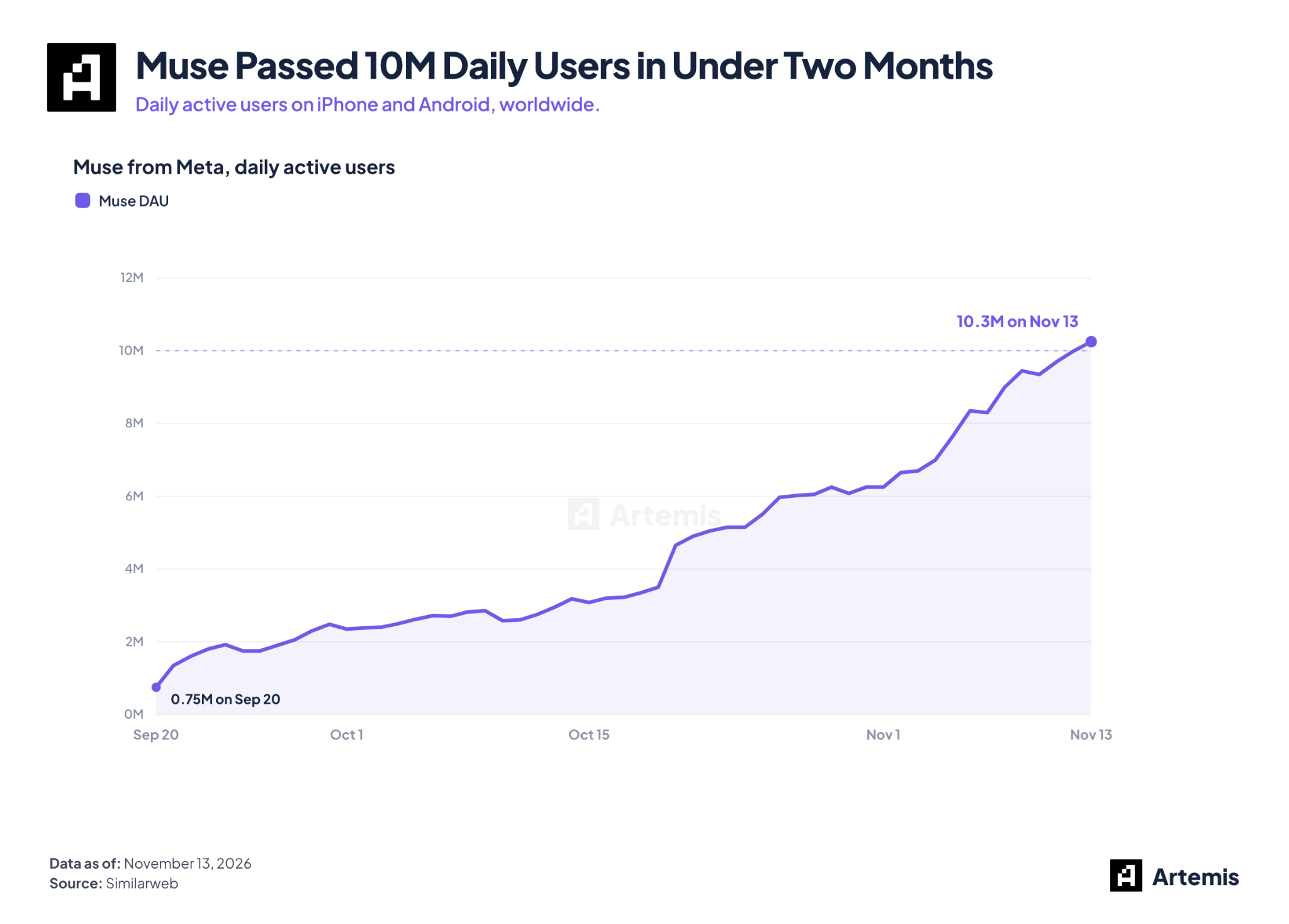
Consensus bets in the capital markets are shifting comprehensively from the foundational "shovels and pickaxes" (AI hardware infrastructure) upward to the top-layer core applications and agent operating layers.
Anthropic not only participates in chip energy efficiency design and data center customization; most importantly, it firmly controls the most critical intellectual production layer within the enterprise application ecosystem.
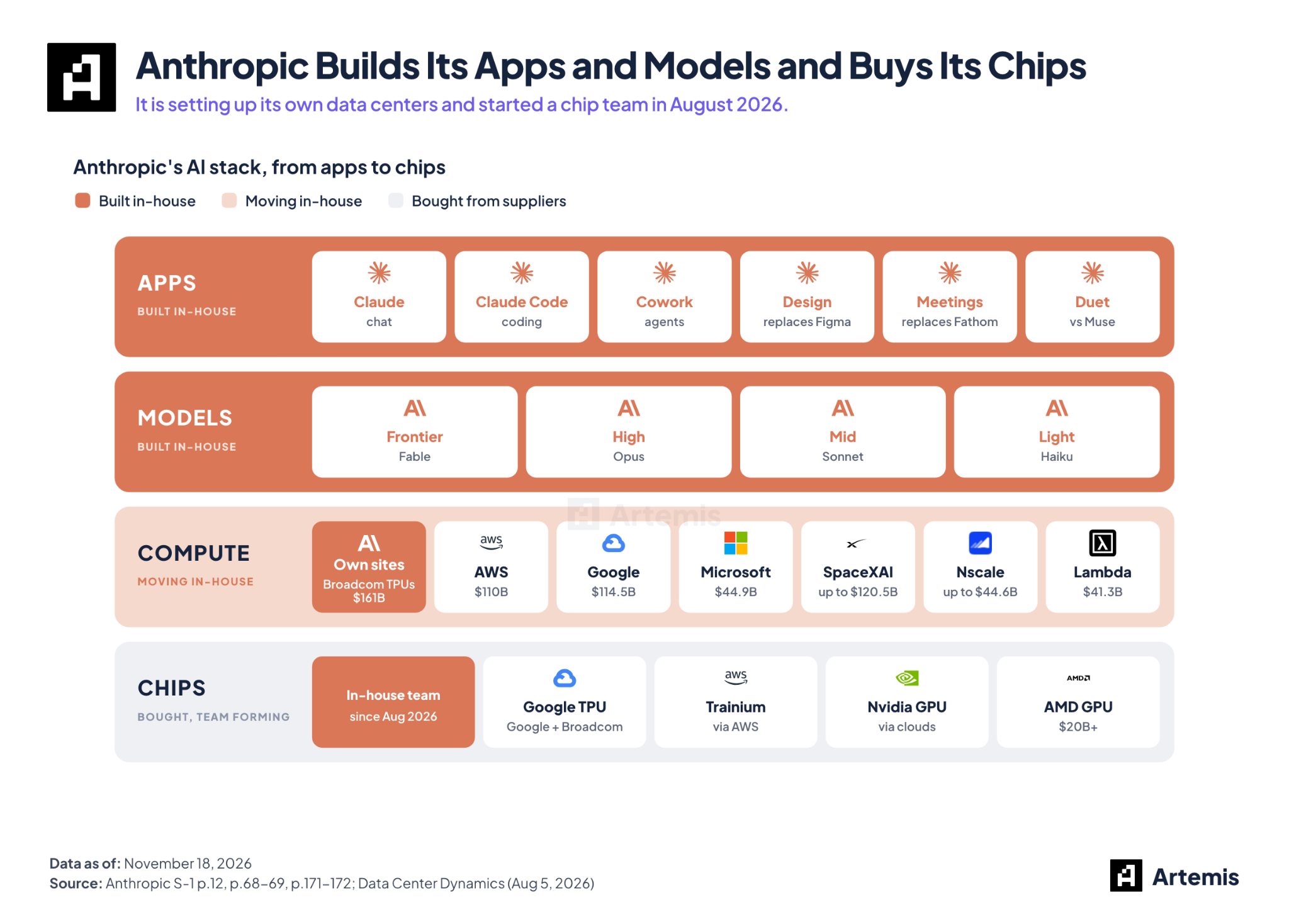
Massive capital inflows and corporate budgets will accelerate toward practical AI application scenarios, with the overwhelming majority ultimately required to pay Anthropic for compute and intellectual usage fees.
I believe the world's first company to reach a $10 trillion market cap will most likely not emerge in the hardware and data foundation layers, but will belong to the ruler of the enterprise agent operating system.
We firmly believe that company is Anthropic.
Join TechFlow official community to stay tuned
Telegram:https://t.me/TechFlowDaily
X (Twitter):https://x.com/TechFlowPost
X (Twitter) EN:https://x.com/BlockFlow_News
 @artemis__xyz