
Goldman Sachs Research Report Decoded: S&P 500 Seen at 8,700 by Year-End Next Year, AI Investment Shift Sparks Four Key Themes
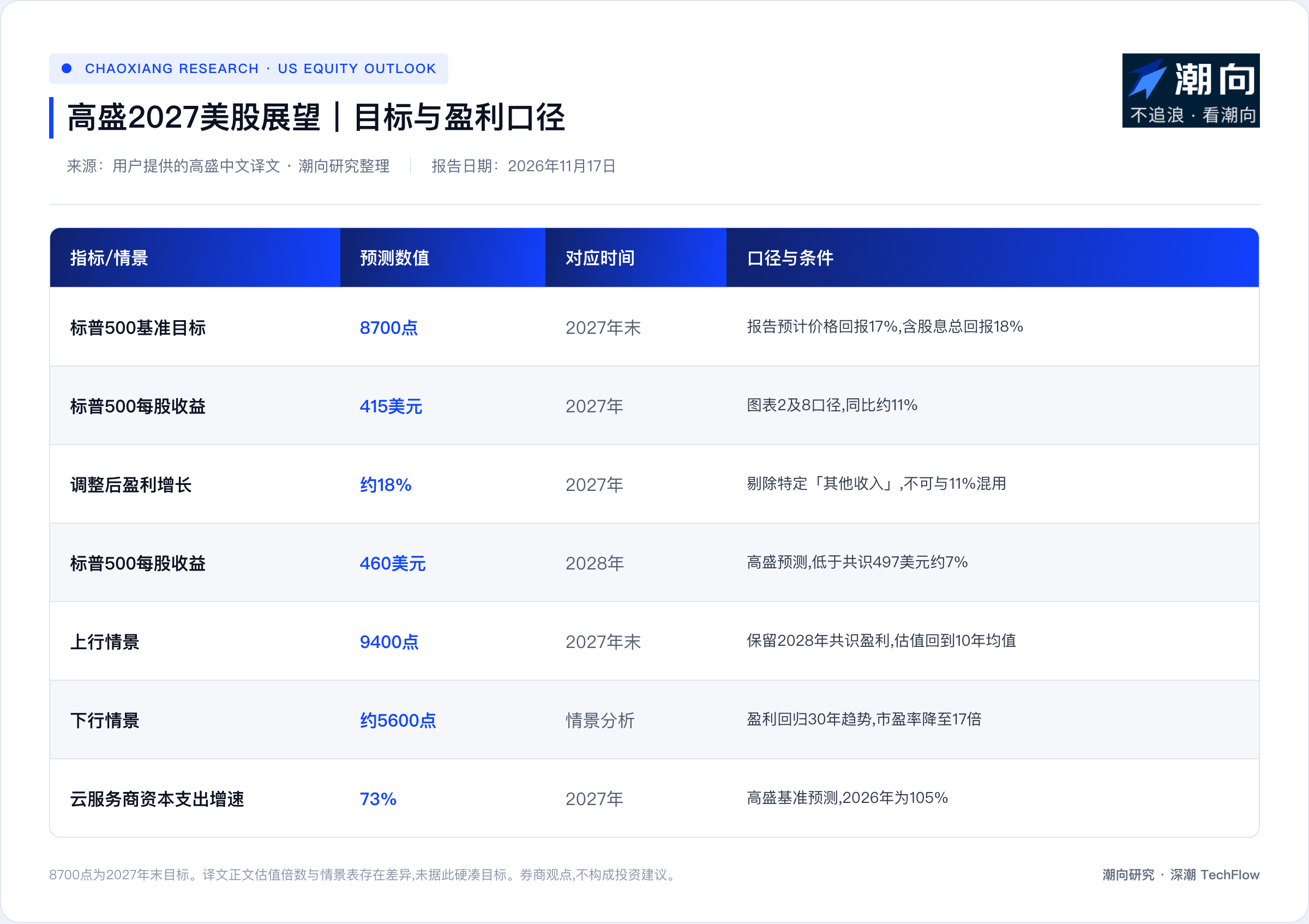
The US stock market's super bull run has not ended, but the frenzy has quietly entered its midgame. In its "2027 US Stock Market Outlook" released on November 17, 2026, Goldman Sachs noted that a healthy economic foundation and sustained AI investment will still drive the S&P 500 index to reach 8,700 points by the end of 2027. This implies there is still approximately 17% upside for US equities next year. However, as the growth rate of AI capital expenditures peaks, market sentiment is shifting from infrastructure speculation to pragmatic pursuit of monetization.
Earnings Growth Cools, 18x P/E Anchors Valuation Floor
US equities in 2026 were driven by soaring earnings. But such extraordinary high growth will be hard to replicate next year.
Goldman Sachs' US equity strategy team forecasts that EPS growth for the S&P 500 index will decelerate significantly from around 30% in 2026 to 11% in 2027. Even excluding additional income generated by tech giants through investments, core earnings growth would only be around 18%.
Valuations, on the other hand, appear relatively safe. The S&P 500's 12-month forward P/E contracted by 19% in 2026 and has now retreated to around 18 times, sitting right at the 10-year historical average.
Goldman Sachs' target price of 8,700 points is derived from 2028 earnings expectations priced at an 18x P/E. Amid dual uncertainties from the high-interest-rate environment and AI development, Goldman Sachs believes systemic valuation expansion is unlikely. Next year's rally must be genuinely driven by earnings.
The AI Relay Passes the Baton, Computing Infrastructure Yields to Application Monetization
The biggest payers for this AI feast are slowing down their spending pace.
Over the past few years, the vast majority of US equity outperformance has come from AI infrastructure.
Goldman Sachs estimates that capex alone from hyperscale cloud providers contributed 12 percentage points to overall market earnings growth in 2026.
The inflection point will arrive in 2027. As the absolute scale of capex continues to expand, its year-over-year growth rate is expected to plunge from 105% to 73%. The depreciation pressure stemming from massive investments is beginning to erode profits. By 2028, the net drag from cloud providers' capex on S&P 500 earnings could even reach 5 percentage points.
Capital flows are shifting. With previous expectations for infrastructure stocks already fully priced in, Goldman Sachs advises turning attention to the next leg of the relay. Companies capable of substantially realizing AI technology monetization or leveraging AI to boost productivity will become the new favorites. To avoid the risk of technological disruption, Goldman Sachs is particularly bullish on physical, heavy-asset companies benefiting from productivity gains.
Corporate Leverage Re-emerges, Buyback Aristocrats Highlight Scarcity Value
Frenzied AI investment has not only overdrawn future earnings expectations but is also quietly pushing up corporate leverage.
Goldman Sachs credit strategists forecast that issuance of US investment-grade and high-yield bonds will surge to $2.8 trillion in 2027. Cloud providers are not only borrowing heavily on their balance sheets but also carrying massive off-balance-sheet lease and procurement commitments.
The cost of leveraging up for infrastructure is a significant drain on cash flow returned to shareholders. S&P 500 stock repurchase growth stalled in Q3, with buyback yields dropping to 1.4%, marking a 20-year low outside of recession periods.
In an environment where corporate cash flows are under general pressure, "buyback aristocrats" have become truly scarce assets. Goldman Sachs emphasizes that companies with strong free cash flow and the ability to consistently reduce share count will capture excess returns against a backdrop of slowing macroeconomic growth.
Hunting for Value in Growth, Hedging Volatility with Defensive Assets
When broad market earnings growth edges into single digits, market style will inevitably tilt toward names capable of sustaining organic growth.
Goldman Sachs favors growth stocks characterized by long-term secular growth trends. Regarding specific sector allocation, Goldman Sachs highlights energy infrastructure and transportation. Energy infrastructure is one of the rare sectors set to accelerate earnings next year. The transportation sector offers excellent cyclical elasticity for potential above-consensus macroeconomic upturns.
Defensive positioning is equally indispensable. Excessive earnings concentration in the broad market poses a looming threat to US equities. Goldman Sachs suggests using healthcare and select consumer staples sectors trading at valuations at a discount for defense. Mid-cap stocks, whose earnings are not yet fully priced and whose P/E ratios remain relatively low, are an ideal choice for diversifying away mega-cap risks.
This article is compiled and analyzed by Chaoxiang Research based on third-party brokerage research reports. All ratings, target prices, earnings forecasts, and related judgments cited herein reflect the views of the respective broker's analysts, represent only the stance of their affiliated institutions, do not represent the views of Chaoxiang Research, and do not constitute any investment advice.
Markets involve risk; decisions should be independent. This article should not serve as the basis for buying or selling any securities.
Join TechFlow official community to stay tuned
Telegram:https://t.me/TechFlowDaily
X (Twitter):https://x.com/TechFlowPost
X (Twitter) EN:https://x.com/BlockFlow_News
 @chaoxiangooo