JST Buyback and Burn Mechanism Fully Upgraded: Adds GasFree Revenue and Injects $20.34 Million in Reserve Funds, JUST’s Three Core Businesses Co-Build a New Value Foundation for JST
Recently, positive developments within the JUST ecosystem, the DeFi infrastructure of the TRON network, have continued unabated. On October 16, JUST successfully completed its fifth buyback and burn of its native JST token on schedule, marking the successful conclusion of the first phase of the JST buyback and burn program. Shortly after, on October 23, the JUST brand underwent a comprehensive upgrade to become the unified entry point for the ecosystem, fully integrating the three core business lines—JustLend, USDD, and GasFree—under JUST DAO as the unified governance body for all JUST ecosystem businesses. Meanwhile, JUST also launched a completely new JST buyback and burn mechanism, formally advancing the JST value feedback system into a new stage.
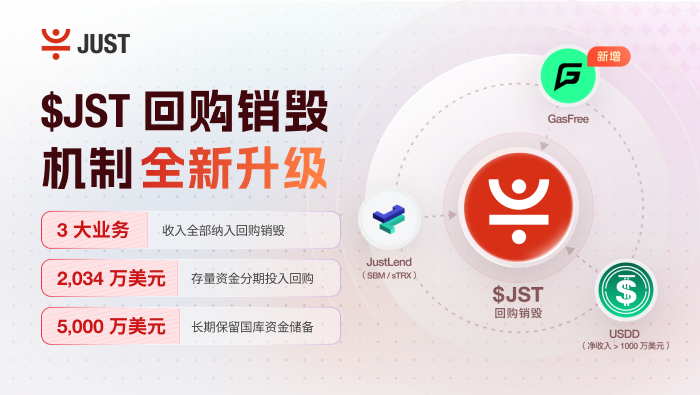
As the native governance token of the broader JUST ecosystem, how JST derives value support and utility has always been a key focus for the community. This upgrade to the JST buyback and burn mechanism not only diversifies and expands its funding sources but also ensures the continuous utilization of existing capital: beyond the original JustLend and USDD revenue streams, income from GasFree is now added. Additionally, $20.34 million in existing capital will be allocated to execute future phased buybacks, providing more stable and predictable financial backing for the buyback and burn process.
Overall, under the new mechanism, the funding sources for JST buyback and burn have officially expanded from the two business lines of JustLend and USDD to the three core operations of the JUST ecosystem: JustLend, USDD, and GasFree, supplemented by the ongoing injection of existing capital, resulting in a more diversified and robust financial foundation. This is not merely an expansion of buyback funding but signifies that the development achievements of each JUST business line can now directly feed back into the value of JST itself—reflecting JUST’s long-term commitment to the JST value feedback mechanism and demonstrating its resolve to deeply align with the interests of JST holders and the broader community.
With the simultaneous rollout of the JUST brand upgrade, unified governance, and enhanced buyback and burn mechanism, the logic behind JST’s value support is shifting from “single-business-driven” to “whole-ecosystem value capture.” For JST holders and ecosystem collaborators, this creates a deflationary mechanism with more diverse funding sources, transparent execution, and predictable pacing, thereby laying a stronger foundation for JST’s long-term value.
New JST Buyback and Burn Mechanism Implemented: $50 Million Reserve Backstop, New GasFree Revenue Stream, Injection of $20.34 Million in Existing Capital
With the completion of the fifth JST buyback and burn on October 16, the first phase of the program has officially concluded. The new JST buyback and burn mechanism is now in place: adding GasFree revenue alongside JustLend and USDD to bring all three core business streams into the buyback framework; simultaneously allocating approximately $20.34 million in existing capital for phased implementation in subsequent buybacks; and centralizing the execution of buybacks and burns under JUST DAO.
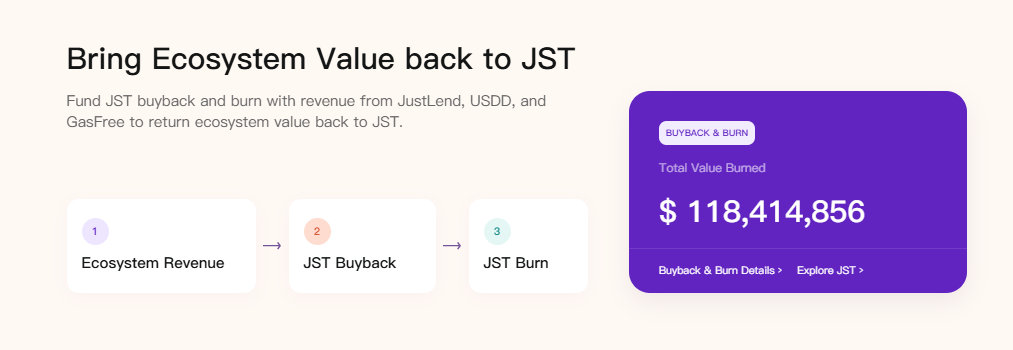
The new JST buyback and burn mechanism builds upon the successful practices established during the first phase. Since its launch in October 2025 and culminating in the fifth buyback on October 16, the entire year-long process has seen JUST successfully complete five consecutive large-scale JST buyback and burn rounds on schedule. In total, approximately 1.881 billion tokens have been burned, representing a cumulative deflation rate exceeding 19%, with over $118 million in real buyback funds deployed. The smooth operation of the first phase has verified the executability of the buyback mechanism and accumulated reliable practical experience for the upcoming upgrades.
According to the Announcement on the Adjustment of the JST Buyback and Burn Mechanism, the new mechanism has been upgraded across five dimensions: treasury fund reserves, funding sources, existing capital, buyback/burn execution, and execution entities. These adjustments set clear risk boundaries for ecosystem operations while providing more stable and predictable funding channels for JST repurchases:
In terms of treasury fund reserves, a reserve of at least $50 million will be maintained indefinitely to serve as a risk buffer, cover redemption obligations under extreme scenarios, and ensure liquidity.
Regarding funding sources, the new mechanism adds GasFree business revenue to the existing framework, ensuring all three core JUST businesses fully cover buyback funding. This specifically includes JustLend’s sTRX staking yields and SBM revenue, GasFree business revenue, and the portion of USDD net income exceeding $10 million. Moving forward, sustainable new revenue generated across JUST’s business lines will serve as the primary source for buyback funds.
Concerning existing capital, funds outside the reserve threshold will be utilized for JST buybacks. Approximately $20.34 million has already been extracted, primarily originating from GasFree’s historical cumulative profits and treasury addresses exceeding the reserve limit. This capital will be allocated in installments starting in Q4 2026 for subsequent buybacks.
For the execution of buybacks and burns, a strategy of “long-term buybacks with periodic burns” will be adopted: 100% of revenue from all JUST business lines will be continuously directed toward buying back JST. The specific amount for each buyback round will be dynamically adjusted based on market conditions, and the acquired JST tokens will be regularly burned.
Regarding the execution entity, all JST buybacks and burns will be centrally managed by JUST DAO. Relevant financial data will be regularly disclosed to the community, with all transactions remaining open and transparent on-chain.
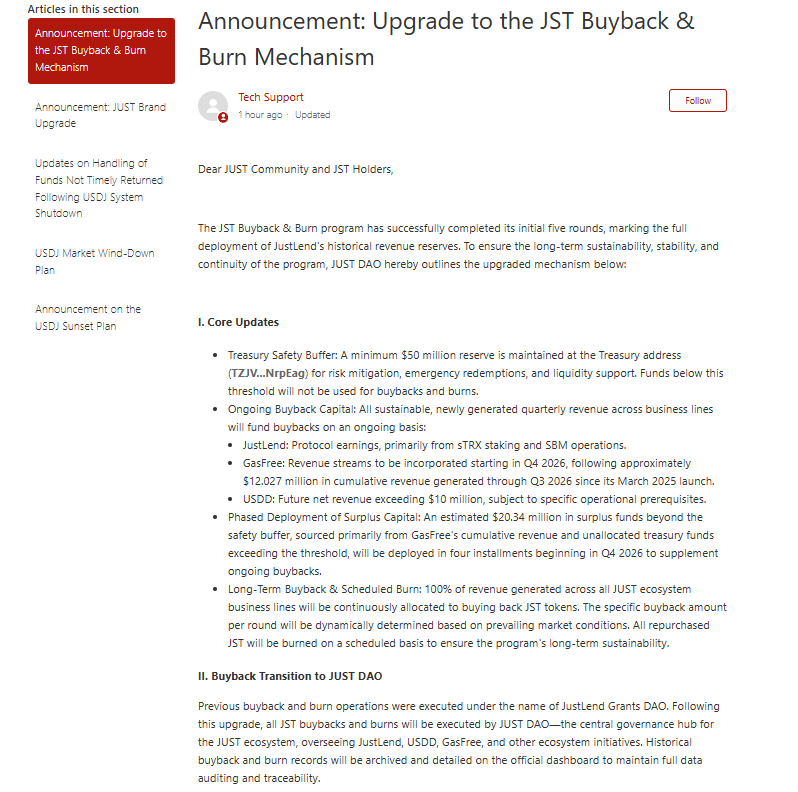
Compared to the first-phase buyback and burn plan, the updated JST mechanism introduces five core changes:
First, clearer capital reserves: The new mechanism establishes a separate $50 million treasury reserve line distinct from buyback funds, providing a foundational safety net for ecosystem operations while clearly defining the boundary of available capital for buybacks;
Second, seamless transition of existing capital: The $20.34 million in existing capital extracted under the new mechanism will be deployed in phases for subsequent buybacks, offering a relatively fixed funding source alongside business revenues. Phased deployment ensures a smoother buyback pace and allows for a more natural transition between existing capital and future business income.
Third, more diverse funding sources: Previously, buyback funds primarily came from JustLend and USDD business revenues. With the addition of GasFree revenue, funding sources now comprehensively cover all business lines within the JUST ecosystem, tightly coupling JST’s value with the overall development of ecosystem operations.
Fourth, clearer execution pacing: The “long-term buybacks, periodic burns” strategy establishes a fixed rhythm for acquisitions and destructions, facilitating community tracking and verification.
Fifth, unified execution authority: Evolved from the former JustLend DAO, JUST DAO now serves as the unified governance organization for the JUST ecosystem, overseeing the execution of buybacks and burns. This consolidates decision-making and execution under a single entity, aligning seamlessly with JUST’s prior brand upgrade and governance integration.
In summary, the new JST buyback and burn mechanism follows a “secure baseline first, then release, followed by sustained flow” approach: it first utilizes an asset reserve line worth at least $50 million to guarantee ecosystem security and define buyback boundaries; then releases existing capital above the reserve threshold in stages to provide stable foundational funding; subsequently, new revenue from the three core businesses continues to replenish the pool, creating a sustainable funding source. This arrangement balances risk preparedness and liquidity while gradually transitioning JST buybacks from temporary injections to a long-term mechanism synchronized with business growth.
GasFree Poised to Become the Second Growth Engine for JST Buyback and Burn Funding
With the implementation of the new mechanism, GasFree business revenue has been officially integrated into the buyback and burn fund pool, participating in the JST buyback program starting in Q4 2026. This move not only expands the funding sources for buybacks and burns but also enables the growth outcomes of JUST’s various business lines to more directly support JST’s value. More importantly, GasFree has demonstrated exceptionally strong performance and significant revenue-generating potential, positioning it to evolve into the second major growth driver for JST buyback funding.
From a capital structure perspective, the inclusion of GasFree directly shifts JST’s previously highly concentrated reliance on a single business stream. Previously, JST buyback funds mainly derived from JustLend business revenues and the portion of USDD net income exceeding $10 million; since USDD has not yet met its activation threshold, actual buyback capital largely depended solely on JustLend. With GasFree revenue incorporated, funding sources now expand across JustLend, GasFree, and future incremental gains from USDD once standards are met, significantly enhancing the anti-risk capacity of the capital structure.
GasFree is a no-Gas on-chain transfer solution launched within the TRON ecosystem, allowing users to pay transaction fees directly using the transferred token: without needing to pre-hold native network tokens like TRX, users can utilize the assets being transferred to settle fees and execute on-chain transfers, effectively breaking the industry limitation that requires holding specific native tokens beforehand, thereby significantly optimizing stablecoin transfer experiences. Currently, GasFree supports gas-free transfers for two mainstream stablecoins, USDT and USDD, and will continue to expand supported asset categories in the future.
Looking at its operational scale, GasFree’s user base and transaction volume are still rapidly expanding. As of October 23, cumulative stablecoin transfer volumes processed via GasFree have exceeded $157.1 billion, with over 9.14 million transactions completed, saving users nearly $9.4 million in fees. Total active users have surpassed 500,000. This fast-growing operational foundation is precisely what empowers GasFree to consistently generate buyback funds and solidify its role as the second growth pole for JST repurchases.
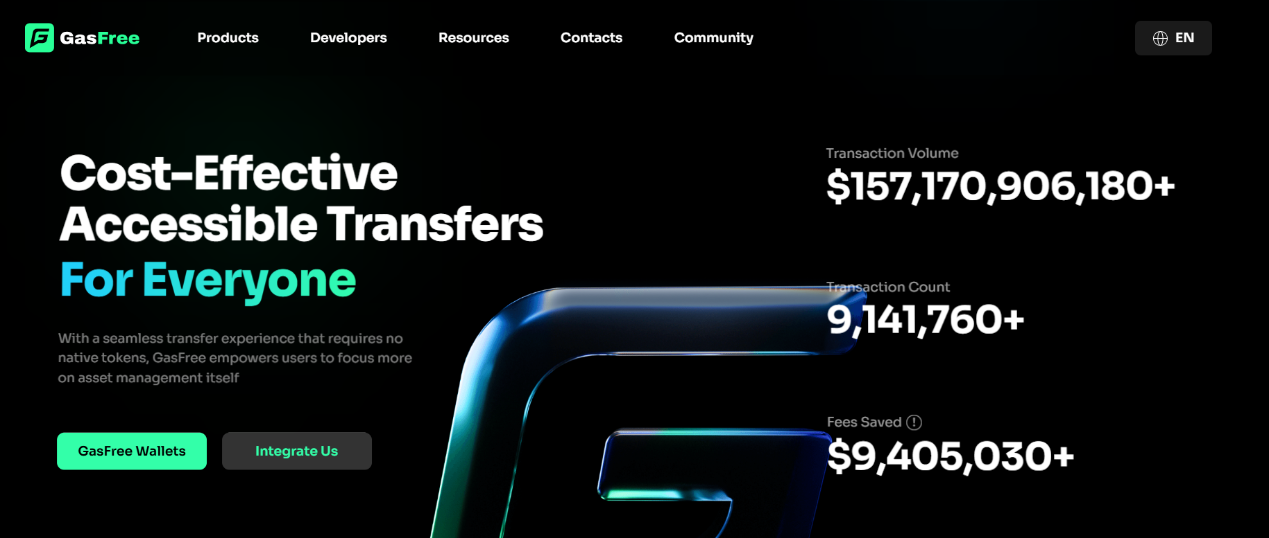
In terms of revenue performance, GasFree’s profitability has been validated by data. According to the announcement, since its launch in March 2025, GasFree’s revenue has grown continuously. By the end of Q3 2026, its cumulative historical revenue reached approximately $12.027 million. The roughly $20.34 million in existing capital extracted for this upgrade primarily stems from GasFree’s historical cumulative earnings and treasury addresses exceeding the reserve threshold.
Overall, the integration of GasFree opens entirely new revenue channels for JST buybacks and burns, improving the previously relatively single-source funding landscape. Simultaneously, the steadily growing user base and transaction volume lay a solid foundation for the long-term, stable, and sustainable supply of buyback capital. As GasFree’s revenue contribution climbs, JST buyback mechanisms will gradually shed their sole dependence on JustLend, entering a new phase of multi-business collaborative support that deeply binds the JST value feedback system with the holistic development of the JUST ecosystem.
Synergistic Empowerment from JUST’s Three Core Businesses Drives JST Buybacks, Marking a New Phase of Multi-Faceted Value Support
With the new mechanism in place, GasFree has been formally included as a buyback funding source, with qualifying portions of USDD net revenue joining concurrently. Consequently, JST buybacks and burns have evolved from early reliance on a single JustLend stream into a diversified support structure backed by multiple collaborating business lines. Within this new framework, the growth achievements of JustLend, USDD, and GasFree will continuously convert into JST’s long-term deflationary momentum and value feedback capabilities. This diversified capital foundation not only enhances the stability and sustainability of buyback funding but also significantly bolsters JST’s resilience against market volatility, firmly establishing the groundwork for the enduring operation of its deflationary mechanism.
The shift toward diversified buyback funding sources aligns perfectly with JUST’s brand upgrade. The upgraded JUST platform unites its three core products—JustLend, USDD, and GasFree—under a single brand and interface, with JUST DAO coordinating governance decisions, product synergies, and JST value empowerment across all business lines.
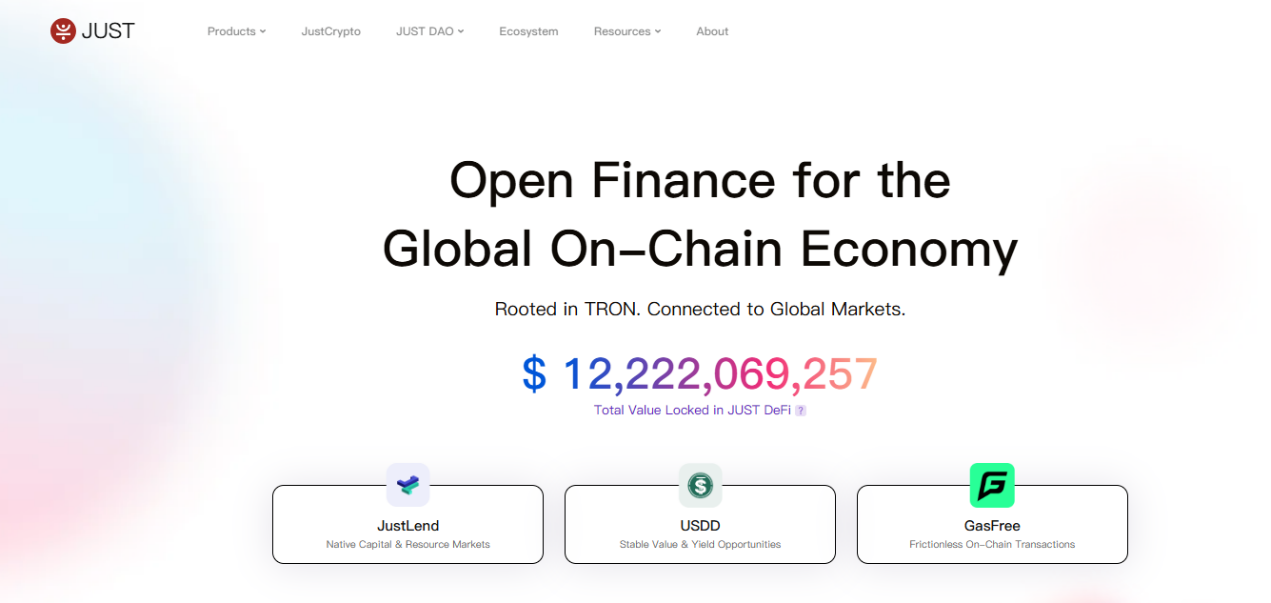
As the native governance token of the broader JUST ecosystem, JST’s value support will permeate the core product scenarios of JUST as brand consolidation and JUST DAO governance advance: JustLend covers lending and resource markets, USDD provides stablecoin services, and GasFree handles on-chain transfer payments. JST’s value foundation no longer corresponds to a single product but is intrinsically linked to the developmental trajectory of the entire ecosystem.
As a core financial infrastructure within the TRON ecosystem, the JUST platform has maintained custodial encrypted asset scales exceeding tens of billions of dollars for years, currently surpassing $12.2 billion in TVL, accounting for over half of TRON’s network capital. Concurrently, its three core businesses have each established competitive moats in their respective niches with solid fundamentals, laying a firm foundation for sustained ecosystem returns to fuel JST.
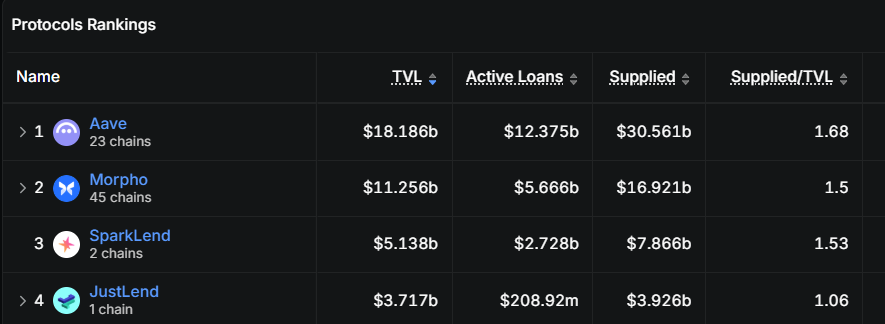
JustLend remains both the primary funding source for JST buybacks in the first phase and a crucial revenue backbone under the new mechanism, with steady operations in its SBM lending and sTRX liquid staking segments. As of October 23, the TVL locked within the JustLend platform approaches $7.135 billion. Specifically, the JustLend SBM lending market holds approximately $3.71 billion in TVL, consistently ranking among the top five globally in the lending sector. In its Staked TRX liquid staking segment, total user-staked TRX exceeds 9.83 billion tokens, with staking scale continuing to grow, providing robust support for stable revenue generation at JustLend. Furthermore, leveraging sTRX-derived energy services, JustLend is evolving into the premier energy supply gateway on the TRON network, with direct energy purchases and leasing businesses expanding steadily.
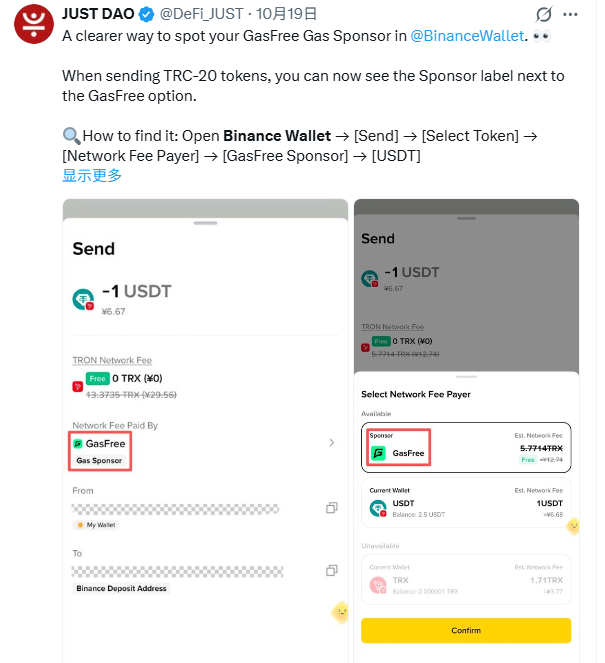
As a newly added funding source under the updated mechanism, GasFree’s ecosystem expansion is accelerating rapidly. At the end of September, GasFree partnered with Binance Wallet, the Web3 wallet beneath the world’s leading cryptocurrency exchange Binance, to jointly launch a new feature enabling third-party payment of gas fees for TRC-20 USDT: users transferring USDT or other TRC-20 assets on the TRON network via Binance Wallet no longer need to hold TRX, and can directly deduct gas costs using USDT. This integration carries dual significance: on one hand, it extends GasFree’s gas-free transfer experience to mainstream users of top-tier global CEX platforms, marking a leap from an intra-ecosystem tool to an industry-grade payment gateway; on the other hand, proactive adoption by a leading platform strongly validates the GasFree model’s value, likely accelerating further growth in both user base and business revenue.
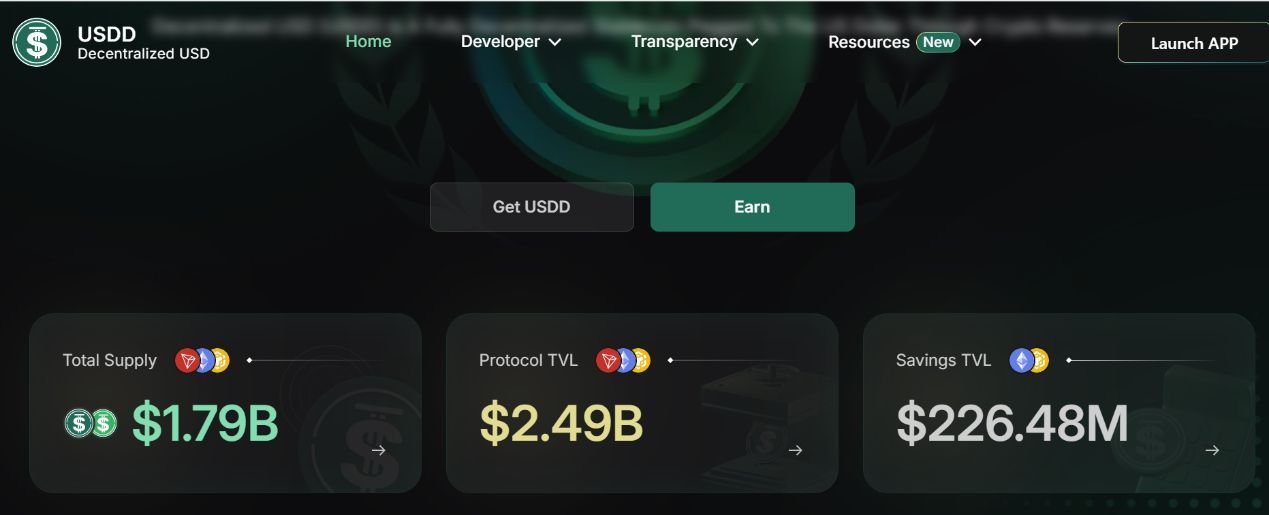
USDD represents a latent source for buyback and burn funding, with its revenues also experiencing continuous growth. Currently, USDD has completed cross-chain deployments on networks including Ethereum and BNB Chain. As of October 23, the TVL on the USDD platform exceeds $2.48 billion, with a total supply nearing $1.8 billion, elevating its market capitalization into the top ten stablecoins globally. Regarding revenue, USDD generated approximately $9.7 million in Q3 2026, up over 27% quarter-over-quarter from the previous quarter’s figure exceeding $7.65 million. Per prior regulations, the portion of USDD’s ecological net revenue surpassing $10 million will be channeled into JST buyback reserves. Given current growth trajectories, crossing this threshold is increasingly imminent, at which point USDD will formally join as another standardized funding source for the buyback mechanism.
Under value empowerment driven by multi-business collaborative revenue generation, JUST has successfully broken through the limitations of relying on a single business to support token value. Relying on the continuous genuine earnings from JustLend, GasFree, and USDD, complemented by unified and transparent governance execution from JUST DAO, ecosystem growth dividends will persistently flow back into JST, fostering synergistic growth across the ecosystem, the token, and community collaborators.
Looking ahead, as JustLend’s SBM lending and sTRX liquid staking maintain steady revenue generation, GasFree continually unleashes incremental profits, and USDD’s cross-chain ecological value progressively materializes, larger volumes and more diversified streams of genuine business cash flows will continuously channel into the JST buyback fund pool. This internally driven cycle rooted in actual business operations not only serves as the core engine propelling the long-term operation of JST’s deflationary mechanism but also significantly enhances the risk-resistant resilience of the token value system, ensuring it delivers consistent and stable value feedback across varying market cycles.