JUST Brand Comprehensive Strategic Upgrade: Synergy Across Three Core Businesses – JustLend, USDD, and GasFree, with Simultaneous Diversified Enhancement of the JST Buyback and Burn Mechanism
After the successful completion of the fifth JST buyback and burn, on October 23, JUST, the core financial infrastructure of the TRON ecosystem, officially completed its strategic brand refresh: alongside a comprehensive review and unified entry consolidation of the JUST brand ecosystem, the buyback and burn mechanism for its native token JST has simultaneously upgraded to a diversified new phase. This is not merely a brand image upgrade, but a systematic leap by JUST toward becoming a unified entry point for a multi-protocol ecosystem.
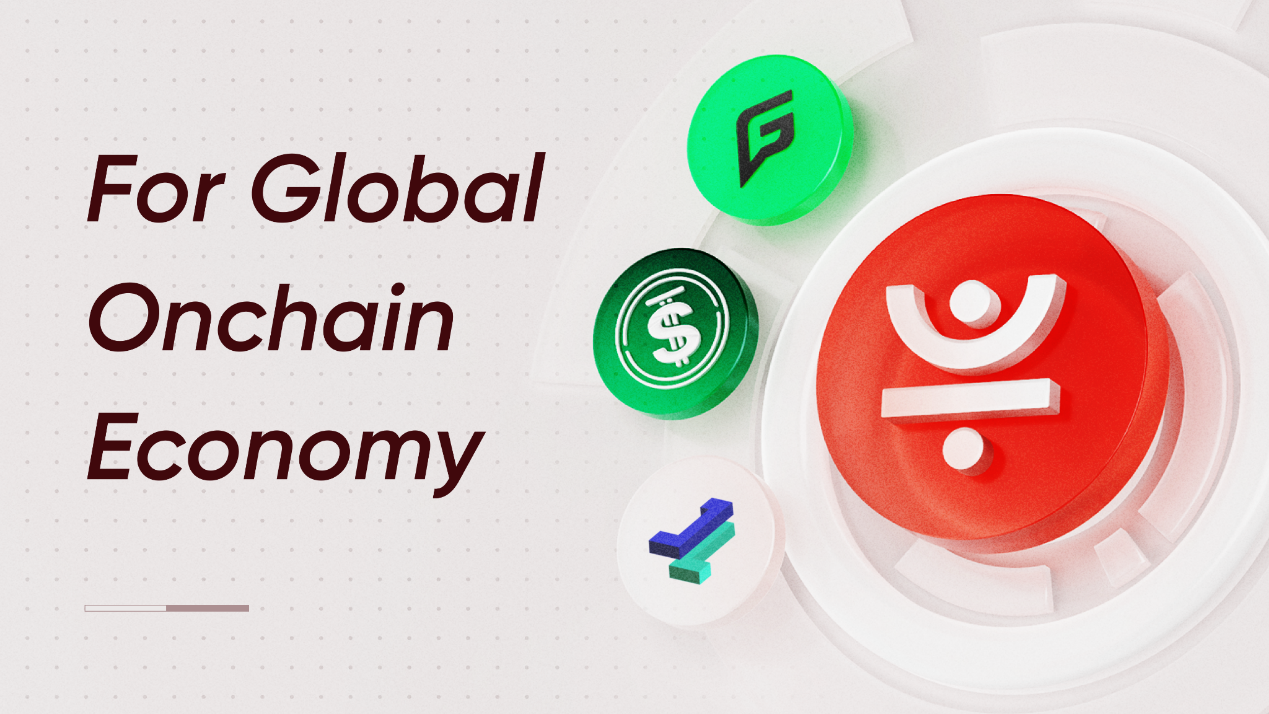
Under the new brand system, JUST consolidates its three core products—decentralized lending and resource market JustLend, decentralized stablecoin USDD, and on-chain transfer solution GasFree—under a unified brand. Meanwhile, the newly upgraded JUST DAO (evolved from the former JustLend DAO) serves as the central hub for ecosystem governance and co-construction, overseeing governance decisions, product synergy, and JST value empowerment across all business lines.
Through this deep integration and restructuring, JUST leverages its three business lines to build a one-stop open center for on-chain financial networks, covering full-link scenarios such as capital lending and resource services, stablecoin issuance and yield generation, and on-chain transfer payment solutions. This brings previously fragmented capabilities into a single entry point, synergistically releasing the network effects of the ecosystem.
If brand integration is the "visible thread" of this refresh, then the upgrade of the JST buyback and burn mechanism serves as its ecosystem's "value undercurrent". The new mechanism builds upon the revenue sources of JustLend (formerly JustLend DAO) and USDD, further incorporating income from the GasFree business line into the buyback pool; meanwhile, it will permanently reserve treasury funds worth no less than $50 million and make a one-time extraction of $20.34 million in existing funds for subsequent buybacks. This means that the growth and protocol revenues of JUST's three core businesses will more directly and efficiently feed back into the long-term intrinsic value of JST.
From this perspective, this upgrade is not merely a brand refresh, but a systematic advancement in both business synergy and value mechanisms: the former aggregates previously scattered capabilities through a unified entry point to improve capital efficiency and liquidity, making network resources and transactions easier to use; the latter introduces more diversified buyback funding sources, ensuring that business growth is more completely capitalized into the long-term value of JST.
Integrating JustLend, USDD, and GasFree: JUST Upgrades to a Unified Entry Point for Multi-Protocol Ecosystems
Through this strategic upgrade, JUST integrates JustLend, USDD, and GasFree under a unified brand and entry point for collaborative development, with JUST DAO comprehensively overseeing governance decisions, ecosystem construction, and JST asset management across all business lines, officially solidifying its role as the unified entry for the multi-protocol ecosystem.
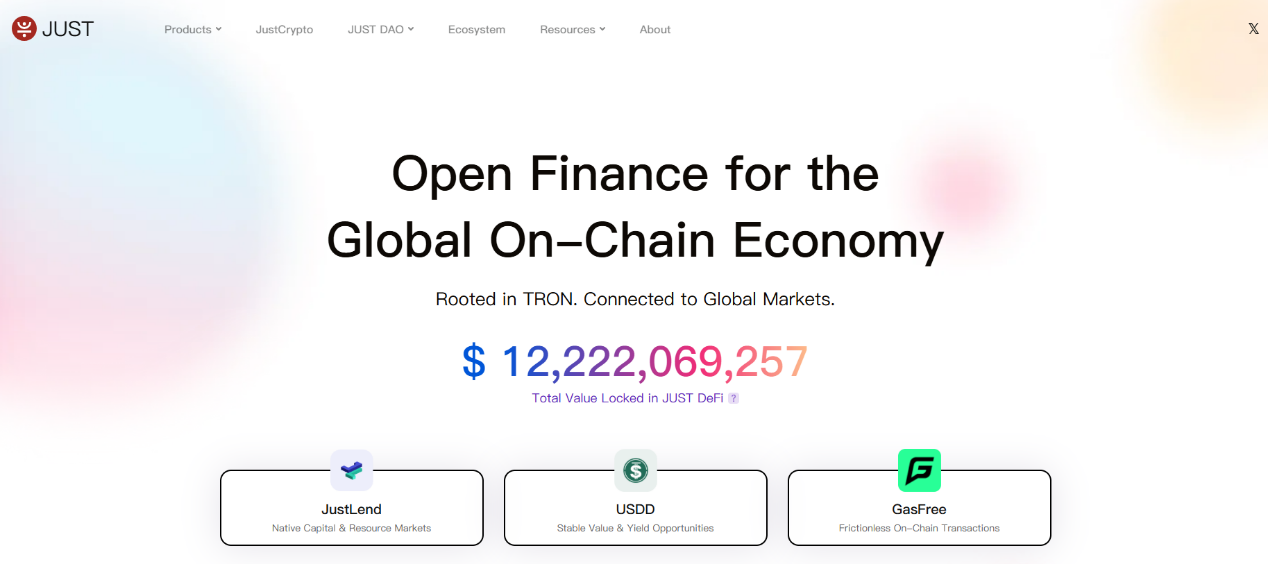
The newly launched JUST official website systematically showcases the core functional modules and real-time key operational metrics of the three products, while fully disclosing JST token basic information, ecosystem empowerment progress, and full-cycle on-chain buyback and burn data details, achieving high transparency regarding the ecosystem's operational status for the entire market.
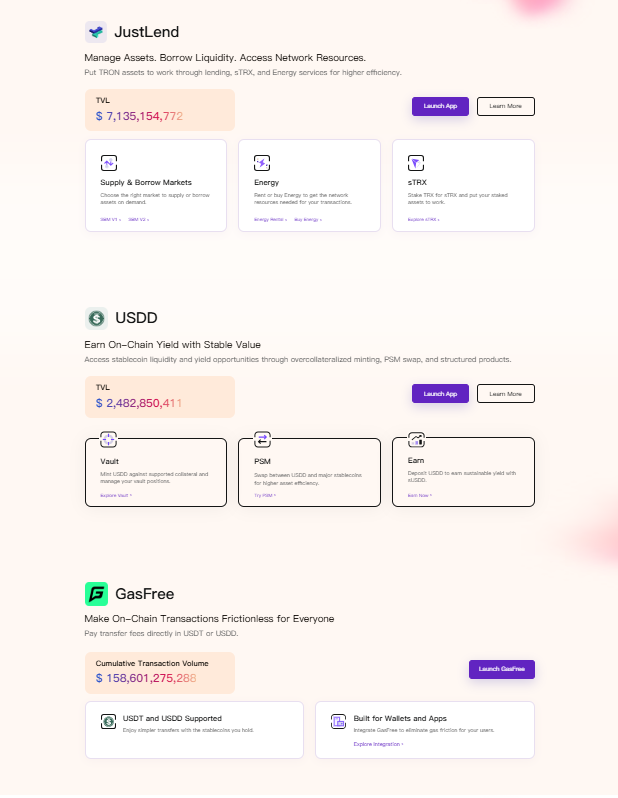
The new JUST ecosystem system is primarily composed of a product matrix and governance mechanisms. At the product level, JUST relies on its three core products—JustLend, USDD, and GasFree—to build a clear-bounded, complementary service matrix covering core on-chain financial scenarios such as asset lending, staking for yield, network resource acquisition, stablecoin allocation and earnings, and transfer transactions, forming a complete product system across the entire service chain. At the governance level, JUST DAO serves as the main body for ecosystem governance and co-construction, using the native token JST as a value bond. While coordinating the in-depth development of each business line, it drives deeper resource interoperability and functional synergy between products.
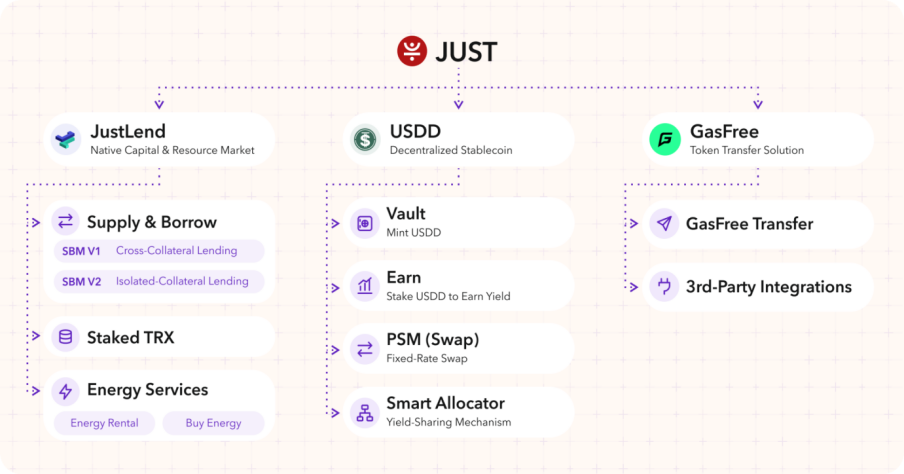
In terms of product service capabilities, the JUST ecosystem assigns specific roles to JustLend, USDD, and GasFree, each establishing functional modules around its corresponding business, collectively forming the protocol and service foundation of the ecosystem.
1. JustLend: Lending, Staking, and Network Resource Market
JustLend is the hub for asset lending, staking services, and resource scheduling in the JUST ecosystem. Composed of three main modules—the Lending Market (SBM), Staked TRX (sTRX), and Energy Services (Energy Rental & Energy Buy)—it connects asset suppliers and borrowers via smart contracts, while linking TRX holders and network resource users through staking and energy services.
Lending Market (SBM): Supports asset deposits and collateralized lending services, balancing asset appreciation yields with liquidity turnover needs. Currently, the JustLend Lending Market SBM evolves collaboratively with dual versions V1 and V2. V1, as the ecosystem's primary lending protocol, uses a shared liquidity pool and cross-collateralization mechanism to provide deposit and lending services for mainstream assets like TRX, USDT, and USDD; V2 innovatively introduces an isolated collateral architecture, capable of supporting more diverse asset portfolios to meet customized lending scenarios.
Staked TRX (sTRX): Allows users to stake TRX in exchange for yield-bearing receipts (sTRX), releasing underlying liquidity to participate in more on-chain DeFi yield scenarios while earning TRON network node staking rewards.
Energy Services (Energy Rental & Energy Buy): A network resource solution derived from staked TRX, providing on-chain interaction users with a more convenient, efficient, and cost-effective way to acquire energy resources, helping reduce gas costs on the TRON network. Currently, JustLend has built a diversified energy resource service system comprising energy rental and direct purchase, covering energy demands across various on-chain scenarios: energy rental adapts to planned, long-term, large-scale resource needs, while direct purchase instantly responds to ultra-short-term, pay-as-you-go sporadic or batch on-chain interaction demands.
2. USDD: Stablecoin Protocol
USDD is a decentralized stablecoin built on an overcollateralization mechanism, providing underlying capabilities for stable pricing, settlement, and yield participation in on-chain scenarios. It serves as both a base unit of account and the core link connecting various on-chain financial activities, forming the cornerstone for ecosystem value measurement, cross-scenario settlement, and stable yield participation. Currently, USDD has expanded from TRON to public chains including BNB Chain and Ethereum, becoming a vital carrier for cross-chain financial activities and liquidity circulation.
The core capabilities of USDD mainly include Collateral Vault, Peg Stability Module (PSM), and User Earn, corresponding to functions such as stablecoin issuance, exchange, and user returns respectively:
Collateral Vault: Users deposit vault-supported collateral assets (e.g., TRX, sTRX, WBTC, etc.) to mint USDD.
Peg Stability Module (PSM): A stablecoin exchange tool supporting zero-slippage exchange at a fixed 1:1 rate between designated stablecoins (e.g., USDT) and USDD, assisting USDD in maintaining its peg to $1 through exchange and liquidity management.
Earn: Provides yield participation channels for USDD holders. Currently, users who deposit USDD on Ethereum and BNB Chain receive yield-bearing receipts (sUSDD), accumulating returns through exchange rate appreciation; on TRON, users can also deposit USDD into on-chain DeFi protocols like JustLend to participate in yields.
3. GasFree: On-Chain Transaction Transfer Solution
GasFree is a "no-Gas" solution designed for on-chain transaction transfers. Users can directly pay network gas fees with their transferred tokens without needing to hold the native TRX token in advance, thereby eliminating the usage friction where users possess assets but cannot send them. This makes the on-chain receiving and paying experience closer to the simplicity of traditional financial transfers.
Currently, GasFree supports transfers of two mainstream stablecoins in the TRON ecosystem: USDT and USDD. When initiating USDT or USDD transfers, users can directly use the transferred currency to offset transaction fees without preparing additional TRX.
At the integration level, GasFree provides standardized API tools, a developer center, interface documentation, and testing environments. It supports flexible integration by wallets and Web3 applications, enabling rapid implementation of gas-free transfer capabilities, thereby building robust underlying infrastructure for the scaled adoption of crypto payments.
The three core products of JUST are capable of both independent deep development, while functioning in coordination under a unified framework: JustLend, operating as an asset lending and resource market, efficiently matches capital supply and financing needs through the Lending Market (SBM), and handles staking yields and network resource circulation via TRX staking and energy services; USDD serves as decentralized stablecoin infrastructure, providing foundational support for value anchoring and stable yield participation within the ecosystem; GasFree acts as an on-chain transfer payment solution, simplifying the fee payment pathway with its "gas-free" process to ensure smooth, frictionless asset circulation. Complementing and supporting one another, they form a comprehensive financial service chain covering capital, resources, stablecoins, and transfers.
To truly harness the combined force of this chain, unified coordination at the governance level is essential. In ecosystem governance and development, JUST DAO will serve as the primary governance and co-construction entity for the JUST ecosystem, evolving from the former JustLend DAO. It will uniformly oversee governance and ecosystem construction for all JUST brand business lines, with its scope covering JustLend, USDD, and GasFree, and assuming responsibilities such as JST asset management, buyback and burn processes, ecosystem grants, and decision execution. Specifically, JUST DAO coordinates the multi-protocol collaborative development, ecosystem resource allocation, and community building of the JUST ecosystem, while simultaneously providing governance safeguards for the long-term stable operation and continuous iteration of the ecosystem. Consequently, the three business lines can operate independently yet synergistically within a unified governance framework.
This dual-layer architecture of "tiered product complementarity and unified governance coordination" constitutes the core logic behind JUST's upgrade to a unified entry for a multi-protocol ecosystem — supporting financial needs inside and outside the TRON ecosystem through a clearer business matrix, a more complete service chain, and a unified governance framework.
This upgrade ultimately materializes as a dual improvement in user experience and asset efficiency: full-link needs such as financing for yield, resource acquisition, asset allocation, stablecoin earnings, and transfer circulation can all be completed in one stop within JUST's unified entry system. The entry and governance systems are interlinked, meaning users do not need to leave the ecosystem or switch platforms to find services. Multi-scenario DeFi experiences are seamlessly connected under a unified framework.
JST Buyback and Burn Mechanism Completes New Upgrade: Addition of GasFree Business Revenue, Synergistic Empowerment of JST Value by JUST's Three Core Businesses
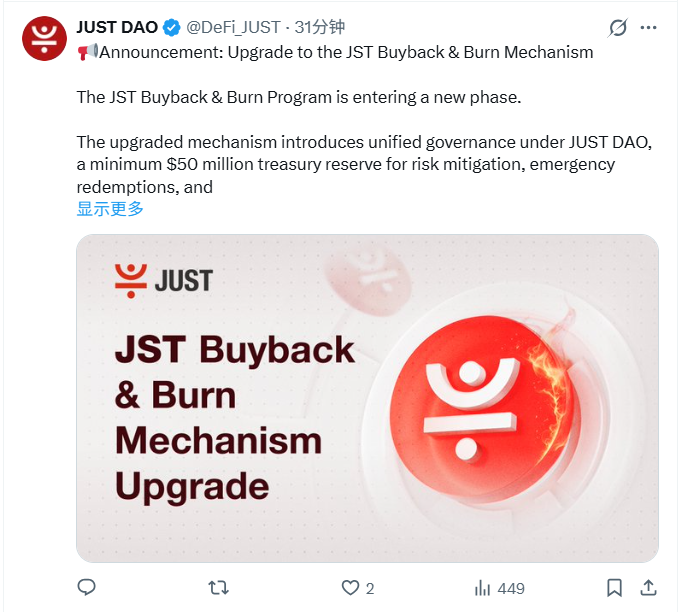
Alongside the comprehensive upgrade of the JUST brand, JST, as the native governance token of the JUST ecosystem, has simultaneously completed its buyback and burn mechanism upgrade, officially entering a new phase of diversification. Upon the launch of the new mechanism, revenues from JUST's three core businesses—JustLend, USDD, and GasFree—will jointly support JST buybacks and burns, executed uniformly by JUST DAO. This continuously translates ecosystem business growth into support for JST's token value. This represents a crucial improvement to the JUST DAO governance system and signals that JST's value support logic is accelerating from relying solely on JustLend's contribution toward multi-business collaborative driving forces.
This upgrade is built upon the successful conclusion of the first phase of buybacks and burns. With the fifth buyback and burn concluding on October 16, the remaining 70% of the historical JustLend ecosystem yield earmarked for buybacks has been fully deployed, marking the official end of the first phase. To date, the five buyback and burn events have cumulatively destroyed over 1.881 billion JST tokens, with the total destroyed amount surpassing 19% of the initial supply, and cumulative actual buyback funds exceeding $118 million. This deflationary mechanism, driven by genuine business yields, has completed its first phase of closed-loop validation within the TRON ecosystem.
Building on this, according to the "Announcement on the Upgrade to the JST Buyback and Burn Mechanism", the JST buyback and burn system has undergone systematic upgrades, featuring new arrangements across three dimensions: fund reserves, revenue sources, and deployment pacing.
Regarding treasury fund reserves, funds valued at no less than $50 million will be permanently retained for risk buffers, redemptions in extreme scenarios, and liquidity guarantees, serving as an underlying safety cushion for stable ecosystem operations.
Regarding revenue sources, the new mechanism adds GasFree as a foundational buyback fund. Consequently, the funding sources for JST buybacks and burns now comprehensively cover all JUST business lines, mainly including JustLend's business incomes such as sTRX staking yields and SBM returns, GasFree's existing and newly generated business revenues, and the portion of USDD net income exceeding $10 million.
Regarding existing revenues, funds beyond the reserve threshold will be utilized for JST buybacks. Approximately $20.34 million in existing funds has already been extracted for subsequent buybacks, primarily originating from the historical cumulative yields of the GasFree business and treasury addresses exceeding the reserve threshold. Starting in Q4 2026, these funds will be released in four tranches to supplement each buyback round.
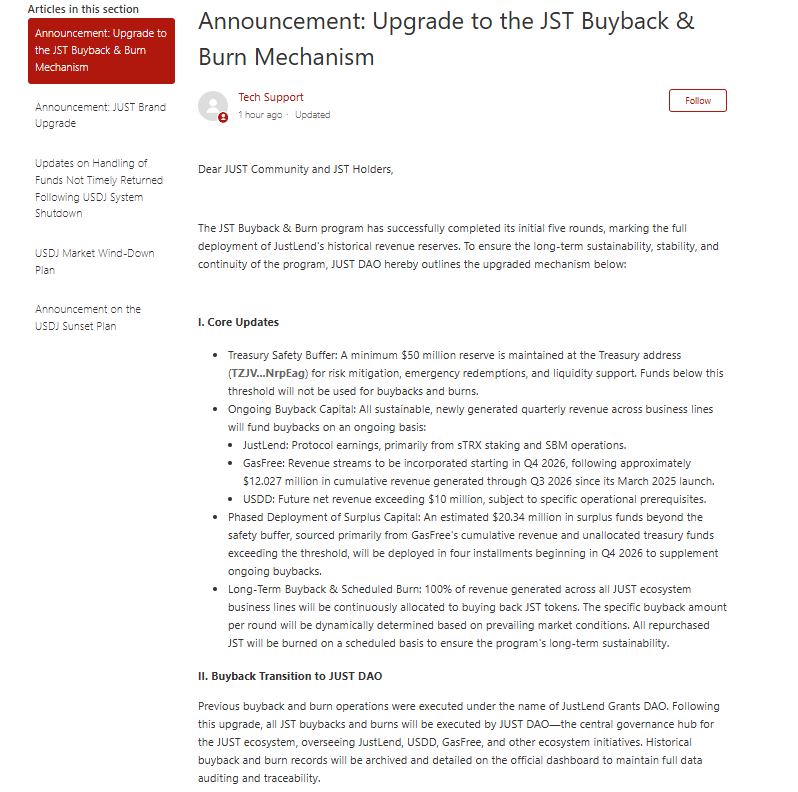
Furthermore, the executing body for JST buybacks and burns has shifted from the former JustLend DAO to JUST DAO, which will uniformly coordinate the execution of subsequent buybacks and burns.
In summary, revenues from JUST's three core businesses will be centrally collected through JUST DAO and continuously funneled into the JST buyback and burn pool, including JustLend's lending and staking income, USDD's stablecoin business net income exceeding $10 million, and GasFree's transfer service income. This means that the growth of each business line within the JUST ecosystem will no longer remain isolated, but will continuously convert into support for JST's token value through a unified governance and distribution mechanism, forming a comprehensive feedback loop from the ecosystem to JST — the stronger the business foundation, the more stable the funding source for buybacks and burns, and thus the more sustainable the support for token value.
More importantly, as a newly added funding source, the GasFree business is in a high-growth trajectory, and its revenues will become another critical pillar for the JST buyback and burn mechanism following JustLend. According to the announcement, since its launch in March 2025, GasFree revenue has continued to grow. As of Q3 2026, cumulative historical revenues amounted to approximately $12.027 million. The roughly $20.34 million in existing funds extracted for this upgrade largely stems from GasFree's historical cumulative yields and treasury address balances exceeding the reserve threshold. Starting from Q4 2026, GasFree will be formally integrated into the JST buyback plan. This indicates that GasFree's profitability has been publicly validated by data, and it is poised to continuously expand the funding foundation for JST buybacks and burns, growing into another powerful growth engine alongside JustLend.
As the three business lines of the JUST ecosystem continue to develop and their revenue structures diversify, the JST buyback and burn mechanism is expected to operate smoothly over longer cycles, continuously driving JST supply contraction and value support, thereby constructing clear and stable long-term value expectations for ecosystem participants.
From Unified Entry to Value Mechanism Upgrade: JUST Enters a New Phase of Multi-Protocol Development Through Collaborative Advancement
With the comprehensive brand refresh and the official rollout of the new buyback and burn mechanism, JUST has completed a systematic evolution spanning product integration, governance coordination, and value mechanisms. The unified brand entry has transformed the three businesses from fragmentation to synergy; JUST DAO's centralized governance provides a clear decision-making body for cross-business-line decisions; the new buyback and burn mechanism clarifies the transmission path from ecosystem business growth to JST value. Progressing layer by layer and mutually reinforcing each other, products, governance, and value mechanisms drive JUST into a new stage of multi-protocol collaborative development.
Alongside completing its overall strategic leap, JUST has also released the New White Paper, systematically explaining JUST's ecosystem architecture, three core products, and JST economic model, providing comprehensive informational reference for users, developers, and partners.
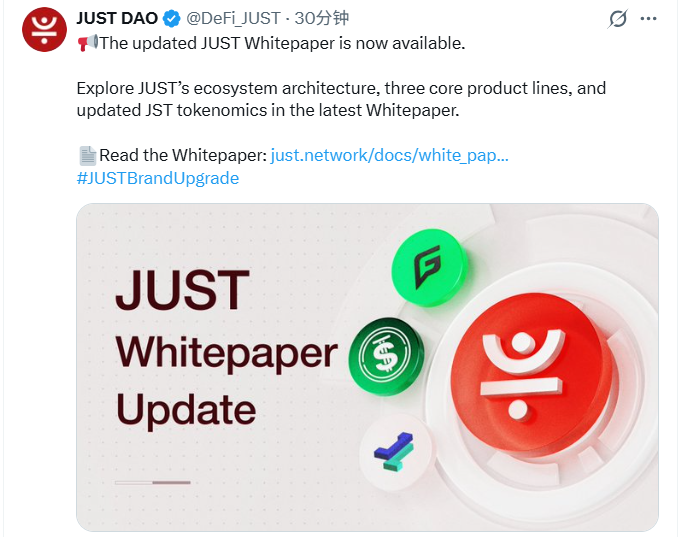
The significance of this upgrade extends beyond architectural adjustments to the tangible results brought about by business synergy. The value of this collaborative advancement will ultimately release its impact synchronously across three dimensions: ecosystem, users, and long-term development:
At the ecosystem synergy level, JUST's three businesses form a mutually reinforcing division of labor: GasFree lowers the barrier to on-chain interactions through "gas-free" transfers, continuously expanding the ecosystem's asset and user entries; USDD locks in liquidity through its stablecoin and yield system, providing a unified value benchmark for cross-scenario settlements and yield circulation; JustLend handles lending financing and network resource scheduling, ensuring efficient matching of capital and resources within the ecosystem. Positioned distinctly yet channeling traffic to one another, they shift ecosystem growth away from reliance on a single product toward building structural resilience through multi-business resonance.
At the user experience level, business synergy directly translates into highly efficient improvements. Users enter the ecosystem via GasFree's gas-free transfers, complete lending, staking, and resource acquisition at JustLend, and then engage in stablecoin yields and circulation through USDD. These three businesses string together a coherent asset usage path, covering the entire process of asset "entry, utilization, and circulation." Compared to the past requirement of repeatedly switching between multiple independent ecosystem protocols, users can now satisfy their core needs from holding to circulating within a single ecosystem. Cross-platform operations are reduced, and the risk boundaries of each product are much clearer.
At the long-term development level, the unified JUST DAO enables holistic coordination of multi-protocol governance decisions, capital allocation, and ecosystem investments, preventing individual protocols from operating in silos and granting the ecosystem stronger adaptive synergy. Meanwhile, as a governance token, JST links governance participation across business lines with the buyback and burn mechanism: the more active the business, the more solid the protocol income foundation, and thus the more stable the funding source for buybacks and burns. Business growth consequently translates continuously into the long-term management of JST's supply.
Looking ahead to this new phase, JUST will continue to deepen the synergy among its three core businesses—JustLend, USDD, and GasFree; refine governance participation and value capture mechanisms centered around JST; steadily expand ecosystem boundaries; and continuously advance toward the vision of "building an open financial network for the global on-chain economy." At the same time, JUST will further solidify the financial infrastructure of the TRON ecosystem, leveraging its accumulated financial capabilities to serve broader on-chain markets.