Babylon Submits Proposal to Aave V4: Borrow Against Bitcoin While Keeping Your Coins in Your Own Wallet
Author: Alea Research
Compiled by: TechFlow
TechFlow Summary: For a long time, Bitcoin, as the largest collateral asset in crypto, has faced a trust dilemma in DeFi lending that requires ceding control. Almost all wrapped Bitcoin or centralized lending products heavily rely on custodians and multisig alliances. The new ARFC proposal submitted by Babylon Labs to Aave V4 completely breaks this constraint: through its innovative BaBe zero-knowledge proof system and native Taproot scripts, borrowers keep their private keys and assets while pledging Bitcoin, slashing dispute resolution costs from $14,211 for BitVM2 to just $37.82. This mechanism not only activates idle WBTC reserves within the Aave protocol to support instant liquidations, but also opens a new channel for institutions to borrow stablecoins while keeping compliant assets on their balance sheets, potentially restructuring the liquidity landscape of trillion-dollar Bitcoin assets.
Bitcoin represents the largest pool of idled collateral in the cryptocurrency space because pledging it often means surrendering control. Of the 20.1 million mined Bitcoins, only 1.7% exist as tokens on other blockchains, with virtually every underlying Bitcoin held by custodial institutions or signer consortia. Nevertheless, holders remain highly demand-driven. Coinbase integrated its Bitcoin staking and lending business into a market on the Morpho lending protocol; YoY to September 30, USDC lending on this market grew 74.9% to $1.5 billion. On October 14, Babylon Labs submitted an ARFC request to Aave V4 to support native Bitcoin remaining in the owner's UTXOs as collateral. As long as a single honest challenger exists, malicious withdrawals can be prevented, and the Bitcoin holder themselves can serve as this challenger. Aave voters passed the temperature check vote with 299,743 AAVE in favor and 0 against; a Snapshot vote will follow immediately.
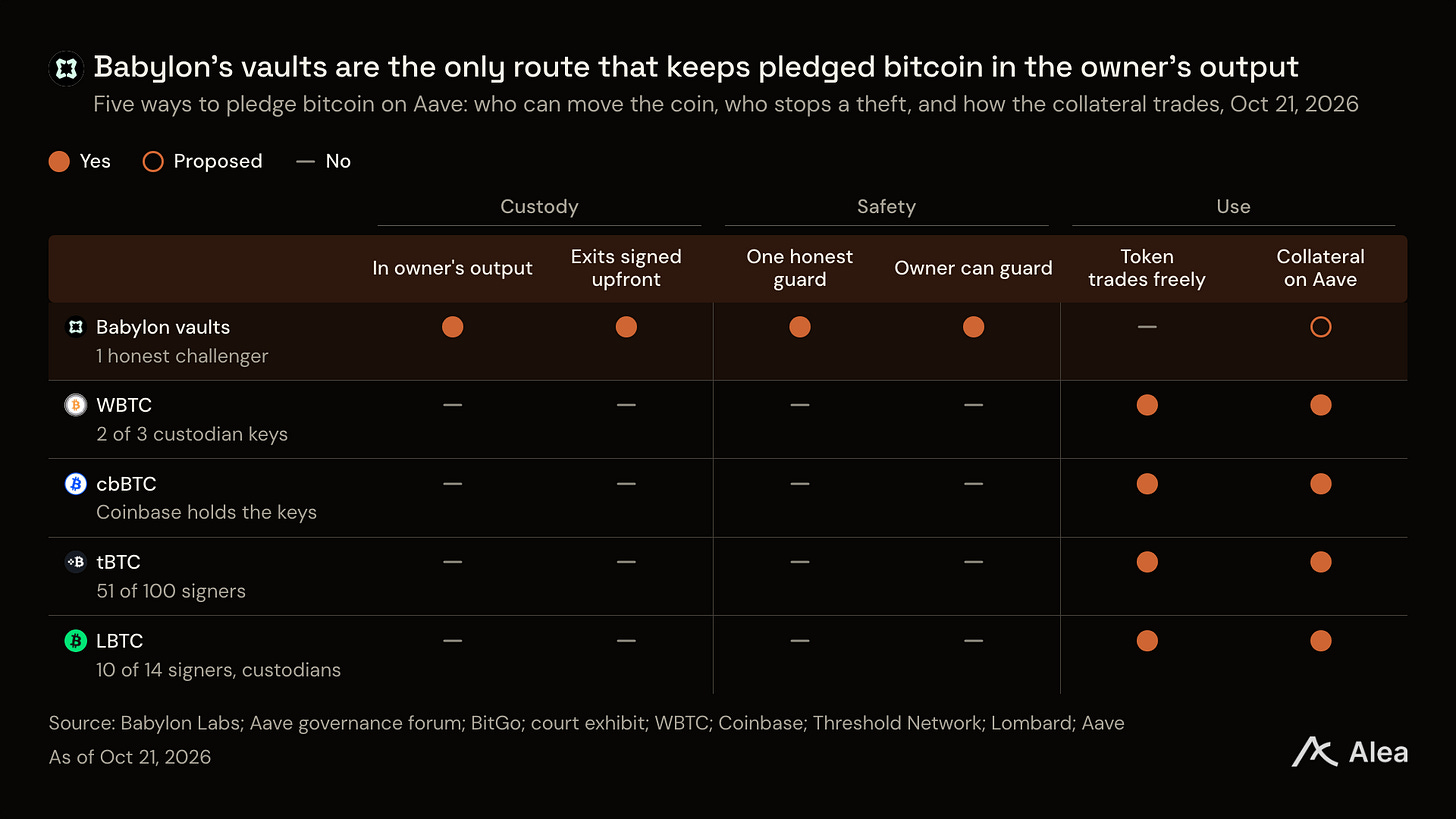
Figure 1: The Babylon committee can pause vault contracts on Ethereum, but cannot transfer Bitcoin.
Core Takeaways
• The Babylon vault reduces the required trust threshold for borrowers to a single honest party. By contrast, WBTC custodians manage reserves via 2-of-3 multisig, tBTC requires 51 of 100 signers to transfer tokens, and LBTC relies on 10 of 14 syndicate members. The Babylon vault only needs a single honest challenger, a role entirely fulfillable by the coin holder themselves.
• Within the BaBe framework, on-chain dispute resolution costs only $37.82, compared to $14,211 for BitVM2. This proof system developed by Babylon Labs will be presented at ACM CCS 2026, drastically reducing per-vault initial setup data from 40.5 GiB to 22.2 MiB.
• Bitcoin holders have previously borrowed large amounts of USD through custodians. As of September 30, Coinbase’s Morpho lending channel leveraged 38,536 cbBTC as collateral to lend out $1.5 billion, growing 74.9% annually, with Coinbase holding the physical Bitcoin backing each cbBTC.
• Aave gains access to a new borrower demographic and finds a use for its idle WBTC. As of September 30, out of 34,545 WBTC supplied on Aave, borrowers only drew down 2.10%; Babylon’s Swap Spoke can draw funds from this reserve to instantly pay liquidators. Aave retains the first $500,000 of qualifying annual revenue and receives at least 61.5% of every subsequent dollar.
• Before mainnet launch, two reviews, two rounds of voting, and one re-audit remain. Aave risk services provider LlamaRisk and Aave Labs will publish evaluation reports on the forum, followed by Snapshot voting on specific risk parameters and the deployment of an on-chain AIP proposal.
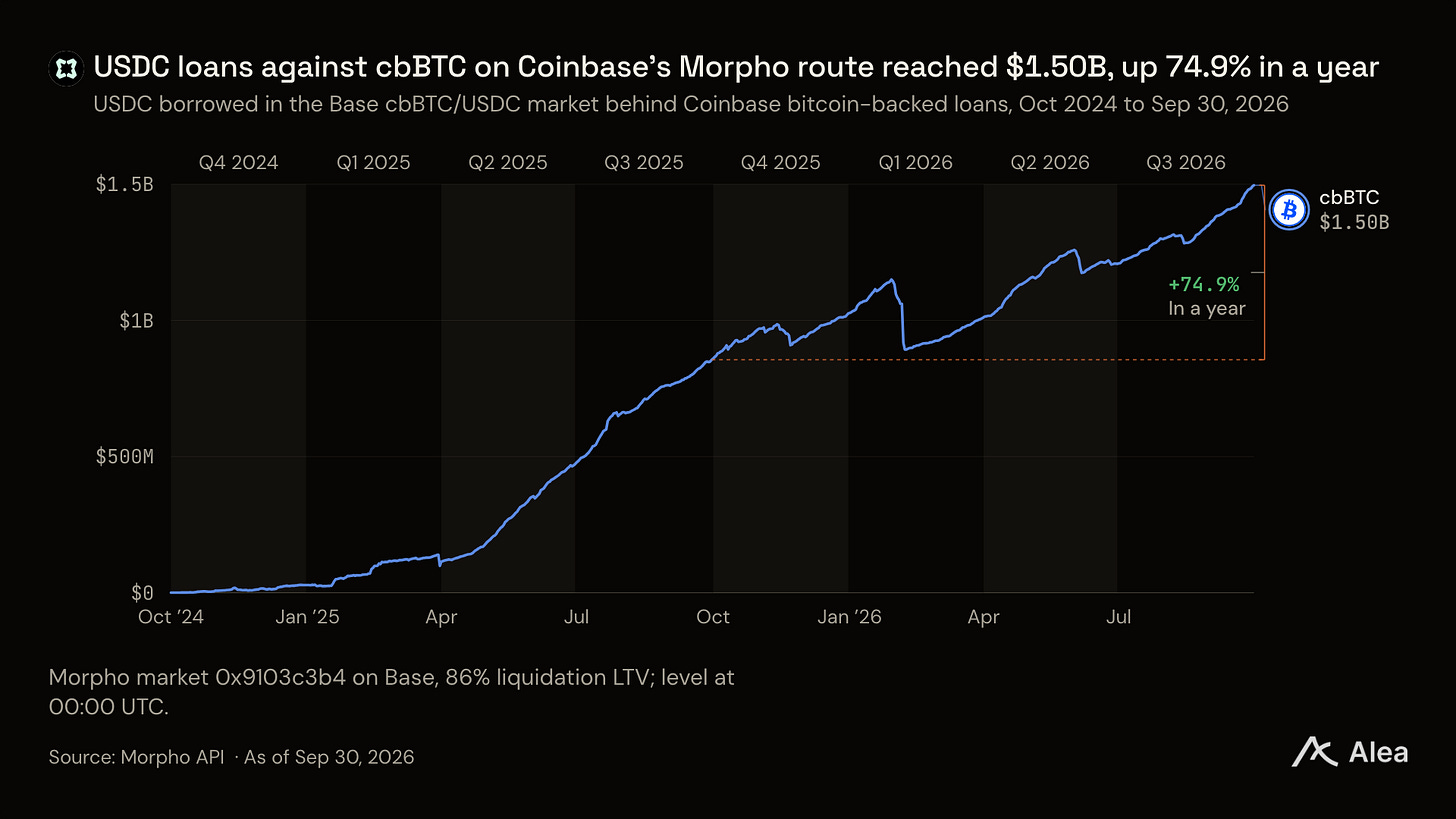
Figure 2: Coinbase integrates its Bitcoin mortgage loans into this Morpho market on the Base chain. As of September 30, 38,536 cbBTC backed these loans, with Coinbase holding the underlying Bitcoin for each cbBTC.
Why Bitcoin Was Previously Custodied: Dispute Costs Dropping from $14,211 to $37.82
Bitcoin’s scripting language verifies signatures, hashes, and timelocks, but cannot directly verify zero-knowledge proofs or read state from other blockchains. Writing a proof verifier in Bitcoin script consumes roughly 900 MB of block space per proof, equivalent to 225 full blocks. Consequently, Bitcoin in DeFi has always required some entity to hold it on behalf: a custodian, a signer consortium, or a coalition that signs off-release transactions upon loan repayment.
BitVM, released in October 2023, moved verification off-chain, allowing claims to default as valid unless proven false. BitVM2, launched in August 2024, reduced cross-chain bridge trust assumptions to a single honest party, despite requiring $14,211 per dispute and relying on non-standard transactions rarely relayed by most Bitcoin nodes. BitVM3 used garbled circuits to bring dispute costs down to $37.65, though each vault still required storing 40.5 GiB of initial setup data. BaBe, built by Babylon Labs, UC Berkeley, and Stanford researchers using witness encryption, not only keeps dispute costs at a remarkably low ~$38, but slashes setup data volume by 1,868x down to just 22.2 MiB.
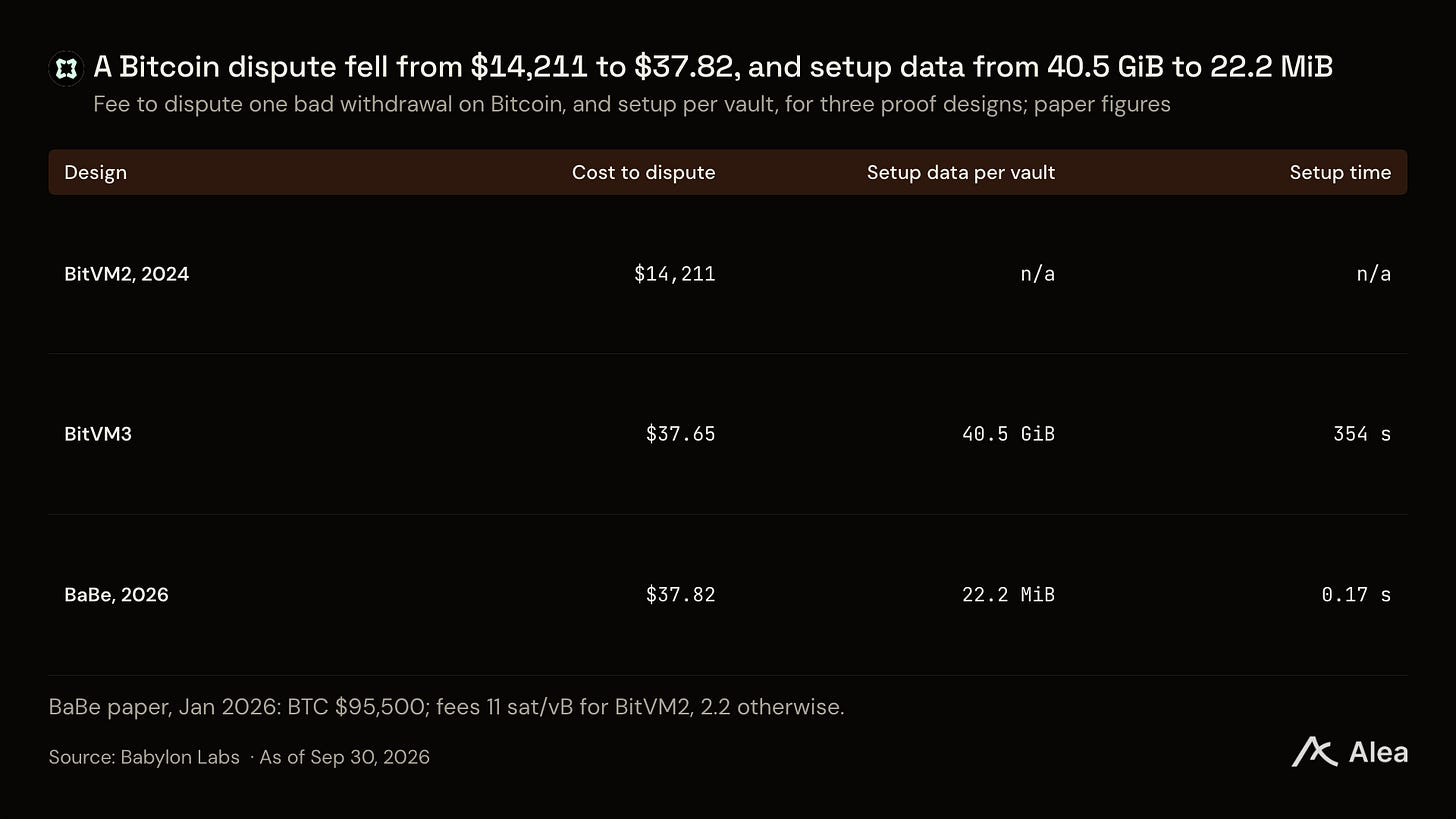
Figure 3: Paper data calculated based on January 2026 fee and price assumptions. Savings in on-chain overhead stem from BitVM3; BaBe builds on this advantage, eliminating the storage costs required to run BitVM3 per vault.
The Babylon vault constructs this proof system around individual owner-held coins. Before Bitcoin is locked, all parties pre-sign every possible destination for those BTC: refunds, withdrawals, liquidation claims, and challenges. Subsequently, the Bitcoin network only accepts these pre-signed transaction paths. Claims must contain valid proofs and undergo a multi-day challenge window. During this window, the vault operator, application keepers, generic challengers, or the Bitcoin holder themselves can step in to block malicious claims.
How Vault Lending Operates on Aave V4: Tokens Remain on Chain, WBTC Settles Liquidations
Since its Ethereum launch on March 30, Aave V4 divides lending into Hubs (holding liquidity) and Spokes (imposing specific rules for various borrowers). This ARFC introduces two new Spokes. The Babylon Spoke, written by Aave Labs, is a derivative of the standard Aave Spoke, using native Bitcoin as its sole collateral. Aave has already deployed an LBTC Spoke, making Babylon’s proposal the first for unwrapped native Bitcoin. Stani Kulechov described this specialized BTC hub as “the exact use case V4 architecture was built for.”
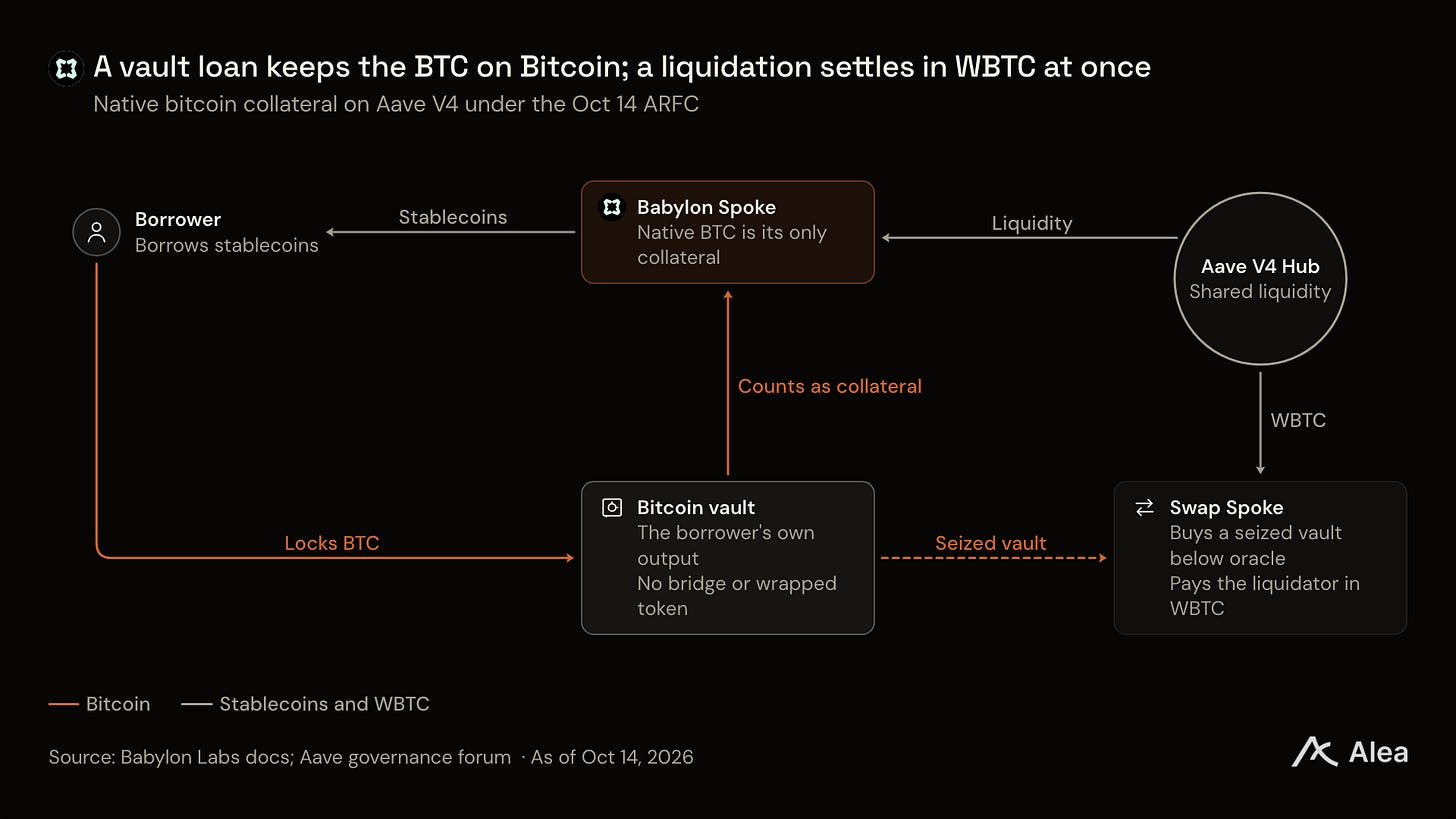
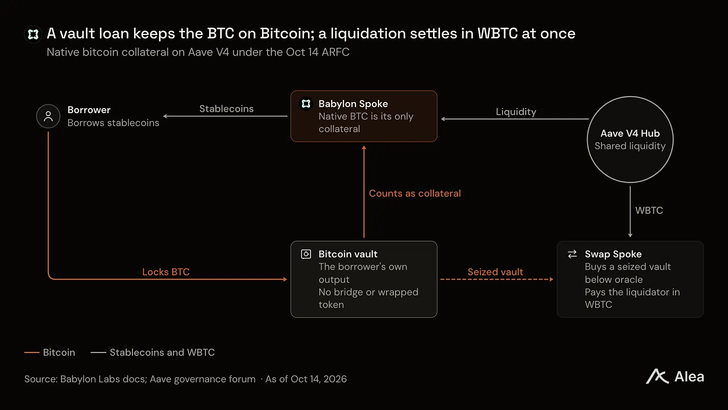
Figure 4: Vault records are stored within the user’s Aave position. Upon liquidation, the entire vault transfers to the Swap Spoke, which uses WBTC drawn from the Hub to pay the liquidator.
Asset owners lock BTC in Taproot outputs on the Bitcoin network, after which an adapter on Ethereum records it as an admin-free, non-transferable, non-tradable, and non-upgradable receipt token. Owners then borrow stablecoins from the Hub, paying Aave’s base rate plus a Babylon interest fee (unset in the current ARFC).
The liquidation mechanism provides Aave with a second stream of interest income. If a position’s Health Factor drops below 1, liquidators repay the debt and confiscate the entire vault. The Swap Spoke acquires the vault at a discount to oracle prices and pays liquidators using WBTC drawn from the Hub; authorized arbitrageurs then repay the WBTC and redeem the Bitcoin from the network over several days. Since borrowers only drew down 2.10% of the 34,545 WBTC supplied on Aave V3 as of September 30 (down from 14.6% in May 2024), this model fully utilizes reservoir pools with ample surplus liquidity.
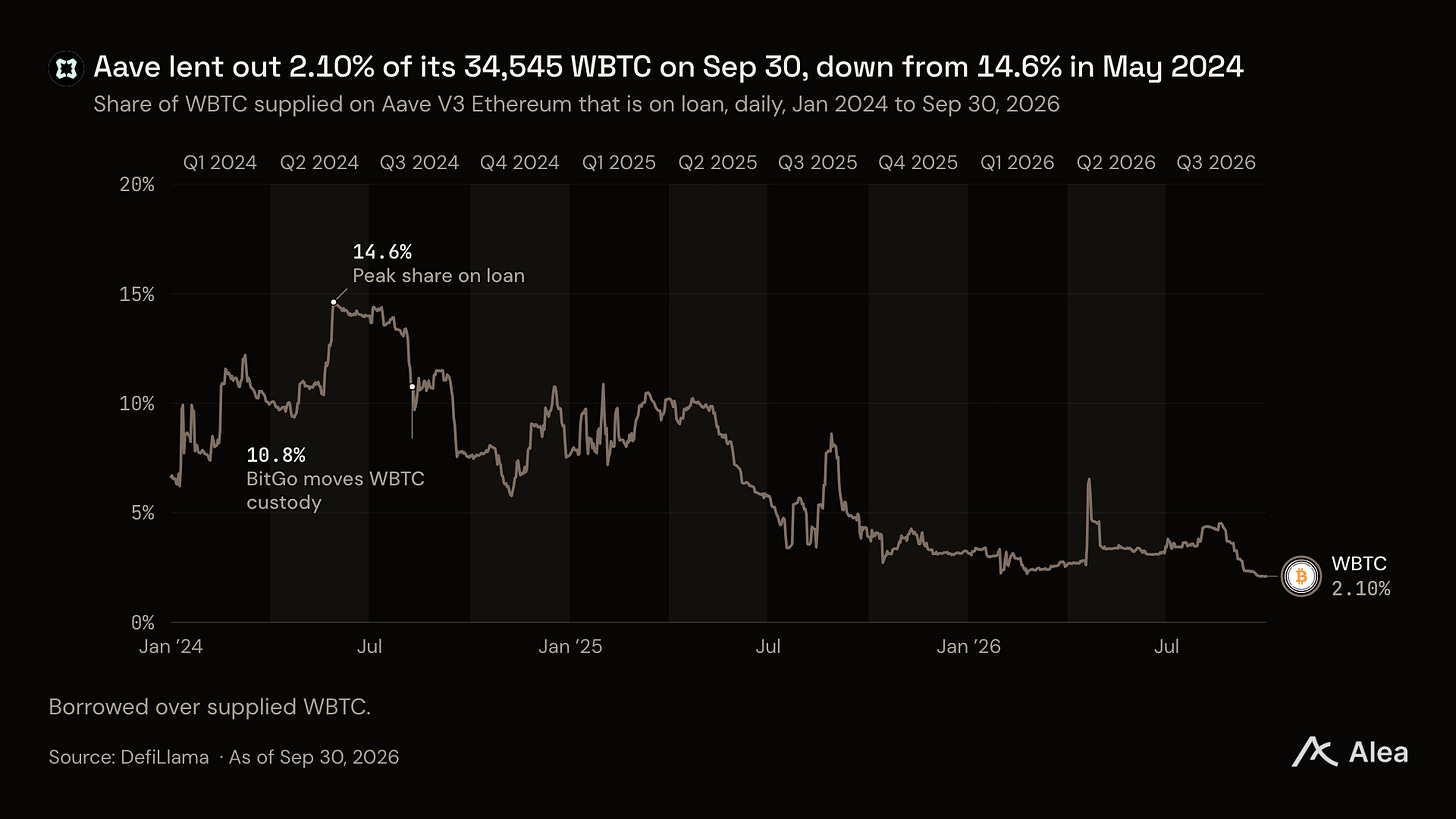
Figure 5: After BitGo migrated its custody solution in August 2024, WBTC lending volumes declined. Each vault held by the Swap Spoke carries WBTC debt payable to the Hub until arbitrageurs repay it.
What Institutions Stand to Gain: Bitcoin Remains on the Balance Sheet
Institutional investors have long financed assets through similar structures. In tri-party repo trades, collateral stays with a mutually trusted custodian while lenders hold executable claims; the Babylon vault preserves this structure, substituting Bitcoin scripts for a custodial agent, where the true custodian is the asset owner themselves. Fisher Yu describes it as “Bitcoin that never leaves the owner’s possession, balance sheet, or jurisdiction.” HashKey Cloud plans to allow Asian institutional clients to borrow against native Bitcoin via these vaults and deploy the obtained stablecoins into yield strategies.
Lending pricing has also been revolutionized. Bitcoin lender Ledn offers annual rates ranging from 11.49% for loans under $250k to 9.25% for large loans above $2M. Over the 30 days ending September 30, the average APY for USDC lending on Aave V3 was only 4.64%, applying a uniform rate regardless of loan size. Babylon expects vault lending costs to range between 3% and 5% APY, planning to charge 0% vault protocol fees during the initial launch phase.
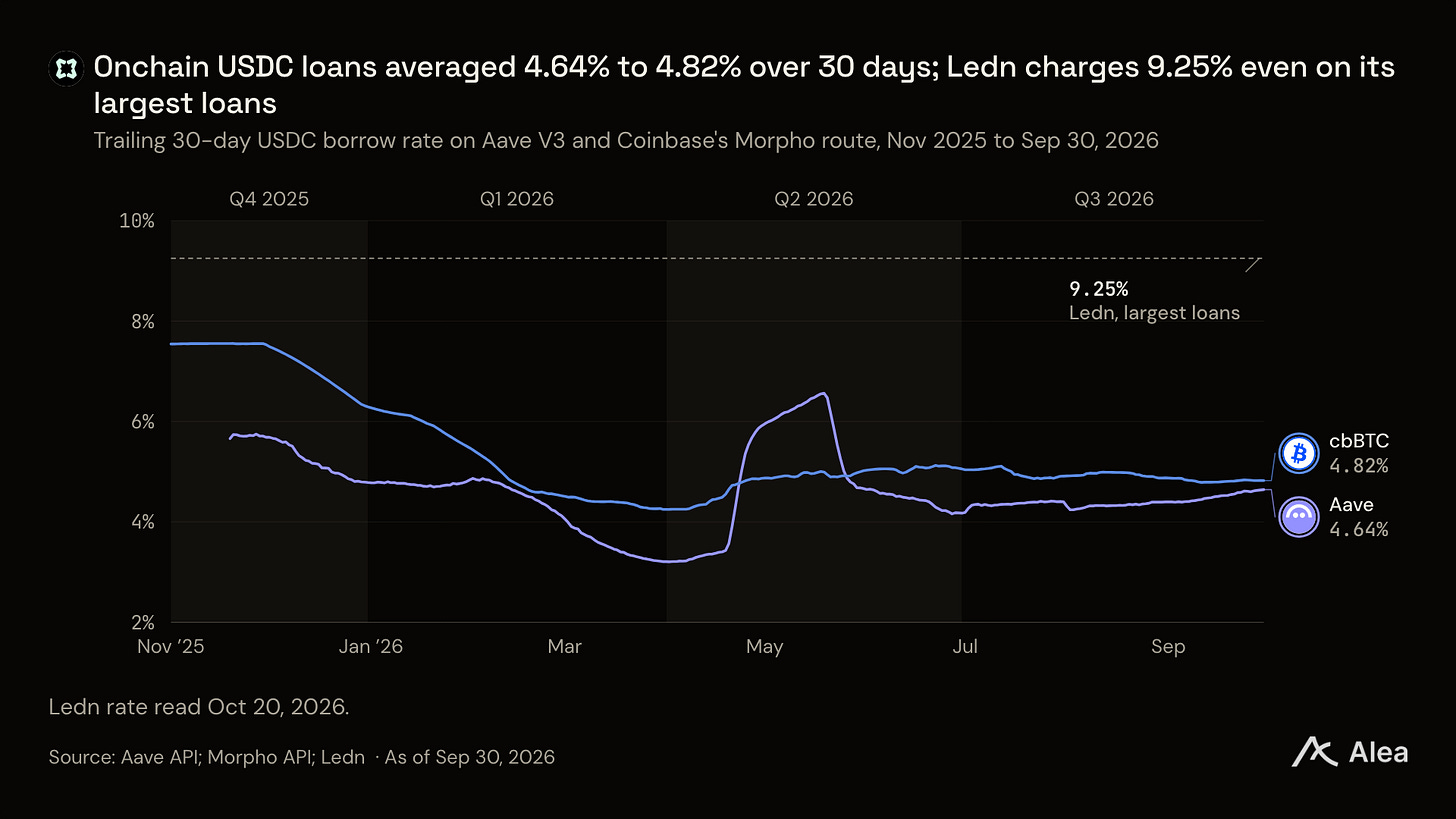
Figure 6: On-chain rates fluctuate based on market utilization, applying uniformly across all loan sizes; whereas Ledn’s quoted rates decrease as borrowing scales increase.
The strong institutional demand for decentralized self-custody lending stems from painful historical losses. Former lending platforms like BlockFi lent customer crypto to institutional borrowers, and Genesis lent crypto from Gemini Earn; both declared bankruptcy before January 2023. When BitGo migrated WBTC custody to a joint venture with BIT Global in August 2024, stablecoin issuer Sky immediately voted to slash its WBTC lending cap to zero. As of October 20, WBTC reserves held 116,512 BTC, down 25% from the 154,707 BTC held on announcement day. With Babylon vaults, asset allocators no longer focus on fragile counterparty balance sheet risks, but rather transparent on-chain exit mechanisms. After a multi-day challenge window, Bitcoin returns directly to the sender. Vault contracts on Ethereum can be paused instantly by two multisig setups: a 4/7 interim governance multisig and a 3/5 emergency guardian multisig including Aave Labs and LlamaRisk seats. Emergency guardians can independently unpause, while contract upgrades feature a 5-day timelock. Aave’s risk services will set lending caps and LTV ratios prior to on-chain voting.
Revenue Distribution: Aave Retains the First $500,000 and Takes At Least 61.5%
The ARFC outlines precise revenue distribution: income sources include the Hub liquidity fee extracted from interest paid by Babylon Spoke borrowers, plus liquidation-generated fees. Remaining interest from borrowers goes directly to Hub liquidity providers. Aave exclusively retains the first $500,000 of annual qualifying revenue. Excess amounts split incrementally, with Babylon’s share scaling from 18% to 31.5%, while 4% to 7% of revenue is allocated to buy back AAVE and BABY tokens publicly (85% allocated to AAVE). Buybacks will be split equally between the Aave DAO and the Babylon Foundation.
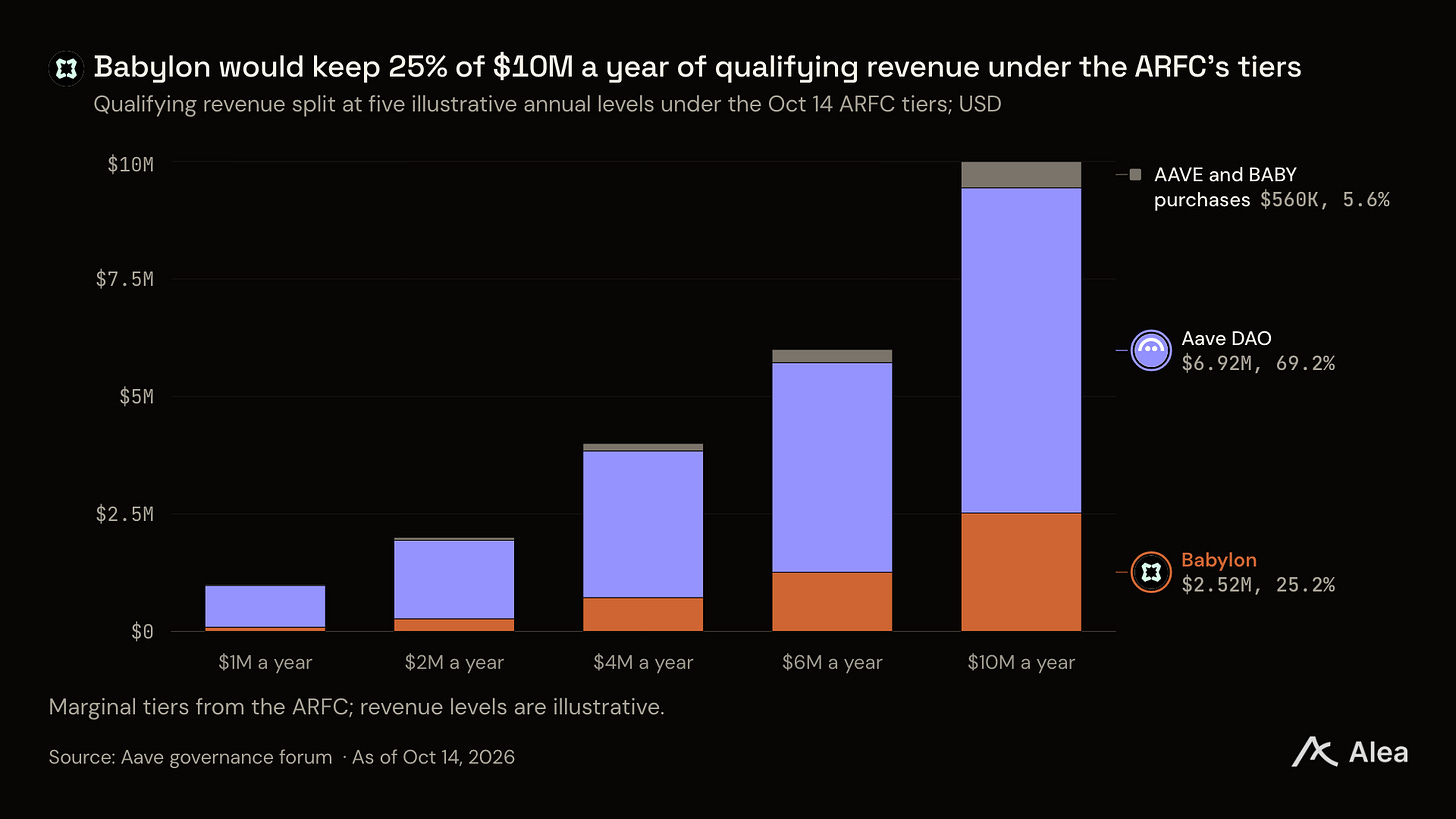
Figure 7: Tiered splits apply only to income within that bracket. At $10 million in annual qualifying revenue, the Aave DAO retains approximately $6.92 million, Babylon takes ~$2.52 million, and $560,000 is allocated to repurchasing AAVE and BABY.
For BABY token holders, these vaults establish the first direct link from borrower interest to token value capture. At $10 million in annual qualifying revenue, the repurchase tranche buys $84,000 worth of BABY yearly, while Babylon’s own protocol revenue share is substantially larger; Babylon plans to introduce a new emissions plan in January to reduce inflation and steer token supply toward vault usage. Since December 1, 2025, BABY has fallen 37.1%, compared to BTC down 9.2% and AAVE down 14.6%, currently trading at a circulating market cap of roughly $60.4 million—starkly contrasting with the 40,843 BTC staked on the Babylon protocol.
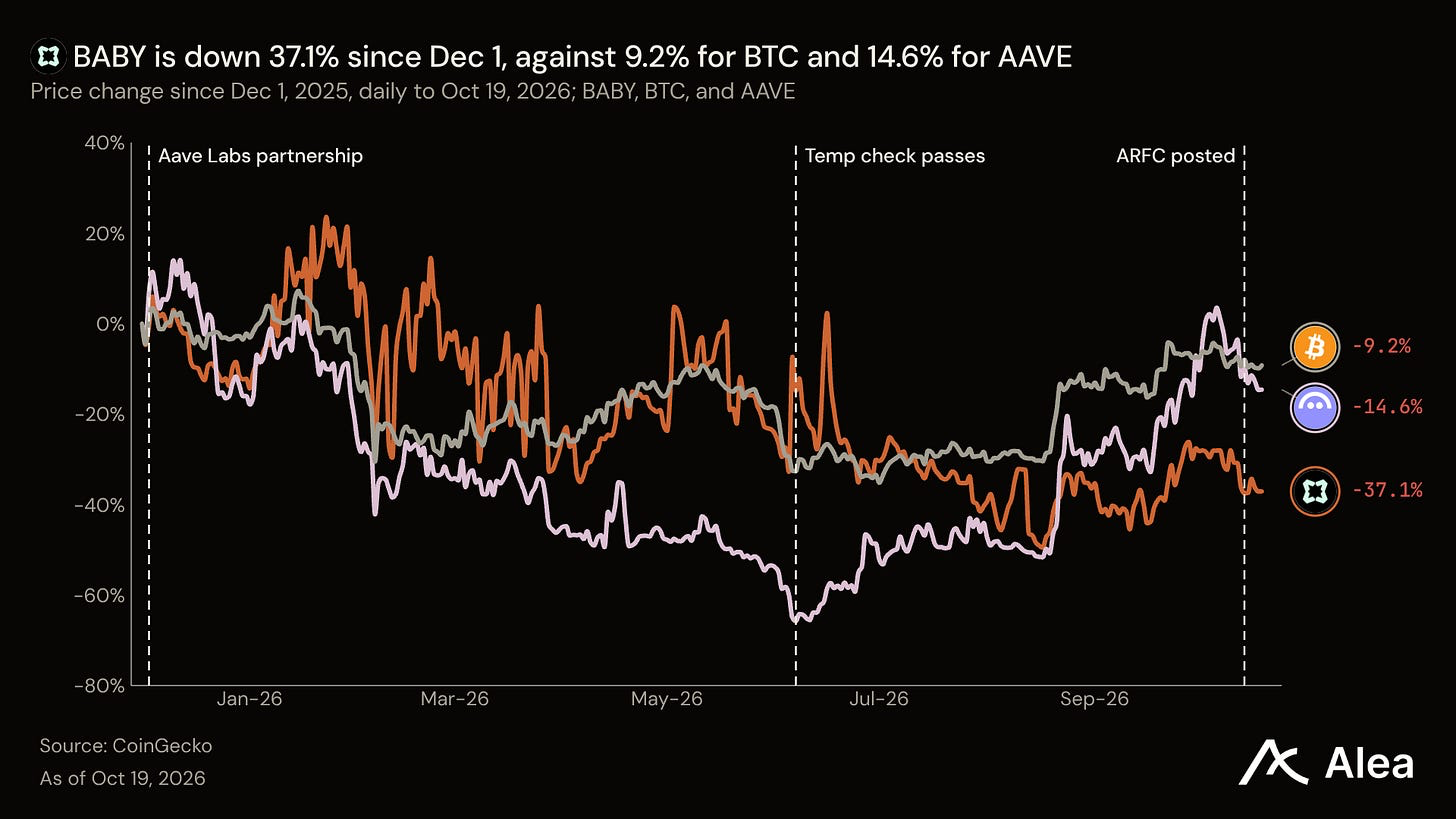
Figure 8: Price chart since December 1, 2025. Dotted lines mark key milestones: partnership with Aave Labs, passing the temperature check vote, and submission of the ARFC proposal.
Next Steps: Two Reviews, Two Votes, and a Capped Mainnet Launch
Since the proposal dropped on October 14, Stani Kulechov and community members have strongly supported this ARFC, with Babylon swiftly addressing core questions regarding vault pause authority within 10 hours. This year alone, Aave voters passed 73 out of 74 binary Snapshot proposals. Under Aave’s governance framework, four standardized steps remain before mainnet deployment:
• Risk and Technical Review: LlamaRisk publishes a risk assessment report, and Aave Labs releases a technical evaluation report. These are mandatory prerequisites under Aave’s August framework before Snapshot voting on new assets.
• Snapshot Vote: Features a 1-day delay period followed by a 3-day community vote, requiring a quorum of 320,000 AAVE.
• On-chain AIP Proposal: Formally sets parameters like lending caps and LTV ratios, followed by a 1-day delay, 3-day on-chain vote, and 1-day timelock execution period.
• Re-audit and Phased Rollout: Coinspect, Sherlock, Zellic, ABDK, ZK Security, and Runtime Verification previously conducted multiple audits on the vault code. Sherlock reported 8 high-severity and 55 medium-severity issues, all fully resolved or acknowledged. Coinspect, ABDK, and Zellic will re-review final code changes before mainnet. The mainnet will roll out conservatively with initial cap limits; earlier December projections targeted April for mainnet launch.
Yield Scenario Projections: $1.5 Billion in Vault Lending Generates $4.5 Million to $8.2 Million Annually for Aave
Assuming vault lending reaches Coinbase’s September 30 scale ($1.5 billion borrowed at 4%, right at the midpoint of Babylon’s expected 3%-5% range), applying a 10% to 20% liquidity fee would generate $6 million to $12 million in qualifying revenue annually. In Aave V4, the Core Hub charges a 10% liquidity fee on USDC, the Plus Hub charges 15%, and the Core Hub charges 20% on USDG. The ARFC leaves the decision of which Hub the Babylon Spoke specifically connects to for subsequent AIP proposals.
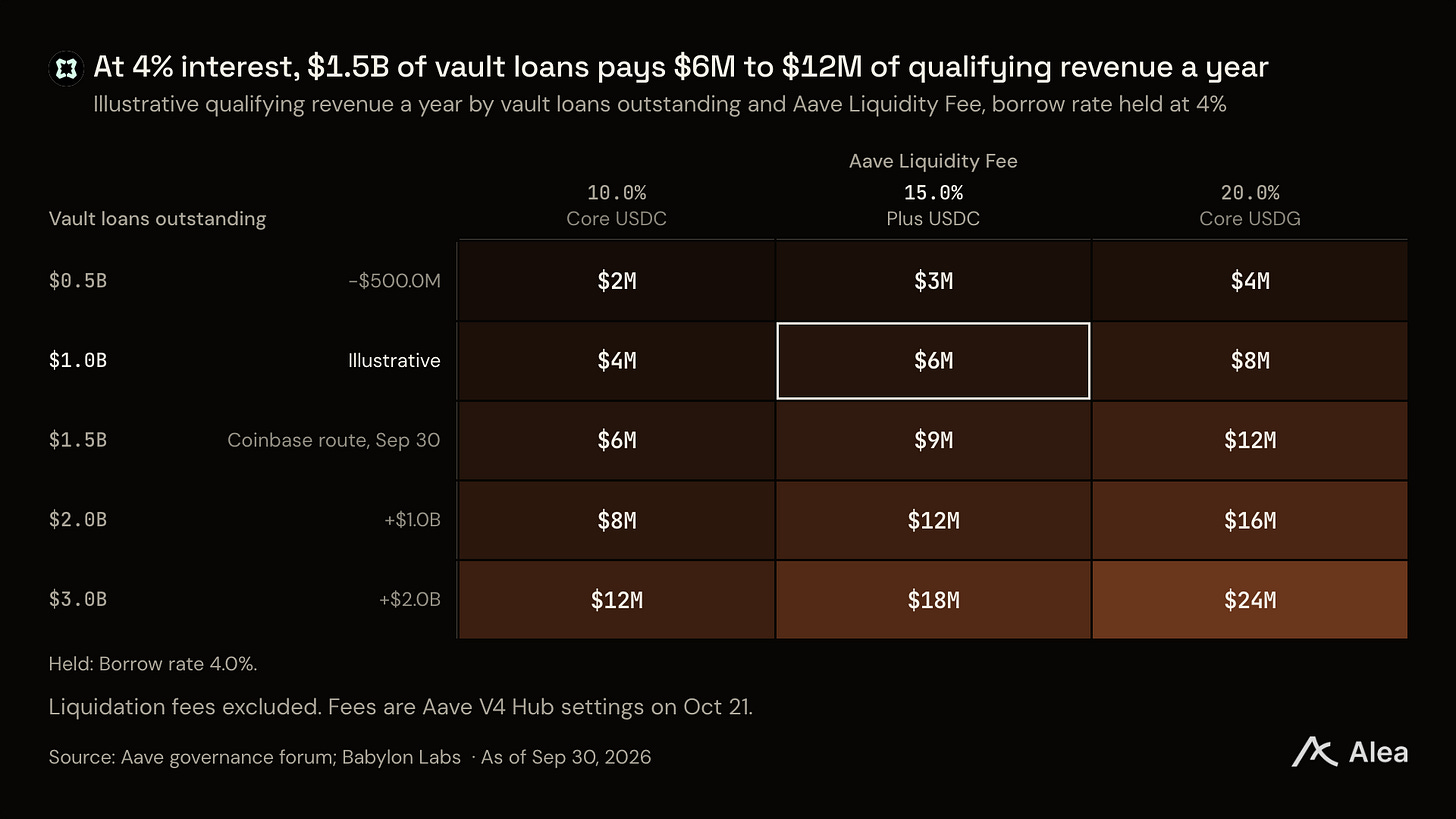
Figure 9: Arithmetic model illustration, not a profit forecast. Borrowing rate fixed at 4%, excluding liquidation fee revenue.
In a $6 million annual qualifying revenue scenario, Aave DAO retains ~$4.5 million yearly, Babylon takes ~$1.3 million, with $280,000 allocated to AAVE and BABY buybacks. If annual revenue hits $12 million, these figures jump to $8.2 million, $3.2 million, and $700,000 respectively. Assuming a 50% LTV, a $1.5 billion loan volume would require roughly 36,800 BTC in collateral at October 20 prices, closely aligning with Babylon’s current total stake of 40,843 BTC, though yield-generating staking and vault collateralized borrowing represent distinct use cases for the same token.
Babylon successfully transformed frontier academic research into a credit service directly listable on Aave. Bitcoin remains locked within owner-controlled scripts, trust assumptions simplify to a single honest party (fulfillable by the owner), and Aave simultaneously earns substantial returns from borrower interest and idle WBTC reserves. On September 30, Coinbase relied on custodied Bitcoin to lend $1.5 billion; Babylon vaults deliver identically capable lending while entirely eliminating custodians.
Important Links
• Aave ARFC Native Bitcoin Collateral Proposal
• Vault Safety and Trust Assumptions
• Aave Integration Architecture Document
Join TechFlow official community to stay tuned
Telegram:https://t.me/TechFlowDaily
X (Twitter):https://x.com/TechFlowPost
X (Twitter) EN:https://x.com/BlockFlow_News
 @AleaResearch