J.P. Morgan Research Report Analysis: ServiceNow Momentum Unabated Ahead of Earnings, AI Monetization Not Expected Until 2027
By Rita
JPMorgan maintains an overweight rating on ServiceNow ahead of its earnings, projecting that current cRPO organic growth will stabilize around 19%. This assessment aligns with a $150 price target against the current price of $145.36, representing 3.2% upside. With the stock up approximately 58% since the last earnings report, further re-rating requires evidence of stable organic growth.
In its October 20, 2026 report, JPMorgan breaks down the key takeaways for Q3 2026 into four areas: renewal expansion, AI product version upgrades, US federal seasonality, and security product momentum. Short-term upside beats will rely on renewals and add-on sales, while AI consumption monetization will largely shift to 2027.
Pre-earnings upside beats and valuation re-rating are two separate matters. The former hinges on cRPO, while the latter depends on consumption monetization. These two factors will not materialize in the same quarter.
High Probability of Pre-Earnings Upside Beat
For Q3 2026, JPMorgan forecasts subscription revenue at $3.978 billion, up 20.6% year-over-year, compared to market consensus of $3.984 billion. cRPO is projected at $13.56 billion, up 19.5% YoY, with organic growth at approximately 17.4%. After 19% organic cRPO growth in Q2, the Q3 organic growth rate is nearing stabilization.
Partner checks support the upside scenario. One Elite partner indicated that Q3 is proceeding as planned, with Q4 accounting for 35% to 40% of annual bookings and 2027 budgets remaining unchanged. Renewals stand out as a bright spot, with all renewed clients migrating to AI-native product versions, driving expenditure increases of 10% to 25%.
US federal business peaks seasonally in Q3. Management noted that federal demand pulled some on-premises revenue forward into Q2, leaving the Q3 pipeline strong. Armis and Veza are providing tailwinds to core operations, with the security suite displacing competitors in several deals.
Renewal Expansion Sustains Growth
Renewal expansion remains the most certain source of growth today. Partners noted that renewal deal sizes typically expand by 10% to 20%, and overall billing increases by 10% to 25% after migrating to AI product versions. The Advanced tier is the preferred choice.
While Q2 already benefited from early renewals, Q3 will face a higher base. JPMorgan expects a ~200 basis point beat in Q3, slightly lower than Q2 due to some of the early renewal contribution. Organic cRPO growth decelerates from 19% in Q2 to 17.4% in Q3, indicating stabilization.
Whether this short-term upside can reinforce the long-term narrative will be a key focal point post-earnings. Renewal expansion supports cRPO, while AI product version upgrades drive ARPA.
AI Monetization Will Wait Until 2027
Annual Contract Value (ACV) for AI exceeded $1 billion in Q2 2026, up from roughly $600 million at the end of 2025, with Moveworks contributing over $100 million in the first half. Net new AI ACV grew over 40% quarter-over-quarter; adding less than $500 million net new in H2 will be sufficient to reach the $1.5 billion target.
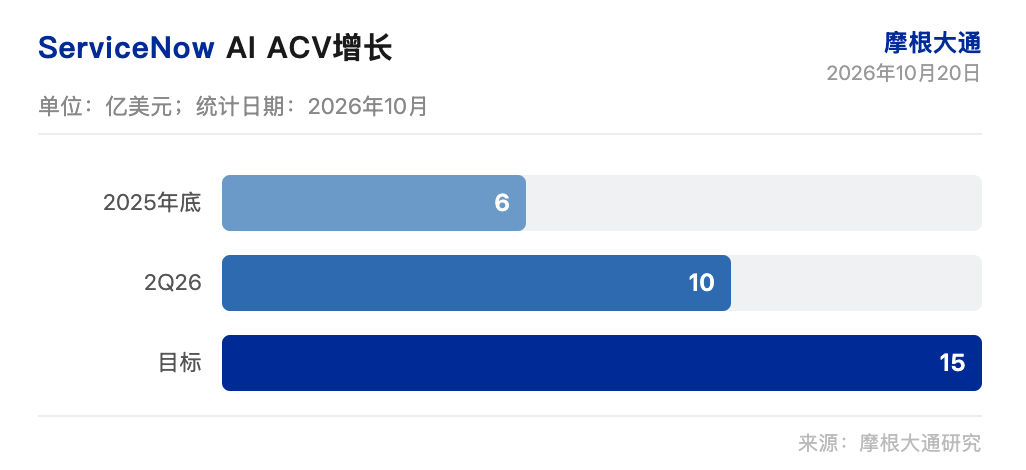
The bulk of current AI ACV stems from price premiums on upgraded AI product versions, with incremental consumption making up a minimal share. Most clients have not yet exhausted their credit pools, and management anticipates that consumption monetization will primarily occur in 2027. The pace of credit pool depletion depends on actual client usage volumes. Early adopters are concentrated in a few specific workflows, with broad-scale rollout expected in H1 2027.
Seat compression has not yet emerged. Elite partners reported no client-driven seat reductions, though one noted trimming unused licenses that sales reps had oversold during renewals. Impacts are expected to hit high-volume IT service desks and contact centers first in 2027, with approximately 50% of net new business already structured on a non-seat basis.
The visibility of 2027 consumption monetization hinges on two metrics: credit pool burn rate and the proportion of non-seat-based revenue. The former determines whether AI ACV can transition from upgrade pricing to pay-as-you-go consumption charges, while the latter dictates the magnitude of seat compression impacts. Cross-selling of AI Control Tower, Armis, and Veza is also lifting ARPA, with bundled security and governance offerings enabling some clients to upgrade multiple modules simultaneously upon renewal.
Valuation Re-Rating Requires Evidence of Stability
Up ~58% from the last earnings report, the $150 price target implies 3.2% upside. JPMorgan believes further re-rating requires concrete evidence of stabilizing organic cRPO growth.
Q4 cRPO guidance is pivotal. If management raises the implied organic growth guidance to 19%-20%, the market will interpret it as confidence in the momentum. JPMorgan expects management to maintain conservative guidance initially, setting a low bar to leave room for upside. Should Q4 guidance land between 17% and 18%, the market may view Q3's stabilization as a transient phenomenon, pushing the re-rating window further out.
Risks are concentrated in three areas: Q3 facing a high base from Q2's early renewals, AI consumption monetization delayed until 2027, and seat compression only entering high-volume scenarios in 2027. Pre-earnings upside relies on renewal expansion, while valuation re-rating depends on consumption monetization; the timing gap ultimately dictates the stock's upside potential.

Disclaimer
This article compiles and analyzes a third-party brokerage research report (JPMorgan, October 20, 2026) supplemented by publicly available market information. The ratings, price targets, earnings forecasts, and related assessments cited herein reflect the views of that brokerage's analysts, represent solely the stance of their respective institutions, do not constitute the views of TechFlow Research, and do not amount to any investment advice.
Markets involve risk, and decisions must be independent. This article should not serve as the basis for buying or selling any securities.
Join TechFlow official community to stay tuned
Telegram:https://t.me/TechFlowDaily
X (Twitter):https://x.com/TechFlowPost
X (Twitter) EN:https://x.com/BlockFlow_News
 @chaoxiangooo