On-Chain Reinsurance Yields: Re Is Unlocking a Vault Independent of Traditional Crypto Yields
Author: Noveleader (Castle Labs)
Translated by: TechFlow
TechFlow Summary:Nearly 40% of current on-chain RWA yields rely on short-term U.S. Treasuries, with their yield trajectories highly correlated with macro interest rate cuts and crypto credit market trends; meanwhile, the $760 billion reinsurance industry, backed by physical underwriting businesses, naturally possesses non-correlated, stable cash flows that are extremely decoupled from broader financial markets. As a pioneer in the on-chain reinsurance track, the Re protocol opens an alternative asset channel for DeFi depositors through tiered vault structures and highly compliant, transparent ledger mechanisms, offering both high liquidity and superior, stable returns.

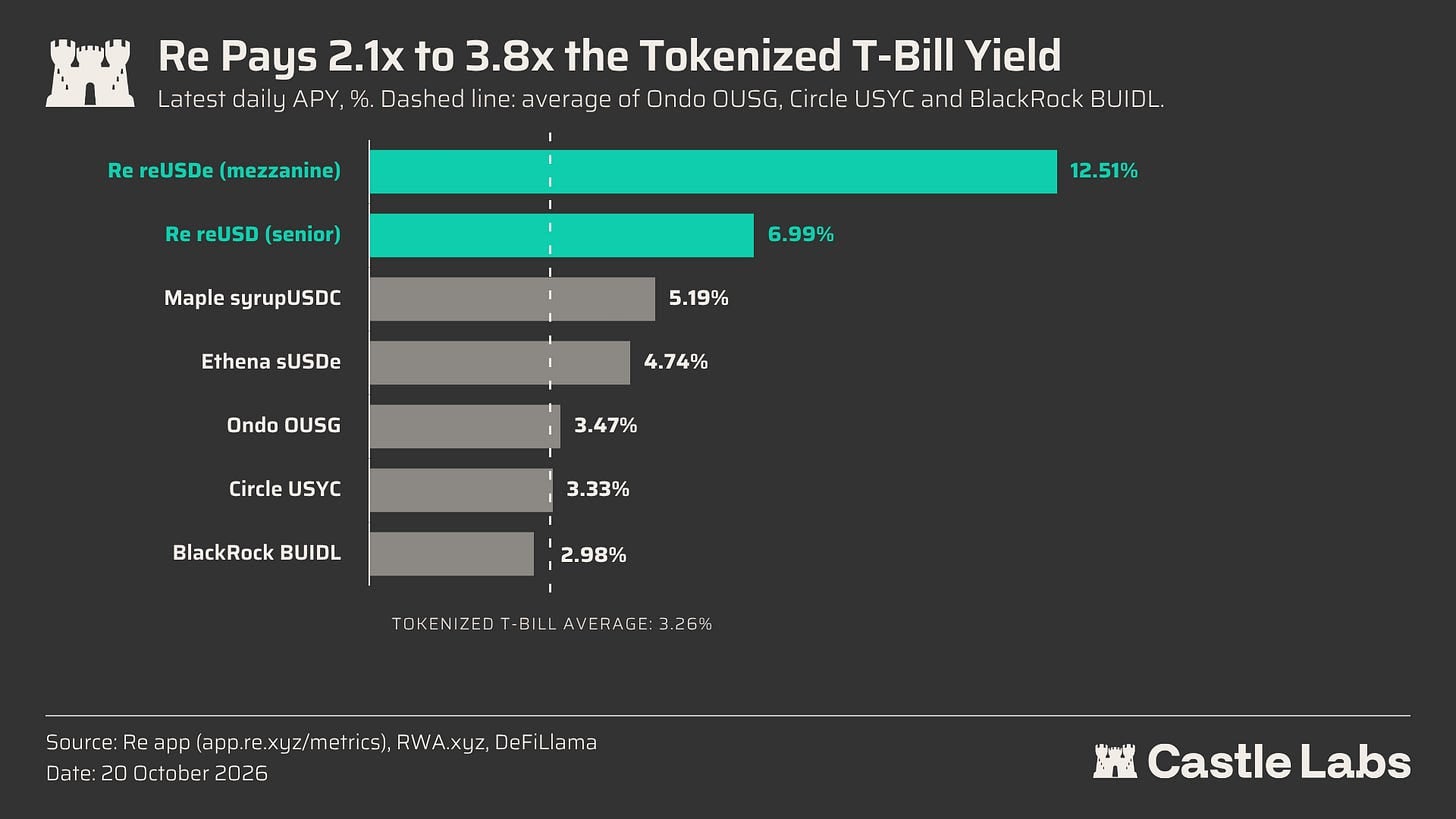
Today, most on-chain Real World Asset (RWA) yields primarily originate from short-term U.S. Treasury bills (T-bills). These assets are packaged into over 100 tokenized treasury products, including BlackRock’s BUIDL, Circle’s USYC, Ondo’s OUSG, and Franklin Templeton’s BENJI. These products have reached a cumulative Assets Under Management (AUM) of $14.7 billion, accounting for 38% of the total on-chain RWA supply. They belong to an extremely low-risk category, with a 7-day average Annual Percentage Yield (APY) of approximately 3.48%.
Similarly, we can observe the private credit sector, such as Maple’s syrupUSDC, which has a 30-day average APY of around 5.1%; as well as crypto funding rates, DeFi, and institutional lending sectors, like Ethena’s sUSDe, which carries an APY of roughly 4.7%.
Although these products differ in scope and structure, they exhibit high correlation across benchmark interest rates, borrower creditworthiness, and demand for crypto leverage, often moving in tandem.
In other words, if macro interest rates decline, credit conditions typically tighten, subsequently impacting perpetual contract volumes and funding rates.
To explore more income-generating RWA assets, this article turns its attention to a completely different and largely uncorrelated yield source: reinsurance.
We take Re as a case study. As of October 20, 2026, the protocol reported total deposits exceeding $375 million, having paid out a cumulative $12 million in yields to depositors.
This article delves into why reinsurance represents a highly attractive RWA asset class, how the Re protocol operates, and how its yields are generated.
Reinsurance, often described as “insurance for insurers,” is a massive industry worth up to $760 billion as of October 2026.
Compared to other RWAs, this concept might seem slightly obscure, but the basic logic is as follows: every time you purchase an insurance policy, your risk is pooled with thousands of other policies. To mitigate their own risk exposure and smooth out yield volatility, insurers sell a portion of their portfolio’s risk to reinsurers. Reinsurers may then decide to resell a portion of that risk to other reinsurers (known as retrocession).
By offering unique risk exposures, the reinsurance market has also become a highly attractive non-correlated yield source: it does not rely on broad macroeconomic fluctuations but generates returns through actual reinsurance underwriting activities. In traditional finance, certain reinsurance products (such as the Re Global Cat Bond Index) achieved an annualized return of 11.40% in 2025.
Migrating these products on-chain brings three core advantages:
• Broader Access: Democratizing traditionally high-barrier, heavily restricted markets.
• Ultimate Transparency: Enforcing full operational transparency through daily verification of off-chain funds, public reinsurance ledgers, and regular rigorous audits.
• Instant Liquidity: Unlocking idle capital. Capital supporting reinsurance risks is often locked off-chain in traditional models, whereas on-chain tokenized representation keeps funds highly liquid and readily accessible throughout the entire reinsurance lifecycle.
Based on this understanding, we now examine the core protocol bringing reinsurance on-chain: Re.
Re is an on-chain reinsurance protocol that allows depositors to stake stablecoins, which will then be utilized to underwrite regulated reinsurance contracts.
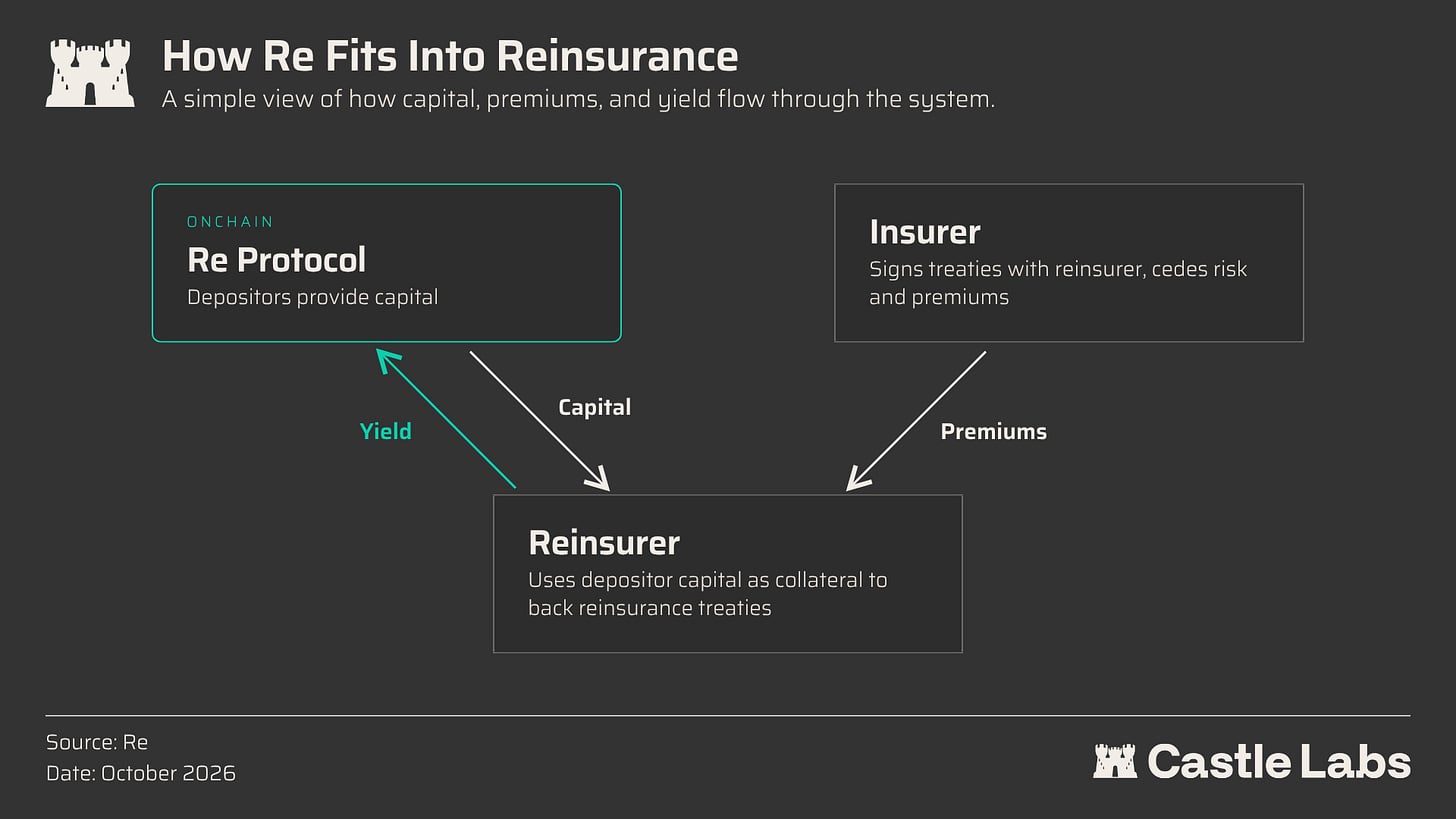
A portion of deposited funds is held as collateral in U.S. trustee bank accounts to guarantee the reinsurer’s performance obligations. Before a reinsurer underwrites a Treaty, collateral meeting both Cayman Islands Monetary Authority (CIMA) regulatory requirements and the primary insurer’s standards must be deposited. The remaining funds stay on-chain as a liquidity buffer to handle redemption requests. Portfolio performance (underwriting profit) supports token yields by increasing the token’s Net Asset Value (NAV). For Re specifically, NAV measures the degree of yield accumulation rather than total asset value.
Re’s total deposits currently exceed $375 million, growing 45% since September, making it the largest on-chain reinsurance protocol by deposited capital.
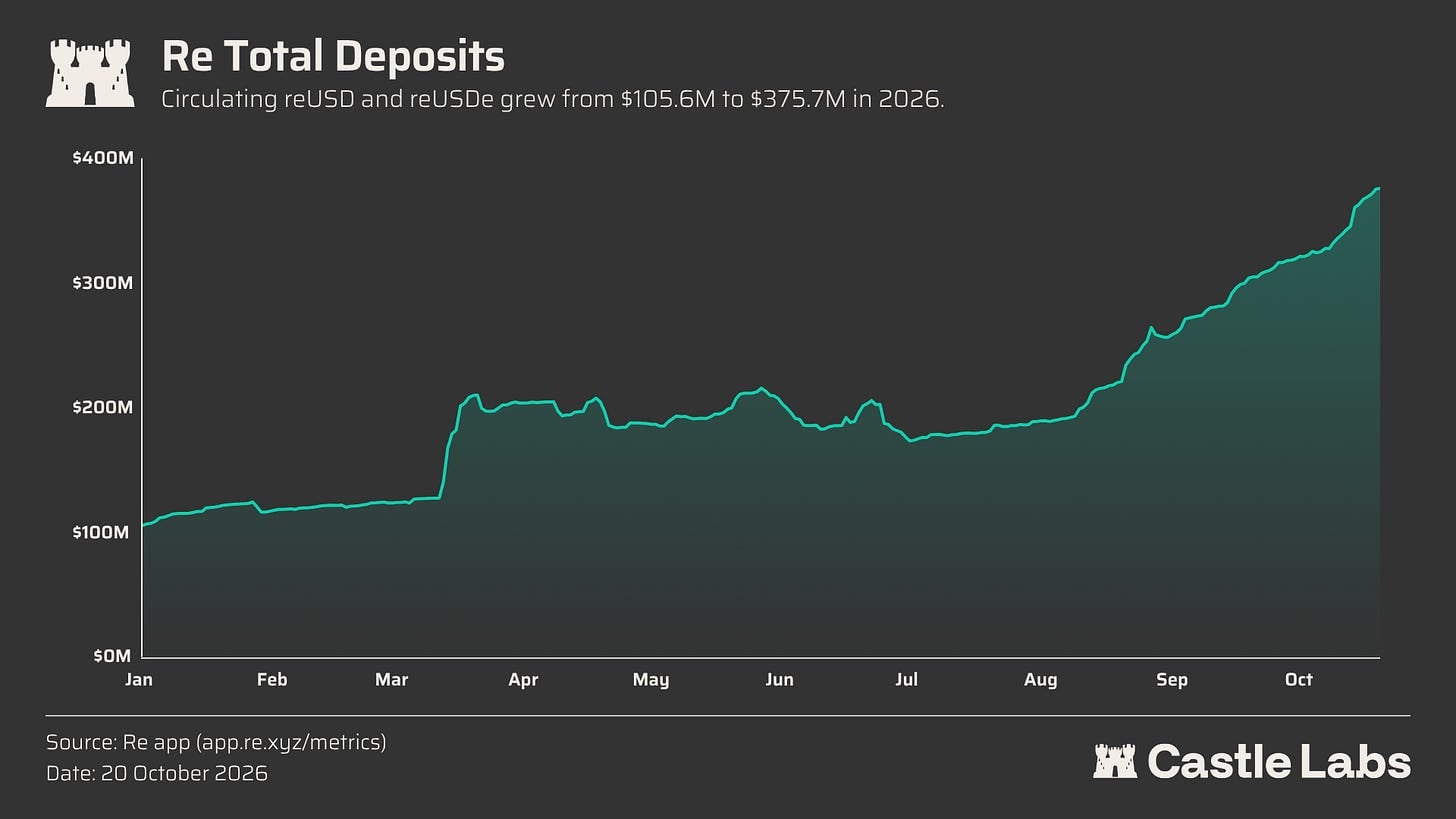
All key metrics can be tracked on the official dashboard: https://app.re.xyz/metrics
To attract depositors with varying risk appetites and manage risk effectively, Re employs a three-tier tranched structure to absorb potential underwriting losses:
• Re Proprietary Capital & Reserves (Junior Tranche): At the bottom sits Re’s proprietary capital, acting as the first-loss absorbing layer, prioritizing the absorption of any potential underwriting losses before touching depositor capital.
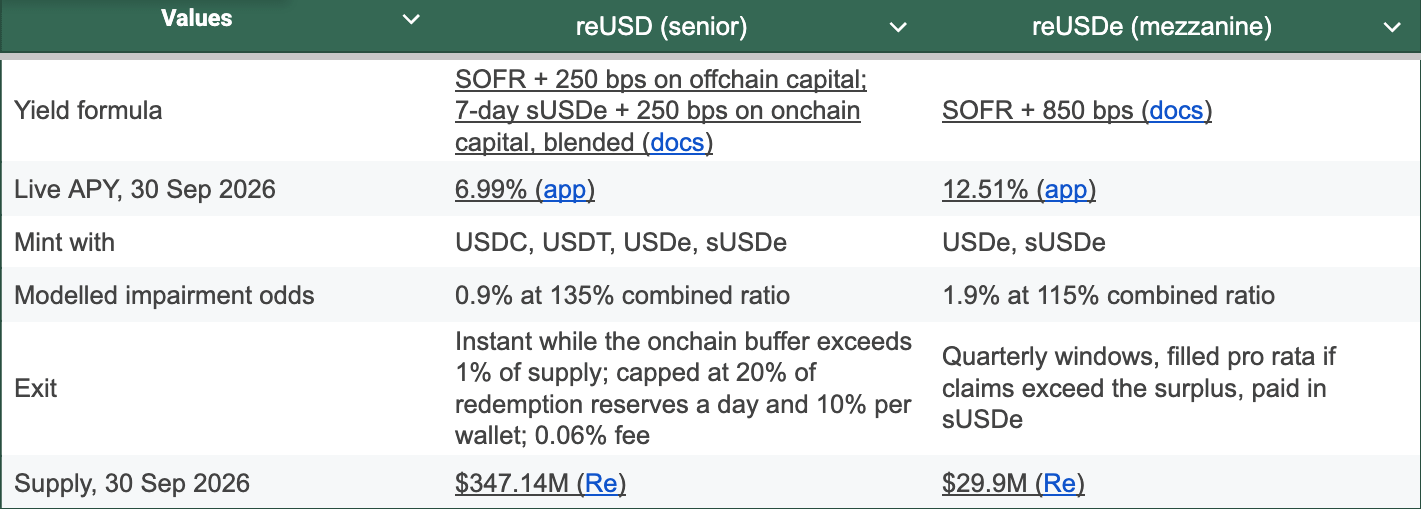
• reUSDe Holders (Mezzanine Tranche): If underwriting losses exhaust the junior tranche, this layer absorbs further losses before affecting senior tranches. It exchanges higher yield for subordinated loss recovery priority and lower liquidity (quarterly redemptions).
• reUSD Holders (Senior Tranche): At the top is reUSD, earning relatively stable yields with deep isolation from loss risk and benefiting from high liquidity (instant redemptions).
The protocol operates deposits in the senior and mezzanine tranches differently.
reUSD deposits serve a dual function: providing on-chain redemption liquidity while acting as off-chain collateral deployed into reinsurance operations.
Whenever funds are allocated off-chain, at least 50% of reUSD’s historical peak deposit total remains on-chain to meet instant redemption demands. This portion is primarily held as sUSDe, generating yields produced by Ethena. As USDe collateral reserves expand into equity basis perpetual contracts, sUSDe yields are expected to rise further, benefiting Re depositors.
The remaining funds are transferred to off-chain trust accounts to serve as collateral for underwriting reinsurance contracts.
As of October 2026, off-chain funds earn the risk-free benchmark rate (Secured Overnight Financing Rate, SOFR) plus a 250 basis points (bps) spread set by the protocol (funded by reinsurance business yields); on-chain funds earn a moving average of past 7-day sUSDe yields plus a 250 bps spread.
As long as the liquidity buffer has capacity, reUSD supports instant redemptions. As of October 2026, on-chain funds available for redemption have never fallen below 40% of the circulating supply.
In contrast, reUSDe funds are fully allocated off-chain and used solely as reinsurance collateral. It earns the risk-free SOFR rate plus an 850 bps spread derived from the reinsurance business.
reUSDe redemptions are processed quarterly, depending on collateral requirements and cash flow settlements from maturing reinsurance contracts.
To date, Re focuses on more conservative underwriting businesses, adhering to a “minimal or near-zero catastrophe exposure” principle to build a sturdier portfolio and strategy framework. This is fully reflected in its asset allocation, covering small business commercial property & liability, commercial auto insurance & liability, homeowners property insurance, workers’ compensation, and commercial property & personal vehicle insurance.
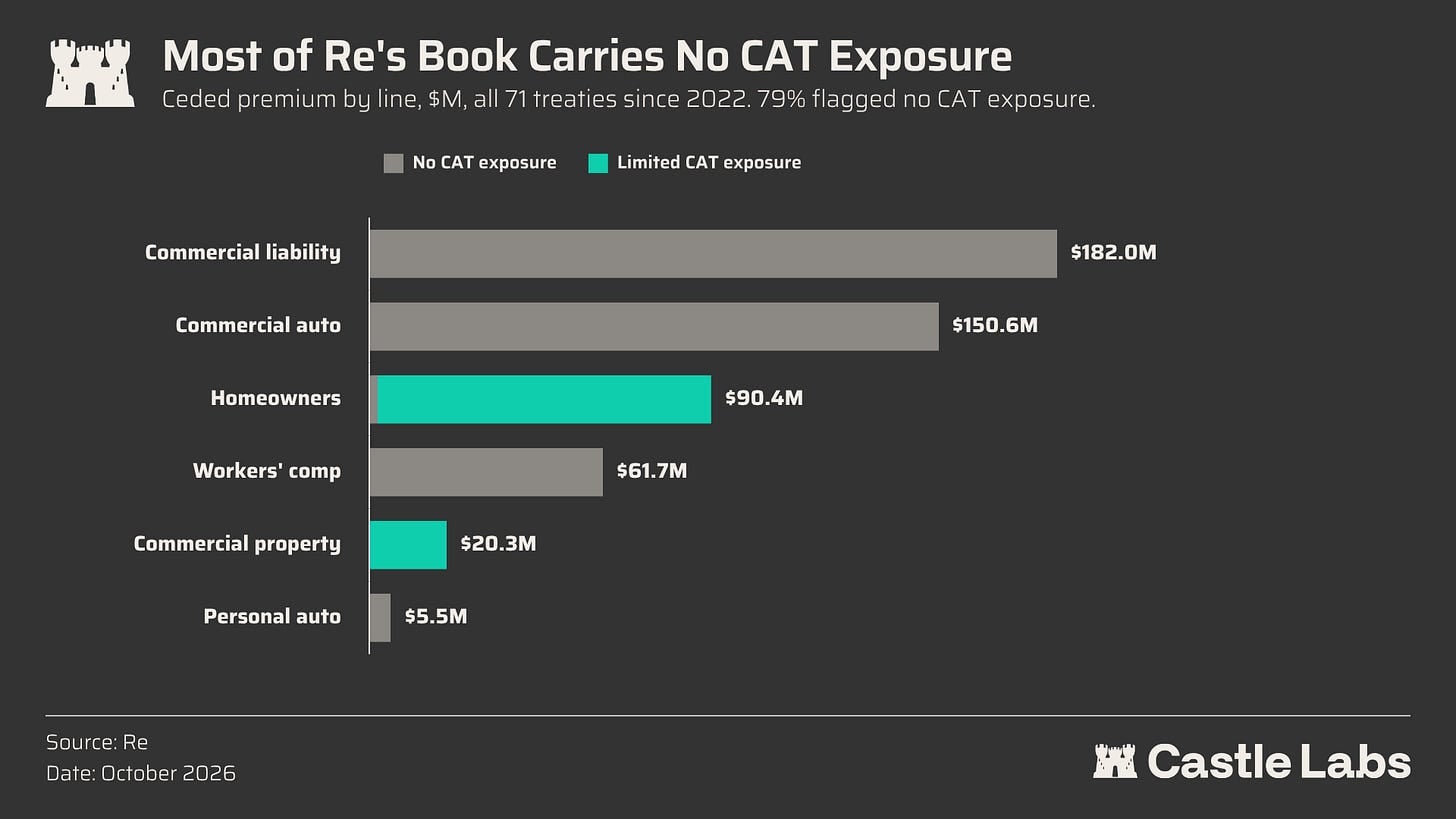
Now, they are preparing to gradually expand their business coverage, beginning pilot programs to underwrite catastrophe risks.
Re’s yield consists of a base interest rate plus a protocol spread funded by reinsurance underwriting profits: the reUSD spread is 250 bps, and the reUSDe spread is 850 bps.
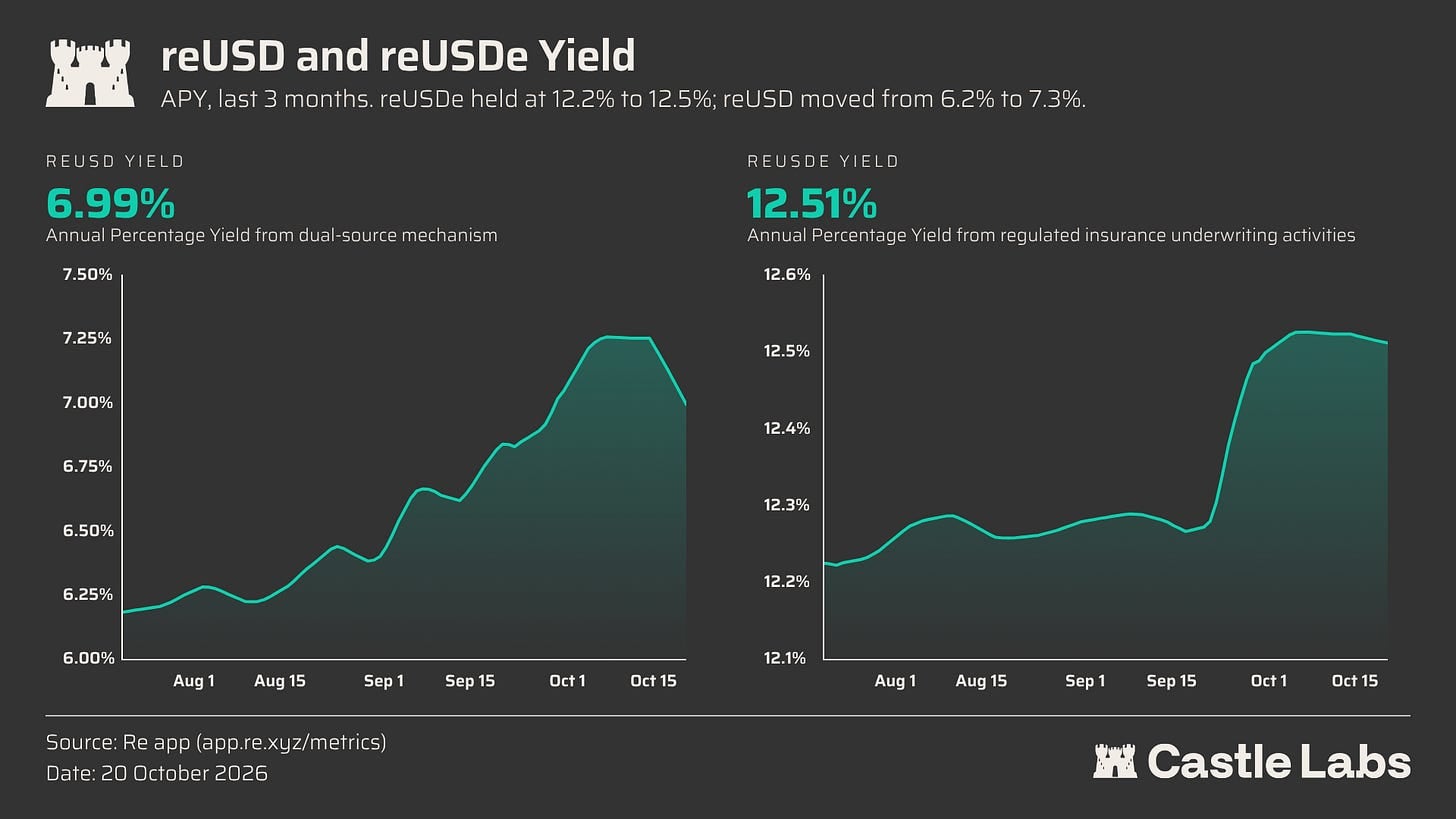
Once introduced on-chain, these returns significantly outperform tokenized treasuries (averaging ~3.7%), private credit (~5.1%), and funding rates (~4.7%). As of publication, by APY, reUSD yields approximately 300 bps above tokenized treasuries, while reUSDe exceeds them by roughly 800 bps.
Base Yields
Off-chain funds roughly earn SOFR yields. The on-chain buffer is primarily held as sUSDe, generating Ethena yields.
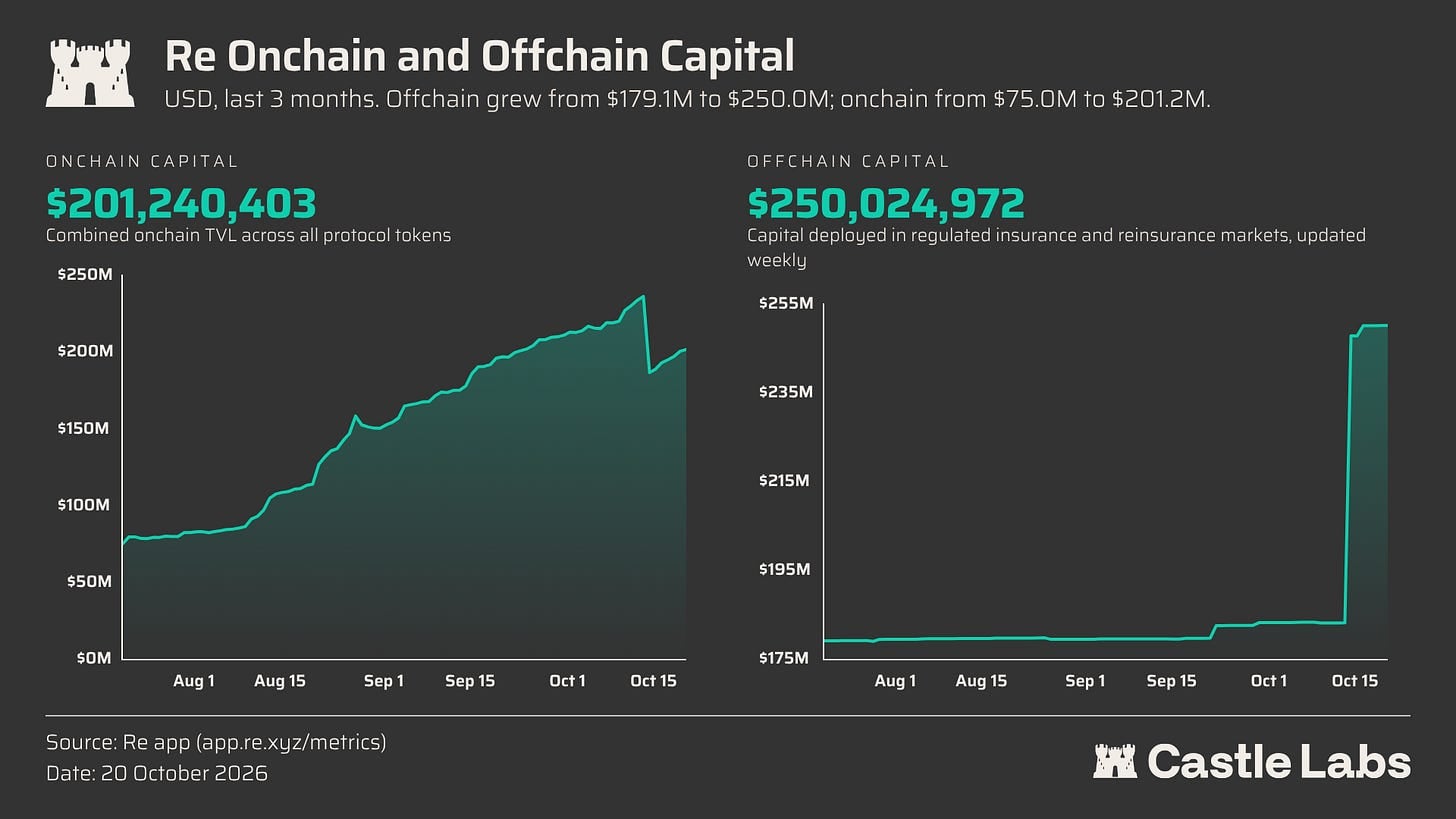
In October 2026, Re reported approximately $200 million in on-chain funds and around $250 million in off-chain reserves (covering reUSD and reUSDe deposits). The on-chain to off-chain allocation depends on multiple factors and does not merely reflect a single strategy. This is mainly dictated by the maintenance standards for the reUSD liquidity buffer (the aforementioned 50% historical peak deposit requirement) and the deployment timeline of funds into reinsurance operations. Furthermore, on-chain is always the initial destination for incoming capital; the instant deposit of stablecoins explains the temporary on-chain bias, as Re conducts regular dynamic rebalancing.
Growth Drivers & DeFi Integration
One of Re’s core strategies is deeply embedding reUSD as a foundational collateral asset in DeFi, a direction recently validated by a series of integration developments.
Expanding into the Solana ecosystem is one of the team’s most strategic moves: Solana ranks third among major public chains in RWA asset scale, making it naturally one of Re’s most critical core markets.
In August, the integration on Kamino reached $20 million in size just over a week after launch, while Jupiter Lend absorbed $6 million in less than three hours, fully demonstrating the market’s appetite for this yield.
With its unique risk-return profile, reUSD serves as a highly attractive differentiated RWA yield source that aligns perfectly with the Solana ecosystem.
Solana is one of the fastest-growing RWA ecosystems, a space Re bet on early and which provides ideal ground for scaling the adoption of Re’s income-generating assets.
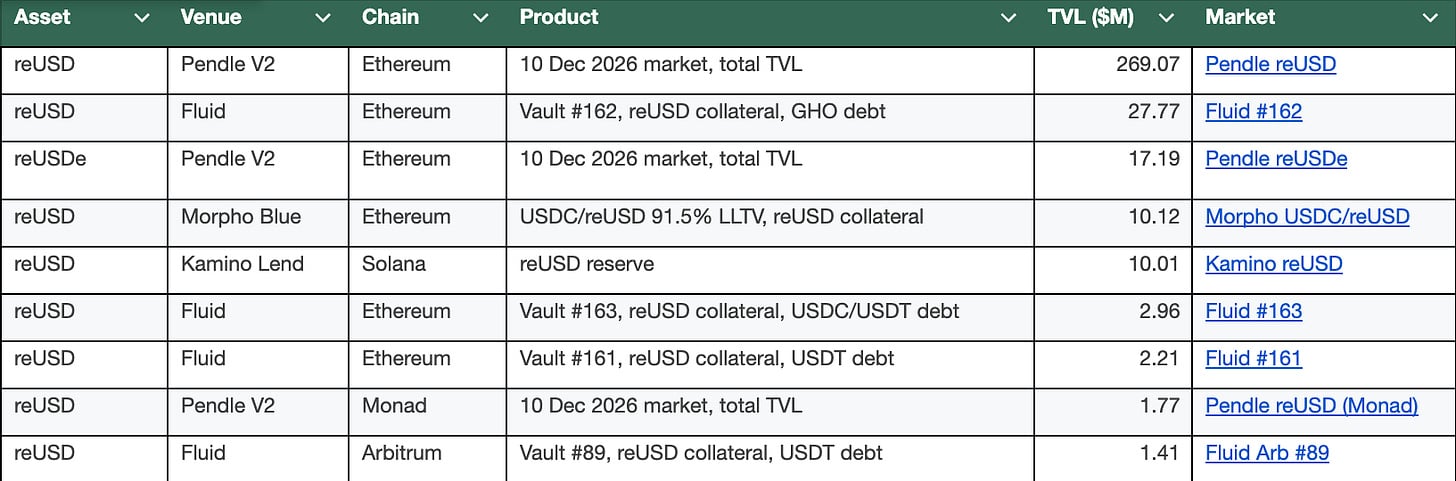
reUSD also acts as a base asset in Morpho-driven vaults, where supplies recently surpassed $100 million: users holding idle USDC can lend their funds against PT-reUSD collateral to achieve over 7% APY.
As of September 28, reUSD became the largest looping market on Pendle. For PT-reUSD expiring in December 2026, the maximum looping APY exceeded 32%, with Total Value Locked (TVL) surpassing $200 million.
Additionally, the Fluid protocol on Arbitrum has launched three distinct reUSD vaults:
• reUSD / USDC
• reUSD / USDT
• reUSD-USDC LP / USDC
For a detailed distribution map of reUSD integrations across the DeFi landscape, please refer to the table below:
However, these DeFi deployments also carry secondary risks.
If any lending market incurs bad debt, liquidators will flood open markets to dump assets, draining on-chain liquidity and potentially causing severe depegging risks for reUSD in secondary markets.
For example, if third-party price oracles rely on volatile on-chain liquidity pools, leveraged PT-reUSD positions face oracle risk, which could trigger mass liquidations.
This vulnerability recently manifested: a large YT-reUSD purchase caused the PT-reUSD price to drop by approximately 3%, subsequently triggering $36.4 million in cascading liquidations on Morpho.
Although the incident was not triggered by Re itself, with its native smart contracts and reUSD remaining intact, it highlights the necessity of carefully considering third-party risks (such as oracle risk and market leverage) when dealing with leveraged assets.
Finally, because Re’s on-chain liquidity relies on sUSDe backing (53% of reUSD funds are invested in sUSDe), any secondary depegging or mass panic redemption pressure within the Ethena ecosystem could directly restrict or impair Re depositors’ assets.
This article presents Re as a highly valuable exploration in bringing differentiated yields on-chain. Compared to the $760 billion reinsurance market, its approximately $320 million deployed capital remains insignificant, underscoring vast future opportunities: the popularization of alternative RWA yield assets in the crypto world has only just begun.
Through its layered tranche system, the protocol created two tokens, each possessing distinct asset liquidity characteristics.
Beyond this differentiated advantage, reUSD already operates as core collateral in Kamino, Jupiter Lend, and Morpho vaults, and can be traded for yields on Pendle.
While these products offer double-digit returns, they also carry secondary risks potentially arising from DeFi integration, as revealed by the Morpho liquidation event last August.
To date, Re has never suffered any underwriting errors, maintaining steady profitability annually since its inception.
Re is moving in the right direction. By targeting the massive traditional reinsurance sector, it is leading RWA yields toward differentiation and breaking through the limitations of existing income-generating assets (such as short-term Treasuries).
Join TechFlow official community to stay tuned
Telegram:https://t.me/TechFlowDaily
X (Twitter):https://x.com/TechFlowPost
X (Twitter) EN:https://x.com/BlockFlow_News
 @castle_labs